


The sleekest, lightest race machine in the showroom might actually be the slowest bike for your typical Sunday morning spin. It sounds counterintuitive, but if a frame forces you into a position your body simply cannot maintain, your power output will drop long before you finish your route. We understand that investing in a high-performance bicycle is a major decision. The confusion surrounding geometry terminology often leads to a fear of buyer’s remorse, especially when you’re worried that an aggressive setup might result in nagging back pain after just an hour in the saddle.
In this guide, we’ll answer the essential question: Endurance Vs Race bikes- what’s the difference? You’ll discover how subtle changes in frame design impact your comfort and speed, giving you the confidence to choose a bike that aligns with your physical flexibility and cycling ambitions. We’ll also explain how to use the Cycle to Work scheme to make professional-grade Giant or Cube models more accessible. Whether you’re aiming for a local podium or a long-distance sportive, this breakdown ensures your next purchase is the right one for your lifestyle.
Key Takeaways
- Master the basics of frame geometry to understand how “Stack” and “Reach” measurements dictate your torso angle and long-term comfort.
- Discover the performance trade-offs between the lateral stiffness required for explosive sprinting and the vertical compliance needed to dampen Irish road buzz.
- Get a definitive answer to “Endurance Vs Race bikes- what’s the difference?” by comparing gearing ratios and modern disc brake specifications.
- Find out how to maximise your investment using the Cycle to Work scheme for tax-free upgrades on premium brands like Giant and Cube.
Understanding the Core Differences in Frame Geometry
When you walk into a bike shop, the silhouettes of various road bikes might look nearly identical to the untrained eye. However, the blueprint of the frame dictates everything from how your lower back feels after fifty kilometres to how confidently you can carve through a sharp bend. At its heart, the debate of Endurance Vs Race bikes- what’s the difference? comes down to a set of measurements that determine your physical relationship with the machine. Whilst a race bike is designed to cheat the wind, an endurance bike is engineered to support the human body over long durations.
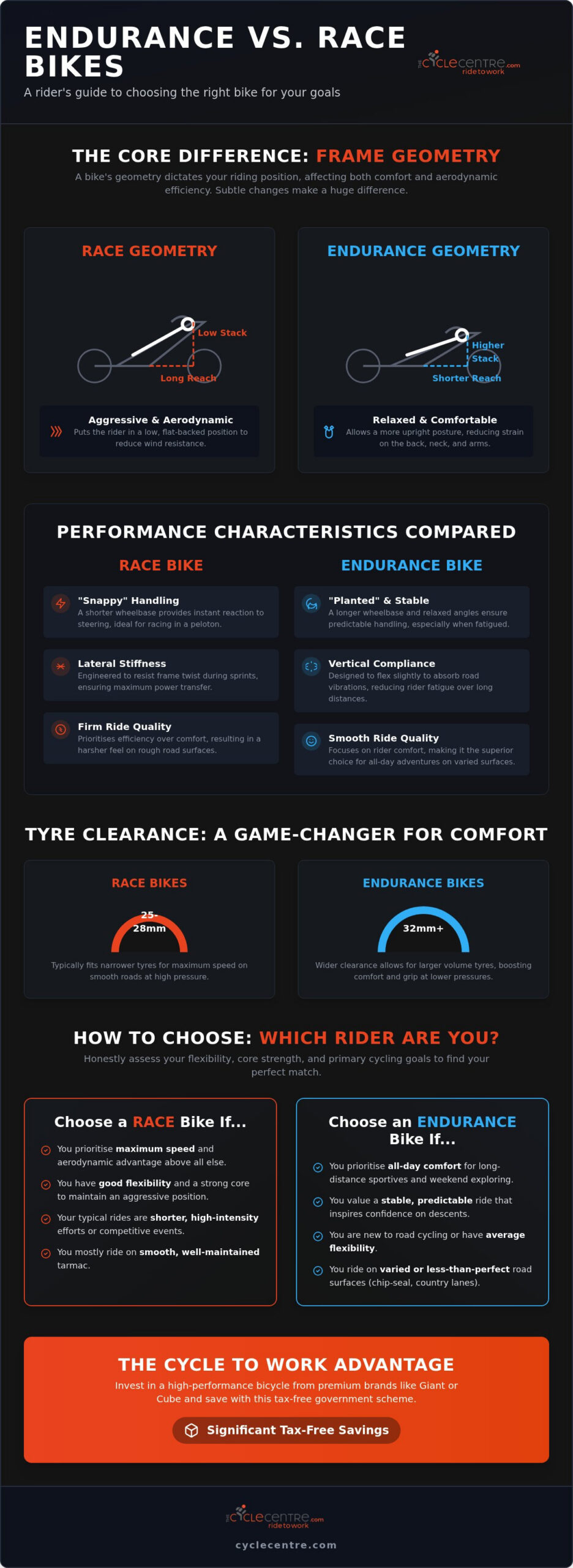
Two measurements stand above the rest: Stack and Reach. Stack is the vertical distance from the centre of the bottom bracket to the top of the head tube, whilst Reach is the horizontal distance between those same points. A race bike typically features a low stack and a long reach, pulling your torso into a flat, aerodynamic position. Conversely, endurance bikes increase the stack and shorten the reach, allowing for a more upright posture. This subtle shift significantly reduces the load on your neck and hamstrings, making the bike far more forgiving if you don’t spend twenty hours a week in the gym working on core stability.
The Road bicycle overview provided by industry experts highlights how these design choices cater to different riding styles. Beyond the cockpit, the wheelbase plays a critical role. A shorter wheelbase, common on race frames, makes the bike feel “snappy” and responsive. It reacts instantly to steering inputs, which is vital in a crowded peloton but can feel “twitchy” to a novice. Endurance frames utilise a longer wheelbase and more relaxed head tube angles to provide a “planted” feel, ensuring the bike tracks straight and true even when you’re fatigued on a high-speed descent.
Race Geometry: Built for Aerodynamics
Race-focused frames are built with a singular focus on velocity. By lowering the front end, manufacturers reduce your frontal area, which is the primary source of aerodynamic drag. These bikes often feature incredibly stiff carbon layups in the bottom bracket and head tube areas. This ensures that every watt of energy you produce is converted into forward motion, though it often results in a firmer, less forgiving ride quality over rougher surfaces. It’s a setup designed for the clock, not necessarily for the scenery.
Endurance Geometry: Designed for Longevity
Endurance bikes prioritise the rider’s longevity in the saddle. By incorporating a taller head tube, these frames allow you to sit in a position that doesn’t require professional-level flexibility. This geometry is ideal for sportives or long-distance exploration where comfort is the ultimate performance metric. The frame angles are slightly more relaxed, which slows down the steering response just enough to make the bike feel predictable and stable, regardless of the road conditions or your energy levels.
Speed is a seductive metric, but it’s often a slave to surface quality. While a professional-grade race machine is untouchable on smooth tarmac, the reality of cycling on many routes involves navigating chip-seal surfaces and the occasional pothole. This is where the physical sensation of the ride becomes paramount. When considering Endurance Vs Race bikes- what’s the difference?, you have to look at how the frame handles ‘road buzz’. Endurance frames are engineered with vertical compliance, which allows the carbon fibre to flex slightly under load, soaking up vibrations before they reach your hands and spine.
Race bikes, by contrast, prioritise lateral stiffness. This design ensures that the frame doesn’t twist when you’re out of the saddle sprinting, providing an immediate, explosive response. However, this rigidity can be punishing over four or five hours. Aerodynamics also play a significant role. Once your speed exceeds 30kph, air resistance becomes your primary enemy. The aggressive, tucked position of a race bike offers a measurable advantage here, but if the road surface is particularly rough, an endurance bike might actually be the faster choice. A comfortable rider is a fast rider because they aren’t constantly fighting the bike’s feedback.
Tyre Clearance and Road Surface Versatility
One of the most practical differences lies in tyre clearance. Race-oriented models typically accommodate 25mm to 28mm tyres. These are lightweight and fast on perfect roads, but they require high pressures that can feel harsh. Endurance bikes are designed with extra room, often fitting 32mm tyres or wider. This increased volume allows you to run lower pressures, which dramatically improves grip and comfort without a significant loss in rolling speed. If you’re planning all-day adventures through varied terrain, this extra cushioning is a game-changer for reducing fatigue.
Weight and Climbing Efficiency
In the world of high-end cycling, every gram counts. Race bikes often utilise the most advanced carbon layups to achieve the lowest possible weight, making them the preferred tools for conquering steep gradients. Endurance bikes may carry a slight weight penalty due to their more robust construction and comfort-enhancing features. However, when you’re tackling long, steady climbs and challenging gradients, the more relaxed seating position of an endurance bike can actually help you maintain a steady cadence for longer. If you’re looking to upgrade your current setup, our range of Road Performance Bicycles includes world-class options from Giant and Cube that balance these competing demands perfectly. Understanding Endurance Vs Race bikes- what’s the difference? in terms of weight helps you choose a partner that won’t feel like a burden when the road points upwards.
Componentry and Technical Specifications
Beyond the frame’s geometry, the components bolted to the chassis define your daily experience. When considering Endurance Vs Race bikes- what’s the difference?, the drivetrain and cockpit specifications reveal the bike’s true intent. Race bikes frequently utilise integrated cockpits where cables are hidden internally to minimise drag. This creates a sleek aesthetic but can make fine-tuning your position more complex. In contrast, endurance bikes usually feature traditional, adjustable stems. This allows you to raise or lower the handlebars easily as your flexibility improves or as you prepare for different types of events.
Modern road bike design has shifted almost entirely toward hydraulic disc brakes. These systems provide reliable, modulated stopping power, which is essential when descending narrow lanes in damp Irish conditions. High-end performance models also tend to feature electronic shifting. This technology removes the risk of cable stretch and provides perfect, lightning-fast gear changes every time. While mechanical shifting remains reliable and easier to repair mid-ride, electronic systems have become the gold standard for those seeking a premium, hassle-free experience.
Gearing for the Real World
The gears you choose can be the difference between enjoying a climb and struggling through it. Endurance bikes typically come equipped with ‘compact’ cranksets, usually featuring a 50/34-tooth chainring combination. Paired with a wide-range cassette, these “easier” gears are designed to help you maintain a high cadence on steep Irish gradients. Race bikes often use ‘semi-compact’ (52/36) or even larger setups. These are built for the high speeds of a competitive peloton where you need to keep pedalling at 50kph. For the average enthusiast, the wider gear range of an endurance setup is almost always the more practical choice.
The Importance of Professional Maintenance
Investing in a high-performance machine requires a commitment to its upkeep. Advanced features like internal hydraulic routing and electronic groupsets mean these bikes need a Shimano accredited bike service to stay in peak condition. Our workshop offers specialised Silver and Gold service packages tailored to these complex systems. A Silver service focuses on precision tuning and wear checks, whilst a Gold service involves a comprehensive strip-down and deep clean. Proper maintenance ensures that your integrated cabling remains friction-free and your hydraulic brakes stay responsive, protecting your investment for years to come.
How to Choose: A Decision Framework for Riders
Selecting a new bicycle is a significant investment, and we want to ensure you feel confident in your choice. Deciding between these two categories isn’t just about aesthetics; it’s about matching a machine to your physical capabilities and your cycling ambitions. To help you navigate the question of Endurance Vs Race bikes- what’s the difference? for your specific needs, we’ve developed a simple five-step framework. This logical approach moves you from abstract goals to a practical, informed decision.
- Step 1: Define your primary goal. Are you planning to enter competitive criteriums or local road races? If the clock is your primary motivator, a race bike is likely your partner. If you’re aiming for 100km sportives or weekend group spins, endurance is the way to go.
- Step 2: Conduct a physical audit. Be honest about your current core strength and flexibility. If you can’t comfortably touch your toes or maintain a plank, the aggressive “tucked” position of a race bike may lead to neck and back strain.
- Step 3: Evaluate your local terrain. Consider the road surfaces you’ll encounter most often. For the varied chip-seal and occasional rough patches found on many Irish backroads, the vibration dampening of an endurance frame provides a distinct advantage.
- Step 4: Check for practical features. Do you plan on riding through the Irish winter? Endurance bikes often feature discreet mounts for mudguards, which are rarely found on pure race machines.
- Step 5: Feel the difference. Nothing replaces a test ride. We encourage you to experience both geometries firsthand to see which one feels more natural for your body.
When to Choose a Race Bike
You should opt for a race bike if you prioritise flat-out speed and “snap” in your accelerations. These machines are designed for riders who have the flexibility to maintain a low aerodynamic profile for extended periods. If your goal is to stay at the sharp end of a fast-moving peloton or shave seconds off your personal best on a local climb, the lateral stiffness and lightweight construction of a race-focused frame will serve you best. It’s a tool for those who view every ride as a chance to test their limits.
When to Choose an Endurance Bike
An endurance bike is the superior choice if you value stability and want to avoid post-ride aches. These bikes feel predictable in all weather conditions, making them ideal for long-distance exploration. You can explore our endurance road bikes Ireland to see how modern designs from Giant and Cube balance performance with all-day comfort. If you want a bike that encourages you to stay in the saddle for four hours or more without feeling beaten up by the road, this is the category for you. Ready to find your perfect match? Use our Smart-bike Search tool to narrow down the right geometry for your fitness level today.
The Cycle Centre Advantage: Expert Support and Savings
Choosing a performance road bike is a journey that shouldn’t be taken alone. Since our founding in 1974, we’ve spent 50 years guiding Irish cyclists through every major evolution in frame design and componentry. We don’t just sell bicycles; we facilitate experiences that last a lifetime. Our Smart-bike Search tool is designed to take the guesswork out of the equation, helping you find a frame that matches your specific reach and stack requirements perfectly. By stocking world-class brands like Giant and Cube, we ensure you have access to the latest 2026 models that define the current answer to Endurance Vs Race bikes- what’s the difference? in the modern market.
Maximising the Bike to Work Scheme
The financial aspect of a new purchase can often feel like a hurdle. However, the bike to work scheme Ireland offers a logical solution for professionals seeking a performance upgrade. This government initiative allows you to save significantly on the cost of a new bike and essential safety equipment through salary sacrifice. You can effectively reduce the ‘sticker price’ of a premium Giant or Cube model by utilising your tax-free allowance. We provide clear, no-obligation quotes that you can submit to your employer, and you can even bundle high-quality cycling helmets and apparel into your application to ensure you’re fully equipped from day one.
Ongoing Care for Your Performance Machine
Once you’ve made your choice, protecting your investment becomes the priority. A high-end road bike is a precision instrument that requires specialised care to maintain its performance and resale value. Our Shimano accredited workshop is staffed by experts who understand the nuances of both race and endurance setups. From routine Silver services to comprehensive Gold overhauls, we ensure your hydraulic systems and electronic drivetrains remain flawless. Regular professional maintenance is the best way to ensure your bike continues to feel as responsive as the day you first rode it. Apply for your Cycle to Work quote today! and let our team help you take the next step in your cycling journey.
Finding Your Perfect Rhythm on the Road
Finding your ideal road bike is about more than just aesthetics; it’s about matching the machine to your physical reality and long-term goals. We’ve explored how stack and reach measurements dictate your posture, and why the vertical compliance of an endurance frame often wins out over pure stiffness on varied Irish surfaces. Understanding Endurance Vs Race bikes- what’s the difference? empowers you to invest with confidence, ensuring your new bicycle supports your ambitions rather than causing nagging post-ride aches.
Since 1974, The Cycle Centre has been a trusted presence in the Irish cycling community. As official stockists of world-class brands like Giant and Cube, we provide the seasoned authority needed to navigate these technical choices. Our commitment doesn’t end at the showroom floor; our Shimano Accredited Gold Workshop Service ensures your performance machine stays in peak condition for years to come. Whether you’re chasing local podiums or exploring the hills of Wicklow, the right bike is waiting for you.
Browse our range of Performance Road Bikes and discover the perfect balance of speed and longevity for your next adventure.
Frequently Asked Questions
Is an endurance bike slower than a race bike?
An endurance bike isn’t necessarily slower, especially over long distances or on typical Irish road surfaces. Whilst a race bike is more aerodynamic at high speeds, an endurance frame reduces the physical fatigue caused by road vibrations. If you’re comfortable, you can maintain your power output for longer. On a perfectly smooth track, the race bike wins, but on a four-hour sportive, the endurance bike often proves faster for the average rider.
Can I use an endurance bike for racing?
Yes, you can absolutely use an endurance bike for competitive events. Most modern endurance frames from brands like Giant and Cube are UCI-approved and built with high-grade carbon fibre that offers plenty of stiffness for sprinting. Unless you’re competing at an elite level where every millisecond counts, the added stability of an endurance bike can actually be an advantage in a crowded amateur peloton or on technical descents.
Do race bikes always have carbon frames?
Most high-performance race bikes utilise carbon fibre because it offers the best stiffness-to-weight ratio, but high-quality aluminium race frames do exist. Carbon allows engineers to tune the frame for specific characteristics, like lateral rigidity for climbing. However, many riders still prefer the “road feel” and durability of premium alloy or even titanium. In our experience, the carbon models from Giant and Cube remain the most popular choice for those seeking pure speed.
Are endurance bikes better for beginners?
Endurance bikes are generally the better choice for those new to road cycling. The more upright riding position puts less strain on your neck, shoulders, and lower back whilst you’re building the specific core strength required for road riding. This makes the learning process much more enjoyable. Choosing an endurance model helps beginners avoid the common pitfall of “buyer’s remorse” caused by an overly aggressive and uncomfortable riding position.
What is the difference in tyre clearance between the two types?
Endurance bikes offer significantly more tyre clearance than traditional race machines. Most race-focused frames are designed around 25mm or 28mm tyres to keep weight and drag to a minimum. Endurance frames often accommodate tyres of 32mm or even 35mm. This extra space allows you to run lower tyre pressures, which provides a much smoother ride and better grip on the damp, unpredictable surfaces often found amongst Irish country lanes.
Can I change the geometry of my bike with a different stem?
You can modify your riding position with a different stem, but you cannot change the bike’s inherent geometry. Swapping to a shorter or higher-angled stem can make a race bike feel more comfortable by reducing the reach. However, it won’t change the wheelbase or the head tube angle, which dictate how the bike handles. It’s always better to choose the correct frame type from the start rather than trying to “fix” an unsuitable geometry later.
How much can I save on a road bike using the Cycle to Work scheme?
You can save up to 52% on the cost of a new road bike through the Irish Cycle to Work scheme, depending on your tax bracket. For a standard road performance bicycle, the tax-free limit is currently €1,500. This includes the bike and essential safety equipment like helmets and lights. It’s a highly efficient way to upgrade to a premium brand whilst spreading the cost through manageable salary sacrifice payments over twelve months.
Is it worth getting a professional bike fit before choosing?
A professional bike fit is a vital step in answering the question: Endurance Vs Race bikes- what’s the difference? for your specific body. A fitter can assess your flexibility and limb proportions to see which geometry naturally suits you. This prevents you from forcing your body into a position it can’t maintain. Investing in a fit before you buy ensures your new Giant or Cube is perfectly tailored to your anatomy from the very first kilometre.