
Why settle for a bicycle that only performs from Monday to Friday when you could invest in a machine that masters the morning rush and the Sunday mountain trails with equal poise? Many riders assume a rugged E-MTB isn’t a “sensible” choice for the office run, yet the Bike to Work scheme for electric mountain bike purchases is actually one of the most versatile ways to upgrade your lifestyle in 2026. It’s natural to feel a bit overwhelmed by the technicalities. You might be questioning if the €1,500 e-bike threshold is enough for a premium motor, or perhaps you’re simply dreading the perceived complexity of HR salary sacrifice forms.
We understand those frustrations. Managing government incentives shouldn’t feel like a second job, and choosing a bike should be about freedom, not restriction. In this guide, we’ll show you exactly how to maximise your tax savings, which can reach as high as 52% depending on your bracket, ensuring you get the best possible value for your investment. We’ll also demystify the paperwork and help you identify the features that make an electric mountain bike a practical, powerful companion for the Irish commute. From understanding motor specifications to protecting your new asset with professional workshop care, we’ve mapped out everything you need to move from uncertainty to informed confidence.
Key Takeaways
- Maximise your budget by navigating the €1,500 threshold to secure tax savings of up to 52% on your new purchase.
- Discover why the rugged stability and upright geometry of an E-MTB offer a safer, more comfortable commute on unpredictable Irish road surfaces.
- Understand how to select the right mid-drive motor and battery capacity to balance your daily mileage with weekend trail performance.
- Follow our streamlined guide to the Bike to Work scheme for electric mountain bike applications to ensure a smooth approval process with your employer.
- Learn why professional workshop maintenance is essential for protecting the longevity and performance of your high-end electric bike investment.
What is the Bike to Work Scheme for Electric Mountain Bikes?
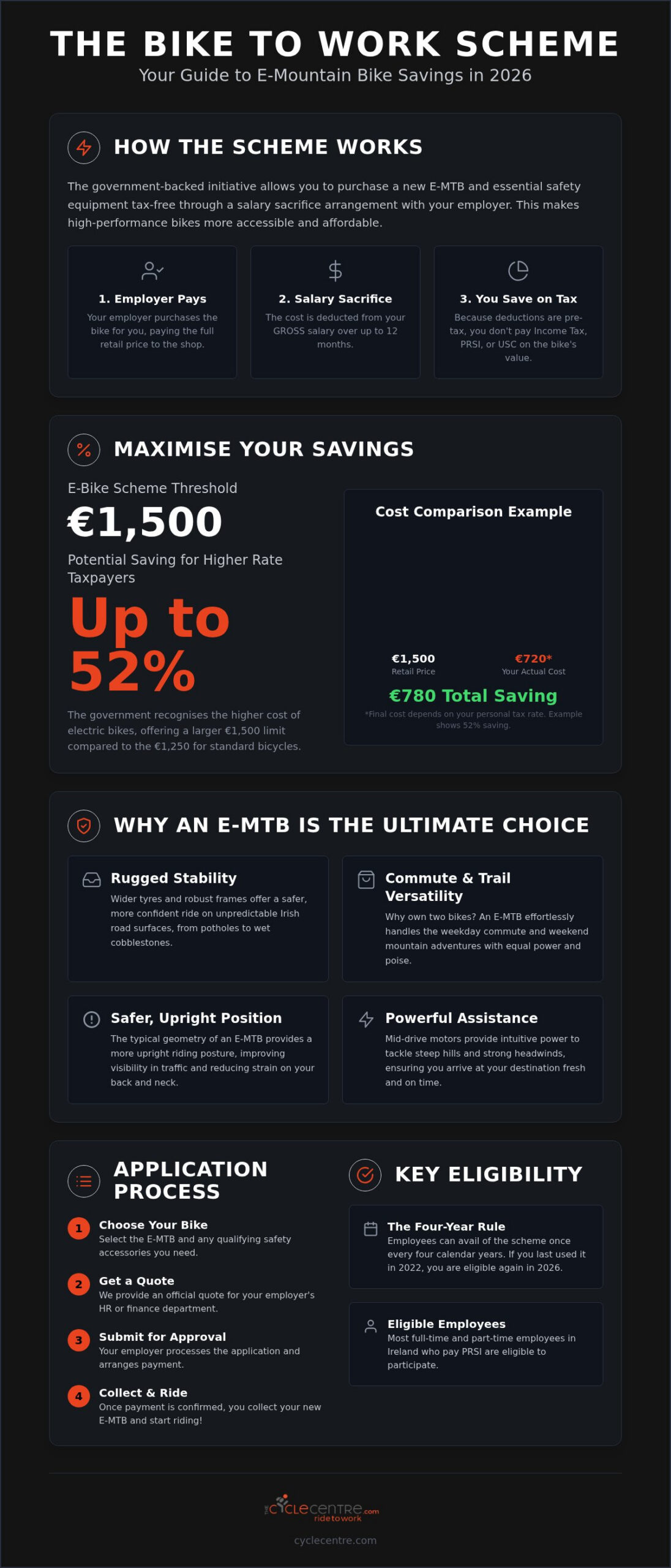
The government-backed initiative remains the most effective way for Irish workers to access high-performance machinery without the full upfront financial burden. At its core, the scheme functions as a tax incentive designed to encourage healthier, more sustainable commuting habits across the country. By opting into a salary sacrifice arrangement, you can purchase a bike and essential safety equipment entirely tax-free. This approach doesn’t just benefit your physical health; it is a strategic move for your personal finances.
Your employer typically pays the full cost of the bike to the retailer initially. They then recoup this expenditure by deducting a set amount from your gross salary over a period of up to 12 months. Because these deductions happen before Income Tax, PRSI, and Universal Social Charge (USC) are applied, your take-home pay is reduced by significantly less than the actual cost of the bike. In 2026, this remains the gold standard for those looking to secure a premium E-MTB for their daily travels. Using the Bike to Work scheme for electric mountain bike acquisitions allows you to bypass the standard retail tax burden while spreading the cost comfortably over a year.
The Different Names for the Scheme
You might encounter several different titles for this initiative, such as the Cycle to Work scheme or “Ride to Work.” It is a common point of confusion for many employees. These names usually refer to third-party providers that facilitate the administration between your HR department and the bike shop. Whether your company uses a specific platform or manages the process internally, the underlying tax benefit remains exactly the same. We have spent decades building relationships with all major Irish scheme providers to ensure the process is as seamless as possible for every rider.
Eligibility for Irish Employees in 2026
Most employees paying PRSI in Ireland are eligible to participate, including both full-time and part-time staff. One of the most critical factors to track is the “four-year rule.” Under current regulations, you can avail of the scheme once every four years. If you last used the incentive in 2022, 2026 marks the year you become eligible for a full upgrade. This cycle is designed to keep commuters on safe, modern equipment that meets current technical standards.
Self-employed individuals face a different set of criteria. While they can’t use the salary sacrifice model in the same way as an employee, they can often treat the purchase of a bicycle as a business expense to reduce their tax liability. It is always wise to consult with an accountant to verify the specific deductions available for your business structure. For everyone else, the process is a straightforward path to a more active and cost-effective lifestyle.
Calculating Your Savings: The €1,500 E-Bike Threshold
Understanding the financial mechanics of the incentive is the first step toward a smarter investment. For 2026, the expenditure limit for pedelecs and e-bikes is capped at €1,500. This specific threshold is higher than the €1,250 allowance for standard bicycles, reflecting the government’s recognition of the advanced technology required for electric assistance. By following the official Revenue guidelines, you can ensure your purchase qualifies for the maximum possible relief from Income Tax, PRSI, and Universal Social Charge (USC).
The Bike to Work scheme for electric mountain bike purchases operates through a gross salary deduction. This means the cost is taken from your pay before the taxman takes his share. Because you aren’t paying tax on that portion of your income, the actual “out-of-pocket” cost is significantly lower than the price tag suggests. For those in the higher tax bracket, this can result in a total saving of up to 52% on the first €1,500 of the bike’s value.
Breaking Down the 52% Tax Saving
Deductions from your gross salary naturally lower your overall taxable income. If you are a higher-rate taxpayer, you’ll effectively bypass the 40% income tax, along with relevant PRSI and USC contributions, on the amount sacrificed. When you compare the monthly repayment to the spiraling costs of a car commute, including fuel, parking, and maintenance, the E-MTB often pays for itself within the first year. It’s also worth remembering that the scheme covers essential safety equipment. You can include high-quality helmets, heavy-duty locks, and lighting sets within your tax-free package, ensuring you’re fully equipped for both the trail and the tarmac from day one.
Purchasing a High-End E-MTB Above the Limit
Many premium models from manufacturers like Giant or Cube naturally exceed the €1,500 threshold due to their sophisticated mid-drive motors and high-capacity batteries. If your heart is set on a machine that costs more than the allowance, you can still utilise the scheme. You simply pay the balance—the “top-up”—directly to the shop. The tax benefit still applies to the first €1,500 of the total price, ensuring you still receive the maximum government subsidy regardless of the bike’s final cost. This remains an exceptionally savvy way to own a top-tier mountain bike that might otherwise feel out of reach. To see how these savings apply to specific models, you can explore our Smart-bike Search for a clearer picture of your potential investment.
Why an E-MTB is the Ultimate Choice for the Irish Commuter
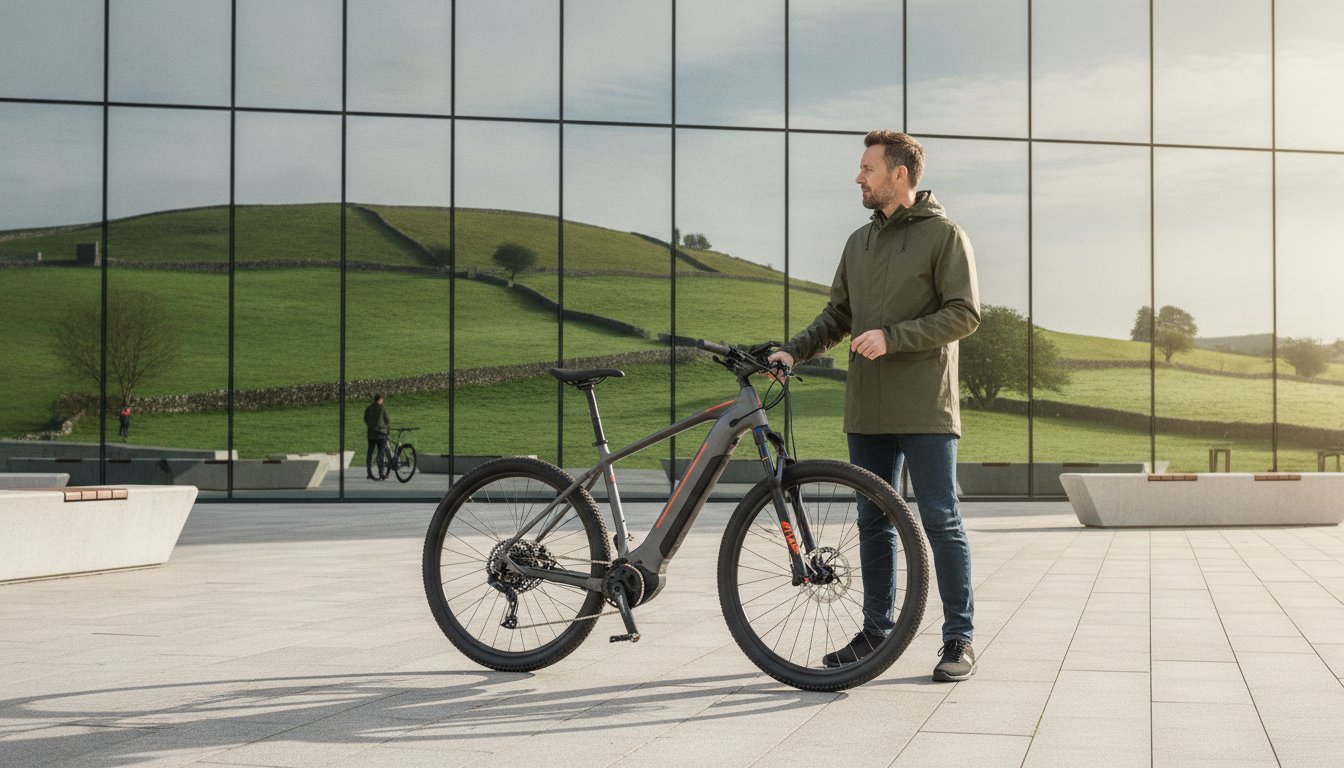
While many urban riders naturally gravitate towards sleek city frames, the Irish landscape often demands something more robust. Our roads are variable. They feature everything from smooth asphalt to deep potholes and loose debris. Opting for the Bike to Work scheme for electric mountain bike purchases provides you with a machine designed to handle far more than a simple pavement. E-MTBs offer superior stability on uneven surfaces, ensuring that a sudden dip in the road doesn’t compromise your safety. The upright geometry is another significant advantage; it places you in a commanding position with better visibility in heavy traffic, reducing the neck strain often associated with aggressive road bike postures.
Safety during wet Irish winters is a primary concern for year-round commuters. Wide, high-grip tyres provide the necessary traction on greasy, rain-slicked tarmac. They offer a level of confidence that narrow road tyres simply can’t match. When combined with the powerful motors found in modern E-MTBs, the hilly terrain found across Ireland becomes a minor detail rather than a physical hurdle. You’ll arrive at the office feeling fresh and composed, regardless of how many inclines stand between your front door and your desk.
From the Office to the Trails
The “One Bike” philosophy is gaining significant traction amongst savvy riders in 2026. Instead of maintaining two separate bicycles, a single high-quality E-MTB serves as both a rugged commuter and a weekend adventure companion. Modern designs from brands like Cube now often integrate lights and mudguards directly into the frame, making them fully practical for the work run. Using the Bike to Work scheme for electric mountain bike investments ensures you aren’t just buying a commuter, but a lifestyle tool. There’s a profound psychological benefit to this versatility; knowing your commuter is the same machine that conquers forest trails on a Sunday makes the Monday morning ride feel like the start of an adventure.
Durability and Maintenance on Irish Roads
Mountain bike components are inherently built to withstand harsher conditions than their road-going counterparts. This durability is essential when dealing with the grit and salt of Irish winter roads. The Citizens Information guide to the scheme confirms that safety equipment is fully covered, which is vital as few components offer more safety than hydraulic disc brakes. These provide consistent, powerful stopping power even in torrential rain. Additionally, front suspension significantly reduces fatigue during longer commutes by absorbing the vibrations that would otherwise travel through your wrists and shoulders, leaving you with more energy for the actual workday.
Choosing the Right E-MTB: Motors, Batteries, and Brands
Selecting the hardware is where the Bike to Work scheme for electric mountain bike becomes truly exciting. In 2026, mid-drive motors from industry leaders like Bosch, Shimano, and Yamaha dominate the market for a simple reason: they offer the most natural ride feel. Unlike hub motors, these systems are positioned at the bike’s crank, applying power through the drivetrain in a way that mimics your own pedalling rhythm. High torque ratings, often reaching 85Nm in premium models, ensure you can glide up steep Irish inclines without breaking a sweat. Giant and Cube remain the leading choices for local riders because their engineering balances high-performance output with the long-term reliability needed for daily use.
Battery capacity, measured in Watt-hours (Wh), is another critical factor for the commuter. A higher Wh rating translates to a longer range between charges. For most Irish commutes, a 500Wh or 625Wh battery provides ample power for a round trip with plenty of reserve left for weekend trail sessions. Understanding this balance helps you avoid “range anxiety” whilst ensuring you aren’t carrying the extra weight of a battery that exceeds your actual needs.
The Importance of Motor Aftercare
Sophisticated E-MTB motors require specialised attention that goes beyond standard bicycle maintenance. You should always prioritise Shimano-accredited workshops for your motor aftercare. These facilities have the diagnostic tools required to perform essential firmware updates, which can optimise battery efficiency and even improve motor torque delivery. We offer specific Silver and Gold service packages tailored to E-bikes, focusing on the unique wear patterns of electric drivetrains. Regular servicing in a professional workshop isn’t just about performance; it is about protecting the longevity of your investment and ensuring your Bosch or Yamaha motor remains under warranty.
Selecting Your Frame and Wheel Size
Wheel size significantly impacts how your bike handles both the tarmac and the trail. 29-inch wheels are the gold standard for commuters because they maintain speed more efficiently and roll over potholes with ease. In contrast, 27.5-inch wheels offer better agility if you plan on spending most of your weekends on technical forest tracks. Choosing between a hardtail E-MTB and a full-suspension model often comes down to your route. Hardtails are generally more efficient for road-heavy commutes, whilst full-suspension models provide unparalleled comfort on rougher backroads. You can use our Smart-bike Search to filter through these options and find your ideal fit based on your height and riding preferences.
Ready to see which model suits your lifestyle? Get a no-obligation quote for your new E-MTB today and take the first step towards a better commute.
How to Apply for the Scheme: A Step-by-Step Guide
Moving from technical motor specifications to administrative paperwork shouldn’t feel like an uphill struggle. Applying for the Bike to Work scheme for electric mountain bike purchases is a logical, methodical process that we’ve refined over decades to ensure it’s as friction-free as possible. Once you’ve identified the machine that fits your lifestyle, the transition from browsing to riding happens surprisingly quickly. Most Irish businesses are well-versed in these procedures, making the journey from your first quote to your first trail ride a smooth one.
The application typically follows four clear stages:
- Employer Verification: Confirm your company is registered with a scheme provider. Most Irish employers are already set up to facilitate these tax breaks.
- Selection and Quoting: Choose your E-MTB and any necessary safety accessories to receive a formal, itemised quote.
- HR Submission: Present this quote to your Finance or HR department for their internal approval and processing.
- Collection: Once your employer processes the payment and provides a voucher or notification, you’re ready to collect your bike and start your journey.
Getting Your No-Obligation Quote
The most efficient way to begin is by using our online application tool. This system allows you to build your ideal package from the comfort of your home. It ensures you don’t overlook essential safety apparel or heavy-duty locks that are also eligible for tax relief under the 2026 regulations. If you’re seeking a deeper understanding of the specific rules governing these incentives, our Ultimate Guide to the Bike to Work Scheme Ireland 2026 provides a comprehensive breakdown of the latest policy details. Remember, a quote is simply a starting point. It doesn’t commit you to a purchase until your employer approves the final agreement.
Finalising Your Salary Sacrifice Agreement
Your salary sacrifice agreement is the engine that drives your financial savings. Most Irish employers organise the repayment over a 12-month period, though some may offer shorter terms depending on their internal payroll cycles. The critical factor is that these deductions are taken from your gross salary. This ensures you bypass the taxes discussed earlier in this guide, maximising the value of every Euro spent on your new machine. It’s a common concern to wonder what happens if you leave your job before the year ends. Typically, the remaining balance of the bike’s cost is deducted from your final net pay packet. This settles the agreement and ensures the bike remains your personal property, ready for whatever adventures your next chapter holds.
Elevate Your Commute and Your Weekends
The path to a more active, cost-effective lifestyle in 2026 is clearer than it has ever been. By leveraging the Bike to Work scheme for electric mountain bike purchases, you aren’t just saving up to 52% on your initial investment; you’re securing a machine that bridges the gap between daily utility and weekend exploration. We’ve seen how the €1,500 threshold provides a substantial foundation for high-performance Giant and Cube models, even when you choose to top up for professional-grade specifications that meet your specific riding needs.
As an independent, family-owned business established in 1974, we understand that a premium E-MTB is a significant investment. Our Shimano-accredited workshop stands ready to protect that investment through expert motor maintenance, technical diagnostics, and essential firmware updates. Don’t let the perceived complexity of paperwork or motor technicalities hold you back from the freedom of the trails. We’re here to facilitate the entire process, moving you from a state of uncertainty to one of informed confidence.
Get a no-obligation quote for your E-MTB today and discover how simple the transition to electric power can be. We look forward to helping you find your perfect match and getting you out on the road.
Frequently Asked Questions
Can I buy an electric mountain bike that costs more than €1,500?
You can certainly choose a model that exceeds the €1,500 limit. In such cases, you simply pay the difference between the tax-free voucher amount and the final retail price directly to the shop at the point of purchase. The tax benefits of the Bike to Work scheme for electric mountain bike acquisitions still apply to the first €1,500 of the total value. This allows you to secure a premium Giant or Cube model whilst still maximising your savings.
How often can I use the Bike to Work scheme in Ireland?
You are eligible to avail of the incentive once every four years. This timeline is calculated from the date you last utilised the scheme, regardless of whether you’ve changed employers in the meantime. If you last purchased a bicycle through the programme in 2022, you are fully eligible for a new application in 2026. This regular cycle ensures you can upgrade to the latest motor and battery technology as industry standards continue to evolve each year.
Does the scheme cover second-hand electric mountain bikes?
No, the scheme only applies to new bicycles and equipment purchased from a recognised retailer. Second-hand bikes or private sales don’t qualify for the tax relief. By purchasing a new E-MTB through a specialist centre, you ensure the bike is covered by a full manufacturer’s warranty. You also gain peace of mind knowing the motor and battery have been professionally inspected and prepared by a Shimano-accredited workshop before you take delivery of your new machine.
What cycling accessories can I include in my Bike to Work application?
You can include a wide range of essential safety equipment within your application. Qualifying items include helmets, high-visibility clothing, heavy-duty locks, lights, and pannier bags. You can also add practical tools such as pumps, puncture repair kits, and mudguards. Including these accessories in your Bike to Work scheme for electric mountain bike quote ensures you’re fully equipped for all-weather commuting whilst benefiting from the same tax savings as the bike itself, provided you stay within the limits.
Do I have to cycle to work every single day to qualify for the scheme?
You don’t need to use the bike every day to qualify. The primary requirement is that the bicycle is used “mainly” for qualifying journeys, which include travelling between your home and your place of work. There is no legal requirement for you to log your mileage or prove a specific number of commutes per week to your employer. The government’s goal is to reduce car dependency, so even using your E-MTB for a few days a week meets the criteria.
Is there a minimum distance I must travel to use the tax incentive?
There is no minimum distance requirement for your commute. Whether your office is two kilometres away or twenty, you’re equally eligible to apply for the incentive. E-MTBs are particularly effective for those with longer or hillier routes that might otherwise feel daunting on a standard bicycle. The motor assistance ensures you can cover any distance comfortably, arriving at your destination without the physical fatigue often associated with unassisted cycling over varying Irish terrain and unpredictable weather conditions.
Can I get two bikes on the scheme if the total is under the limit?
You can technically purchase two bicycles under the scheme if the combined cost of both bikes and all accessories remains within the €1,500 limit. However, given the advanced technology and motor systems found in premium electric models, it’s highly unlikely you’d find two quality E-MTBs at this price point. Most riders find it far more beneficial to invest their full allowance into a single, high-specification machine that handles both commuting and off-road trails with total ease.
What happens if my E-MTB is stolen while I am still paying for it?
You’re still responsible for completing the salary sacrifice repayments even if the bike is stolen. Because the bike belongs to you from the day you collect it, the financial agreement with your employer remains in place. We strongly recommend taking out a comprehensive bicycle insurance policy or adding the E-MTB to your home insurance. Using a high-quality, Sold Secure rated lock, which can be included in your scheme application, is also a vital and necessary deterrent.