


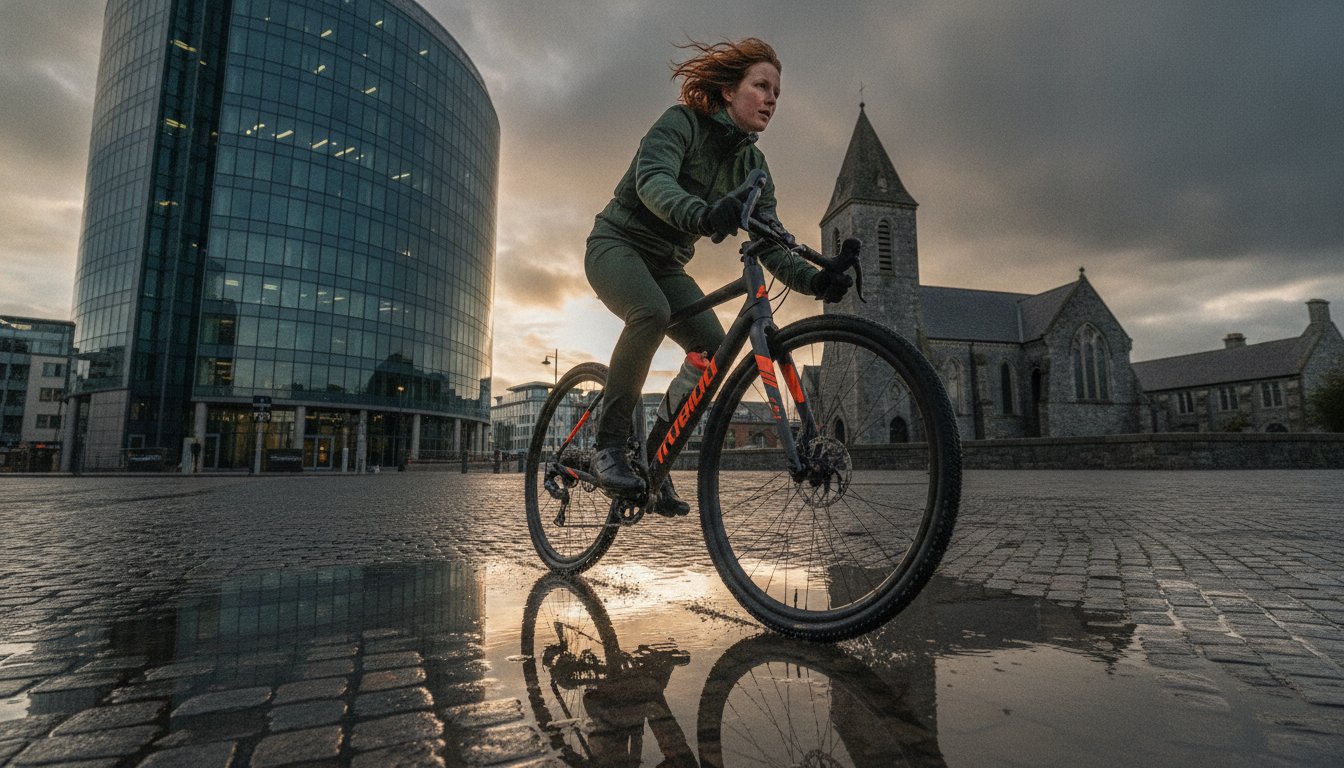
Why are you still battling the daily grind on a bike that wasn’t built for the realities of Irish roads? You’ve likely experienced that sinking feeling when a hidden pothole claims another inner tube, or the sharp lack of confidence that comes with leaning into a greasy, rain-slicked corner. We understand that the Irish commute is often a battle against unpredictable weather and poorly maintained surfaces that can leave you soaked and frustrated before you’ve even reached the office. It’s time to stop compromising on your equipment.
Choosing gravel bikes for commuting Ireland is the most logical decision you can make for your morning routine. These machines offer the perfect blend of speed and rugged durability, ensuring you stay upright and comfortable regardless of the conditions. In this 2026 guide, we’ll explore why these versatile bikes are the superior choice for our unique landscape. We also provide a clear roadmap for maximising your savings through the Cycle to Work scheme, allowing you to secure a premium brand like Giant or Cube while saving up to 52% on the total cost. Let’s look at how you can lower your costs, improve your fitness, and finally enjoy the ride.
Key Takeaways
- Discover why the high tyre volume and stable geometry of gravel bikes provide a smoother, puncture-resistant ride on poorly maintained Irish backroads.
- Learn how to maximise your budget through the Cycle to Work scheme, potentially saving up to 52% on premium models from Cube and Giant.
- Understand why gravel bikes for commuting Ireland offer the perfect middle ground between road bike speed and mountain bike durability for all-weather performance.
- Identify the technical specifications, such as wide-range gearing and frame materials, that will help you tackle steep Irish hills with confidence and ease.
- Master the essentials of year-round maintenance and security to keep your commuter in peak condition through the harshest winter months.
Why Gravel Bikes Have Redefined the Irish Commute in 2026
The Gravel bicycle has shifted from a niche off-road pursuit to a mainstream transport solution for a very simple reason: it’s built for reality. These bikes are a clever hybrid, blending the aerodynamic speed of a road performance bicycle with the rugged, go-anywhere durability of a mountain bike. For anyone looking at gravel bikes for commuting Ireland, the primary benefit is the sheer versatility they offer. You aren’t confined to the smoothest tarmac; you have the psychological freedom to take the scenic route through a park or a gravel canal path without worrying about your equipment failing.
Navigating Potholes and Poor Surfaces
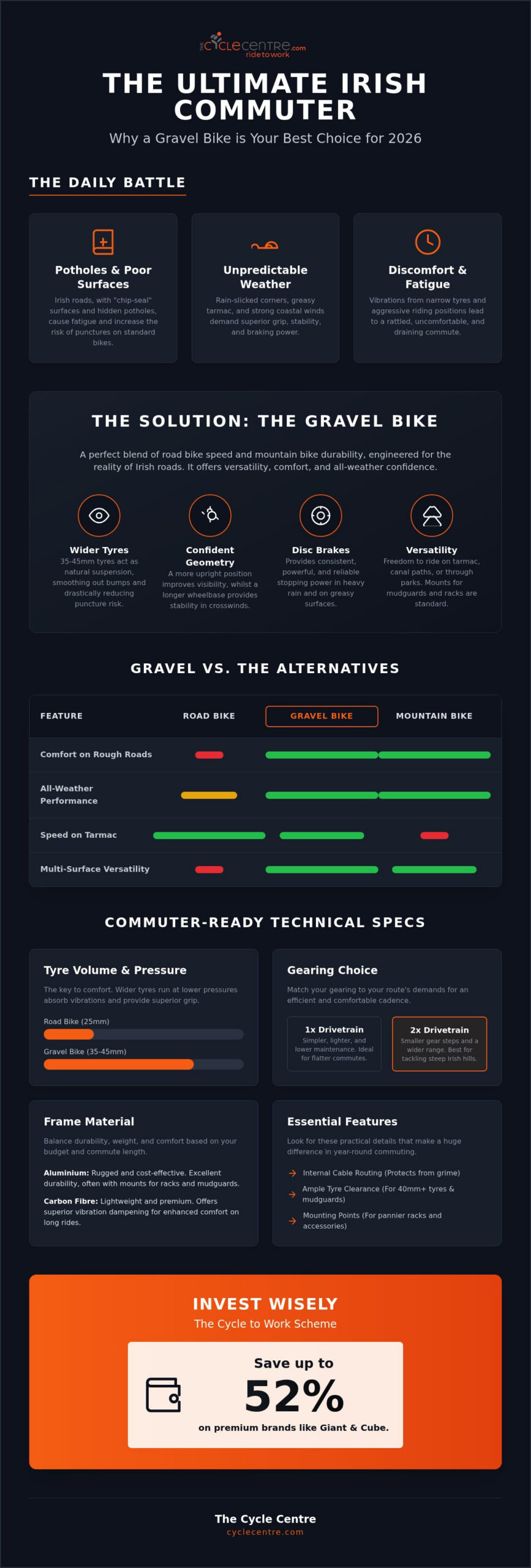
Irish roads are often a patchwork of “chip-seal” surfaces and unexpected potholes. Traditional road bikes with narrow 25mm tyres transmit every vibration directly to your wrists and lower back, leading to fatigue. Gravel bikes solve this by using wider tyres, typically between 35mm and 45mm. This increased volume acts as natural suspension, smoothing out the chatter of uneven tarmac and providing a much more comfortable ride.
- Lower tyre pressures provide better grip on loose or damp surfaces.
- Wider tyres significantly reduce the risk of pinch punctures from hidden potholes.
- Increased air volume protects your rims from expensive impact damage.
This “all-road” capability is vital for rural-to-urban commutes where road quality can vary wildly within a single five-mile stretch. It ensures you arrive at your destination feeling fresh rather than rattled by the road surface.
Confidence in the Irish Weather
Wet, greasy tarmac is a staple of the Irish morning. Gravel bikes for commuting Ireland are particularly effective because they feature a slightly more upright geometry than aggressive road bikes. This gives you a better field of vision to navigate city traffic and reduces strain on your neck. Most importantly, these bikes come equipped with disc brakes. Unlike rim brakes, which can lose efficiency when wet, disc brakes provide consistent, reliable stopping power even in a heavy downpour.
The wider wheelbase of a gravel frame also offers superior stability during high-wind coastal commutes. You’ll feel more planted and secure when a sudden gust catches you. Because these frames are built for mud, they have generous clearances that prevent road grime from clogging up your components. It’s a practical, solution-oriented approach to the unique challenges of our climate, making the daily ride something to look forward to rather than endure.
Technical Foundations: What Makes a Gravel Bike Commuter-Ready?
When selecting gravel bikes for commuting Ireland, the technical specifications are what separate a weekend toy from a reliable daily workhorse. A commuter bike faces unique stresses, including corrosive road salt in winter and the constant grit of damp mornings. Choosing a frame with internal cable routing is a practical first step. By housing the gear cables and brake lines inside the frame, you protect them from the elements, ensuring your shifting remains crisp and reliable throughout the year without constant adjustment.
Frame material choice often comes down to your specific route and budget. Lightweight aluminium (alloy) frames are the rugged choice for many, offering excellent durability and often including the necessary eyelets for pannier racks and full-length mudguards. Carbon fibre, whilst a larger investment, provides superior vibration dampening which can be a blessing on long commutes over “chip-seal” country roads. Regardless of the material, ensure the frame has ample tyre clearance. You’ll want enough space to fit 40mm tyres alongside mudguards to stay dry during the inevitable Irish drizzle.
Gearing is equally critical. A 1x drivetrain, featuring a single front chainring, simplifies your ride by reducing the number of moving parts that can fail or collect grime. However, if your commute involves the steep gradients found in the Dublin mountains or the hills of Cork, a 2x system provides the finer gear steps needed to maintain a comfortable cadence. You can explore our range of Gravel and Adventure Bikes to see how these different setups feel in person.
Tyre Volume and Pressure: The Secret to Comfort
The true magic of a gravel bike lies in the ability to run higher-volume tyres at lower pressures. This setup absorbs the micro-shocks of the road that would otherwise travel through the bike to your body. Rolling resistance is the energy lost as a tyre deforms over the road surface, which is paradoxically reduced on rough Irish tarmac by using wider tyres at lower pressures rather than rock-hard narrow ones. Many commuters are now moving to tubeless technology, where a liquid sealant inside the tyre automatically plugs small punctures. It’s a game-changer for avoiding the “snake-bite” punctures caused by hitting sharp-edged potholes in the dark.
Disc Brakes and Reliable Stopping Power
In the wet Irish climate, traditional rim brakes can feel like a suggestion rather than a command. Disc brakes are the standard for gravel bikes for commuting Ireland because they offer consistent stopping power regardless of the weather. Hydraulic disc brakes are the gold standard, providing better modulation and requiring less hand force, which is vital for safe emergency stops in heavy traffic. Mechanical disc brakes are a solid, budget-friendly alternative that is easier to repair at home. To help fund these safety-critical features, you can check your eligibility for the Cycle to Work Scheme, which significantly reduces the effective cost of a high-specification commuter bike.
Gravel vs Road vs Hybrid: Finding Your Ideal Commuter Framework
Many riders begin their journey on a hybrid, assuming it’s the safest bet for urban streets. Whilst a hybrid is a common starting point, gravel bikes for commuting Ireland offer a distinct performance advantage. They provide a superior strength-to-weight ratio, giving you a bike that’s light enough to carry up office stairs but tough enough to survive the daily grind. Unlike a heavy mountain bike, which wastes energy through wide, knobby tyres and unnecessary suspension, a gravel bike translates every pedal stroke into forward motion. It’s the logical middle ground for the modern professional who values both efficiency and resilience.
The drop-bar design is often misunderstood as being purely for racing. In reality, it’s a comfort feature. Having multiple hand placements, such as the hoods, tops, and drops, allows you to shift your weight and reduce pressure on your ulnar nerves during longer rides. This variety is essential for preventing the hand numbness that often occurs on flat-bar hybrids. It also provides a significant aerodynamic advantage when you’re battling a headwind on the way home, allowing you to tuck down and maintain your speed with less effort.
The Speed of a Road Bike with the Toughness of an MTB
Choosing a gravel bike often simplifies your life through the “one-bike” philosophy. You don’t need a dedicated road bike for fitness and a separate hybrid for work; a single high-quality frame from a brand like Giant or Cube can handle both. These frames are engineered to carry luggage loads that would cause a lightweight road racing bike to flex or shimmy. The Road Safety Authority provides excellent guidance on the necessary safety equipment for all road users, and a gravel bike’s design makes it easy to comply with these standards whilst maintaining high average speeds. You get the ruggedness of a mountain bike without the weight penalty, making it the fastest way to navigate a 15km cross-city route.
Mounting Points: The Practicality of Panniers and Mudguards
Practicality is where gravel bikes truly shine for the daily commuter. Before you commit to a purchase, look for “eyelets” on the fork and rear stays. These small threaded holes are the mounting points for racks and guards. Carrying your laptop and a change of clothes in a rear pannier is far superior to wearing a rucksack. It lowers your centre of gravity, improves bike handling, and prevents the “sweaty back” syndrome that ruins many office mornings. Full-length mudguards are equally vital. They ensure that road spray from your tyres doesn’t end up on your trousers, allowing you to arrive at your desk looking presentable even after a damp Irish morning.
Essential Gear and Maintenance for Year-Round Irish Riding
To truly get the most out of gravel bikes for commuting Ireland, you need to look beyond the frame and focus on the “commuter kit” that makes a wet Tuesday morning manageable. Visibility is your first priority. During the dark winter months, high-visibility apparel isn’t just about fashion; it’s about safety. You also need a lighting strategy. In urban areas, you need lights “to be seen”, but if your route involves unlit backroads or canal paths, you’ll need high-lumen front lights “to see” the road surface clearly.
Security is the next pillar of a successful commute. We recommend investing in a high-quality D-lock with a Sold Secure rating. Understanding urban locking techniques, such as securing both the frame and the rear wheel to a fixed anchor point, is essential for protecting your investment in a premium brand like Cube or Giant. Don’t rely on a thin cable lock that can be snipped in seconds; a solid D-lock is a deterrent that keeps your bike where you left it.
Mudguards and Apparel: Staying Dry in the Atlantic Rain
The Atlantic weather system doesn’t play fair, so your gear shouldn’t either. Whilst many off-roaders prefer “clip-on” guards for easy removal, a dedicated commuter should always opt for permanent, “full-wrap” mudguards. These provide much better protection for your feet and your bike’s drivetrain by catching spray before it leaves the tyre. Pair these with breathable waterproof fabrics that allow sweat to escape whilst keeping the rain out. For your feet, dedicated gravel boots or high-quality overshoes are the difference between a productive morning and a day spent with damp socks.
Professional Servicing: Keeping Your Drivetrain Smooth
A bike doing 100km or more every week requires a different level of care than a weekend leisure bike. Irish road salt is incredibly corrosive; it acts like liquid sandpaper on your chain and cassette. Regular home cleaning is vital, but professional oversight is a non-negotiable. Our Professional Bike Servicing and Workshop Maintenance ensures that wear is caught before it becomes an expensive failure.
If you’re riding high mileage, a Workshop Silver service every six months is usually sufficient, but those tackling harsh winter conditions may require a Gold service annually to deep-clean the bearings and reset the drivetrain. Keeping your bike in peak condition ensures your gravel bikes for commuting Ireland remain a joy to ride rather than a chore to maintain. Proper maintenance preserves the life of your components and ensures your daily transport remains reliable.
Book your next service at our Shimano-accredited workshop to keep your commute running smoothly throughout the year.
Investing Wisely: The Cycle to Work Scheme at The Cycle Centre
Investing in a high-quality bicycle is a significant decision, yet the Irish tax system makes it remarkably accessible for the modern professional. In 2026, the Cycle to Work scheme remains the most efficient mechanism for acquiring gravel bikes for commuting Ireland. By utilizing a salary sacrifice arrangement, you can reduce the effective cost of your new equipment by up to 52% if you are a higher-rate taxpayer. This financial framework allows you to spread the cost over twelve months, making a premium machine from a legacy brand like Giant or Cube a practical reality rather than a luxury.
The timing for an upgrade is particularly relevant this year. Under current Irish legislation, employees can avail of the scheme once every four tax years. If you last utilized the incentive in 2022, you are now fully eligible to refresh your setup as of January 1st, 2026. This cycle ensures that commuters can stay at the forefront of cycling technology, benefiting from the latest advancements in hydraulic braking and puncture-resistant tubeless tyres that we’ve explored in previous sections.
Maximising Your Tax Savings in Ireland
One common oversight is failing to include essential accessories in the initial application. The scheme isn’t limited to the bicycle frame alone. You can include safety-critical items such as helmets, high-visibility apparel, and those vital full-length mudguards that are essential for the Irish climate. Locks and lights are also covered, allowing you to build a complete, commuter-ready kit without paying a penny in upfront tax. For a comprehensive breakdown of the current rules and thresholds, consult The Ultimate Guide to the Bike to Work Scheme Ireland 2026. These small monthly deductions from your gross salary make the transition to a healthier, more cost-effective commute incredibly smooth.
The Smart-bike Search: Finding Your Perfect Match
With over 50 years of industry experience, we understand that technical specifications can feel overwhelming. To simplify your journey, we developed the Smart-bike Search tool. This system allows you to filter our extensive range of gravel and adventure bikes by frame material, gearing, and your specific commuting distance. It’s a logical, step-by-step process that replaces guesswork with informed confidence. Whether you need the lightweight agility of carbon or the rugged reliability of alloy, our tool narrows down the options to the models that best suit your unique route.
Once you’ve identified your ideal match, getting started is easy. You can request a no-obligation quote through our website to present to your HR department. This transparent process ensures that every detail is covered, from the technical specs of the bike to the administrative requirements of the tax scheme. Take the first step toward a better morning by using our Smart-bike Search tool today and discover how gravel bikes for commuting Ireland can transform your daily experience.
Transform Your Daily Ride
The transition to a gravel bike is more than just a change of equipment; it’s a commitment to a more reliable, comfortable, and efficient lifestyle. We’ve explored how the rugged durability and superior stopping power of these machines solve the specific frustrations of the Irish commute, from rain-slicked corners to the inevitable potholes of our backroads. By leveraging the Cycle to Work scheme, you can access world-class engineering from Cube and Giant whilst enjoying significant tax savings of up to 52%.
As a family-owned business established in 1974, we take pride in being your trusted local experts. Our Shimano Accredited Workshop is ready to keep your bike in peak condition, and our free Smart-bike Search tool is the perfect place to begin your journey. Don’t let another damp morning hold you back. Start your Cycle to Work application and get a no-obligation quote today and discover why gravel bikes for commuting Ireland are the definitive choice for the modern professional. We’re here to help you every step of the way. Enjoy the ride.
Frequently Asked Questions
Is a gravel bike faster than a hybrid for commuting?
A gravel bike is generally significantly faster than a hybrid due to its more aerodynamic riding position and lighter frame construction. Whilst hybrids are comfortable, their upright geometry and flat bars create more wind resistance. Gravel bikes for commuting Ireland allow you to tuck into the drops when facing a headwind, whilst their stiffer frames ensure more of your energy is converted into forward motion on the tarmac.
Can I use the Cycle to Work scheme for a gravel bike in 2026?
Yes, you can absolutely use the scheme to purchase a gravel bike in 2026. If you previously used the incentive in 2022, you’re now eligible to apply again as the four-year tax cycle has reset. This allows you to upgrade to a modern machine from brands like Giant or Cube with the latest braking and tyre technology. We provide an easy online application for no-obligation quotes to assist your HR department.
How much can I realistically save on a new bike through the scheme?
You can save up to 52% on the retail price of a new bike and essential accessories. The exact saving depends on your personal tax rate, as the purchase is made through a salary sacrifice arrangement before income tax, PRSI, and USC are deducted. This makes high-end gravel bikes for commuting Ireland much more affordable, as the cost is spread over twelve months without any upfront interest or hidden fees.
Are gravel bikes more prone to theft in Irish cities?
Any premium bicycle can be a target for theft, so high-quality security is essential. Because gravel bikes look similar to expensive road bikes, they may attract attention in urban environments. We strongly recommend using a Sold Secure rated D-lock to secure the frame to a fixed anchor. Avoid using thin cable locks alone, as these don’t provide the necessary resistance against modern cutting tools used in busy city centres.
Do I need special shoes to ride a gravel bike for commuting?
You don’t strictly need specialised footwear, but they can improve your efficiency. Many commuters start with flat pedals and standard trainers for convenience. However, if your journey is over 10km, switching to stiff-soled cycling shoes or a “clipless” pedal system can reduce foot fatigue. Gravel-specific shoes are ideal because they have recessed cleats, allowing you to walk comfortably across the office floor or into a shop without slipping.
Can I fit a child seat or a trailer to a gravel bike?
Most gravel bikes are highly compatible with child seats and trailers, provided the frame has the correct mounting points. Since these bikes are designed for adventure and luggage, they often feature reinforced eyelets that are perfect for rear-mounted seats. If you’re using a trailer, ensure your rear axle is compatible with the hitch system. This versatility makes them an excellent choice for parents who need a multi-purpose family vehicle.
How often should I service my gravel bike if I commute daily?
We recommend a professional service every six months for daily commuters. If you’re covering over 100km a week, the drivetrain and brake pads will wear more quickly due to Irish road grit. A Silver service every six months keeps the shifting crisp, whilst a Gold service once a year is ideal for deep-cleaning bearings. Our Shimano-accredited workshop specialises in maintaining high-mileage bikes to ensure they remain reliable in all weather conditions.
Which is better for Irish roads: an alloy or carbon gravel frame?
The choice depends on your priorities for durability versus comfort. Alloy frames are exceptionally rugged and often feature more mounting points for heavy pannier racks, making them the classic choice for a workhorse commuter. Carbon frames offer superior vibration dampening, which smooths out the “chatter” of rough Irish roads and reduces rider fatigue on longer distances. Both materials are excellent, provided the bike is fitted with high-volume, puncture-resistant tyres.