

A child’s bicycle is far more than a simple toy; it is a vital developmental tool that can either foster a lifelong passion for the outdoors or create a lasting fear of the saddle. Many parents find that learning how to choose a kids bike involves wading through a confusing sea of wheel sizes and technical jargon. We know you want to ensure your child is safe and comfortable, yet the fear of buying a frame that is too heavy for them to handle is a genuine worry. It’s a significant investment, and getting the fit right is essential for their confidence and your peace of mind.
This guide will help you master the selection process, ensuring you find a bicycle that balances safety, weight, and longevity. We provide a clear explanation of sizing that goes beyond basic age charts, helping you decide exactly when to move from a balance bike to pedals. By focusing on essential safety features and the durability of world-class brands like Giant and Cube, you will find a bike that offers incredible performance now and excellent resale value later. From professional assembly insights to weight considerations, we’ll walk you through every step to ensure your little rider starts their journey with confidence.
Key Takeaways
- Prioritise immediate fit and standover height over the temptation to buy a bike for your child to “grow into,” which can significantly compromise safety and confidence.
- Discover the most accurate method for how to choose a kids bike by using the “Inseam Rule” to match your child’s leg length to the correct wheel diameter.
- Choose lightweight aluminium frames over heavy steel alternatives to ensure the bicycle remains easy for a smaller rider to control and manoeuvre.
- Implement a simple five-minute “M-Check” safety routine to verify that essential components like brakes and tyres are always in peak condition.
- Understand why investing in reputable brands like Giant and Cube provides better long-term value through superior durability and high resale potential.
Understanding Why the Right Fit Matters More Than the Colour
Many parents are tempted to pick a bike based on their child’s favourite colour or a popular cartoon character. Whilst aesthetics matter to a young rider, the mechanical fit determines whether they actually enjoy the experience or develop a lasting fear of cycling. At The Cycle Centre, we’ve seen many families struggle because they bought a bike that was simply too large. Understanding how to choose a kids bike starts with recognising that a bicycle is a vehicle, not a garment. Just as you wouldn’t buy school shoes three sizes too big—a principle of proper fit upheld by brands like Crabkids London—the same logic applies to a frame.
The Danger of the “Growth Spurt” Logic
Buying a bike with the intention that a child will “grow into it” is one of the most common safety hazards we encounter. An oversized frame makes it difficult for a child to reach the handlebars comfortably, which directly hinders their steering and braking control. If a rider cannot place both feet firmly on the ground whilst seated, they lose the ability to stop and stabilise themselves safely in an emergency. This lack of control often leads to early tumbles, which frequently results in the bike being relegated to the back of the shed. Unlike adult models, kids’ bike wheel sizes are the primary way we categorise fit, but the frame’s physical dimensions are what truly dictate a child’s safety.
Building Confidence Through Ergonomics
Confidence is fragile in young cyclists. A poorly fitted bike feels heavy and unstable, making the learning process frustrating rather than fun. Proper geometry ensures a lower bottom bracket, which creates a stable centre of gravity. This makes it much easier for a child to mount and dismount without losing their balance. We also look for specific components like shorter crank arms to suit smaller legs and reach-adjustable brake levers for tiny hands. Standover height is the vertical distance between the ground and the top of the top tube, and it’s the most critical measurement for ensuring a child can safely straddle the bike.
Whilst age brackets provide a rough starting point, they are often misleading because children grow at vastly different rates. When learning how to choose a kids bike, the industry standard is to categorise models by wheel diameter rather than frame height. This differs significantly from adult bikes, where the seat tube length is the primary metric. Selecting the correct wheel size ensures the bike’s overall proportions, including the reach to the handlebars and the height of the bottom bracket, are ergonomically suited to your child’s physical stature.
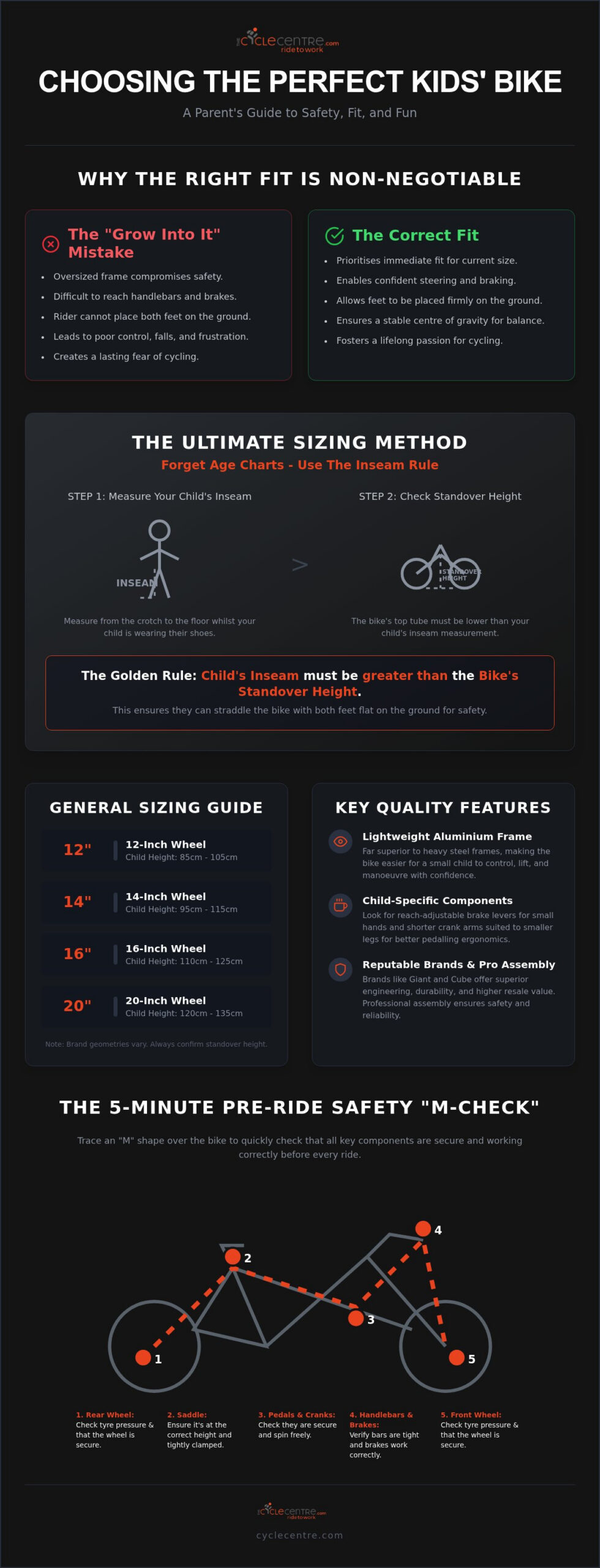
The “Inseam Rule” is your most reliable tool for achieving a perfect fit at home. Measure the distance from the crotch to the floor whilst your child stands in their favourite trainers. For a safe and confident ride, the bike’s standover height must be slightly less than this measurement. This ensures they can straddle the top tube with both feet flat on the ground. Verifying this measurement is a core component of any bike safety checklist, as it prevents awkward falls during sudden stops or when mounting the saddle.
The Sizing Chart: A General Guide for 2026
Use the following table as a baseline, but remember that brand-specific geometry from manufacturers like Giant or Cube can vary. A 20-inch bike from one brand might feel slightly larger than another due to the frame’s reach.
- 85cm – 105cm: 12-inch wheel (typically balance bikes or first pedal bikes)
- 95cm – 115cm: 14-inch wheel
- 110cm – 125cm: 16-inch wheel
- 120cm – 135cm: 20-inch wheel
- 135cm – 150cm: 24-inch wheel
- 150cm+: 26-inch wheel or Extra Small adult frame
You’ll know your child has officially outgrown their current ride when their knees begin to interfere with the handlebars whilst turning, or when the seat post is extended beyond its safety limit. If they look “cramped” and their weight is shifted too far forward, it’s time to move up. If you’re unsure about specific geometry, the team at The Cycle Centre can help you compare different models to find the ideal match.
Balance Bikes vs Stabilisers: The Great Debate
Balance bikes have revolutionised how we teach children to ride. By removing the distraction of pedals, a child focuses entirely on their centre of gravity and the mechanics of counter-steering. For those interested in other ways to help children develop these skills through modern play, you can check out Hoveroo for their selection of self-balancing hoverboards and electric toys. Stabilisers, whilst traditional, often create a false sense of balance. They teach a child to lean away from corners, which is a habit that must be unlearned later. If your child is struggling to move to a pedal bike, try removing the pedals from the new frame temporarily. This allows them to get used to the increased weight and height whilst using it as a large balance bike, making the eventual transition to pedalling much smoother.
When parents ask us how to choose a kids bike, they often focus on the wheel size we discussed in the previous section. However, the weight of the machine is perhaps the most overlooked factor in a child’s success. A heavy bike is difficult to start, hard to stop, and exhausting to pedal uphill. At The Cycle Centre, we advocate for a “weight-to-child” ratio that prioritises ease of handling over decorative features. If a bicycle is too cumbersome, the child will quickly lose interest in the activity altogether.
Consider the physics of the ride. A typical steel bike from a high-street toy shop often weighs upwards of 12kg. If your child weighs 20kg, they are trying to manage a piece of equipment that is 60% of their own body mass. It’s the equivalent of an adult trying to ride a heavy motorcycle. By opting for a high-quality aluminium frame, you can significantly reduce this burden. Aluminium is not only lighter but also resistant to the British weather, ensuring the bike doesn’t succumb to rust after a few rainy outings in the park.
The Impact of Bike Weight on Handling
Ideally, a child’s bike should weigh less than 40% of their total body weight. This threshold is where riding stops being a chore and starts being an adventure. Lighter bikes allow for sharper manoeuvres and make it much easier for a child to lift the front wheel over a kerb or navigate a grassy slope. Avoid bikes cluttered with heavy plastic fairings or faux-suspension forks that add significant weight without offering any functional benefit. These “extras” are often marketing gimmicks that hinder a child’s ability to develop proper bike control and balance.
Durable Components for Daily Adventures
The quality of individual components determines the longevity of the bicycle. We stock brands like Giant and Cube because they utilise child-specific ergonomics. This includes thinner grips for smaller palms and narrower saddles that match a child’s pelvic structure. Look for bikes with sealed bearings in the wheels and bottom bracket; these keep dirt out and ensure the bike stays easy to pedal for years. Adjustable-reach brake levers are also essential, as they can be moved closer to the handlebars to accommodate growing fingers.
When it comes to gears, less is often more. For a child’s first geared bike, a simple seven or eight-speed system with a single front chainring is perfect. This reduces the mechanical complexity and prevents the “chain crossover” issues that plague 21-speed systems. Because we operate a Shimano accredited workshop, we ensure these components are perfectly tuned before they leave our shop. Choosing a bike from a reputable manufacturer means that when a part eventually wears out, it can be easily replaced or repaired rather than the entire bike being scrapped. This durability is why premium brands hold such high value as hand-me-downs.
Safety First: Essential Features and the Pre-Ride Checklist
Whilst choosing the right frame is vital, maintaining its mechanical integrity is what keeps your child safe on the road. Many parents focus solely on the initial purchase, but learning how to choose a kids bike also involves understanding the maintenance required to keep it roadworthy. A bicycle that has been neglected can quickly become a liability, regardless of its original quality. At The Cycle Centre, we believe that safety is a combination of high-quality engineering and regular parental oversight.
Braking systems are a primary consideration for safety. For younger children on smaller wheels, V-brakes are the standard because they are lightweight and easy for small hands to operate. As your child moves up to 24-inch or 26-inch wheels, you will often see disc brakes. These offer much better stopping power in wet British weather and require less physical effort to engage, which is a significant advantage for older children tackling more adventurous terrain or cycling to school in the rain.
The Parent’s 5-Step Pre-Ride Checklist
Before every outing, we recommend performing a quick “M-Check.” This is a simple routine that follows the shape of the letter M, starting at the front wheel, moving up to the handlebars, down to the pedals, up to the saddle, and finishing at the rear wheel. It takes less than five minutes but provides essential peace of mind.
- Step 1: Squeeze the tyres to check pressure and look for any sharp debris or glass embedded in the tread.
- Step 2: Pull both brake levers firmly. They should engage well before the lever reaches the handlebar grip.
- Step 3: Ensure the saddle and handlebars are straight and the bolts are tight enough that they don’t twist under pressure.
- Step 4: Check that the chain is clean, lightly lubricated, and moves smoothly without any stiff links.
- Step 5: Verify that the wheel nuts or quick-release skewers are fully tightened and secure.
Safety Standards and Professional Assembly
The rise of “bikes in a box” from online retailers has led to an increase in mechanical failures. A bicycle is a complex machine that requires expert tuning to be truly safe. When a bike is professionally assembled in a Shimano accredited workshop, every bolt is torqued to the correct specification and the bearings are pre-loaded to prevent premature wear. This level of care ensures the gears shift perfectly and the brakes are centred correctly from the very first mile. Beyond the bike itself, it is vital to equip your rider with high-quality cycling helmets and high-visibility apparel to ensure they are protected and seen by other road users. If you want to ensure your child’s current ride is in peak condition, book a Workshop Silver Service with our expert team today.
Investing in Quality: Why Premium Brands and Expert Support Win
Buying a bike is a significant milestone for any family. Whilst the initial price tag of a premium model might seem high compared to high-street alternatives, the long-term economics tell a different story. When you learn how to choose a kids bike, you quickly realise that durability is the most effective way to save money. A bicycle built with standardised parts and a high-quality frame isn’t just a purchase; it’s an asset that retains its value through years of use. Choosing a reputable brand ensures that the bicycle remains a joy to ride rather than a source of mechanical frustration.
The Financial Logic of Quality
Consider the total cost of ownership over several years. A “toy shop” bike often features non-standard components that are difficult or impossible to repair once they fail. These bikes frequently end up in landfills after a single season of use. In contrast, investing in brands like Giant or Cube ensures you have a machine that can be serviced indefinitely. A bicycle costing around €400 that maintains a 50% resale value after two years is ultimately more affordable than a €200 bike that breaks and has zero second-hand appeal. These premium models are engineered to be hand-me-downs, easily surviving the rigours of multiple siblings without losing their mechanical precision.
To make these high-end options more accessible, many parents take advantage of tax-incentive programmes. By using the Guide to the Bike to Work Scheme Ireland 2026, you can significantly reduce the out-of-pocket expense of a new bicycle. This allows you to prioritise safety and performance for your child without compromising your household budget. It’s a sensible way to secure a professional-grade bike that will last for years.
Why the Independent Cycle Centre Experience Matters
Choosing a bike from an independent, family-owned retailer provides a level of mentorship you won’t find in a large chain. Since 1974, we’ve helped generations of riders find their perfect match. Our experts don’t just sell a box; they match the bike’s geometry to your child’s specific riding style, whether they are commuting to school or exploring forest trails. This personalised approach ensures the bike fits perfectly from day one, which is essential for building confidence.
Our relationship with your family doesn’t end when you leave the shop. From fixing the first inevitable puncture to providing advice on the next size up, we offer ongoing support that keeps your child on two wheels. Because our workshop is Shimano accredited, we provide the professional assembly and maintenance required to keep these high-quality machines running smoothly. Investing in quality means choosing a bike that grows with your child’s skills and stands the test of time.
Starting a New Adventure on Two Wheels
Choosing the right bicycle is about much more than just picking a favourite colour. By prioritising immediate fit and a manageable weight ratio, you provide your child with the confidence they need to explore the world around them safely. We’ve seen how understanding how to choose a kids bike involves looking past the marketing fairings to focus on quality components and professional assembly. Investing in reputable brands like Giant and Cube ensures your child enjoys a smooth ride today whilst you benefit from excellent resale value tomorrow.
At The Cycle Centre, our family-owned business has provided expert sizing advice for every stage of growth since 1974. Every bicycle we sell undergoes professional assembly in our Shimano Accredited Workshop, ensuring it’s road-ready and safe from the very first mile. Whether you’re transitioning from a balance bike or moving up to a performance mountain bike, we’re here to act as your mentor in every cycling milestone.
Explore our range of premium Giant and Cube kids’ bikes and give your child the gift of freedom. We look forward to helping your family start their next great adventure on two wheels.
Frequently Asked Questions
What size bike should I buy for a 5-year-old?
A 14-inch or 16-inch wheel size is generally suitable for a five-year-old, though height is the only truly reliable metric. Most children this age fall between 105cm and 115cm tall. You must ensure they can stand over the frame comfortably with both feet flat on the ground. Since every child grows at a different rate, we recommend checking the standover height against their inseam measurement rather than relying purely on age brackets.
Are stabilisers necessary for learning to ride?
Stabilisers are not necessary and can actually delay the learning process by preventing a child from developing a natural sense of balance. They teach a rider to lean away from corners, which is a habit that must be unlearned later. We advocate for starting with a balance bike or removing the pedals from a small pedal bike. This method allows the child to master counter-steering and weight distribution before they ever have to worry about pedalling.
Why are some kids’ bikes so much heavier than others?
Weight differences usually stem from the materials used in the frame and fork. Cheaper models often use heavy high-tensile steel, whilst premium brands like Giant and Cube utilise lightweight aluminium. Additionally, toy-shop bikes frequently include heavy plastic accessories or decorative fairings that add mass without adding function. Choosing a lighter bike is a critical part of how to choose a kids bike, as it makes the machine significantly easier for a small rider to control.
Can I get a kids’ bike on the Cycle to Work scheme in Ireland?
You can use the Cycle to Work scheme in Ireland to purchase bicycles and safety equipment tax-free, provided the equipment is for your own use. Whilst the primary focus is on your commute, many parents utilise the scheme to invest in high-quality adult bikes or essential safety gear like helmets. We provide no-obligation quotes for various programmes, including Bike to Work and Ride to Work, helping you secure professional-grade equipment whilst making significant savings through your employer’s payroll.
How do I know if my child’s bike helmet fits correctly?
A correctly fitted helmet should sit level on the head, covering the forehead and resting about two fingers’ width above the eyebrows. The side straps should form a clean “V” shape just below the ears, and the chin strap must be tight enough that only one or two fingers fit underneath. If the helmet wobbles or tilts back when the child moves, it’s too loose and won’t provide adequate protection during an impact.
Is it better to buy a bike with gears or a single-speed for a beginner?
A single-speed bike is almost always better for a beginner because it allows them to focus entirely on balance and braking. Introducing gears too early can be overwhelming and often leads to the child looking down at their hands instead of the path ahead. Once they are confident with their bike handling and have mastered the “M-Check” safety routine, you can move them up to a simple seven-speed system with a single front chainring.
How often should a child’s bike be serviced?
We recommend a professional service every six to twelve months, depending on how often the bike is used. Children are often tough on their equipment, and cables can stretch or brakes can become misaligned over time. Regular maintenance in a Shimano accredited workshop ensures that the bicycle remains safe and reliable. Between professional visits, you should perform a quick weekly check of tyre pressures and chain lubrication to prevent premature wear on expensive components.
What is the difference between a balance bike and a regular bike?
The primary difference is the lack of pedals, a chain, and a drivetrain on a balance bike. It is designed solely for the child to sit on and push along with their feet, focusing on the mechanics of leaning and steering. A regular bike includes a full drivetrain for pedalling. Understanding this distinction is vital when learning how to choose a kids bike, as balance bikes are the most effective starting point for toddlers.