


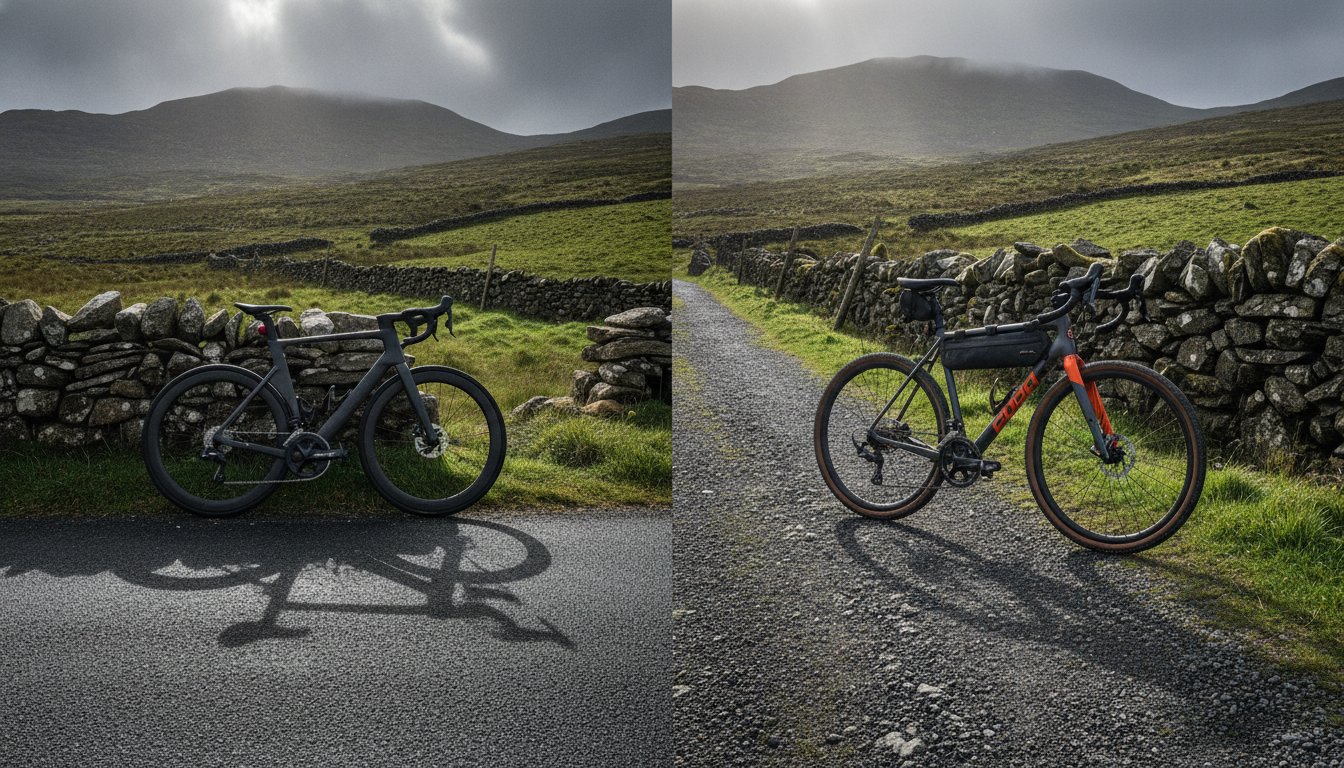
You might assume a featherweight road bike is the quickest way to tackle your local loop, but on the reality of our weather-beaten national lanes, the obvious choice is often the wrong one. When choosing between a gravel bike vs road bike Ireland presents a very specific set of challenges, from the bone-shaking vibration of coarse chip-seal to the constant threat of punctures on rural boreens. We understand the frustration of a ride cut short by mechanical issues or the lingering back pain caused by a frame that’s simply too aggressive for our uneven surfaces.
This guide helps you navigate the technical differences between these two categories to find a machine that truly masters the Irish terrain. We’ll examine how modern frame geometry can save your spine and why wider tyre clearances are becoming the standard for year-round reliability. You’ll also discover how to maximise the 2026 Cycle to Work scheme, which now offers up to €1,250 for standard bicycles, to ensure your new investment delivers the best possible value for every season of riding.
Key Takeaways
- Understand the core engineering differences between aerodynamic road efficiency and the stable, “go-anywhere” capability of modern gravel machines.
- Learn how to interpret stack and reach measurements to ensure your next frame supports your back and remains stable in heavy Irish crosswinds.
- Evaluate the gravel bike vs road bike Ireland debate through the lens of tyre volume, discovering why 32mm+ widths are essential for dampening road chatter.
- Use our decision matrix to align your cycling ambitions, whether you are targeting weekend sportives or a reliable daily commute.
- Discover how to utilise the 2026 Cycle to Work scheme to save up to 52% on your purchase with official retailers for Giant and Cube.
Defining the DNA: Pure Road Speed vs Gravel Versatility
Choosing between a gravel bike vs road bike Ireland means weighing pure tarmac efficiency against the freedom to explore our more rugged national routes. Whilst both categories share the familiar silhouette of a drop-bar bicycle, their internal engineering priorities are fundamentally different. A road bike is a precision tool built for the pursuit of speed on paved surfaces. In contrast, the Gravel bicycle definition describes a machine evolved from road and cyclocross origins to provide stability and comfort across varied, unpaved terrain.
The distinction is no longer as binary as it once was. The lines have blurred with the rise of the “all-road” category, where endurance road bikes adopt wider clearances and gravel racers become increasingly aerodynamic. Leading brands like Giant and Cube have organised their 2026 ranges to reflect this shift in rider behaviour. For instance, a lightweight climbing frame remains a pure specialist, whereas adventure models are designed for those who want to transition from smooth tarmac to forest trails without hesitation.
The Performance Road Specialist
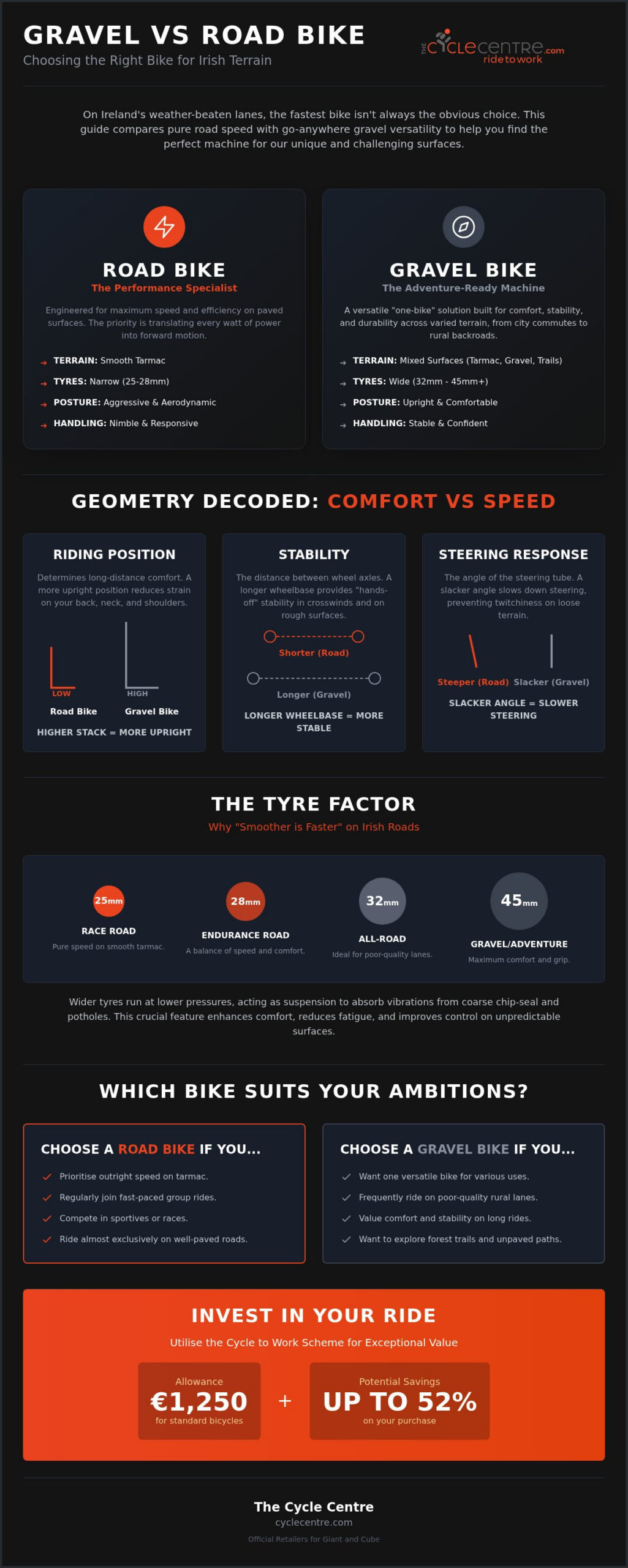
If your goal is to shave seconds off a local climb or stay at the front of a fast-moving club group, the performance road bike remains the gold standard. These machines prioritise lightweight frames and explosive power transfer. They typically utilise narrower tyres, often between 25mm and 28mm, to minimise rolling resistance on smooth tarmac. The geometry is purposefully aggressive. It places the rider in a lower, wind-cheating position, which is a vital advantage during blustery coastal rides where every watt of energy counts.
The Adventure-Ready Gravel Machine
The gravel bike is the ultimate “one-bike” solution for the reality of the Irish national road network. These frames feature massive tyre clearance, often accommodating widths of 45mm or more. This extra volume provides a crucial cushion against potholes and coarse chip-seal surfaces. You will also find lower gearing ratios, which are essential when you are tackling a steep, loose ascent whilst carrying bikepacking gear. These machines are built for durability. The components are often reinforced to withstand the grit and grime of rural lanes. At our Shimano accredited workshop, we frequently see how dedicated gravel groupsets offer the chain retention and braking modulation needed for technical descents in the unpredictable Irish rain.
Geometry Decoded: How Frame Angles Affect Your Comfort
While frame material and componentry often steal the spotlight, the hidden blueprint of a bicycle lies in its geometry. These measurements dictate whether you will finish a long ride feeling invigorated or plagued by lower back pain. When evaluating a gravel bike vs road bike Ireland riders must consider how these angles interact with our specific environment, from the gusty Atlantic crosswinds to the twisting lanes of the midlands.
The fundamental differences in gravel vs road bike geometry centre on balancing aerodynamic efficiency with long-distance stability. Understanding these numbers allows you to choose a machine that complements your physical flexibility rather than working against it.
Postural Comfort: Race vs Endurance vs Gravel
The most critical measurements for your comfort are stack and reach. Stack is the vertical distance from the bottom bracket to the top of the head tube. A gravel bike typically features a higher stack, which brings the handlebars closer to the rider and higher up. This upright position reduces the strain on your neck and shoulders, making it much easier to stay in the saddle for several hours. Conversely, a performance road bike has a lower stack to tuck you into a wind-cheating profile.
Reach determines how far you must stretch to grab the hoods. A shorter reach, common on gravel and endurance road frames, allows for better lung expansion and more comfortable power production. If you find yourself constantly reaching too far, your core muscles will fatigue prematurely, leading to that all-too-familiar ache between the shoulder blades.
Handling the National Terrain
Stability is another area where these categories diverge. Gravel bikes utilise a longer wheelbase, which is the distance between the front and rear axles. This design provides “hands-off” stability, which is incredibly helpful when you are hit by a sudden side-wind or when riding over loose, vibrating surfaces. A road bike’s shorter wheelbase makes it feel “twitchy” and nimble, which is perfect for rapid direction changes in a tight peloton but can feel nervous on a potholed backroad.
Head tube angles also play a role. A “slacker” angle on a gravel bike leads to predictable, slow steering that helps you maintain your line on rougher tracks. When combined with a lower bottom bracket drop, which lowers your centre of gravity, you gain immense confidence during steep, technical descents. You can use our Smart-bike Search tool to filter through our Giant and Cube models based on these specific comfort-focused measurements.
The Comfort Factor: Why “Smoother is Faster” in Ireland
Irish roads are rarely as smooth as the velodromes or alpine passes seen on television. The coarse chip-seal surfaces found across the country create high-frequency vibration, often called “road chatter”, which does more than just cause discomfort. In the debate of gravel bike vs road bike Ireland riders often overlook the science of impedance. When your bike vibrates excessively, your body absorbs that kinetic energy. This leads to premature muscle fatigue and a measurable loss in power. Smoother is indeed faster because it preserves your energy for the pedals rather than wasting it on dampening road buzz.
A detailed look at the comfort and handling differences reveals that tyre volume is often the most significant factor in real-world speed. Whilst a rock-hard, narrow tyre might feel fast on a pristine track, it will skip and bounce over the uneven tarmac of a typical Irish boreen. This lack of constant contact reduces grip and increases rolling resistance, proving that a slightly wider, softer setup is more efficient for our national terrain.
Tyres: The Ultimate Performance Upgrade
The transition to wider tyres is the most notable trend for 2026. For many Irish road riders, 32mm tyres have become the new standard, effectively bridging the gap between pure racing and gravel. These larger volumes allow you to run lower air pressures without the risk of “snake-bite” punctures. We strongly recommend moving to a tubeless setup for rural lanes. By removing the inner tube and using liquid sealant, you can virtually eliminate the anxiety of small flint or thorn punctures. This setup allows the tyre to deform around road imperfections, maintaining momentum where a traditional road bike would struggle.
Vibration Damping Technologies
Modern engineering from brands like Giant and Cube focuses heavily on frame compliance. This isn’t about making a frame “soft” or “slow”; it’s about engineering flex into specific areas, such as the carbon fibre layup of the seatstays and fork. These frames are designed to flex vertically to absorb impact whilst remaining laterally stiff to ensure every ounce of your power goes into the drivetrain. Proprietary components, such as D-shaped seatposts and specialised handlebars, further filter out high-frequency vibrations before they reach your contact points. This ergonomic focus ensures that your endurance remains high, even when the road surface deteriorates, allowing you to stay in the saddle longer and finish your ride with less physical strain.
The Decision Matrix: Which Bike Suits Your Ambitions?
Deciding on your next purchase requires an honest appraisal of where you actually ride, not just where you wish you rode. In the debate over a gravel bike vs road bike Ireland offers such diverse conditions that the answer often depends on your specific mission. Are you aiming for a sub-four-hour century in a summer sportive? Or is your priority a reliable, year-round machine that can handle the Monday morning commute through standing water and grit? Your long-term cycling goals should be the primary driver of your investment.
The “N+1” rule suggests you always need one more bike, but modern engineering offers a practical loophole. Many Irish riders now use a gravel bike as their primary machine, keeping a second set of wheels shod with 28mm road tyres for club outings. This allows you to swap from a rugged adventure bike to a capable road machine in minutes. However, if you spend the vast majority of your time on tarmac, an endurance road bike is often the “Goldilocks” choice. It provides the upright comfort of a gravel frame without the slight weight penalty of off-road components.
Choose a Road Bike If…
- You prioritise speed: You want a light, “snappy” bike that responds instantly to every pedal stroke during climbs.
- You ride in a peloton: Your main goal is participating in club races or fast-paced group sportives.
- Your routes are predictable: You mostly stick to well-surfaced primary and secondary roads where rolling resistance is the main enemy.
Choose a Gravel Bike If…
- You value freedom: You want the ability to transition from tarmac to forest tracks and greenways without hesitation.
- You are a year-round commuter: You need a versatile frame that easily accommodates full-length mudguards, pannier racks, and wider winter tyres.
- Stability is paramount: You prefer a bike that feels composed amongst heavy crosswinds and provides confidence on loose, unpredictable surfaces.
Ready to find your perfect match? Use our Smart-bike Search tool to filter through our Giant and Cube ranges by category and geometry.
Investing in Your Ride with The Cycle Centre
Finding the right balance in the gravel bike vs road bike Ireland debate is only the beginning of your journey. Once you’ve identified the ideal frame geometry and tyre clearance for your specific routes, the focus shifts to making a smart financial investment and ensuring your machine survives the Irish elements. We’ve been supporting the national cycling community since 1974. Our experience shows that a well-chosen bike, backed by professional maintenance, offers a significantly higher return on enjoyment and reliability.
Selecting a bike involves more than just picking a category. It’s about finding a partner for your weekend adventures. You can use our Smart-bike Search tool to filter through our extensive inventory of Giant and Cube models. This allows you to narrow down your search by the specific geometry metrics we discussed earlier, ensuring your new road or gravel machine matches your physical flexibility and performance goals.
Tax-Free Performance: The Cycle to Work Scheme
The most effective way to secure a premium performance bicycle is by utilising the Cycle to Work scheme Ireland. In 2026, the scheme remains a powerful incentive, allowing employees to save up to 52% on the total cost of a new bicycle and essential safety equipment through salary sacrifice. For standard road and gravel bikes, the tax-free threshold is currently €1,250. This can be applied once every four tax years. If you last utilised the scheme in 2022, you’re eligible to refresh your ride from January 1, 2026.
Applying for a no-obligation quote is a straightforward process. We specialise in these applications, ensuring you receive the correct documentation for your employer. Buying through a specialist retailer ensures you don’t just get a bike that fits the budget, but one that is perfectly sized and specced for your needs. We take the friction out of the administrative process, moving you from uncertainty to informed confidence.
Specialist Maintenance for National Riders
The Irish climate is notoriously tough on high-performance drivetrains. Constant exposure to rain, road salt, and grit from rural lanes can quickly degrade expensive components. Our Shimano accredited workshop provides the expert care required for modern hydraulic brakes and electronic shifting systems. We offer tailored Workshop Silver and Gold Service packages designed to keep your bike running like new, regardless of the mileage you cover.
Longevity is built on the quality of the initial build. When you order from us, we provide national delivery across Ireland. Every bike undergoes a rigorous assembly and safety check by our professional mechanics before it leaves our centre. This means your bike arrives at your door expertly tuned and ready for its first spin on the local lanes. Whether you’ve chosen a lightweight road specialist or a rugged gravel adventurer, we’re here to facilitate every stage of your cycling experience.
Ready for Your Next Irish Adventure?
Choosing between a gravel bike vs road bike Ireland involves balancing your need for aerodynamic speed with the reality of our national road surfaces. Whether you opt for the “go-anywhere” stability of a gravel machine or the lightweight response of a road specialist, prioritising frame geometry and tyre volume will ensure your comfort over long distances. We’ve seen how the right technical choices can transform a difficult commute into an inspiring journey across our beautiful landscape.
With over 50 years of independent cycling expertise, our team is here to help you find the perfect match. As official retailers for Giant and Cube, we provide national delivery and the peace of mind that comes with a Shimano Accredited Workshop. We don’t just sell bikes; we facilitate experiences that last for decades. Our heritage is built on providing reliable, professional guidance to riders of all levels.
Apply for a no-obligation Cycle to Work quote on your dream road or gravel bike today. It’s time to rediscover the freedom of the open road with a bike built for the unique challenges of the Irish terrain.
Frequently Asked Questions
Is a gravel bike significantly slower than a road bike on tarmac?
A gravel bike is typically 2 to 4 km/h slower than a dedicated road machine on perfectly smooth surfaces. This speed gap is primarily due to the increased rolling resistance of wider tyres and a more upright aerodynamic profile. However, on the rough chip-seal common across the national road network, the increased vibration damping of a gravel bike can actually help you maintain a more consistent pace by reducing physical fatigue over long distances.
Can I use a gravel bike for a charity sportive in Ireland?
You can certainly use a gravel bike for any Irish charity sportive or club leisure cycle. In fact, many riders find them preferable for long-distance events like the Ring of Kerry or local 100km loops. The stable geometry and wider tyres provide a much more forgiving ride on weather-worn surfaces, allowing you to focus on the experience rather than dodging every minor pothole or road imperfection you encounter along the route.
What is the most important geometry measurement for comfort?
Stack and reach are the most critical measurements for ensuring long-term comfort. Stack defines the vertical distance from the bottom bracket to the head tube, and a higher value generally results in a more relaxed, upright riding position. This reduces strain on your lower back and neck. When comparing a gravel bike vs road bike Ireland riders should prioritise a stack height that matches their natural flexibility to avoid injury during high-mileage weeks.
Do I need a gravel bike for Irish backroads, or is an endurance road bike enough?
An endurance road bike with 32mm tyres is often sufficient for most paved Irish backroads. However, if your routes frequently include greenways, forest tracks, or extremely broken “boreens”, a gravel bike offers a significant safety margin. The wider tyre clearance and lower gearing found on gravel models provide the necessary grip and control for loose surfaces that would likely cause a standard road bike to struggle or suffer frequent punctures.
Can I fit mudguards and a rack to a performance road bike?
Most pure performance road bikes do not have the necessary eyelets for traditional full-length mudguards or pannier racks. These frames are engineered for minimal weight and maximum speed. If you require a versatile machine for commuting or winter training, a gravel or endurance road bike is a much better choice. These categories almost always include dedicated mounting points, allowing you to stay dry and carry gear without using awkward clip-on alternatives.
How much can I save on a gravel bike using the Cycle to Work scheme?
You can save up to 52% on the total cost of a new gravel bike and essential accessories through the 2026 Cycle to Work scheme. This saving is achieved through Income Tax, PRSI, and USC relief on a maximum threshold of €1,250 for standard bicycles. We specialise in these applications and can provide a no-obligation quote for premium Giant or Cube models, helping you maximise your budget for a high-performance machine that lasts.
Are gravel bikes more expensive to maintain than road bikes?
Maintaining a gravel bike isn’t inherently more expensive, but the components often face harsher conditions. Riding on grit and mud accelerates wear on the chain, cassette, and brake pads. To ensure longevity, we recommend regular professional servicing. Our Shimano accredited workshop offers specialised Silver and Gold packages that are essential for keeping hydraulic disc brakes and modern drivetrains performing reliably in the challenging and often damp Irish climate throughout the year.
What tyre width is best for a mix of Irish road and light gravel?
A tyre width between 35mm and 40mm is the ideal “sweet spot” for a mix of Irish road and light gravel paths. This volume is wide enough to provide excellent comfort and traction on unpaved greenways, yet narrow enough to remain relatively efficient on the tarmac. For those sticking primarily to the road but wanting extra security against potholes, a 32mm tubeless setup is often the most effective compromise for speed and reliability.