

What if an e-bike could help you stay with the group without taking the ride out of your hands? If you’re worried about being dropped on a climb or into a headwind, keeping up with faster cyclists using an e-bike can feel like a balancing act: you want support, but not at the expense of your own effort or the group’s rhythm.
Those concerns are understandable. Assistance can help bridge a gap in pace, but how you use it matters. Smooth, measured support is easier to manage than sudden bursts, while thoughtful pacing can help you avoid using too much battery early in the ride.
This guide explains how to use assistance on climbs and exposed roads, manage your effort and battery use, and ride considerately with unassisted cyclists. You’ll also learn what to consider when choosing between an E-Road bike and an E-MTB, and how to match your support to the ride. With a little planning, an e-bike can help you share more miles with your cycling friends while still making the ride your own.
Key Takeaways
- Pedal assistance can help bridge differences in effort, but group pace, terrain, wind and fitness all affect how well you keep up.
- For keeping up with faster cyclists using an e-bike, choose a support level that suits the effort instead of relying on maximum assistance.
- Agree how the group will handle climbs, changes of pace and regrouping points so everyone knows what to expect.
- Plan the route, distance, elevation and expected pace together, then check your bike before setting off.
- Choose between an E-Road bike and an E-MTB based on the terrain and type of group ride you want to join.
Can an E-Bike Help You Keep Up with Faster Cyclists? Set Realistic Expectations
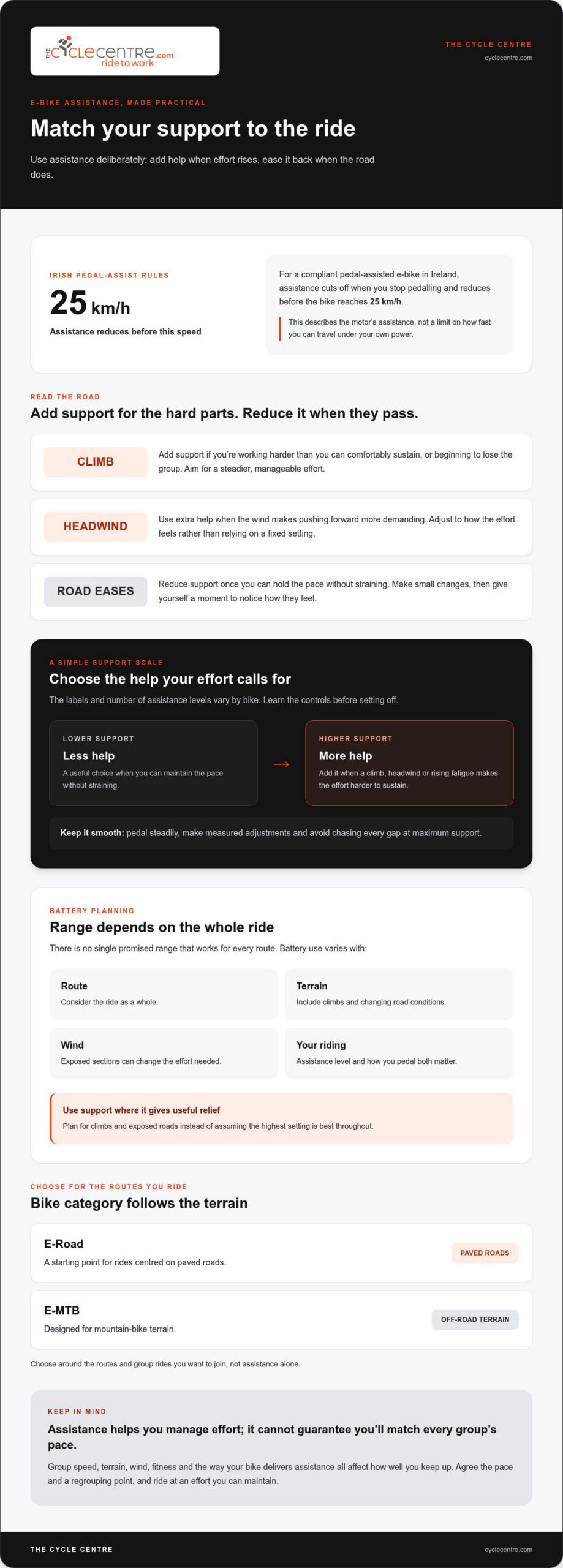
Yes, assistance can help bridge differences in effort, but it can’t guarantee that you’ll match every group’s pace. The outcome depends on how quickly the group rides, the terrain, wind, your fitness and how your bike delivers assistance. Keeping up with faster cyclists using an e-bike is most realistic when the aim is to enjoy the ride alongside friends, not to race them or stay at the front throughout.
It helps to understand what the motor does. Pedal assistance supports your pedalling; it doesn’t replace your contribution. You still turn the pedals and decide how much effort to put in. The electric bicycle overview explains the broad distinction between pedal-assisted and other electric bicycle types.
Where an e-bike can make a noticeable difference
Assistance can make demanding sections feel more manageable. On a climb, it may help you maintain a steadier effort. Into a headwind, it can reduce some of the strain of pushing forward. Over a longer ride, support may also help you conserve energy for later sections. The benefit varies with the bike, its assistance characteristics and the conditions, so treat it as help with effort rather than a guaranteed speed advantage.
Imagine the group reaches a rise after riding on level roads. You can increase support to make the climb feel more comfortable, then reduce it once the road levels out. You’re still working, but you have more choice over how hard you work at that moment. That flexibility can make riding with friends more enjoyable, especially if hills or wind would otherwise make it difficult to stay with them.
When assistance may not close the pace gap
Motor support has limits. If a group rides at a consistently brisk pace, spends long periods at the front or accelerates sharply between climbs, the gap may remain challenging. Riders also differ in fitness, experience and how they respond to changing terrain. An e-bike can ease specific demands, but it can’t guarantee that every rider will arrive at the same pace or find the same effort comfortable.
Assistance also depends on the bike’s design and the rules that apply to it. In Ireland, a compliant pedal-assisted e-bike has assistance that cuts off when you stop pedalling and reduces before the bike reaches 25 km/h. This describes the motor’s assistance, not a limit on how fast the bicycle can travel under your own power. For more on the Irish requirements, see the electric bike laws in Ireland guide.
Set expectations before the ride: assistance can help you manage climbs, wind and effort, but the group’s pace still matters. A shared ride is often more satisfying than trying to prove you can match every surge.
How to Use E-Bike Assistance Without Burning Through Your Effort
Good assistance management means choosing support deliberately, not leaving the motor at its strongest setting for the whole ride. A lower level generally provides less help, while a higher one adds more support as you pedal. The labels, number of levels and way you change them vary between bikes, so learn the controls before setting off. Practise adjusting them without taking your attention away from the road or the group.
The best support level is the one that helps you sustain a comfortable, controllable effort. It may change several times during a ride. For keeping up with faster cyclists using an e-bike, adapt assistance to the road and your energy rather than relying on one fixed setting.
Choose support for the terrain and your effort
On a climb or into a headwind, add support if you’re working harder than you can comfortably sustain or beginning to lose the group. Once the road eases and you can hold the pace without straining, reduce it. There’s no universal setting for a particular hill: your effort, the wind and the group’s speed all matter. Make small adjustments, then give yourself a moment to notice how they feel.
Stay aware of what’s happening around you as you adjust. A change in terrain or rising fatigue may call for more help, but avoid looking down at the controls for too long or making a sudden effort to close a gap. If you’re repeatedly struggling, talk to the group about the agreed pace. Assistance isn’t a substitute for clear communication.
Keep your own effort and battery use in view
Try to pedal steadily rather than easing off completely and then surging to catch the group. A smooth, manageable effort can make it easier to ride consistently and leave you better placed to respond when the road changes. If the group moves away, avoid chasing every gap at maximum support. Settle into an effort you can maintain, and use a regrouping point if one has been agreed.
Battery use varies with factors such as the route, terrain, wind, assistance level and how you pedal. That makes a single promised range unhelpful for planning every ride. Consider the route as a whole, including climbs and exposed sections. Use support where it gives you the most useful relief rather than assuming the highest setting is best throughout.
Your intended riding should also guide the bike category. An E-Road bike may suit rides centred on paved roads, while an E-MTB is designed for mountain-bike terrain. Choosing a category around the routes and group rides you want to join gives you a more relevant starting point than focusing on assistance alone. Explore E-Road and E-MTB options with those riding plans in mind.
How to Ride with Faster Cyclists: Pace, Climbing and Group Etiquette
The simplest group-ride principle is this: join the pace everyone has agreed, rather than assuming the group will change its ride around your e-bike. That applies whether you’re riding with electric or unassisted bikes. Assistance can make some sections feel easier, but considerate behaviour, communication and shared expectations are what keep the ride enjoyable for everyone.
Using an e-bike isn’t inherently unfair. The aim isn’t to use the motor to reach every summit first or prove you can match each surge. It’s to ride safely and comfortably as part of the group. If you can hold the agreed effort, there’s no need to hide the fact that you’re on an e-bike or apologise for it.
Handle climbs, descents and regrouping considerately
Before a climb or longer stretch, agree where the group will regroup. That gives everyone a clear plan and avoids treating the first rider at the top as the one who sets the pace. On descents, keep a safe gap and ride within your control. Don’t use extra assistance to rush ahead or make a sudden move to close distance.
- Helpful: follow the group’s climbing pace, then wait at the agreed regrouping point.
- Unhelpful: surge ahead on the climb and expect others to chase, or sprint after a gap without checking what’s happening around you.
A faster climb doesn’t mean the ride needs to speed up. If the group naturally spreads out, keep a steady effort and let the agreed regrouping plan do its job.
Talk about the ride before setting off
A brief conversation beforehand can prevent awkwardness later. Be open about your bike and ask what the group has in mind, without assuming that everyone has the same definition of a comfortable pace. A mixed group can include different fitness levels, experience and bike types, so a shared plan matters more than the motor someone is riding.
- Agree the planned distance, terrain and general pace, including whether the route has sustained climbs or exposed sections.
- Choose regrouping points together, particularly after hills or longer stretches where riders may become separated.
- Decide how you’ll handle a mechanical stop or a rider falling behind, so nobody has to guess whether to continue or wait.
If the pace feels harder than expected, say so early and calmly. The group can use its agreed plan, adjust the pace if everyone is happy to, or arrange to regroup at a suitable point. Clear communication is more useful than silently pushing beyond a sustainable effort or repeatedly accelerating to catch up.
Good group etiquette isn’t about whether assistance is being used. It’s about riding predictably, respecting the shared pace and making sure everyone knows what to expect. That’s what makes keeping up with faster cyclists using an e-bike feel like a shared ride, not a contest.
Plan a Group Ride with an E-Bike: A Practical Pre-Ride Checklist
A little planning can make a mixed-pace ride feel relaxed before anyone turns a pedal. Agree the important details as a group, then check your bike and kit with the route in mind. That way, you’re less likely to discover halfway along that the planned climb, pace or battery state doesn’t suit the day.
Agree a route and ride expectations
Talk through the route together, including its length, elevation and likely pace. A short ride with a few steep climbs can ask more of you than a longer route on easier roads, so distance alone doesn’t tell the whole story. Raise concerns before setting off, while the group can still agree a suitable plan.
Prepare the e-bike and yourself
Once the ride plan is clear, check that your bike and clothing are ready for both riding and stops. Battery use varies with assistance, rider input, route and conditions, so don’t treat a displayed or expected range as a guarantee. The aim is to set off prepared, not to rely on one figure.
- Agree the route and ride length. Make sure everyone knows the planned roads or trails, approximate distance and any likely detours. Consider whether the terrain suits the group’s mix of bikes and experience.
- Discuss elevation and effort. Identify longer climbs, exposed stretches and other sections that could affect pace or energy. Share concerns now rather than waiting until the group is stretched out.
- Set expectations for pace and regrouping. Talk about the intended effort and choose sensible places to wait, such as after a climb or at a planned stop. Agree how you’ll handle a rider falling behind or a mechanical issue.
- Check the battery state. Start with enough charge for the ride you’ve agreed, allowing for the route and conditions. Hills, wind and your choice of assistance can all influence battery use, so avoid planning around a guaranteed distance.
- Inspect the bike and essentials. Check the tyres and brakes, and make sure your helmet, water and anything else you need for the ride are ready. If a fault needs attention, deal with it before departure rather than hoping it won’t matter on the road.
- Dress for riding and pauses. Effort can change as the route rises or eases, and you may cool down when the group stops. Adjustable layers help you adapt; the cycling apparel guide offers further guidance on clothing for changing effort and stops.
A checklist won’t set the pace for you, but it can make keeping up with faster cyclists using an e-bike more comfortable by helping the group start with shared expectations. For guidance on an e-bike suited to your planned rides, explore e-bike options.
Choose an E-Bike and Specialist Support for Riding with Faster Cyclists
The right e-bike category depends less on the pace you hope to match and more on the rides you want to join. Think about the surfaces your group uses, the terrain you enjoy and the routes you’re most likely to ride. A suitable bike won’t guarantee that you’ll keep up with every rider, but choosing a category that fits your plans gives you a practical starting point for keeping up with faster cyclists using an e-bike.
Match the e-bike category to the rides you want to join
For group rides centred on paved roads, an E-Road bike is a category to consider. If your plans involve mountain-bike routes and off-road riding, look at an E-MTB. These categories suit different riding contexts, so focus on where you’ll ride rather than assuming one will automatically make you faster or suit every route.
Other options may fit different plans. An E-City bike is worth considering for urban journeys, while a gravel or adventure bike may suit rides that include varied surfaces. If your group changes its routes from ride to ride, list the terrain you’ll encounter most often and use that to guide your choice. Consider whether the bike’s intended riding context aligns with how the group actually spends its time together.
A useful starting point is to ask yourself:
- Will most rides be on paved roads, mountain-bike trails, urban streets or a mix of surfaces?
- What kind of ride do you want to join regularly, rather than only occasionally?
- Does the category suit the routes you enjoy, as well as the group’s plans?
These questions help keep the decision grounded in your real riding. Assistance can support your effort, but choosing a bike for the wrong terrain won’t make a ride feel like the right fit.
Why specialist e-bike knowledge can support your riding
Motor systems and the needs of road and electric bikes make specialist knowledge useful when choosing or maintaining a bike for group riding. The Cycle Centre’s Shimano accredited workshop provides specialist servicing for Road and E-bikes, with expertise across Bosch, Shimano, Yamaha and Bafang motor systems. That knowledge is relevant to the bike itself, not a promise that assistance will erase differences in fitness, terrain or group pace.
When considering an e-bike, look at the category and intended use first, then factor in the support and maintenance that will help you ride with confidence. A bike should make sense for the routes you want to explore, whether those are road-focused group rides or off-road outings. Keeping your riding plans at the centre of the decision can help narrow the options without chasing a particular speed or performance claim.
Explore e-bikes and specialist support at your own pace, and consider which category best fits the rides you want to share.
Make Your Next Group Ride Your Own
Your next ride doesn’t have to be a test of whether you can match every turn of speed. Treat it as a chance to find a comfortable rhythm with the group, learn how your assistance feels on different sections and enjoy time on the bike. A ride that leaves room to talk and regroup can be just as rewarding as one focused on pace.
As you plan future outings, notice which routes bring you the most enjoyment and what kind of support helps you feel in control. Those observations can guide your next step, whether that’s refining your ride routine or considering an e-bike suited to your plans. Keeping up with faster cyclists using an e-bike is about making shared rides more achievable, not turning every outing into a race.
Explore e-bikes and specialist support as you plan where you’d like to ride next. With a considered approach, there’s more room to enjoy the company, the route and the ride ahead.
Frequently Asked Questions
Can an e-bike keep up with faster road cyclists?
It can help you stay with a group on demanding sections, but it can’t guarantee that you’ll find every pace manageable. For keeping up with faster cyclists using an e-bike, consider how the group rides between climbs too: a steady tempo, frequent accelerations and long stretches at the front place different demands on you. If you’re new to the group, try a shorter ride first and see how its pace feels.
Will riding an e-bike with non-electric cyclists feel unfair?
Not necessarily. A mixed-bike ride can work well when everyone understands the plan and rides considerately. For instance, agree that the group will pause at a particular junction or after a climb, rather than treating whoever arrives first as the pace-setter. Be open about using an e-bike, ride predictably and avoid repeatedly accelerating away. That keeps attention on sharing the route, not comparing equipment or effort.
Do you still get exercise when riding an e-bike with a faster group?
Yes. You still pedal, and you can choose how much effort to contribute alongside the motor’s support. For example, you might pedal more strongly on a level stretch and use assistance to make a steep section feel manageable. Your workload will vary with your own input, support level and route, so an e-bike ride won’t necessarily feel like the same workout every time.
How should I use e-bike assistance on hills when riding with friends?
Use enough support to keep your effort controlled, rather than treating the climb as a race to the top. If the group plans to wait at a safe stopping point, follow that arrangement instead of pushing ahead to arrive first. Before riding, practise adjusting your own bike’s assistance so you can do it confidently. Controls and labels differ, so avoid assuming another rider’s settings will match yours.
Can an e-bike ride with a group drain its battery faster?
Not in a predictable way simply because you’re riding with a group. Battery use is affected by factors such as terrain, conditions, assistance and how much you pedal. Before leaving, check the charge and consider whether the route includes climbs or exposed sections. Use your bike’s own battery information as a planning aid, but don’t treat any displayed range as a guarantee for the whole ride.
Which e-bike is suitable for keeping up with road cyclists?
For rides mainly on roads, an E-Road bike may be a suitable category to explore; for mountain-bike routes, an E-MTB is designed for that off-road context. The group’s usual terrain is a better guide than assuming one type will suit every rider. The Cycle Centre’s specialist technicians work on Road and E-bikes, with motor expertise covering Bosch, Shimano, Yamaha and Bafang systems.
Is it acceptable to ride an e-bike on a group ride in Ireland?
Yes, provided the ride suits the group and your e-bike complies with the rules that apply to it. In Ireland, a compliant pedal-assisted e-bike has a motor of no more than 250 watts continuous power, assists only whilst you pedal and cuts assistance before 25 km/h. Electrically assisted bikes outside these criteria may be treated differently. Read the electric bike laws in Ireland guide for further detail.