

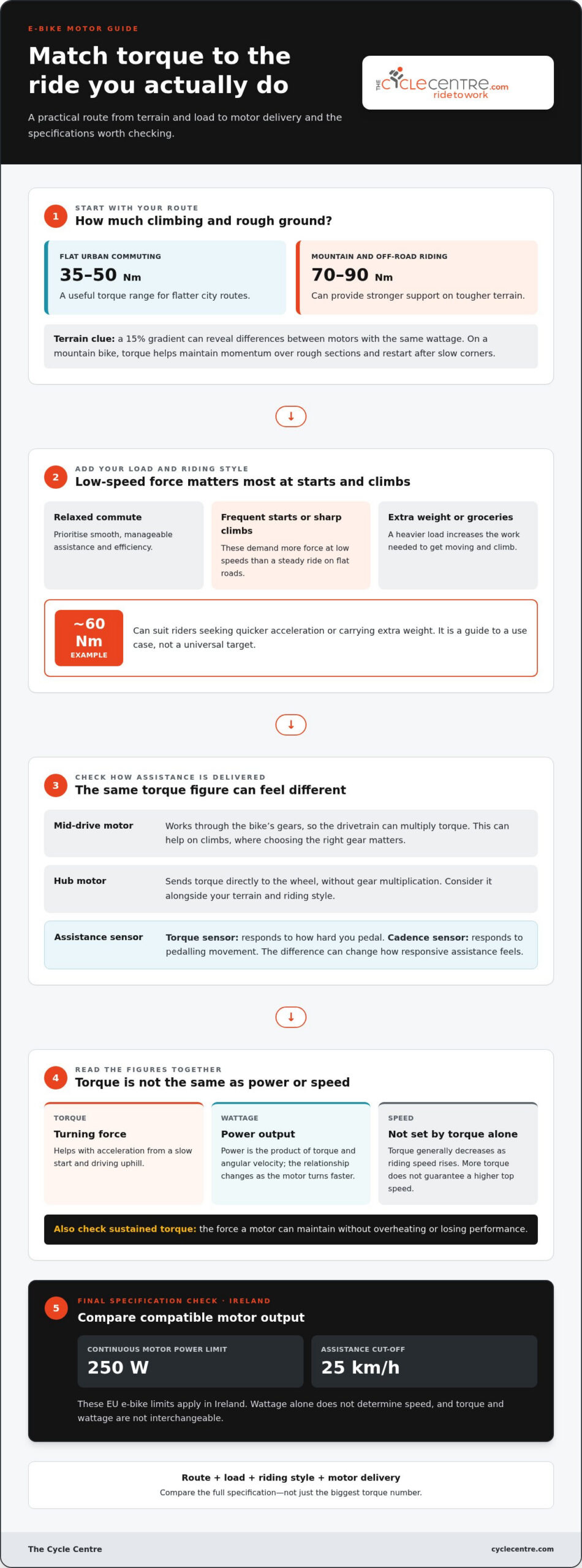
For flat urban commuting, 35-50 Nm is a useful torque range; for mountain and off-road riding, 70-90 Nm can provide stronger support. Understanding e-bike motor torque helps you choose assistance that suits your routes, loads and riding style, rather than relying on a bigger number alone.
It’s easy to assume that more wattage or torque automatically means a faster, better ride. In practice, torque affects the force available when starting and climbing, while wattage describes the motor’s power output. Together, they shape how an e-bike feels on the road.
This guide explains what torque measures, how riding needs vary, and how torque and wattage influence acceleration, climbing and speed. It also covers why hills, carried loads and motor type matter when comparing electric bikes in Ireland.
Key Takeaways
- Match motor torque to your usual terrain, load and riding style rather than choosing the highest rating by default.
- Torque describes turning force, while wattage and angular velocity help explain how motor power changes with speed.
- Compare how a bike delivers assistance as well as its torque rating, especially when you want smooth starts and steady climbing.
- Use the differences between commuter, mountain and cargo bike ratings to narrow down which type best suits your rides.
Power vs torque, what matters when?
Torque describes turning force; wattage describes power output. Your route, load and preferred riding style determine which specification matters most.
Matching torque to riding conditions
Torque choice should reflect terrain and load: gentle urban routes need less climbing force than steep trails or a heavily loaded bicycle. Riders tackling off-road terrain or regular climbs with belongings may benefit from choosing a motor with more torque, depending on the terrain and load. A 15% gradient can reveal differences between motors with the same wattage. On a mountain bike, torque helps maintain momentum over rough sections and restart after slow corners.
Choosing wattage for load and riding conditions
Wattage describes motor power, so consider how much assistance your riding conditions demand. A rider mainly using flat roads may manage with moderate wattage, whilst frequent hills or extra weight can call for stronger output. Higher-wattage hub motors generally provide more power, but use more energy and cost more. In Ireland, EU e-bike rules set a 250 W continuous-power limit and assistance cut-off at 25 km/h, so compare compatible specifications rather than assuming wattage alone sets speed.
Matching torque to riding style
Your riding style affects how noticeable torque feels. Frequent starts, sharp climbs and carrying groceries all place greater demands on low-speed force than a steady ride on flat roads. Around 60 Nm can suit riders seeking quicker acceleration or carrying extra weight. For a relaxed commute, prioritise smooth, manageable assistance and efficiency; for steep routes, stronger torque can make starts and climbs feel less demanding.
Choosing a motor type for different rides
Motor position affects how torque reaches the wheel. A mid-drive motor works through the bike’s gears, so the drivetrain can multiply torque. This can help on climbs, where choosing the right gear matters. A hub motor sends torque directly to the wheel, without this gear multiplication. Consider your usual terrain and riding style: gear-assisted delivery may suit varied climbs, while direct delivery may suit simpler, steady routes. Compare the full specification, not just the torque figure.
What is electric bike torque, and how much do I need?
Torque is the rotational force an electric bike motor produces, measured in newton metres (Nm). The right amount depends on your route, load and riding style; for city commuting on gentle roads, around 40 Nm can be sufficient, while steep climbs call for more support.
Torque and power describe different things. Power output is the product of torque and angular velocity. As the motor turns faster, the relationship between torque and power changes, and torque generally decreases as riding speed rises. That is why a higher torque rating can help at low speeds without guaranteeing a higher top speed. Sustained torque matters too: it describes the force a motor can maintain without overheating or losing performance.
In Ireland, EU e-bike rules limit continuous motor power to 250 W, with assistance cutting off when the bicycle reaches 25 km/h. Japan also applies a 250 W continuous-power limit and 25 km/h assisted-speed maximum. These limits shape the motor’s permitted output; they don’t make torque and wattage interchangeable.
Rules differ elsewhere. Canada permits 500 W continuous motor power and a maximum speed of 32 km/h. Australia’s limits vary by state, ranging from 250-500 W and 25-32 km/h. These are comparisons, not the rules for riding an e-bike in Ireland.
Can higher e-bike motor torque reduce battery range or increase wear? Higher torque can use more battery energy and generate more heat, especially under prolonged heavy load. Avoid keeping a hub motor under high load for long periods, and don’t leave the battery at low power for an extended time.
A torque sensor measures how hard you pedal and adjusts assistance in proportion to that force. A cadence sensor responds to pedalling movement instead, so assistance follows the act of turning the pedals rather than the pressure applied. That distinction can change how responsive support feels during a ride. Compare electric bike specifications with your usual routes and preferred assistance.
How wattage affects speed, acceleration and climbing
Wattage describes motor power, while torque contributes to the force available at the wheel. Their balance affects acceleration and climbing, but neither figure alone determines maximum speed.
Wattage, speed and acceleration
Wattage indicates how much power a motor can deliver, so it helps explain its output under load. More wattage can support stronger assistance, but it doesn’t automatically mean a higher maximum speed. For example, e-bike assistance in Ireland cuts off at 25 km/h under the applicable European rules, regardless of a rider wanting more speed. Moderate wattage may suit flat-road riding; extra power can help when hills or heavier loads demand sustained assistance. Compare the full motor specification, not wattage alone.
Torque for climbing and acceleration
Torque is the turning force that helps a motor accelerate from a slow start and drive the bicycle uphill. A 60 Nm system can suit riders seeking quicker acceleration or carrying extra weight. More torque can help when starting on a slope, where the motor must move the rider and bicycle against gravity. Peak torque describes the maximum momentary force, often available during initial acceleration or a short climb. Sustained climbing also depends on how long the motor can maintain its output.
Torque for heavy loads and varied terrain
The torque you need depends on rider and bike weight, carried load, gradient and surface conditions. A heavier rider or loaded panniers increase the work required, while a steep gradient or loose surface adds further demands. The same load may feel easier to move on flat tarmac than on a rough climb. Riders who often tackle hills or carry loads may prefer a higher-wattage hub motor; moderate wattage may suit mainly flat-road riding. Match the motor’s output to the routes you actually ride.
Torque ratings for mountain, commuter and cargo e-bikes
Torque ratings vary by bike type because terrain, load and riding pace place different demands on the motor. Use the figures as a starting point, then consider whether you need smooth assistance on flat streets or stronger support over steep, uneven ground.
For urban commuting on mostly flat roads, 35-50 Nm is a practical range; European and Japanese commuter guidance also places city models around 40-60 Nm. Riders who want moderate assistance for everyday trips or leisure rides can compare these figures with their route’s gradients and stop-start sections. A smooth response matters too: sensors affect how assistance responds to pedalling, so two models with similar torque can feel different on the road.
Mountain and off-road riding calls for more force over rough surfaces and steep climbs. E-mountain bikes are often equipped with motors rated at 75 Nm or more, while 80 Nm is a useful benchmark for off-road use. Riders who regularly tackle steep terrain can look above 70 Nm, especially when climbs involve loose ground or repeated slow starts. Consider the trails you ride, not just the highest rating available.
Cargo bikes face the added demand of moving both the bicycle and its load. A recommendation of at least 70 Nm gives a useful baseline, whilst cargo models commonly have ratings of 85 Nm and upwards. Family trips or grocery runs with heavier loads may benefit from stronger support on hills, but a flat route places less demand on the motor. Match the rating to how often you carry weight and the gradients along your journey.
Use these ranges to shortlist a bicycle that suits your usual rides. If off-road routes are part of the plan, explore electric mountain bikes and compare their torque specifications with your terrain.
The Cycle Centre: Bike to work
The Cycle Centre’s Bike to work scheme can help you choose an e-bike for commuting. If your regular journey includes hills, extra weight or a mix of roads and paths, use the torque guidance above to identify the support that may suit your ride.
For off-road riding, Electric Mountain Bikes are another option to explore. Consider the terrain you ride most, how much assistance you want on climbs, and whether a smooth commute or trail capability matters more. These practical details can help narrow down the kind of e-bike that fits your plans.
Contact The Cycle Centre to discuss your riding needs and Bike to work.
Choose the ride that fits your next journey
A bike should support the way you want to travel, whether that means making a daily commute more manageable or exploring new routes at the weekend. Understanding e-bike motor torque helps you focus on how a bike’s assistance suits your actual journeys, rather than choosing a specification in isolation.
The Cycle Centre offers Bike to work, Cycle to work and Ride to work, giving you options to explore when considering an electric bike for commuting. Think about the routes you take, the hills you encounter and the kind of riding you want to do next. Those details can help shape a more confident choice.
Take the next step and contact The Cycle Centre to discuss your riding plans. Your next ride could open up a new way to travel.
Frequently Asked Questions
What kind of bikes have lots of torque?
Electric mountain bikes and cargo e-bikes commonly have higher-torque motors, because steep trails and heavier loads need stronger assistance. Mountain models often have 75 Nm or more, while cargo models commonly start around 85 Nm. If your rides rarely involve rough climbs or carrying loads, prioritise how smoothly assistance responds over choosing the highest rating.
How much torque do I need on my ebike?
Choose torque for the most demanding conditions you regularly ride. Around 40 Nm can suit a city bike on flatter routes; frequent steep climbs or off-road trails may call for 70-90 Nm. For a mixed commute, consider the hills, panniers and repeated starts you encounter. This helps narrow the specification to your everyday riding rather than an occasional outing.
What does torque mean in an e-bike motor?
Torque is the turning force a motor applies to help rotate the wheel and move the bike. To understand e-bike motor torque, picture pulling away from a junction: the motor’s force helps get the bike moving. You’ll notice it most at low speeds, such as restarting uphill or riding slowly over a trail obstacle.
How is e-bike motor torque measured in Nm?
Motor torque is measured in newton metres, written as Nm. A newton measures force, while a metre describes the distance from the turning point where that force acts. Together, they express rotational force. Understanding e-bike motor torque also means looking beyond the Nm figure, since the rating alone doesn’t show how assistance feels across different speeds and riding conditions.
What torque range is typical for city, trekking, and cargo e-bikes?
City e-bikes commonly sit around 35-50 Nm for flatter urban journeys, although commuter models span a wider range. For trekking across mixed surfaces, 60-80 Nm is a useful reference. Cargo models commonly reach 85 Nm and upwards. Use these category ranges as a starting point, then account for gradients, carried weight and how often you ride with a full load.
How does motor torque affect hill climbing and acceleration?
More torque can make an e-bike feel more responsive when pulling away and help maintain drive on a climb. You may notice the difference when restarting on a slope or climbing with panniers. Gear choice matters too: on a mid-drive bike, selecting an easier gear helps the drivetrain use the motor’s force effectively.