

Buying a child’s first bicycle is often treated like picking out a new toy, but you are actually purchasing their very first mechanical vehicle. It’s easy to feel overwhelmed by the technical jump from a 12 inch wheel to a 20 inch frame, or to worry that a sudden growth spurt will make your investment obsolete within months. When searching for the best kids bikes Ireland has to offer, the goal isn’t just finding a favourite colour; it’s about ensuring the engineering supports your child’s safety and physical development.
We understand the frustration of trying to decipher complex sizing charts whilst worrying about assembly quality and long-term durability. This guide provides expert insights from Ireland’s cycling specialists to help you select a bicycle that’s safe, easy to pedal, and perfectly proportioned. You’ll discover how to measure your child accurately, understand the transition between wheel sizes, and gain the confidence to choose a high-quality bike that offers a superior riding experience. From legal requirements like bells and lights to the importance of the EN 1078 helmet standard, we’ve covered every detail to ensure your child’s cycling journey starts on the right track.
Key Takeaways
- Learn why the weight of a bicycle is the single most important factor in building your child’s confidence and control on two wheels.
- Understand why height and inseam measurements are more reliable than age when selecting the perfect fit from the range of kids bikes Ireland has available.
- Discover the practical benefits of balance bikes over stabilisers and how to choose a frame style suited for local Irish greenways and forest trails.
- Identify the essential safety features and the importance of a professional Pre-Delivery Inspection (PDI) to ensure every component is mechanically sound.
- Realise the long-term financial benefits of investing in a premium brand with high resale value and the advantage of personalised fitting from a specialist.
What to Consider When Buying Kids’ Bikes in Ireland
Many parents view a first bicycle as a simple toy, but in reality, it’s your child’s first introduction to mechanical transport. When you’re looking at kids bikes Ireland, the sheer variety can be confusing. However, there’s a massive distinction between a “toy” bike found in a department store and a “tool” designed by a specialist manufacturer. A quality bicycle is built to be a scaled-down version of an adult machine, prioritising safety, efficiency, and longevity over bright stickers or plastic accessories.
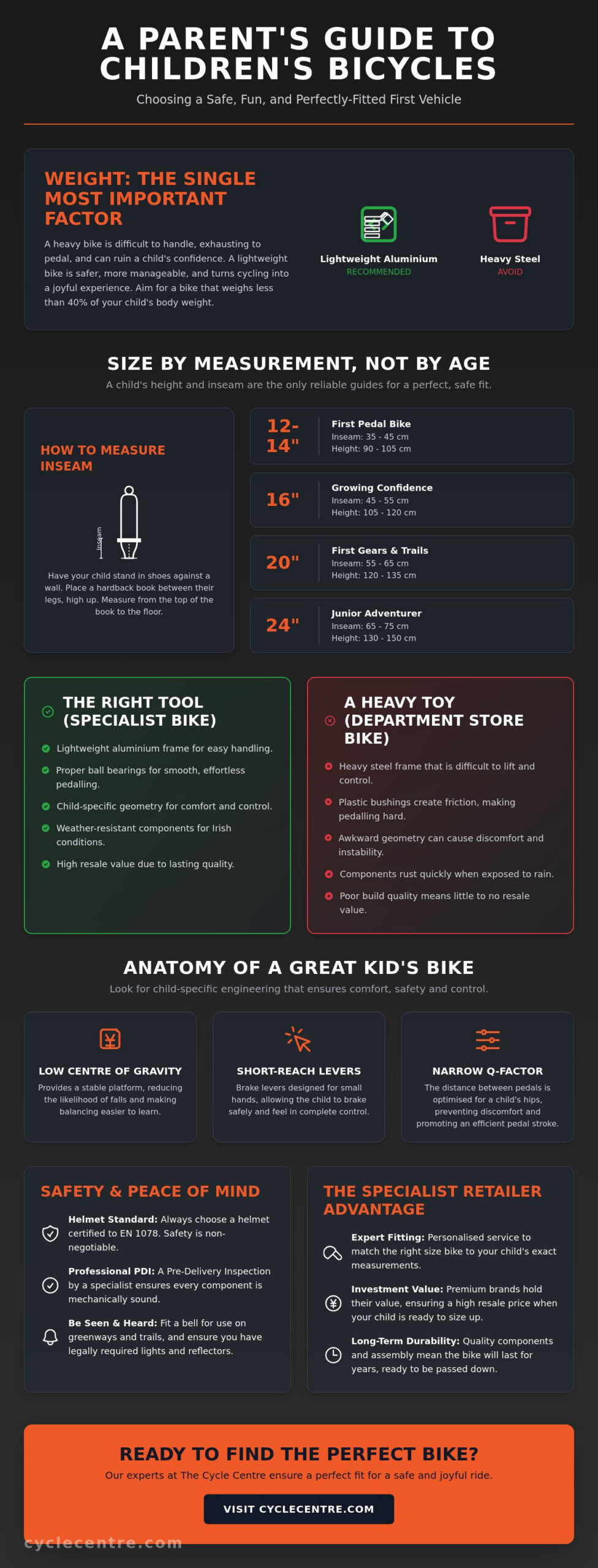
Weight is the single most important factor for a child’s confidence. If a bike is too heavy, it becomes a literal burden. Imagine an adult trying to learn on a machine that weighs half their own body weight; it’s exhausting and makes balancing nearly impossible. Quality junior bikes use lightweight aluminium alloy frames instead of heavy, low-grade steel. This makes the bike easier to manoeuvre, simpler to pedal, and much easier for a child to pick up after a tumble. It turns a potential chore into a joyful experience.
The Irish climate also plays a significant role in your decision. Our frequent rain and damp conditions are the enemies of cheap machinery. Lower-end bikes often use components that rust quickly when exposed to the elements. Specialist bikes are built with weather-resistant finishes and better-quality hardware, ensuring the bike stays in good working order through several Irish winters. This durability isn’t just about the current rider; it’s about maintaining the bike’s resale value or its ability to be passed down to a younger sibling.
The Difference Between a Toy and a Tool
The mechanical guts of a bike determine how much effort it takes to move. Premium brands like Giant and Cube use proper ball bearings in the wheels and pedals, whereas cheaper alternatives often rely on plastic bushings. These bushings create significant friction, making every pedal stroke harder than it needs to be. Understanding different bicycle wheel sizes is also vital, as the right diameter ensures the bike handles predictably on different surfaces. When a bike is easy to pedal, a child is much more likely to want to ride it.
Why Geometry Matters for Young Riders
Ergonomics are vital for small bodies. A well-designed bike features a low centre of gravity, which provides a stable platform and reduces the likelihood of falls. We also pay close attention to the “Q-factor”, which is the distance between the pedals. If the pedals are too far apart, it forces a child’s legs into an unnatural, “duck-like” stance that can cause hip discomfort. Finally, short-reach brake levers are non-negotiable. If a child’s small hands can’t easily reach and pull the brakes, they’ll never feel truly in control of their vehicle.
This commitment to physical health should extend beyond the saddle; just as a bike must fit a child’s proportions, their indoor environment should also be supportive. For parents wanting to maintain this ergonomic standard at home, EKOBOR provides height-adjustable desks designed to grow with your child, ensuring they maintain proper posture during study and creative activities.
The Essential Kids’ Bike Size Guide: Matching Height to Wheel Size
Many high-street retailers group bicycles by age, but children grow at vastly different rates. Relying on age alone is a common mistake when browsing for kids bikes Ireland. A child who is tall for their age will struggle on a bike that is technically “correct” for their year, whilst a smaller child might feel intimidated by a frame that’s too large. At our shop, we advocate for height and inseam as the only definitive metrics for a safe fit. A well-fitted bike allows a child to touch the ground with their feet whilst seated, providing the confidence they need to stop safely.
To measure your child’s inseam at home, have them stand against a wall in their usual cycling shoes. Place a hardcover book between their legs, tucked up to the crotch as if it were a saddle. Measure the distance from the top of the book to the floor. This measurement is more important than total height because it determines “stand-over height”. There should be at least 2 to 5cm of clearance between the child and the top tube of the frame when they stand over the bike. This gap ensures they can hop off the saddle quickly without injury. For a deeper dive into these technicalities, you can read more on how to size a bike for a kid to understand the nuances of frame geometry.
Wheel Size Breakdown: From 12 to 26 Inches
Unlike adult bikes, which are sized by the frame, junior bikes are categorised by wheel diameter. The 12 to 14 inch range represents the “first pedal bike” stage, usually following a balance bike. Once a child reaches approximately 105cm to 120cm, they typically move into 16 or 20 inch wheels. This is a significant milestone where we introduce hand-operated brakes and, in the 20 inch category, the first taste of gears. The final transition is into 24 or 26 inch models. These are essentially performance junior bikes, featuring higher-quality components that allow older children to keep pace on longer family rides.
Avoiding the ‘Growth Spurt’ Trap
It’s tempting to buy a bike that is slightly too big so your child can “grow into it,” but this is a dangerous strategy. A bike that is too large is heavier, harder to steer, and difficult to stop in an emergency. It can lead to a loss of confidence or, worse, a nasty fall that puts them off cycling altogether. Instead, look for quality bikes with highly adjustable seat posts and handlebars. These features allow the bike to evolve with the rider over several seasons. If you’re unsure which model offers the best longevity, you can browse our curated selection of expertly fitted kids bikes to see how modern designs accommodate growing riders.
Choosing the Right Style: From Balance Bikes to Junior MTBs
Once you’ve identified the correct height and wheel size, the next step is matching the bike’s style to where your child will actually ride. Ireland offers incredible variety, from the smooth tarmac of dedicated greenways and cycle routes to the rugged forest trails and challenging mountain biking parks found across the country. Selecting the right category of kids bikes Ireland ensures the machine handles specific terrain safely whilst keeping the experience enjoyable. A bike designed for the road will struggle on muddy paths, just as a heavy mountain bike might feel sluggish on a long cycle path.
For adventurous young riders, front suspension is a significant upgrade. It isn’t just about comfort; it’s a safety feature. Suspension forks absorb the impact from roots, rocks, and potholes, which prevents the handlebars from being jerked out of a child’s grip. This keeps the front wheel planted and the steering predictable. As children gain confidence, they may also look toward junior gravel or adventure bikes. These versatile machines are perfect for older kids who want to explore mixed surfaces without the weight penalty of a full mountain bike.
The End of Stabilisers: Why Balance is Better
The debate between stabilisers and balance bikes is effectively over amongst cycling experts. Stabilisers are a mechanical crutch that actually hinders progress by preventing a child from learning how a bike leans and balances. By contrast, a balance bike teaches core motor skills from day one. Children learn to coast and steer using their body weight, making the eventual transition to pedals seamless. If you’re also looking for your own transport to keep up with your developing cyclist, you might find The Ultimate Guide to Choosing a a Commuter Bike in Ireland for 2026 helpful for your own journey.
Performance Junior Mountain and Road Bikes
For families who enjoy serious trail days, junior E-MTBs are a transformative option. These bikes provide a gentle boost that allows younger riders to tackle steep climbs alongside adults, ensuring the whole family stays together on the mountain. If your child prefers the tarmac, lightweight road bikes with narrow tyres and drop bars are available for the next generation of Irish racers. Tyre selection is particularly important in the varied Irish climate. We generally recommend a “hybrid” tread pattern with a smooth centre for speed on roads and knobbly shoulders for reliable grip on wet grass or loose gravel paths. Parents who want to ride alongside their children on longer routes may also want to explore the Giant vs Cube electric city bikes comparison for 2026 to find a capable adult machine that can comfortably keep pace on family adventures.
Safety Standards and Maintenance for Junior Cyclists
Safety shouldn’t be an afterthought when choosing kids bikes Ireland. Whilst many retailers sell bicycles in a box for home assembly, this approach can lead to critical mechanical errors. A bicycle is a complex machine, and for a child’s safety, it must be perfectly calibrated. This is why every bike we sell undergoes a rigorous Pre-Delivery Inspection (PDI). Our Shimano Accredited workshop technicians check every bearing, bolt, and brake cable to ensure the vehicle is roadworthy before it ever leaves our floor. This professional oversight provides peace of mind that a department store “toy” simply cannot match.
The Irish winter presents unique challenges for young cyclists. Road salt, grit, and constant dampness can quickly degrade components if they aren’t properly maintained. We recommend a regular cleaning routine and a seasonal check-up to prevent rust and mechanical failure. If the bike has been through a particularly muddy winter, booking a Workshop Gold Service is the best way to ensure it remains safe and reliable for the spring season. A well-maintained bike isn’t just safer; it’s also much more enjoyable for the child to ride.
The Critical Safety Checklist
Before every ride, parents should perform a quick “M-Check.” This involves following the shape of the letter ‘M’ across the bike: start at the front wheel, move up to the handlebars, down to the pedals, up to the saddle, and down to the rear wheel. Check that the brake levers are adjusted so small fingers can reach them easily and that there’s enough tension to stop the bike quickly. Tyres also need attention; ensure they’re inflated to the correct pressure to provide grip on wet Irish roads and check the tread for any embedded glass or sharp flints.
Helmets and Essential Apparel
A helmet is only effective if it fits correctly. Ensure any helmet you buy carries the CE mark and complies with the EN 1078 safety standard. Use the “Two-Finger” rule: there should be no more than a two-finger gap between the eyebrows and the helmet, and the straps should form a clean “V” shape under the ears. For children cycling to school during the darker months, high-visibility vests and working lights are legal requirements in Ireland. Don’t overlook quality cycling gloves; they improve grip on the bars and protect small palms from “road rash” if a slip occurs on a greasy corner.
Why Choose a Specialist Retailer for Your Child’s Next Bicycle
Selecting the right retailer is just as critical as choosing the correct wheel size. When browsing for kids bikes Ireland, it’s easy to be swayed by the convenience of big-box stores, but they rarely offer the mechanical precision or personalised fitting that a growing cyclist requires. A specialist retailer treats a child’s bicycle with the same professional respect as a high-performance road machine. This ensures the bike is not only safely assembled but also ergonomically adjusted to your child’s specific reach and height, preventing the discomfort that often leads to a bike being left in the shed.
Investing in premium brands like Cube or Giant also makes long-term financial sense. Whilst a department store bike might be cheaper initially, it often has little to no resale value and a shorter lifespan due to lower-grade components. In contrast, a well-maintained, high-quality junior bike remains a desirable asset. When your child eventually outgrows their frame, you’ll find a robust second-hand market in Ireland for specialist brands. This effectively subsidises the cost of their next upgrade, making the specialist route the smarter choice for family budgets. Parents upgrading to their own electric transport at the same time may find our detailed breakdown of Giant vs Cube electric city bikes for 2026 a useful resource for choosing a reliable commuter alongside their child’s new ride.
The Cycle to Work Scheme for Teens
Many parents don’t realise they can utilise tax-free incentives to purchase bicycles for their older children. If your teenager is beginning to commute to school or taking up cycling for fitness, you can use your employee eligibility under the government’s initiative to make premium models significantly more affordable. By consulting The Ultimate Guide to the Bike to Work Scheme Ireland 2026, you can see how to save up to 52% on the cost of a new bike and essential safety gear. This is a fantastic way to move a teenager onto a performance-level machine that will last them through their secondary school years.
The Cycle Centre Advantage
At The Cycle Centre, we’ve been supporting the Irish cycling community since 1974. Our family-owned tradition is built on providing more than just a product; we provide the foundation for a lifetime of adventure. Our commitment to quality for every young rider includes:
- A comprehensive PDI (Pre-Delivery Inspection) by Shimano accredited technicians to ensure every bolt is secure.
- Personalised fitting sessions to adjust saddle height, brake reach, and handlebar position.
- Expert guidance on selecting the right helmets and high-visibility apparel for Irish roads.
- Access to our Smart-bike Search tool to find the perfect fit across our entire inventory.
Our team is here to offer the seasoned authority and helpful guidance you need to make an informed, confident purchase for your family. Browse our premium range of kids’ bikes and get expert advice today.
Ready for a Lifetime of Cycling Adventures
Selecting the perfect bicycle is about more than just matching a frame to a growth spurt. It’s about providing your child with a vehicle that’s light, safe, and mechanically sound. By prioritising height and inseam over age, you ensure your young rider feels in control from their very first pedal stroke. When you choose from the best kids bikes Ireland has to offer, you aren’t just buying a bike; you’re investing in their confidence and physical development—a focus also shared by institutions like Meridian Private Primary School in their bilingual youth programmes.
At The Cycle Centre, we’ve been a family-run business supporting Irish cyclists since 1974. Our Shimano Accredited Workshop ensures every junior bike is built to professional standards, whilst our team is always on hand to provide expert sizing advice. We also provide free Cycle to Work scheme quotes to help make premium models more accessible for your family. It’s our mission to ensure every child starts their journey on a bike that’s a joy to ride.
Explore our range of premium Kids’ Bikes with national delivery
We look forward to helping your family discover the freedom and joy of the open road together.
Frequently Asked Questions
What size bike does a 5-year-old need in Ireland?
A typical five-year-old usually requires a bicycle with 14 or 16-inch wheels. However, you should always prioritise their height and inseam measurement over their age, as children grow at vastly different rates. Most children at this stage are between 105cm and 115cm tall. Ensuring they can touch the ground comfortably whilst seated is vital for their confidence as they transition to their first pedal bike.
Are balance bikes better than bikes with stabilisers for learning?
Balance bikes are widely considered the superior choice for teaching children the fundamental skill of lean-based steering. Unlike stabilisers, which keep the bike upright and prevent a child from feeling how a bicycle actually moves, balance bikes encourage natural coordination. This method usually leads to a much faster transition to pedals. Most children who start on balance bikes skip the training wheel stage entirely, moving straight to a standard two-wheeler.
Can I use the Bike to Work scheme to buy a bike for my child?
The Cycle to Work scheme is strictly for the employee’s use, but it’s often utilised for teenagers who are commuting to school or part-time work. As long as the bicycle is used for qualifying journeys, it’s a highly effective way to purchase a performance-level machine. This makes high-quality kids bikes Ireland more affordable for parents of older children who need reliable transport for their daily commute.
Why are specialist kids’ bikes more expensive than those in toy shops?
Specialist bicycles are engineered with lightweight aluminium frames and high-quality bearings rather than heavy steel and plastic bushings. This makes the bike significantly easier to pedal and manoeuvre. Whilst the initial cost is higher, the durability and high resale value make them more cost-effective in the long run. They’re built to be mechanical vehicles that can withstand years of use and be passed down through the family.
How do I know if my child’s bike helmet fits correctly?
A correctly fitted helmet should sit level on the head, covering the forehead without tilting back. Use the “Two-Finger” rule: there should be no more than a two-finger gap between the eyebrows and the helmet rim. The side straps should form a clean “V” shape just below the ears, and the chin strap should be snug but comfortable. Always ensure the helmet carries the CE EN 1078 safety mark for use on Irish roads.
What is the best wheel size for a child who is 120cm tall?
A child who is 120cm tall is typically ready for 20-inch wheels. This size is a major milestone because it often introduces the first set of gears and more powerful hand brakes. It provides a stable platform for longer rides whilst still being manageable for their height. Always check the stand-over height to ensure they have enough clearance over the top tube for safe stopping and starting during their adventures.
How often should a child’s bike be serviced in the Irish climate?
We recommend a professional service at least once a year, preferably before the spring riding season begins. The damp Irish climate and road salt can cause premature wear on cables and chains if they aren’t properly lubricated. Regular maintenance ensures the brakes remain responsive and the gears shift smoothly. A quick monthly check of tyre pressure and chain tension will also help extend the life of the mechanical components.
Do kids’ bikes come fully assembled when bought from a specialist?
Yes, every bicycle purchased from a specialist like The Cycle Centre comes fully assembled and ready for the road. Unlike department stores that sell bikes in boxes, we perform a comprehensive Pre-Delivery Inspection (PDI) to ensure every component is torqued correctly. Our technicians adjust the gears and brakes so the bike is safe and efficient from the first ride, saving you the frustration of home assembly errors.