
The bike that looks most appealing in a showroom may not be the one that makes your commute easier. With the cycle to work scheme Ireland, a good choice starts with your daily journey and your employer’s process, before you settle on a bicycle or request a quote.
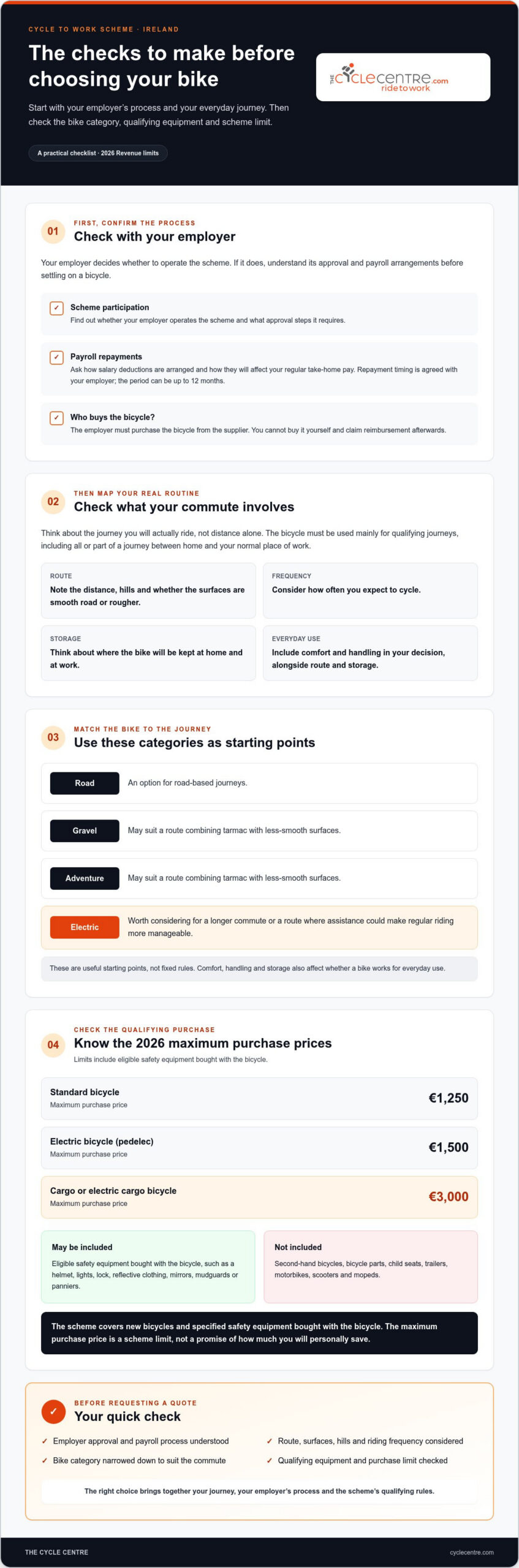
Before you apply, find out whether your employer operates the scheme, how it handles approval and salary repayments, and what equipment may qualify. Revenue’s current maximum purchase prices, including eligible safety equipment, are €1,250 for a standard bicycle, €1,500 for an electric bike and €3,000 for a cargo bike.
This guide covers what to establish with your employer, how to compare road, gravel, adventure, electric and other bike types, and which equipment may be included. It also explains how the employer-purchase and salary-sacrifice process works, and how to request a free, no-obligation quote from The Cycle Centre. The aim is to help you choose a bike that suits your commute and understand what happens next.
Key Takeaways
- Find out how your employer handles approval and salary repayments before settling on a bicycle.
- Compare road, gravel, adventure, electric and cargo bike options against your route and carrying needs.
- Understand how salary sacrifice affects gross pay and why your personal tax benefit can vary.
- Check current Revenue rules for eligible bicycles, safety equipment and scheme use before applying for the cycle to work scheme Ireland.
- Use The Cycle Centre’s online application to request a free, no-obligation quote for your chosen bike.
Cycle to Work Ireland: steps before choosing a bike
The scheme can make buying a bike more straightforward, provided your employer participates and you understand its approval and payment process. The cycle to work scheme Ireland allows an employer to buy a qualifying bicycle and equipment for an employee. The employee repays the cost through salary sacrifice rather than buying the bike personally and claiming reimbursement afterwards.
For 2026, Revenue’s maximum purchase prices, including eligible safety equipment, are €1,250 for a standard bicycle, €1,500 for an electric bike and €3,000 for a cargo bike. The scheme covers new bicycles and specified safety equipment bought with the bicycle, but not second-hand bikes, parts, child seats or trailers. For a general overview of the Cycle to Work scheme in Ireland, see the scheme background alongside current Revenue guidance. Eligibility is only one part of the decision: the bike also needs to suit your route.
What to establish with your employer first
Employers decide whether to operate the scheme, subject to the applicable rules. If yours does, learn its approval steps and payroll arrangements before choosing what to buy. The employer must purchase the bicycle from the supplier. You can’t buy it yourself and seek reimbursement afterwards. Keep two questions separate: whether you can use the scheme, and whether the bicycle you have in mind fits your journey and the qualifying conditions.
Start with the journey, not the bike category
Think about the route you’ll actually ride, rather than distance alone. Consider how often you expect to cycle, whether the route is mainly smooth road or includes rougher surfaces, and where you’ll store the bike at home and work. A short urban commute with secure storage may call for different priorities from a longer journey that mixes road and trail.
Road bikes are one option for road-based journeys. Gravel and adventure bikes may suit routes that combine tarmac with less-smooth surfaces. An electric bike may be worth considering for a longer commute or a route where assistance would make regular riding more manageable. These are useful starting points, not fixed rules. Comfort, handling and storage all affect whether a bike will work for everyday use.
Before asking for a quote, work through this checklist:
- Employer process: Find out how scheme approval and payroll deductions are arranged.
- Commute: Note the distance, surfaces, hills and how regularly you expect to ride.
- Bike category: Narrow down road, gravel, adventure or electric options according to your journey.
- Qualifying equipment: Identify eligible safety items to include with the bicycle, such as a helmet, lights, lock or reflective clothing.
The scheme requires the bicycle to be used mainly for qualifying journeys, including all or part of a journey between home and your normal place of work. Establishing these details first helps you choose a suitable bicycle and prepare a quote that fits your commute and your employer’s process.
How the Cycle to Work Scheme affects payment and personal savings
The scheme changes how an eligible bike purchase is paid for, but the final cost is not the same for every employee. Under the cycle to work scheme Ireland, the employer purchases the bicycle and qualifying equipment from the supplier. The employee repays the cost through an agreed salary-sacrifice arrangement, instead of paying from take-home pay and claiming the money back.
A deduction from gross salary is taken before Income Tax, PRSI and Universal Social Charge are applied to the relevant pay. Under the scheme’s tax treatment, those charges are not paid on the value of the qualifying purchase. Your take-home pay still reduces as repayments are made, but the overall effect can differ from paying the same amount out of net salary.
Salary sacrifice and take-home pay, explained simply
Gross salary is your pay before deductions; take-home pay is what remains after payroll deductions. With salary sacrifice, the agreed repayment is deducted from gross salary. With an ordinary purchase, you pay from money that has already passed through payroll deductions. Your employer agrees the repayment timing and administration, and the repayment period can be up to 12 months. Understand how the deduction will appear in payroll and what it means for your regular take-home pay.
Two employees can save different amounts on the same bike because their tax circumstances and employer’s salary-sacrifice arrangements may differ. Your tax rate, pay and the way the arrangement is administered all matter. Treat any headline saving as an estimate, not a promise or personalised calculation. Your employer or payroll team can explain the deductions that apply to your arrangement.
Scheme limits and qualifying purchases in 2026
Revenue’s 2026 maximum purchase prices, including eligible safety equipment bought with the bicycle, depend on the bicycle category:
- Standard bicycle: €1,250.
- Electric bicycle (pedelec): €1,500.
- Cargo or electric cargo bicycle: €3,000.
These are scheme limits, not estimates of how much you’ll personally save. Eligible safety equipment, such as a helmet, lights, lock, reflective clothing, mirrors, mudguards or panniers, counts towards the applicable limit when bought with the bicycle. The scheme covers new bicycles, but not second-hand bikes, bicycle parts, motorbikes, scooters or mopeds. Child seats and trailers are not included.
Keep the distinction clear: Revenue’s rules determine whether a purchase qualifies and the maximum permitted amount, while the retailer’s quote sets out the bicycle and eligible equipment you’ve selected. The Cycle Centre’s online application lets you request a free, no-obligation Cycle to Work quote once you have a suitable choice in mind. Review it alongside your employer’s process before the purchase is arranged.
Which bike and equipment fit your Cycle to Work Scheme commute?
A suitable scheme bike is the one that fits your regular journey, not simply the category that sounds most appealing. Consider road surfaces, distance, hills, what you carry and where the bicycle will be stored. Then use those needs to narrow down a bike type before building a quote. The Cycle Centre’s Cycle to Work Scheme Ireland guide covers the wider purchase rules; the comparison below shows how your commute can guide your choice.
Match the bicycle to distance, terrain and everyday use
Use your usual route as the test. A short, road-based commute has different demands from a longer ride across mixed surfaces or one that involves carrying work gear. The categories below are starting points. Comfort and practical fit still matter.
| Commute conditions | Categories to consider | Practical trade-off |
|---|---|---|
| Mostly paved roads and a direct route | Road | A road-focused category suits a route centred on tarmac, but may be less appropriate if rougher surfaces are part of your regular journey. |
| Roads mixed with gravel or less-smooth paths | Gravel | Designed for mixed-surface journeys, though your route and riding preferences still determine whether it’s the right fit. |
| Varied routes and everyday riding beyond the commute | Adventure | Worth considering if your regular riding includes changing surfaces or purposes; weigh that versatility against your daily needs. |
| Longer, hilly or more demanding journeys | Electric | Electric assistance may make regular riding more manageable, but the bicycle still needs to suit your route and storage arrangements. |
| Commuting with substantial loads | Cargo | A cargo category may be relevant if carrying goods is central to the journey; consider the load and where you’ll keep the bike. |
Check eligibility before building your quote
A bicycle’s retail label does not determine whether it qualifies. Current Revenue rules set out eligible bicycle types and qualifying equipment, so check the guidance before treating a particular purchase as scheme-eligible. In 2026, the maximum purchase price, including eligible safety equipment, varies by bicycle category. Build your selection around the relevant limit rather than assuming every item can be added.
Consider safety equipment separately from the bicycle. Revenue’s eligible list includes helmets, lights, locks, reflective clothing, mirrors, mudguards and panniers when bought with the bicycle. Accessories can have different treatment, so check whether each item qualifies and counts towards the applicable limit before requesting a quote. The rules exclude items such as child seats and trailers.
For an electric option, scheme eligibility is separate from the rules governing how an electric bike may be used. The electric bike laws in Ireland guide provides related legal context. Once you’ve narrowed down the category and eligible equipment, your quote can reflect a considered choice rather than a guess.
Cycle to Work checklist: bike choice to employer approval
A clear sequence helps you avoid choosing a bicycle before you know how your employer will handle the purchase. For the cycle to work scheme Ireland, treat the quote as a planning document. It describes your proposed bike and equipment, but does not confirm that your employer has approved the purchase.
Keep each responsibility clear. You choose a suitable bicycle, identify qualifying equipment and follow your employer’s application process. The employer arranges the purchase from the supplier and administers the agreed salary repayments through payroll. You can’t buy the bicycle yourself and claim reimbursement under the scheme. Follow your employer’s procedure and the current Revenue conditions throughout.
Prepare the information for a bike quote
Before starting a quote application, think through your commute and intended use. Note whether you’ll ride mainly on roads or mixed surfaces, how far you expect to travel and whether you need to carry work items. This helps narrow the choice to a relevant category, such as road, gravel, adventure or electric, rather than starting with an arbitrary model.
Also note your employer’s application steps and the Revenue purchase limit that applies to your chosen bicycle category. The Cycle Centre’s online application lets you request a free, no-obligation quote. Include the bicycle and any safety equipment you intend to buy with it, so the proposed total can be considered against the applicable scheme rules.
Coordinate the quote with employer approval
Once you have a quote, submit it according to your employer’s process. The employer must approve and arrange the purchase in line with its procedures; the quote itself does not authorise an order. Before the purchase is finalised, understand how the employer will pay the supplier and set up salary repayments. The employer’s process determines the exact administration and timing.
Use this ordered checklist to keep the steps straight:
- Establish participation: Find out whether your employer operates the scheme and how to apply.
- Understand payroll arrangements: Learn how approval and salary deductions are handled before committing to a purchase.
- Describe your journey: Record your route, surfaces, usual load and intended frequency of use.
- Select a suitable category: Choose a bicycle type that fits your commute, then identify any qualifying equipment you want included.
- Request a quote: Use the online application to set out your proposed bicycle and equipment for a no-obligation quote.
- Submit for approval: Give the quote to your employer and wait for its decision and purchase instructions before treating the order as approved.
Before the employer places the order, make sure the selected items fit the current Revenue conditions and the employer’s approved arrangement. Ready to turn your bike choice into a quote? Apply for a Cycle to Work quote online and use it as the next step in your employer’s process.
Get a Cycle to Work quote from The Cycle Centre
Once you’ve considered your commute and understood your employer’s process, a quote can help bring your bike choice into focus. The Cycle Centre’s online application is a straightforward way to request a free, no-obligation Cycle to Work quote. Use it to set out what you’re considering before your employer arranges a purchase.
The range includes electric, road, gravel, adventure and kids’ bikes. The right category depends on who will use the bicycle and the journey it needs to suit. A quote is not scheme approval, so continue to follow your employer’s process and current Revenue conditions.
What happens when you request a no-obligation quote?
Use the online application to request a scheme quote based on the bicycle category you have in mind. Before you begin, clarify your commute needs, intended use and preferred category, along with any eligible safety equipment you’re considering. Keep your employer’s scheme instructions and the relevant purchase limit in view, so the proposed purchase reflects the rules that apply.
The quote gives you something concrete to consider and submit through your employer’s process. It does not confirm that your employer has approved the purchase or replace the employer’s role in arranging payment. Approval and next steps remain subject to the employer’s procedures and the scheme conditions.
Make a confident next move
A measured purchase follows a simple order: understand your employer’s process, choose a bike that suits your regular journey, then request a quote to take the proposal forward. If you’re still comparing categories, weigh each one against your route, storage and everyday use. A considered choice is more useful than rushing into a bicycle that does not fit your needs.
For the cycle to work scheme Ireland, clarity at each stage helps keep the process manageable. Decide on a preferred category and have the relevant scheme details ready, then use the online application when you’re comfortable with your choice.
Request a Cycle to Work quote from The Cycle Centre and take the next step towards a bike that suits your commute.
Make your next commute your own
A bike chosen for your real routine can make travel more flexible, whether you’re heading to work, carrying what you need for the day or fitting a ride into the week. Rather than rushing into a purchase, consider what would make cycling practical and enjoyable for you, then take those priorities into your Cycle to Work application.
The Cycle Centre is an independent, family-owned Irish bicycle retailer founded in 1974. Its online quote application gives you a straightforward way to turn an idea into a proposal to submit through your employer’s process. There’s no obligation to proceed, so you can explore your options while keeping your choice and approval process clear.
Ready to compare your options? Request a free, no-obligation Cycle to Work quote and take a considered next step with the cycle to work scheme Ireland. Start with the journey you want the bike to handle, then choose the option that fits.
Frequently Asked Questions
Can I use the Cycle to Work Scheme if my employer does not participate?
No. You can’t use the cycle to work scheme Ireland through an employer that doesn’t operate it. Employers choose whether to offer the scheme, so a retailer quote alone can’t activate it or authorise a purchase. You could raise the possibility with the relevant person in your organisation, but any decision to introduce the scheme rests with the employer. Check Revenue guidance for the current conditions.
Can part-time employees use the Cycle to Work Scheme in Ireland?
Yes, part-time employees can be eligible if their employer operates the scheme and they meet its conditions. Working fewer hours doesn’t automatically rule you out. Consider how repayments would fit your pay arrangements and what the proposed deductions mean for your usual take-home pay. Your employer can explain its process, while Revenue guidance sets out the applicable scheme conditions.
How often can I use the Cycle to Work Scheme?
You can generally benefit once every four calendar years, with the interval calculated by tax year rather than simply by counting from the date you received a bike. For example, under current guidance, someone who used the scheme during 2022 may use it again from 1 January 2026. Check your previous use and current Revenue rules before applying, particularly if you’re unsure which tax year your earlier purchase fell into.
What happens if I leave my job while repaying for a bike?
Leaving your job may affect how remaining repayments are handled, but the outcome depends on your employer’s salary-sacrifice agreement and your circumstances. Don’t assume deductions will stop, transfer to a new employer or be collected in a particular way. Before accepting the arrangement, read its written terms and understand what they say about leaving employment. If your circumstances change, discuss the outstanding balance and next steps with your employer.
Can I use the Cycle to Work Scheme if I am self-employed?
If you’re solely self-employed, you generally can’t use the scheme because it operates through an employer purchasing a bike for an employee. However, someone who is self-employed and also works as an employee may be eligible through that employment, provided the employer participates and the scheme conditions are met. Check your situation against current Revenue guidance rather than assuming self-employment alone determines eligibility.
Can safety equipment be included with a bike under the scheme?
Yes, certain safety equipment can qualify when bought with an eligible bicycle, subject to Revenue’s rules and the relevant purchase limit. Items listed in current guidance include helmets, lights, locks, reflective clothing, mirrors, mudguards and panniers. An accessory isn’t automatically eligible just because it’s useful for commuting. Check the current list before finalising your proposed purchase, and include eligible items with the bicycle details for your employer to review.
Does the Cycle to Work Scheme cover second-hand bikes?
No. The scheme covers eligible new bicycles, not second-hand bikes. This distinction matters because the employer must follow the conditions for the scheme’s tax treatment. When comparing options, make sure the bicycle you propose is new and that the rest of the purchase meets current Revenue requirements. A quote can set out the proposed purchase, but it does not itself confirm scheme approval.