


Imagine you are halfway through a crisp morning commute when your motor suddenly falters, leaving you to pedal a heavy frame without assistance. It’s a moment many riders face after several years of regular use, as even the best lithium-ion cells eventually lose their ability to hold a charge. You likely feel a mix of frustration and uncertainty when researching the e-bike battery replacement cost Ireland riders face, especially with the wide price gap between genuine parts and cheaper, unverified alternatives.
This guide clarifies exactly what you need to know to keep your bicycle powered efficiently through 2026. We’ll help you decide whether a professional rebuild or a brand-new unit is the right investment for your specific motor system. You’ll discover the key factors that drive price, from cell quality to capacity, along with practical maintenance habits to ensure your next battery survives the damp Atlantic climate. We also cover the latest safety regulations for public transport and disposal, ensuring you stay mobile and compliant on Irish roads.
Key Takeaways
- Recognise the early warning signs of power loss and learn how the damp Irish climate impacts the long-term health of your lithium-ion cells.
- Get a clear breakdown of the e-bike battery replacement cost Ireland owners can expect in 2026, comparing entry-level units with high-capacity premium systems.
- Weigh up the upfront savings of professional rebuilding services against the guaranteed software compatibility and reliability of genuine manufacturer parts.
- Master the “20-80% rule” and other essential maintenance habits to safeguard your investment against the harsh effects of winter frost.
- Understand how a professional workshop diagnostic test can confirm whether you truly need a full replacement or a targeted component repair.
E-Bike Battery Life and Replacement: When is it Time?
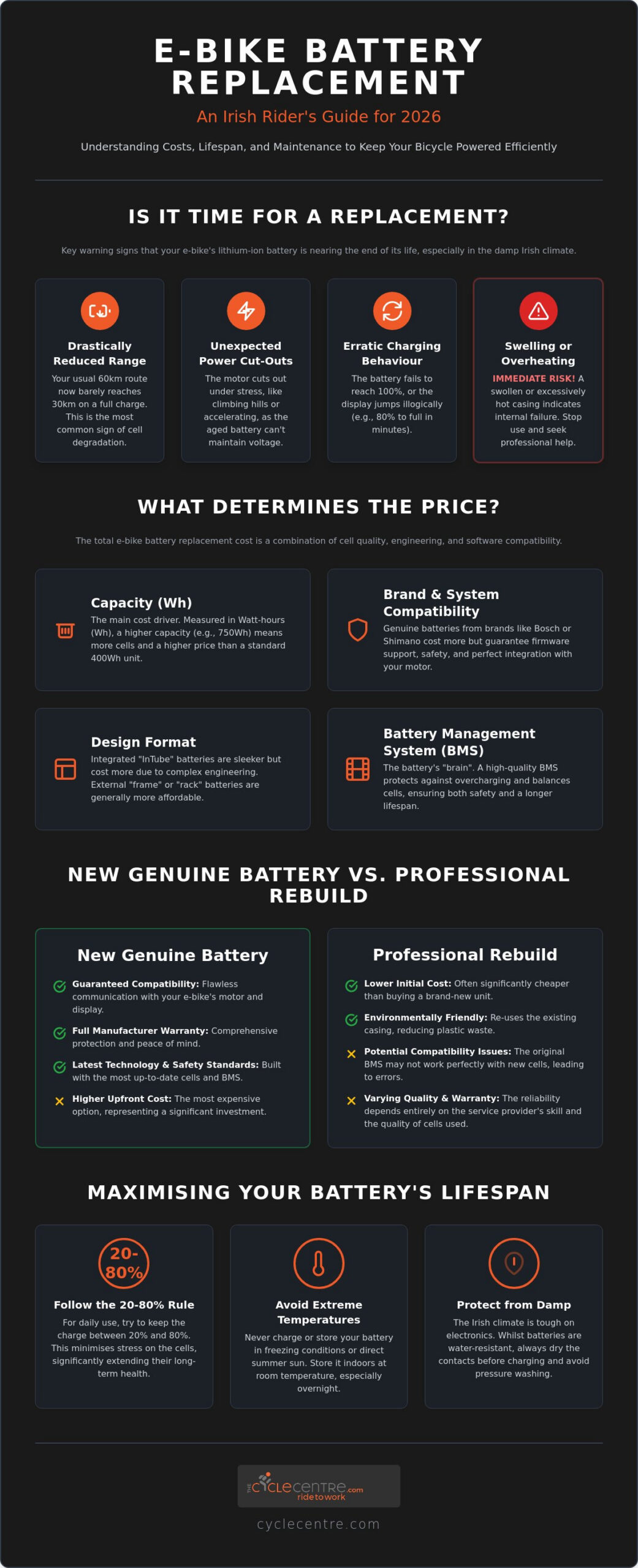
Most modern e-bikes rely on sophisticated Electric bicycle batteries, typically lithium-ion, which are designed to provide between 500 and 1,000 full charge cycles. In practical terms for the average Irish commuter, this translates to a lifespan of approximately three to five years. However, the unique environmental conditions in Ireland, particularly the persistent damp and the biting cold of winter frosts, can accelerate chemical degradation if the battery isn’t stored correctly. Understanding the e-bike battery replacement cost Ireland riders must budget for starts with knowing exactly when your current unit is reaching its end of life.
Chemical aging is inevitable. Over time, the internal resistance of the cells increases, which means the battery can no longer deliver power as efficiently as it did on day one. Whilst a well-maintained battery might still function after five years, its capacity will be significantly reduced. This leads to “range anxiety,” where you can no longer complete your usual routes on a single charge. If you notice your battery casing is “swollen” or feels excessively hot during charging, stop using it immediately. A deformed casing indicates internal cell failure and poses a genuine fire risk; such units require immediate professional attention and specialist disposal.
Signs Your Battery Needs Replacing
The most obvious indicator is a significant drop in range. If you previously achieved 60km on a full charge but now struggle to reach 30km, the cells have likely degraded. You might also experience unexpected power cut-outs whilst climbing hills or accelerating under heavy load. This happens because the aged battery cannot maintain the required voltage under stress. Finally, keep an eye on erratic charging behaviour. If the display jumps from 80% to 100% in minutes, or if it fails to reach a full charge despite being plugged in overnight, the internal management system is struggling to balance the declining cells.
The 2026 Irish Market Context
The landscape for lithium-ion technology has shifted recently. Global supply chain factors continue to influence the price of raw lithium in Ireland, whilst the volume of electrical waste has risen to approximately 23 kilograms per person. This has led to stricter regulations regarding battery safety and disposal. Despite these challenges, battery technology has evolved to offer higher energy density. In 2026, 500Wh and 625Wh units remain the industry standards for daily commuters, providing a balance between weight and sufficient range for hilly Irish terrain. Staying informed about the e-bike battery replacement cost Ireland market ensures you aren’t caught off guard when your current power source eventually reaches its natural limit.
Breaking Down the Cost: What Determines the Price?
The sticker price of a new power unit often causes a moment of pause for many riders. However, the e-bike battery replacement cost Ireland cyclists encounter is dictated by a complex mix of raw material prices, safety engineering, and proprietary software. It’s helpful to view the battery not just as a fuel tank, but as a sophisticated piece of electronics. The primary driver of value is capacity, measured in Watt-hours (Wh). A 750Wh battery contains more physical lithium-ion cells than a 400Wh unit, directly increasing the manufacturing cost. Beyond the cells, the Battery Management System (BMS) acts as the brain. High-quality systems adhere to strict e-cycle battery safety guidelines, ensuring the unit doesn’t just provide range, but also protects your home during charging.
Design format also plays a significant role in the final tally. External batteries, often called “rack” or “frame” packs, are generally more affordable because they don’t require the complex waterproofing and thermal shielding needed for integrated “InTube” designs. If you’re unsure which format fits your frame, our workshop team can help you identify the correct bike components and spare parts for your specific motor system. Premium brands like Bosch and Shimano also include a “brand tax,” which essentially pays for rigorous testing and guaranteed long-term firmware support that cheaper, generic alternatives simply cannot match.
Motor System Compatibility
Your choice is often limited by your motor. Bosch systems illustrate this clearly; a PowerPack (external) is typically more budget-friendly than a PowerTube (internal), even if they share the same capacity. Shimano STEPS batteries are tiered by performance, with higher-end models offering faster charging times and lower weight. For urban riders using Yamaha or Bafang systems, there is often more flexibility. These brands frequently offer external mounting options that prioritise cost-effectiveness over sleek aesthetics, making them a popular choice for high-mileage delivery riders or daily commuters looking to manage their e-bike battery replacement cost Ireland budget.
Technical Specifications that Affect Value
Voltage and cell quality are the final pieces of the puzzle. Most city bikes operate on 36V systems, whilst high-performance mountain bikes often move to 48V to handle steeper gradients. We always recommend Tier-1 cells from manufacturers like Samsung, Panasonic, or LG. These cells maintain their capacity for hundreds of extra cycles compared to “no-name” alternatives, offering better value over time. In the context of the Irish commute, one Amp-hour of capacity generally translates to roughly five to seven kilometres of assisted travel, though this varies significantly with headlong winds and coastal gradients. Quality costs more upfront. It’s that simple.
New Genuine Batteries vs. Professional Rebuilds
When the time comes to restore your bike’s range, you’ll likely face a choice between a factory-fresh replacement and a professional cell rebuild. Whilst the latter is often marketed as a way to significantly lower the e-bike battery replacement cost Ireland riders pay, the decision involves more than just the initial price tag. Genuine batteries are engineered as a complete system, whereas rebuilding involves opening a sealed unit to replace individual internal cells. This distinction is critical for both long-term reliability and the safety of your home.
The financial reality is often a trade-off between upfront savings and total cost of ownership. A genuine unit from a reputable brand typically carries a robust manufacturer warranty, often covering two years or at least 500 full charge cycles. In contrast, a rebuild might offer a shorter guarantee limited only to the new cells, leaving you unprotected if the original circuit board fails a month later. There is also the matter of fire safety. Factory-assembled packs use high-precision robotic spot-welding to connect cells, whilst manual rebuilds rely on the skill of a technician. Poorly executed welds can lead to internal resistance and heat build-up, which is a risk no cyclist should take.
The Case for Genuine Replacements
Modern motor systems from brands like Bosch and Shimano use sophisticated “locked” software. This means the battery, motor, and display must perform a digital handshake before the system provides assistance. Genuine replacements ensure this communication is seamless. You’ll benefit from the latest firmware updates and the peace of mind that comes with international safety certifications like UN38.3. For most daily commuters, the reliability of a factory unit outweighs the modest savings of a third-party alternative.
Understanding Battery Rebuilds in Ireland
Rebuilding can be a viable path, particularly if you own a vintage or discontinued model where original parts are no longer manufactured. The process involves stripping the old lithium-ion cells and installing high-quality replacements into the existing housing. However, because this bypasses the original manufacturer’s safety seals, it’s essential to use an Irish-accredited workshop for any battery work. Professional technicians can verify if your Battery Management System is still healthy enough to support new cells, ensuring you don’t waste money on a failing shell. Choosing a local expert also helps you manage the e-bike battery replacement cost Ireland owners face by providing an honest assessment of whether your current unit is truly beyond repair.
Maximising Your Investment: How to Avoid Early Replacement
Replacing a high-capacity power unit is a significant financial commitment. Because the e-bike battery replacement cost Ireland owners face can be substantial, adopting a proactive maintenance regime is the most effective way to protect your wallet. Small adjustments to your daily routine can add years to the functional life of your cells. It is far better to preserve the battery you have than to rush into an expensive replacement due to avoidable neglect.
Lithium-ion chemistry is sensitive. It thrives when kept between 20% and 80% charge. Whilst it is tempting to top up to 100% after every short trip, keeping the battery at its maximum voltage for extended periods creates internal stress. Use a smart timer on your socket to ensure the charger cuts off before the battery reaches a state of high-voltage tension overnight. This simple habit prevents “trickle charge” degradation, which is a common cause of premature capacity loss.
Charging and Storage Behaviours
The Irish climate presents specific hurdles. Cold weather slows down the chemical reactions inside the cells; charging a frozen battery can cause permanent internal damage. Never plug in your battery immediately after a ride in near-freezing temperatures. Allow it to reach room temperature indoors first. If you aren’t using your bike for several weeks, don’t leave the battery in a damp shed. Store it in a dry, temperate environment at roughly 50% charge to maintain chemical stability and prevent the voltage from dropping to a “deep discharge” state.
The Importance of Professional Servicing
Professional oversight is equally vital for longevity. Our Workshop Gold Service includes a comprehensive diagnostic report that checks cycle counts and identifies individual cell imbalances before they lead to total failure. Software matters too. Manufacturers often release firmware updates specifically designed to improve battery management and efficiency. Regular servicing ensures your system is running the latest code, which can actually extend the functional life of your hardware. To ensure your power system is performing at its peak, consider booking one of our professional Workshop Gold Service sessions for a full diagnostic check.
Don’t forget the physical connections. Cleaning the battery contacts with a dedicated electrical cleaner prevents arcing and power loss. These simple habits ensure you get the best value out of your purchase and delay the need to investigate the e-bike battery replacement cost Ireland market for as long as possible. A well-maintained battery is not just more reliable; it is safer and more efficient on every journey.
Professional E-Bike Support at The Cycle Centre
Navigating the technicalities of e-bike maintenance shouldn’t be a solitary journey. At The Cycle Centre, we combine decades of industry heritage with the latest diagnostic technology to support your riding experience. Whilst the e-bike battery replacement cost Ireland riders face is a significant consideration, our goal is to ensure you only spend what is absolutely necessary. Before committing to a full replacement, our team performs a rigorous health check to determine if a simple software update or a component repair could restore your bike’s performance.
We pride ourselves on being a facilitator of experiences, not just a retailer. This means we provide direct access to genuine Bosch, Shimano, and Yamaha parts, ensuring your motor system remains within warranty and performs as the manufacturer intended. Whether you are a daily commuter or a weekend explorer, our nationwide support network ensures that expert advice is always within reach. We handle the logistical complexities of lithium-ion battery transport and disposal, so you can focus on the freedom of the open road. For those interested in extending these sustainability principles to their home, you can find out more about the specialist renewable energy services provided by Carbon Saving Group.
Our Shimano Accredited Workshop
As a Shimano Accredited Workshop, we maintain the highest standards of technical proficiency. Our technicians undergo regular training in lithium-ion safety and handling, specifically focusing on high-performance systems. This expertise is particularly vital for riders of endurance road bikes, where battery weight and integration are critical to the bike’s handling. We use specialist motor and battery diagnostics to provide you with a transparent view of your system’s health, including precise cycle counts and temperature history.
Financial Support and Schemes
One of the most effective ways to manage the e-bike battery replacement cost Ireland owners encounter is to leverage available government incentives. Many riders don’t realise they can use the ultimate guide to the bike to work scheme Ireland 2026 to upgrade their entire setup. In 2026, the tax-free allowance for e-bikes stands at €1,500, which can significantly offset the cost of a new, high-capacity model if your current battery and motor have reached their limit. For those simply looking to maintain their existing ride, we offer transparent pricing across our professional Silver and Gold service tiers, ensuring your investment is protected through every season.
If your range is dropping or your charging is becoming erratic, don’t leave it to chance. A professional assessment can save you hundreds of euros by identifying the root cause of the issue. Enquire about a replacement battery diagnostic today and let our trusted experts get you back to full power with confidence.
Powering Your Future Journeys
Restoring your e-bike’s original range is a vital step in maintaining the freedom and efficiency of your daily commute. We have seen how capacity, cell quality, and motor compatibility influence the e-bike battery replacement cost Ireland riders experience. However, the most important takeaway is that professional diagnostics often reveal simpler solutions than a full replacement. By prioritising genuine parts and adopting better storage habits, you safeguard both your safety and your bicycle’s long-term value.
As a family-owned Irish business serving the community since 1974, we understand the specific challenges posed by our local climate. Our Shimano Accredited Workshop provides specialist support for Bosch and Yamaha motor systems; this ensures your power unit is handled with the highest level of technical care. Don’t let a failing battery stall your adventures or leave you pedalling a heavy frame without assistance. Book a Professional E-Bike Battery Diagnostic today and let our experts confirm exactly what your system needs to stay on the road. Your next great ride is just a full charge away.
Frequently Asked Questions
How much does a 500Wh e-bike battery cost in Ireland in 2026?
A mid-range 500Wh battery typically costs between €400 and €700 in the 2026 Irish market. This range covers the e-bike battery replacement cost Ireland riders pay for most standard commuter systems. The final price depends on whether the unit is an external frame pack or an integrated design, as integrated models require more complex housing and waterproofing.
Is it cheaper to rebuild an e-bike battery or buy a new one?
Rebuilding a battery is generally cheaper upfront, but buying a new unit often provides better long-term value. Whilst a rebuild might save you several hundred euros, it usually lacks the two-year manufacturer warranty and guaranteed software compatibility of a new factory unit. For newer bikes with locked systems, a new battery is often the only reliable way to ensure full motor functionality.
Can I use a third-party battery on my Bosch or Shimano e-bike?
Most Bosch and Shimano systems are designed to reject third-party batteries through proprietary software handshaking. These closed systems require a genuine battery to communicate with the motor and display. Using a non-genuine unit can void your warranty and may cause the system to enter an error state that prevents the motor from providing any assistance.
How many years should an e-bike battery last with daily commuting?
An e-bike battery used for daily commuting typically lasts between three and five years. This lifespan equates to roughly 500 to 1,000 full charge cycles. If you commute 20km daily and charge every two days, you can expect to reach the upper end of this estimate, provided you follow the 20-80% charging rule and store the unit indoors during winter.
Does the Cycle to Work scheme cover e-bike battery replacements?
The Cycle to Work scheme is primarily designed for purchasing new e-bikes rather than individual replacement parts. However, because the e-bike battery replacement cost Ireland can be high, many cyclists use their €1,500 tax-free allowance to trade in their old bike for a new model. This approach ensures you get a fresh battery, a new warranty, and the latest motor technology in one package.
What should I do with my old, dead e-bike battery in Ireland?
You should return your old battery to any retailer that sells similar batteries or take it to a local authority civic amenity site. Under WEEE Ireland regulations, retailers must accept these batteries for recycling free of charge, even if you aren’t making a new purchase. Never place lithium-ion batteries in standard household bins, as they pose a significant fire risk in waste processing facilities.
Can cold Irish weather permanently damage my e-bike battery?
Extreme cold can permanently damage your battery if you attempt to charge it whilst the cells are frozen. Cold temperatures temporarily reduce range by slowing the chemical reactions inside, but the real danger comes from lithium plating during a cold charge. Always bring your battery indoors and allow it to reach room temperature before plugging it into the charger to avoid internal degradation.
Why is my e-bike battery losing charge faster than before?
Rapid power loss is usually a sign of chemical aging or an imbalance between the internal cells. As a battery reaches the end of its life, its internal resistance increases, which means it generates more heat and less usable energy. If your battery is less than three years old and losing charge quickly, it may require a professional firmware update or a contact cleaning to restore efficiency.