

What if the most expensive part of your new electric bike isn’t the motor or the battery, but the hidden cost of choosing the wrong setup for the Irish terrain? It is a common concern we hear at our workshop. Many riders feel a bit overwhelmed by the technical jargon surrounding mid-drive systems or worry about range anxiety when facing a steep headwind. If you’ve found yourself confused by the choice between a Bosch or Shimano motor, or hesitant about the initial investment, you aren’t alone. This e-bike buying guide Ireland is here to turn that uncertainty into expertise.
We’ll help you master the technicalities of modern drive units whilst ensuring you don’t miss out on significant savings through the Cycle to Work scheme. Whether you’re eyeing a standard e-bike with a €1,500 tax-free limit or a robust cargo bike at the €3,000 threshold, you’ll gain the clarity needed to choose a motor-battery combination that won’t leave you stranded. We will preview the latest 2026 legal definitions and performance categories so you can navigate Irish roads with total peace of mind and the confidence of a seasoned pro.
Key Takeaways
- Navigate the 2026 legal landscape by understanding how the Road Traffic and Roads Act 2023 defines a “pedelec” for use on Irish roads and cycle lanes.
- Discover why prioritising torque (Nm) over simple wattage is the secret to conquering steep hills and maintaining battery range on diverse Irish terrain.
- Use this e-bike buying guide Ireland to master the Cycle to Work scheme, securing tax savings on purchases up to €1,500 for standard e-bikes or €3,000 for cargo models.
- Identify the ideal frame and motor configuration for your lifestyle, from the upright comfort of an E-city bike to the rugged power of an E-MTB.
- Learn why professional accredited servicing and regular firmware updates for Bosch and Shimano systems are essential for your bike’s long-term reliability.
Understanding the E-Bike Landscape: Irish Laws and Classifications
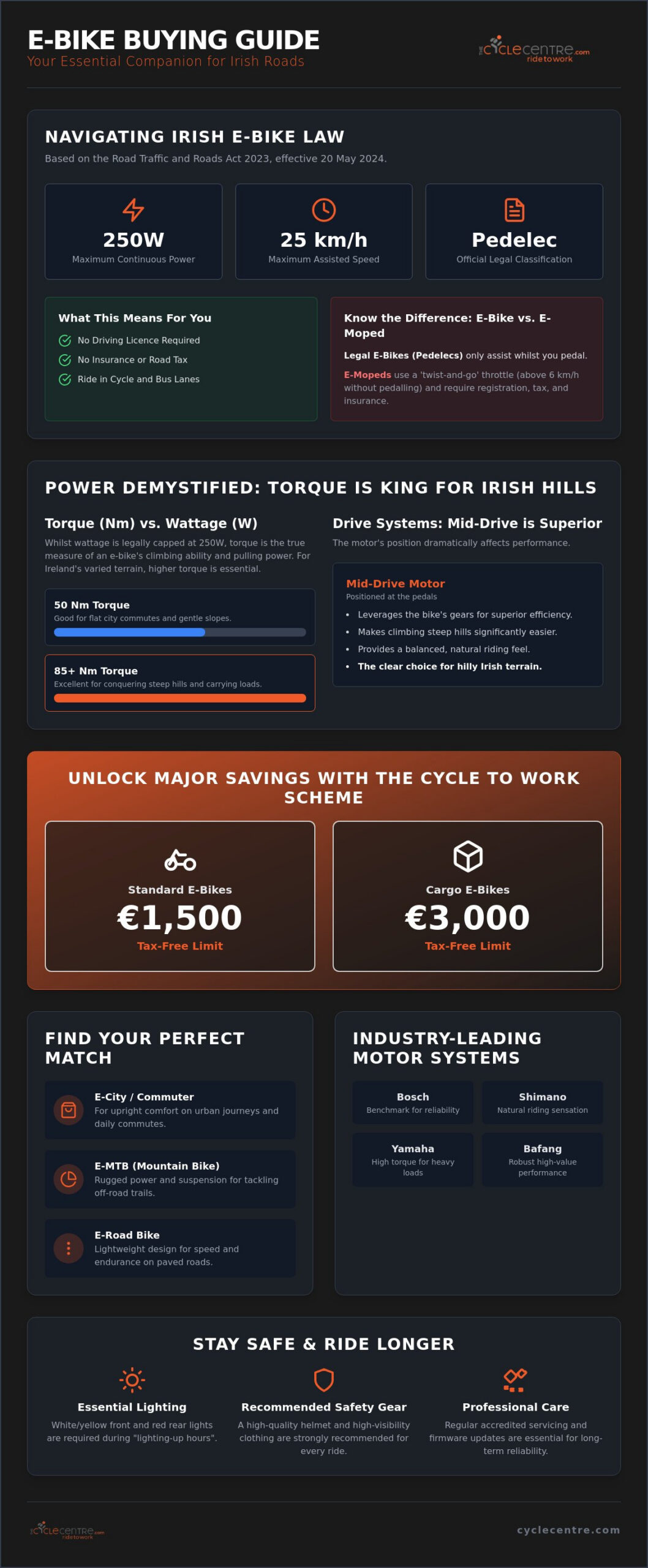
Clear regulations are the backbone of any reliable e-bike buying guide Ireland. Since the Road Traffic and Roads Act 2023 came into full effect on 20 May 2024, the legal path for Irish cyclists has never been more certain. Under this legislation, an electric bike is officially classified as a “pedelec” if it meets specific criteria regarding power and speed. Essentially, if your bike’s motor has a maximum continuous power output of 250 watts and stops assisting you once you reach 25 km/h, it’s legally treated exactly like a traditional bicycle. This means you don’t need a driving licence, insurance, or road tax to enjoy the freedom of the open road.
You can confidently use your e-bike in cycle lanes and bus lanes, following the same rules of the road as any other cyclist. However, it’s vital to remember that motorways and footpaths remain off-limits. This legal parity with standard bicycles is a major draw for commuters looking to bypass traffic without the administrative burden of a motorised vehicle. The evolution of electric bicycle technology has allowed these machines to integrate seamlessly into our transport network whilst providing that extra boost for hilly commutes. As of 2026, standard e-bikes meeting the 250W and 25 km/h criteria are legally classified as bicycles in Ireland, exempting riders from registration, licensing, and motor tax requirements.
E-Bikes vs E-Mopeds: Know the Difference
The line between a bicycle and a moped depends on how the power is delivered. For a bike to remain in the “pedelec” category, the motor must only provide assistance whilst you are actually pedalling. If the bike features a “twist-and-go” throttle that powers the bike beyond 6 km/h without pedalling, it’s classified as an e-moped. These more powerful machines require the rider to be at least 16 years old and necessitate formal registration and insurance. Choosing a compliant pedelec ensures you stay on the right side of the law whilst enjoying the trails.
Safety and Lighting Requirements for Irish Roads
Visibility is paramount, especially given the unpredictable Irish weather. During “lighting-up hours”, your bike must be equipped with a functional white or yellow light at the front and a red light at the rear. Whilst not legally mandated for standard e-bikes, we strongly recommend wearing a high-quality helmet and high-visibility apparel. Staying seen is the best way to ensure your journey is as safe as it is enjoyable, whether you’re on a city commute or a rural adventure.
Powering the Ride: Motors, Batteries, and Drive Systems
Choosing the right drive system is arguably the most critical decision in any e-bike buying guide Ireland. Whilst the law limits continuous power to 250 watts, the way that power reaches the road varies significantly between motor designs. For the rolling hills and varied gradients of the Irish countryside, mid-drive motors are the superior choice. These units are positioned at the pedals, allowing the motor to leverage the bike’s existing gears. This mechanical advantage makes climbing much more efficient than a hub motor, which sits in the wheel and can struggle when the road tilts upwards. It is the difference between a smooth, assisted glide up a steep incline and a laboured struggle.
In addition to purchasing a complete bike, many enthusiasts look into the Sale of 18V e-bike conversion kits from eKITS as a way to electrify their existing bicycle while ensuring they meet the legal requirements for Irish roads.
If you’re planning on tackling the Gap of Dunloe or the coastal climbs of the Wild Atlantic Way, you need to look at torque. Measured in Newton metres (Nm), torque represents the actual pulling power of the motor. A motor with 85Nm of torque will feel punchier and more responsive on a climb than one with 50Nm, even if both are legally capped at the same wattage. Your battery capacity, measured in Watt-hours (Wh), acts as your fuel tank. A higher Wh rating generally equates to a longer range, though real-world performance depends heavily on how you manage your assist levels via the handlebar display unit.
The Big Four: Bosch, Shimano, Yamaha, and Bafang
Most premium bicycles in Ireland utilise systems from these industry leaders. Bosch is widely regarded as the benchmark for reliability and sophisticated power delivery; their Performance Line motors are a staple in our workshop. Shimano STEPS offers a remarkably natural riding sensation and integrates perfectly with high-end road and city components. Yamaha systems are celebrated for providing high torque at low cadences, making them excellent for heavy loads. Bafang has emerged as a robust, high-value alternative that balances performance with accessibility for many rider profiles.
Range Anxiety: Factors Affecting Battery Life
Battery range is never a fixed number. In Ireland, a strong Atlantic headwind or a drop in temperature can reduce your mileage by as much as 20% compared to a calm summer day. Rider weight and the presence of heavy panniers also increase energy consumption. To extend your battery’s lifespan, avoid leaving it at 0% or 100% for long periods; keeping it between 20% and 80% is the sweet spot for longevity. If you’re unsure which motor and battery combination suits your specific route, our Smart-bike Search tool can help you filter options based on your typical terrain and distance requirements.
E-Bike Buying Guide: E-City vs E-MTB vs E-Road Bikes
Identifying your primary riding style is the most important step in this e-bike buying guide Ireland. It isn’t just about the motor power we explored in the previous section; it’s about how the frame geometry and components interact with your daily environment. Before you commit, ask yourself if you’re looking to replace the car for the daily commute, explore the rugged forest trails of the Slieve Bloom Mountains, or simply enjoy longer weekend tours on the coast. Each category is engineered for a specific purpose, and choosing correctly ensures your investment delivers the freedom you’re looking for.
E-city bikes are the quintessential urban workhorses, designed with an upright riding position that prioritises comfort and visibility in traffic. These models often come equipped with practical features like mudguards, pannier racks, and integrated lighting systems that draw power directly from the main battery. If your goal is a sweat-free arrival at the office or a reliable way to carry groceries, these bikes offer the most functional solution for modern Irish life.
E-City and Commuter Bikes: The Workhorses
When selecting a city bike, you’ll need to choose between step-through and step-over frames. Step-through frames offer exceptional accessibility, making them a favourite for riders who frequently stop-start in urban traffic or prefer not to swing a leg over a high top tube. Step-over frames typically provide a slightly more rigid feel, which can feel more stable when carrying heavier loads. For those navigating the capital or larger towns, urban security is a priority. Look for models with integrated frame locks and robust lighting. You can find more detail on urban-specific regulations in our Electric City Bike Ireland guide.
E-MTB and Gravel: Beyond the Tarmac
Electric Mountain Bikes (E-MTB) and gravel bikes are built for those who want to leave the tarmac behind. If you plan on visiting trail centres like Ballyhoura or Ticknock, you’ll need to decide between a hardtail or a full-suspension setup. Hardtails, which only have suspension in the front fork, are often lighter and more efficient on groomed paths. Full-suspension models offer much better control and comfort on technical, rocky descents. Gravel bikes represent a versatile middle ground; they’re fast on the road but feature wider, textured tyres that handle the sometimes-patchy surfaces of Irish secondary roads with ease. In our damp climate, tyre choice and pressure are vital. Opting for a slightly wider tyre with a lower pressure will significantly improve your grip on wet, mossy trails and slippery lanes.
Maximising Value with the Cycle to Work Scheme in 2026
High-quality electric bikes are a significant investment in your lifestyle and health. This e-bike buying guide Ireland would be incomplete without explaining how to leverage government incentives to make that investment more affordable. The Cycle to Work scheme remains the most effective way to reduce the initial cost of a premium e-bike. By using a salary sacrifice arrangement, you can save up to 52% on the total price, depending on your tax bracket. Essentially, your employer pays for the bike upfront and you repay the cost from your gross salary over twelve months. Because these deductions happen before tax, PRSI, and USC are applied, the real-world cost to your pocket is substantially lower.
As of 2026, the financial thresholds are specifically designed to support the transition to electric transport. The limit for a standard e-bike and essential safety equipment is €1,500. If you are looking at a cargo or e-cargo bike to replace a family car or for business deliveries, that limit rises to €3,000. For a conventional bicycle, the limit is €1,250. This makes the scheme the smartest way to access the advanced Bosch or Shimano drive systems we discussed earlier, as the higher thresholds are tailored to the costs of reliable motor and battery technology.
Step-by-Step: Applying for Your E-Bike Quote
The process is straightforward but requires a bit of preparation. First, you need to choose the model that fits your riding style and obtain a formal, itemised quote from a specialist retailer. This quote should include the bike itself and any safety gear like helmets or lights. Once you have this document, you simply submit it to your HR department or your company’s designated scheme provider. For a deeper dive into the financial mechanics and tax brackets, you can consult The Ultimate Guide to the Bike to Work Scheme Ireland 2026.
Who Can Apply? Eligibility and Frequency
Eligibility is open to all PRSI-paying employees in Ireland, including civil servants and private sector workers. If you are self-employed and pay PRSI as an employee of your own limited company, you can also take advantage of these savings. The most important rule to remember is the four-year frequency limit. If you last used the scheme in 2022, you became eligible to apply again on 1 January 2026. This cycle allows you to keep pace with the latest battery and motor advancements without bearing the full retail cost every time. At our shop, we believe in making this process as transparent as possible. All our quotes are entirely no-obligation and free to obtain, giving you the space to make an informed decision. If you’re ready to see the potential savings on your favourite model, you can request a Cycle to Work quote online today.
Professional Support: Servicing and Long-Term Care
Owning a high-quality electric bike is a long-term investment in your mobility. Whilst a standard bicycle requires regular mechanical checks, an e-bike introduces a layer of electronic complexity that demands a more technical approach. This e-bike buying guide Ireland has already touched on the power of Bosch and Shimano drive units, but maintaining that performance requires more than just a bit of oil on the chain. Professional servicing is the only way to ensure your firmware is up to date, which often improves battery efficiency and motor response. Neglecting these updates can lead to suboptimal performance and, in some cases, may even affect your warranty standing.
The damp Irish climate presents unique challenges for electrical components. Road salt, grit, and persistent rain can find their way into sensitive areas if the bike isn’t properly cared for. Regular professional inspections help identify potential issues before they become costly repairs. Beyond just reliability, a documented service history from an accredited centre significantly bolsters the resale value of your bike. It provides future owners with the confidence that the battery health has been monitored and the motor hasn’t been subjected to undue stress or water ingress.
The Shimano Accredited Workshop Advantage
Choosing a workshop with the right credentials is vital for the longevity of your machine. A Shimano Accredited Workshop possesses the specialist diagnostic tools required to communicate with your bike’s internal computer and run comprehensive health checks. Whether you opt for a Workshop Silver Service for a routine check-up or a Workshop Gold Service for a comprehensive strip-down and rebuild, these packages are designed to handle the specific stresses of e-bike components. For those riding performance-focused models, you can find more detail in our guide to High-End Road Bike Service in Ireland.
Daily Maintenance Tips for E-Bike Owners
You don’t need a degree in engineering to keep your bike in top shape between professional visits. When cleaning your bike, never use a high-pressure washer. The force can drive water past the seals of your motor and battery, causing internal damage that isn’t always immediately apparent. Instead, use a damp cloth and specialist bike cleaner. During the colder winter months, store your battery indoors in a dry environment to prevent the cells from degrading. Finally, remember that the extra torque from your motor puts significantly more strain on your drivetrain. Regularly applying a high-quality lubricant to your chain will prevent premature wear and keep your gear shifts feeling crisp and reliable.
Ready to Transform Your Daily Ride?
Navigating the shift to electric power is more than a simple purchase; it’s an investment in a more efficient and enjoyable way to move across Ireland. By mastering the 2026 legal landscape and understanding how the Cycle to Work scheme can significantly lower your initial costs, you’ve already cleared the biggest hurdles. Whether you’re commuting through city traffic or exploring rugged trails, the right combination of torque and battery capacity ensures your bike performs exactly as you need it to. This e-bike buying guide Ireland has provided the technical foundation, but the final choice should always reflect your unique riding profile.
At The Cycle Centre, we’ve been a trusted part of the cycling community since 1974. As an independent family business and a Shimano Accredited Workshop, our team specialises in the high-performance Bosch and Yamaha motors that define modern e-biking. We are here to provide the expert guidance and technical support you need for the long haul. Find your perfect match with our Smart-bike Search tool to filter our range and discover the ideal electric bike for your lifestyle. We look forward to seeing you out on the road.
Frequently Asked Questions
How much should I spend on a good quality e-bike in Ireland?
Quality e-bikes generally start at a price point that reflects the engineering costs of reliable drive systems from brands like Bosch or Shimano. Whilst entry-level models are available, investing in a reputable brand ensures you have access to long-term spare parts and professional accredited servicing. Many riders find that the €1,500 Cycle to Work threshold is an excellent benchmark for a durable, high-quality commuter bike.
Can I use the Cycle to Work scheme for an electric mountain bike?
Yes, you can absolutely use the Cycle to Work scheme to purchase an electric mountain bike. The legislation allows for any compliant “pedelec” to be purchased through the scheme, provided it’s used for at least part of your commute. This e-bike buying guide Ireland notes that the €1,500 limit applies here too, so any cost above this threshold is simply paid from your net income.
What happens if my e-bike battery runs out whilst I am riding?
If your battery depletes, your e-bike functions exactly like a traditional bicycle. You won’t be stranded, though you’ll certainly notice the additional weight of the motor and battery when pedalling without assistance. Most modern display units provide highly accurate range estimates and “limp home” modes to help you manage your power levels effectively on longer journeys.
How often does an electric bike motor need to be serviced?
We recommend a professional motor service at least once a year or every 1,000 kilometres. This process involves more than just mechanical checks; it includes vital firmware updates and diagnostic reports on battery health. Regular maintenance at a Shimano Accredited Workshop ensures that your drive system remains efficient and that your manufacturer’s warranty remains valid over the years.
Are e-bikes waterproof enough for the Irish rain?
E-bikes are designed to be highly weather-resistant and can easily handle a typical Irish downpour. The motors and battery casings are sealed to protect against splashes and rain from any angle. However, you should avoid submerging the motor in deep floodwater and never use a high-pressure power washer, as the force can penetrate the protective seals and damage internal electronics.
Do I need a driving licence or insurance for an e-bike in Ireland?
You don’t need a driving licence, road tax, or compulsory insurance for a standard e-bike in Ireland. As long as the motor is limited to 250 watts and the assistance cuts out at 25 km/h, the law treats it as a regular pedal cycle. This makes it an incredibly accessible transport option for anyone over the age of 14 looking to avoid the costs of motoring.
How long does a typical e-bike battery last before it needs replacing?
A high-quality lithium-ion battery typically maintains its performance for 500 to 1,000 full charge cycles. For the average Irish commuter, this usually translates to roughly three to five years of regular use before a significant drop in capacity is noticed. You can extend this lifespan by storing the battery indoors and avoiding leaving it completely empty for long periods.
Can I fit a child seat to an electric bike?
Most electric bikes are perfectly compatible with child seats, provided the frame or rear rack is rated for the additional weight. Many e-city bikes are specifically designed with reinforced racks for this purpose. The motor assistance is particularly helpful here, as it offsets the extra effort required to carry a passenger, making family trips much more manageable on hilly terrain.