

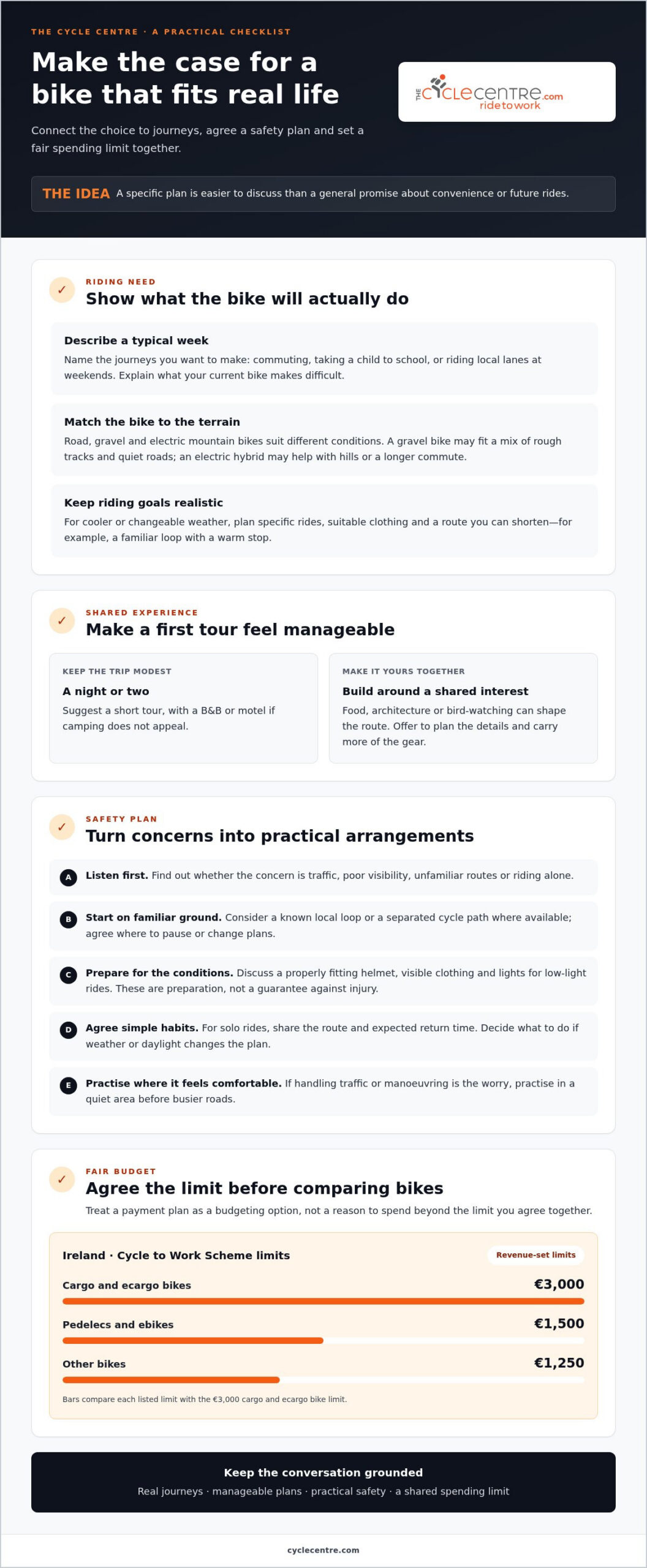
A new bike is easier to justify when it solves a real everyday problem, not just adds another hobby expense. That’s the strongest basis for convincing your partner you need a new bike: explain how it fits your regular journeys, riding goals and budget. In Ireland, Revenue sets Cycle to Work Scheme limits at €3,000 for cargo and ecargo bikes, €1,500 for pedelecs and ebikes, and €1,250 for other bikes.
It’s reasonable to discuss a purchase that affects shared spending. Your partner may have fair questions about cost, safety or how often you’ll use the bike. A practical conversation can address those concerns without turning into a sales pitch.
This guide shows you how to connect your choice to realistic riding goals, explain the everyday benefits of an electric hybrid bike, and discuss safety and spending together. It also covers when a repair or component upgrade may make more sense than replacing your current bike, so you can reach a decision that works for both of you.
Key Takeaways
- Connect the bike to journeys and riding goals you’ll genuinely pursue; for a first tour together, keep the plan manageable and choose an experience you’ll both enjoy.
- Discuss safety concerns calmly by talking through the kind of riding you plan to do and the practical precautions that would help you both feel comfortable.
- Make the purchase a fair conversation: agree a spending limit together and treat any payment plan as a budgeting option, not a reason to exceed it.
- Decide whether to repair, upgrade or replace by considering whether the bike’s condition, fit and type still suit the way you want to ride.
- For Ireland’s Cycle to Work Scheme, Revenue sets limits at €3,000 for cargo and ecargo bikes, €1,500 for pedelecs and ebikes, and €1,250 for other bikes.
Connecting a bike purchase to realistic riding goals
Start with the journeys you’ll actually make, then match the bike to those plans. A specific example, such as commuting, weekend gravel rides or carrying shopping, makes the choice easier to discuss.
To budget as a couple, agree a spending limit before comparing bikes and keep any payment plan within it. In Ireland, Revenue sets Cycle to Work Scheme limits at €3,000 for cargo and ecargo bikes, €1,500 for pedelecs and ebikes, and €1,250 for other bikes.
- Describe a typical week of riding. List the trips you want the bike to make possible, such as cycling to work, taking a child to school or riding local lanes at weekends. Explain what your current bike makes difficult. If an electric hybrid would help with hills or longer commutes, describe those routes rather than making broad claims about convenience. A specific journey gives your partner something practical to assess.
- Choose a different discipline for a clear reason. A road bike, gravel bike or electric mountain bike suits different riding conditions. For example, if your rides now include rough tracks and quiet roads, a gravel bike may better match that mixed terrain. Explain where you expect to ride and why your current bike doesn’t suit it. Avoid treating a new category as an upgrade by itself; connect it to the riding you’ll do.
- Make a first tour manageable. Bike touring can sound like spending months crossing a country in uncomfortable conditions. Instead, suggest a trip lasting a night or two, with a B&B or motel if camping doesn’t appeal. Build the route around a shared interest, such as food, architecture or bird-watching. Offer to plan the details and carry more of the gear, so the proposal feels like a shared break.
- Address safety through a practical plan. If your partner’s concern relates to motorcycling, propose taking a motorcycle safety or advanced riding course as part of your plan. For cycling, explain the routes and riding conditions you intend to tackle, rather than assuming your partner’s concerns are the same. Agree what would make a first ride feel manageable, such as choosing familiar roads together.
- Explain how you’ll extend the riding season. Set out the specific rides you’d like to make in cooler or changeable weather, then identify suitable clothing and a route you can shorten. For instance, plan a familiar loop with a warm stop, rather than promising long rides every weekend. This makes the benefit tangible whilst keeping the proposal grounded in realistic habits.
Addressing a partner’s safety concerns
Ask what concerns your partner most, then respond with a practical plan. Busy roads call for a different conversation than riding after dark.
- Listen before proposing solutions. Invite your partner to name the specific concern, such as traffic, poor visibility, unfamiliar routes or riding alone. Repeat the concern in your own words before replying. If they’re worried about a commute through busy streets, discuss the route and possible quieter alternatives together. Avoid brushing off the worry with “it’ll be fine”; a useful plan starts with understanding what feels risky to them.
- Make the first rides familiar and manageable. Suggest a route you already know, such as a local loop or a separated cycle path where available. Agree where you’ll start, where you can pause and how you’ll change plans if conditions don’t suit you. For example, a short daytime ride together lets your partner see your approach to junctions and traffic without committing to a long journey.
- Talk through equipment without making promises. Discuss a helmet that fits properly, visible clothing and lights for rides in low light. Treat them as part of preparing for the conditions, not as a guarantee against injury. If your partner is concerned about being seen, show how you’ll make yourself more noticeable and choose a route that feels appropriate to your experience.
- Set clear riding habits together. Agree how you’ll share your route and expected return time for solo rides, especially on unfamiliar roads. Decide what you’ll do if weather or daylight changes your plan. For instance, you could choose a shorter alternative route before setting off. These simple arrangements address uncertainty without requiring your partner to control every journey.
- Build confidence through practice. If handling traffic or manoeuvring is the concern, set aside time to practise in a quiet area before using busier roads. For motorcycling, consider a safety or advanced riding course and explain how it fits your plans. Keep the conversation grounded in steps you can take, rather than insisting that a new bike alone will resolve safety concerns. You can also make equipment part of the discussion by considering cycling helmets and apparel suited to your intended rides.
If your partner may ride with you, consider giving them motorcycle safety gear at the same level as your gear. Present it as a way to make shared rides part of the plan, rather than as a response to their concern being unreasonable. Talk together about what they would use and whether it suits the rides you have in mind. This keeps the discussion focused on preparation and gives your partner a say in decisions that affect their comfort.
You can also agree that either of you may pause or change a ride if the conditions feel unsuitable. Choose a familiar route, plan how you’ll get back, and use equipment suited to the ride. After riding together, ask what felt manageable and what still worries your partner. Use that feedback to decide whether to practise more, adjust the route or wait before trying a more challenging ride. The goal is to respect their concerns without treating any equipment as a guarantee of safety.
Discussing hobbies and fairness in a relationship
A respectful approach to convincing your partner you need a new bike starts with listening, not presenting a decision that’s already made. Explain what riding means to you, then make room for your partner’s priorities and concerns.
Choose a calm moment to explain how the bike would fit alongside shared plans and other hobbies. Ask what would make the decision feel fair to both of you.
- Explain the personal value without making demands. Give a specific example of what riding adds to your week, such as time outdoors, a regular commute or a chance to meet friends. Then explain why your current bike doesn’t support that activity well. Avoid insisting on a particular model before discussing its purpose. A conversation about easier weekday journeys is more constructive than an ultimatum about buying a bike.
- Invite your partner to describe their priorities. Ask whether they’re concerned about shared spending, storage space or time away from other plans. Listen before offering a solution. If the issue is a crowded shed, discuss where the bike would live. If the concern is budget pressure, return to the household spending limit rather than arguing that your hobby deserves priority.
- Compare hobby spending fairly. Talk about how each person makes room for interests, including activities that don’t involve cycling. For example, compare the proposed purchase with a planned class, equipment for another hobby or a family outing. The aim isn’t to keep score. It’s to make trade-offs visible and decide together whether the bike fits alongside other priorities.
- Agree on a practical contribution. Offer a clear commitment connected to everyday life. You might take responsibility for planning cycling commutes, maintaining the bike or organising a shared ride. Avoid promises you can’t keep, such as claiming you’ll cycle every day. A realistic plan shows how the bike could be used, rather than relying on enthusiasm alone.
- Leave room for a joint decision. Summarise what you’ve heard and agree on a next step together. You might revisit the household budget or compare the bike’s intended use with your current one. If convincing your partner you need a new bike still feels difficult, ask which concern remains unresolved. A fair conversation can lead to further discussion, without pressuring either person to agree immediately.
Assessing bike condition, fit and recurring limitations
Compare the repair needed with the bike’s intended use, then consider its fit, condition and any recurring faults. Repair makes sense for a specific fault if the bike still meets your riding needs. Replacement may be worth considering if its type, fit or condition no longer does.
For a fair comparison, weigh the required repair against the cost of a suitable replacement. Neither option is automatically better.
Compare buying with repairing
List the fault, the repair required and any other problems affecting regular rides. Compare options that meet the same practical need, rather than weighing one repair against a replacement designed for different uses.
- Identify the fault. Describe what happens, such as a gear slipping repeatedly or a brake needing attention. Keep the example specific.
- Compare the options. Consider the repair’s scope alongside the replacement bike’s suitability, including whether the old bike will still fit your routes.
- Consider repeated issues. If separate faults keep interrupting rides, note their effect on the bike’s reliability and usefulness.
Explain why your bike needs replacing
Explain how your current bike falls short of the riding you now want to do. Age alone isn’t proof that it needs replacing. Describe whether its fit, condition or type is creating a recurring limitation.
- Give a real example. Explain, for instance, that the bike’s fit makes regular commuting uncomfortable, or its design doesn’t suit the rougher routes you now ride.
- Connect the limitation to your goal. Describe what you want to do, what currently prevents it and how a different type of bike addresses that mismatch.
- Separate preference from need. A component upgrade can address a specific limitation when the rest of the bike works for you. Replacement is more persuasive when the bike’s overall fit, condition or type no longer aligns with your plans.
- Share your reasoning clearly. Tell your partner which issue matters most and why. For example, a bike that handles local roads well may still be poorly suited to the off-road rides you’re planning.
Keep the comparison grounded in how you use the bike, not frustration alone. A specific fault may call for a repair; a repeated mismatch between the bike and your riding goals may support replacing it.
Start with the part of riding that no longer works for you. Describe the limitation clearly: does the bike’s fit, condition or type get in the way of the journeys you want to make? Then consider whether a repair or adjustment could address that issue, or whether the mismatch affects the bike more broadly. This keeps the discussion focused on what the bike can do, rather than a general feeling that it’s time for something different.
Replacing a bike may be worth considering when its fit, condition or type no longer suits your goals. Explain how that applies to your plans, and distinguish a recurring obstacle from a preference that a component change could address. If the bike still suits your intended use apart from a specific fault, acknowledge that repairing it is a reasonable option. If its overall suitability has changed, explain what kind of bike would better match the riding you want to do.
Exercise and commuting benefits
Make your case with everyday journeys, not ambitious plans you may never follow through on. A commute, regular errand or weekend ride shows how a suitable bike could fit your routine.
- Map a real commute. Write down the start point, destination and roads you’d use, then explain how cycling could fit around your working day. For example, if your route includes a steep hill, describe where it appears and how it affects your journey. An electric bike may make that route more manageable, whilst a conventional bike may suit flatter roads and a lighter routine. Keep the example specific to your commute.
- Describe the exercise you’ll actually do. Link riding to a repeatable habit, such as cycling to work on suitable days or taking a local loop after work. Avoid promising a fixed number of rides if your schedule changes from week to week. Instead, identify the days or journeys where cycling is realistic. This gives your partner a grounded picture of how the bike could support regular activity, without overstating the outcome.
- Show how a bike fits practical errands. Use a familiar example, such as cycling to the shop, visiting a friend nearby or combining a journey with the school run. Consider the route, what you need to carry and where you’ll secure the bike at your destination. If the trip involves bags or changing terrain, explain what type of bike would suit those needs. A practical use case makes the purchase easier to assess than a vague promise to ride more.
- Set out the Irish scheme limits accurately. Revenue sets Cycle to Work Scheme limits at €3,000 for cargo and ecargo bikes, €1,500 for pedelecs and ebikes, and €1,250 for other bikes. Treat the scheme as one part of the household budget, not permission to exceed the spending limit you’ve agreed together. Discuss which bike category matches your intended journeys before considering how the purchase fits your finances.
- Agree a trial routine and review it. Choose a realistic commute or errand to begin with, then discuss what would help you stick with it. For example, plan where the bike will be stored and how you’ll carry work essentials. Agree to review the routine after you’ve used it in everyday life. If you’re comparing options for regular journeys, explore bikes suited to commuting and relate each choice to the route you’ve mapped.
The Cycle Centre: Bike to work
The Cycle Centre offers Cycle to Work as an option to consider when a new bike supports your regular commute. Revenue sets scheme limits at €3,000 for cargo and ecargo bikes, €1,500 for pedelecs and ebikes, and €1,250 for other bikes. Keep those limits distinct from your household spending agreement, and choose a bike category that suits the journeys you intend to make.
If your commute involves everyday roads, an E-city bike may suit your plans; for mixed surfaces, consider a Gravel and Adventure Bike. The right choice depends on your routes and riding goals, not simply the scheme limit. To discuss your bike options, contact The Cycle Centre.
Make your next ride part of the conversation
A bike can be more than a personal purchase if it supports how you both want to spend your time. If convincing your partner you need a new bike has become a sticking point, shift the discussion from seeking approval to deciding together what place riding could have in your everyday life.
The Cycle Centre offers Bike to Work, Cycle to Work and Ride to Work, which you can consider as you plan your next step. Bring your riding goals and preferred bike type into the conversation, then explore which option suits your plans. For a free, no-obligation quote, use the online application. A clear, shared decision can make your first ride feel like the start of something you’ve chosen together.
Contact The Cycle Centre to discuss your next bike. Take the conversation one ride at a time, and look forward to the journeys ahead.
Frequently Asked Questions
How can I explain the benefits of an electric hybrid bike to my partner?
Explain how an electric hybrid bike could suit a specific journey, such as a hilly commute or a route where you carry work essentials. Electric assistance can make pedalling feel more manageable, while a hybrid design suits everyday riding. Focus on the trip you’d use it for, then discuss whether that practical difference matters enough to justify changing bikes.
What if my partner thinks my current bike is good enough?
Ask what “good enough” means to your partner, then compare that view with how you actually use the bike. If it works well on your regular routes, keeping it may be sensible. If a recurring problem affects a journey you want to make, explain that specific gap. A calm conversation about the bike’s role can help you distinguish a genuine need from a preference for something new.