


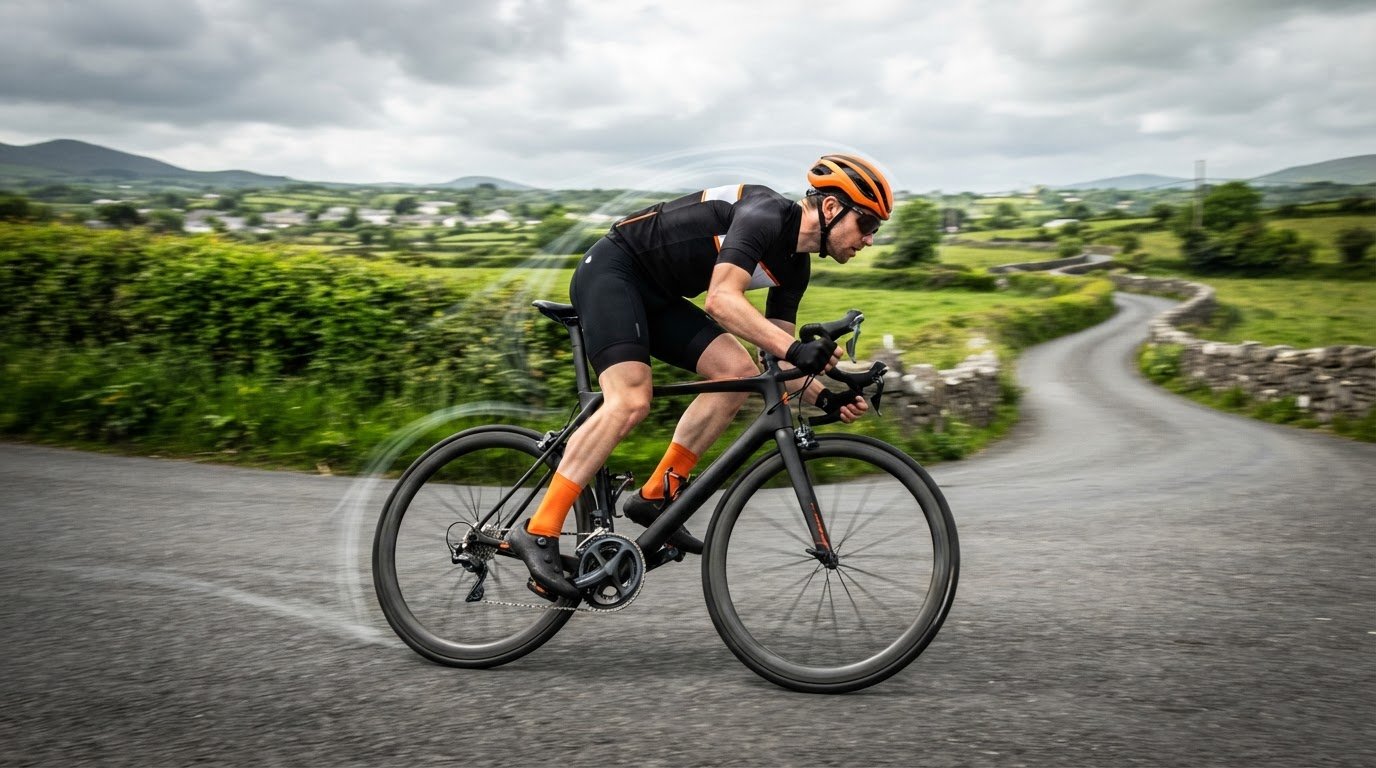
Grinding harder through the pedals is often the slowest way to build real pace on the road. If you have spent months pushing higher heart rates only to watch your bike computer stay stubbornly fixed on the same numbers, you already know how exhausting that plateau feels. Battling punishing headwinds and draining your legs ten kilometres into a weekend spin is intensely frustrating, yet true velocity rarely comes from sheer physical punishment. Learning how to improve cycling speed is fundamentally an exercise in eliminating resistance across your posture, your training habits, and your mechanical setup.
With practical, targeted refinements, you can sustainably lift your average pace by 2 to 5 km/h while expending noticeably less energy. In this guide, we walk through the exact steps needed to unlock genuine road efficiency, from mastering aerodynamic positioning to slice through gusty conditions to dialling in tyre pressures, eliminating drivetrain friction, and structuring smart on-bike fuelling.
Key Takeaways
- Understand how to improve cycling speed primarily through body positioning, since rider posture accounts for the vast majority of aerodynamic drag.
- Eliminate hidden friction by dialling in proper tyre pressures and keeping your drivetrain thoroughly cleaned and lubricated.
- Build sustainable endurance and a higher cruising pace by pairing disciplined Zone 2 base training with targeted intervals.
- Conserve critical watts on group outings by mastering paceline drafting and smoothing out your climbing efforts.
- Prioritise high-impact bike components and apparel upgrades that deliver noticeable rolling efficiency without unnecessary expense.
Mastering Rider Aerodynamics: Unlocking Free Speed on the Road
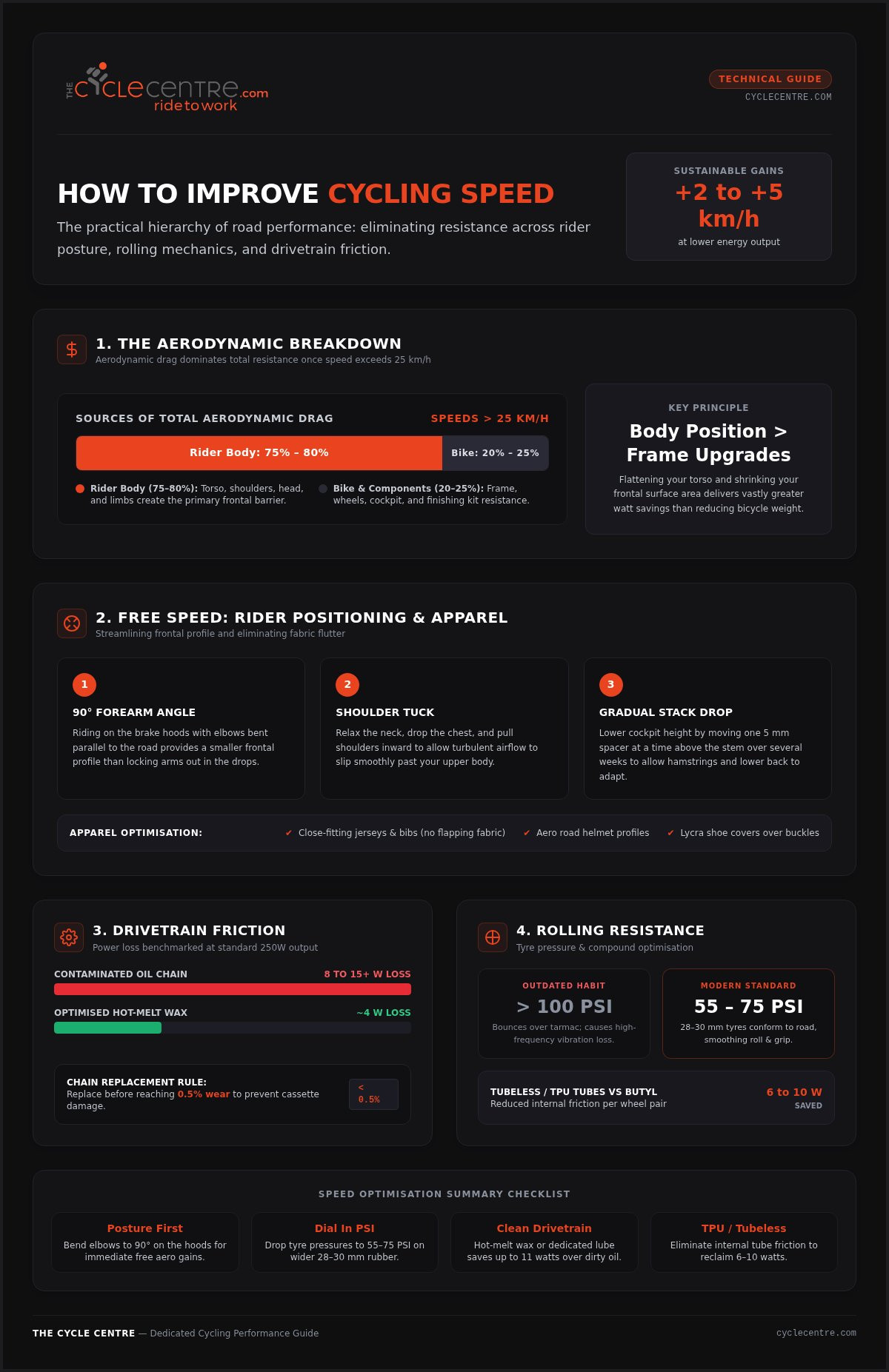
Many cyclists assume that travelling faster requires an expensive aerodynamic bike frame. The physical reality is quite different. The fundamental physics of bicycle performance shows that aerodynamic drag dominates total resistance once your pace exceeds 25 km/h, and your body accounts for roughly 75% to 80% of that total drag. The bike frame and components generate only the remaining 20% to 25%. Understanding this hierarchy is the true secret of how to improve cycling speed without spending a fortune.
Every watt saved in frontal resistance translates directly into free velocity on flat roads and descents. By prioritising your body position and clothing before considering hardware upgrades, you cut through the wind efficiently whilst keeping your heart rate significantly lower.
Adjusting Cockpit Position and Posture
Your upper body acts like a wide sail in the wind. Dropping from a high, upright position down into the brake hoods with horizontal forearms dramatically shrinks your frontal surface area. To dial in an efficient posture safely, focus on these essential adjustments:
- Bend your elbows parallel to the road: Riding on the hoods with elbows bent at 90 degrees delivers a smaller frontal profile than locking your arms out in the drops.
- Tuck your shoulders inward: Actively relax your neck, drop your chest, and bring your shoulders slightly inward to let airflow slip past cleanly.
- Lower stem spacers gradually: Move one 5 mm spacer at a time above your stem over several weeks, allowing your lower back and hamstrings to adapt to a lower stack height.
Rule of thumb: Frontal surface area reduction is your primary speed lever; flattening your torso always yields bigger gains than shaving weight off a frame.
Streamlining Cycling Apparel and Helmets
Flapping fabric creates massive aerodynamic turbulence that saps forward momentum. Swapping a loose jacket for close-fitting, breathable cycling jerseys and tailored bib shorts immediately eliminates that unnecessary resistance. Choosing modern cycling helmets engineered with wind-tunnel tested profiles further smooths the boundary layer over your head, where air first hits you. Adding sleek lycra shoe covers over exposed buckles and dials rounds off the system, proving that small refinements in rider gear deliver the most accessible answer for how to improve cycling speed across open, exposed roads.
Mechanical Efficiency: Eliminating Drivetrain Friction and Rolling Resistance
Pedalling hard into a mechanically compromised setup wastes precious watts before your power even reaches the tarmac. Independent testing by Zero Friction Cycling reveals that a contaminated, oil-lubricated chain robs between 8 and 15+ watts at a standard 250W output, whereas an optimised hot-melt wax treatment limits losses to roughly 4 watts. Eliminating parasitic resistance across your drivetrain and wheels represents a direct, cost-effective blueprint for how to improve cycling speed on every single ride.
Optimising Tyre Pressure and Compound Selection
Pumping tyres past 100 PSI is an outdated habit that actively slows you down. Hard tyres bounce across coarse tarmac, causing high-frequency vibration losses that sap forward momentum. Modern 28 mm and 30 mm road tyres running between 55 and 75 PSI conform to rough road surfaces, smoothing out your rolling resistance and boosting grip. Upgrading to supple tyres paired with lightweight TPU tubes or a tubeless setup reduces internal friction significantly, saving 6 to 10 watts per wheel pair compared to heavy standard butyl tubes.
Deep Drivetrain Care and Chain Lubrication
Road grit mixes with factory grease to form an abrasive grinding paste on jockey wheels and cassette teeth. To stop this power loss, strip your chain completely in a degreaser before applying a dedicated drip wax or high-performance wet lube designed for changeable, damp weather. Keep a chain wear indicator tool in your saddlebag; replacing a chain before it passes 0.5% wear prevents expensive wear across your cassette teeth and preserves crisp gear changes.
The Role of Professional Workshop Servicing
Home maintenance handles routine cleaning, but micro-frictions often hide inside sealed bearings and misaligned hangers. A bent derailleur cage causes subtle chain rub and phantom gear slips during hard sprints, disrupting your pedalling rhythm. Dialling in efficient power transfer aligns directly with USA Cycling’s cadence and power guidelines, which demonstrate how mechanical fluidity supports sustained endurance over undulating terrain.
When you want to ensure bottom brackets, hub bearings, and indexing operate under peak tolerances, book your machine in for a comprehensive Workshop Silver Service or Workshop Gold Service. Seasoned technicians eliminate the subtle mechanical drags that quietly drain your legs, ensuring every pedal stroke propels you forward without resistance.
Physiological Adaptations: Training Protocols to Elevate Your Cruising Pace
Aerodynamic posture and smooth mechanics give you free momentum, but holding high speeds over forty, sixty, or a hundred kilometres requires cardiovascular stamina. Hammering at full gas every time you leave the house quickly leads to chronic fatigue rather than real gains. Discovering how to improve cycling speed over distance rests on cultivating your aerobic engine so that faster tempos feel comfortable rather than punishing.
A resilient aerobic foundation expands your physiological ceiling. When you pair consistent endurance work with targeted intervals, your cruising velocity rises naturally without driving you into muscular failure.
Building the Aerobic Base with Zone 2 Riding
Channelling roughly 80% of your weekly riding hours into low-intensity Zone 2 work is the proven bedrock of endurance cycling. This conversational pace stimulates mitochondrial development and increases capillary density around working muscles, training your system to metabolise fat stores efficiently whilst conserving limited glycogen. Riding at an easy, conversational pace builds deep aerobic stamina without inducing systemic muscular breakdown or burnout.
Targeted High-Intensity Intervals and Cadence Drills
Once your aerobic base is established, dedicating the remaining 20% of your weekly volume to intensity elevates your Functional Threshold Power (FTP). These structured workouts sharpen your top-end speed:
- Sweet-spot intervals: Complete two 15-minute blocks at 88% to 94% of your maximum sustainable threshold. This lifts your flat-road pace efficiently without requiring days of recovery.
- VO2 max hill repeats: Attack three-to-five-minute climbs at maximum sustainable effort, recovering fully on the descent across four to six repetitions.
- High-cadence spin-ups: Practise unweighted pedalling drills holding 100 to 110 RPM on flat tarmac for three-minute stints to eliminate jerky dead spots in your pedal stroke.
Shifting your everyday pedalling cadence from a heavy 70 RPM grind to a fluid 85 to 95 RPM redistributes workload away from tired quadriceps onto your cardiovascular system. This simple motor change provides an enduring answer for how to improve cycling speed, keeping your legs fresh when you need to match sudden surges on open country roads.
On-Bike Tactics: Smart Pacing, Drafting, and Energy Management
Reaching high velocities is only half the battle; maintaining that tempo over hours demands clever tactical discipline. Many riders sabotage their average pace early by charging up short climbs, spiking their heart rate, and blowing through critical energy stores. Learning how to improve cycling speed involves managing physical resources methodically so you have ample reserves to power through late kilometres.
Strategic momentum management transforms your output on undulating routes. Small tactical shifts keep your kinetic energy high whilst sparing your legs from early exhaustion.
Strategic Pacing on Gradients and Headwinds
Surging hard uphill is a costly mistake. Aerodynamic resistance drops sharply at lower climbing speeds, meaning big watt spikes yield tiny time advantages whilst generating debilitating lactic acid. Cap your effort on ascents, selecting easier gears to spin steadily. Once over the crest, tuck into a tight crouch and pedal smoothly over the top to carry speed into downhill descents. When battling blustery headwinds, resist the urge to wrestle the bike; settle into a narrow tuck, maintain a steady cadence, and wait for tailwind sections where aerodynamic positioning lets you fly.
Group Riding Dynamics and Safe Drafting
Wind tunnel testing confirms that sitting directly behind a leading rider cuts your aerodynamic drag by 25% to 30%, whilst deep positioning inside a paceline can slash resistance by over 40%. Mastering this slipstream is an essential skill:
- Hold smooth lines: Follow the wheel ahead within half a metre without touching brakes abruptly, feathering pedal pressure instead to match speed.
- Rotate consistently: Take short, controlled pulls at the front of the paceline before flicking your elbow and sliding smoothly to the back.
- Communicate early: Point out potholes, road debris, and oncoming hazards clearly to protect everyone’s rhythm.
Fuelling and Hydration for Consistent Speed
Your pace drops rapidly once muscle glycogen runs empty. To sustain a high tempo, take in 30 to 60 grams of easily digestible carbohydrates every hour through chews, bananas, or energy bars, starting within the first thirty minutes of your ride. Sip an electrolyte mix consistently to avoid muscle cramps and mental sluggishness. If you want a setup tailored to long-distance efficiency, explore our performance road bicycles and cycling apparel to equip yourself with the endurance gear needed to ride faster across every outing.
Targeted Equipment Upgrades: High-Value Investments for Faster Riding
While dialling in your posture delivers rapid progress, tactical hardware upgrades compound those physical gains. You do not need to replace every part of your setup at once to feel a meaningful difference. Understanding which bike components yield measurable aerodynamic and rolling returns gives you a clear roadmap for how to improve cycling speed without unnecessary expense.
Targeted adjustments create cumulative speed dividends. Upgrading the key contact points between you, the bike, and the road eliminates mechanical drag and channels your full power output forward.
The Most Cost-Effective Speed Upgrades
Investing in your wheels and contact points offers exceptional speed returns per euro spent. Fitting race-calibre folding road tyres with advanced silica compounds lowers rolling resistance immediately. Installing narrower, ergonomically shaped handlebars pulls your shoulders inward, shrinking your frontal profile against the wind. Pairing stiff-soled cycling shoes with stable clipless pedals prevents sole flexion, ensuring every pedal stroke transfers uninterrupted drive directly into the crankset.
Upgrading to a Dedicated Performance Road Machine
When you outgrow an entry-level commuter frame, stepping up to dedicated road performance bicycles unlocks a noticeable leap in responsiveness. Lightweight carbon or double-butted aluminium frames engineered by industry leaders like Giant and Cube feature truncated aero tube profiles and stiff bottom bracket shells designed for sharp acceleration. Working with a specialist fitter ensures the frame geometry matches your flexibility, giving you an aggressive yet sustainable position that lets you hold higher speeds comfortably over dozens of kilometres.
Maximising Value Through the Cycle to Work Scheme
Upgrading your cycling setup does not have to strain your wallet. Utilizing Ireland’s approved national cycling initiatives allows you to purchase high-performance equipment completely tax-free through salary sacrifice. You can package new road performance bicycles with protective cycling helmets and apparel, alongside essential bike components, saving substantially across higher or standard tax bands.
Consult The Ultimate Guide to the Bike to Work Scheme Ireland 2026 to structure your application efficiently. When you are ready to assemble your ideal performance setup, request a quote with The Cycle Centre for reliable advice and nationwide delivery.
Turn Every Watt into Sustainable Road Velocity
Unlocking greater pace is rarely about pure physical punishment. As you have seen, mastering how to improve cycling speed comes down to a harmonious balance of refined aerodynamics, disciplined base training, and friction-free mechanical efficiency. Dialling in your cockpit posture, rolling on supple tyres at calibrated pressures, and pacing your efforts intelligently will instantly yield faster splits across your regular routes.
When you are ready to eliminate subtle mechanical drag or upgrade your ride, dedicated support makes all the difference. Serving cyclists nationally since 1974 with expert guidance and support, The Cycle Centre is an official stockist for premier performance brands including Giant and Cube, backed by a Shimano accredited workshop offering professional Silver and Gold servicing. Explore performance road bikes and book your workshop service at The Cycle Centre to start riding faster, smoother, and with complete confidence on every spin.
Frequently Asked Questions
How much faster does an aerodynamic body position make you on a road bike?
Transitioning from an upright posture to a tucked position on the hoods or drops typically increases your speed by 2 to 4 km/h for the exact same power output. Because your body creates roughly 80% of aerodynamic drag, bending your elbows horizontally shrinks your frontal profile substantially. This simple postural adjustment offers the single largest watt-saving leap available on a road bicycle, requiring zero financial expenditure.
Does lowering your tyre pressure really make you ride faster on tarmac?
Yes, reducing tyre pressure to modern standards between 55 and 75 PSI genuinely improves speed over typical outdoor asphalt. Historical 100+ PSI pressures cause tyres to bounce microscopically over rough aggregate, converting kinetic energy into vertical vibrations. Supple tyres conforming to the road absorb these surface chatter losses, delivering lower overall rolling resistance, better cornering grip, and improved rider comfort over long distances.
How long does it take to improve your average cycling speed significantly?
You can see immediate improvements of 1 to 3 km/h on your next ride simply by adjusting your posture, dialling in tyre pressures, and wearing fitted apparel. However, developing the cardiovascular conditioning required for sustaining higher speeds across 50 to 100 kilometres takes roughly six to twelve weeks of disciplined Zone 2 riding and interval training. Consistency across both mechanics and physiology is how to improve cycling speed permanently.
What is the best pedalling cadence for sustaining high speeds on flat roads?
A cadence between 85 and 95 RPM is generally optimal for holding steady, high speeds without exhausting your legs. Grinding below 75 RPM places heavy torque on knee joints and depletes fast-twitch muscle fibres quickly. Spinning at roughly 90 RPM shifts the metabolic workload from muscular force to your cardiovascular system, enabling you to produce sustainable wattage while delaying muscular fatigue on flat, windy sections.
Can I buy a high-performance road bike through the Cycle to Work scheme?
Yes, you can purchase qualifying road performance bicycles, cycling helmets, and precision apparel through Ireland’s Cycle to Work scheme. Participating employees can save up to 52% of the retail cost through pre-tax salary deductions, depending on their individual tax bracket. The Cycle Centre facilitates this scheme nationally, helping riders acquire race-calibre models from world-class manufacturers like Giant and Cube with minimal administrative friction.
How many watts can you save by cleaning and lubricating your bicycle chain?
Switching from a dirty, contaminated chain to a clean, well-lubricated drivetrain saves between 8 and 15 watts under standard 250W pedalling loads. Gritty road sludge forms an abrasive paste that grinds down sprockets and resists roller articulation. Regularly degreasing your components or upgrading to hot-melt wax immersion preserves power transfer and remains an essential step in learning how to improve cycling speed mechanically.
Is it better to upgrade your wheels or buy a lighter bicycle frame?
Upgrading your wheelset to mid-depth aerodynamic rims delivers far greater speed gains on real-world routes than simply buying a lighter frame. Aerodynamic drag dominates rolling physics on any gradient below 6% to 7%, meaning deep-section wheels slice through the air and carry rolling momentum much more effectively than shedding a few hundred grams from a chassis. Wheels also provide instantaneous improvements in responsiveness and ride feel.
Why do I lose so much speed when riding into strong headwinds?
You lose speed because wind resistance scales with the square of your relative velocity, but the power needed to overcome it scales with the cube of that speed. Riding at 30 km/h directly into a 20 km/h headwind creates an effective 50 km/h aerodynamic wall. Surging recklessly against this force drains glycogen rapidly; dropping your shoulders, tucking your elbows, and holding a steady tempo is far more effective.