


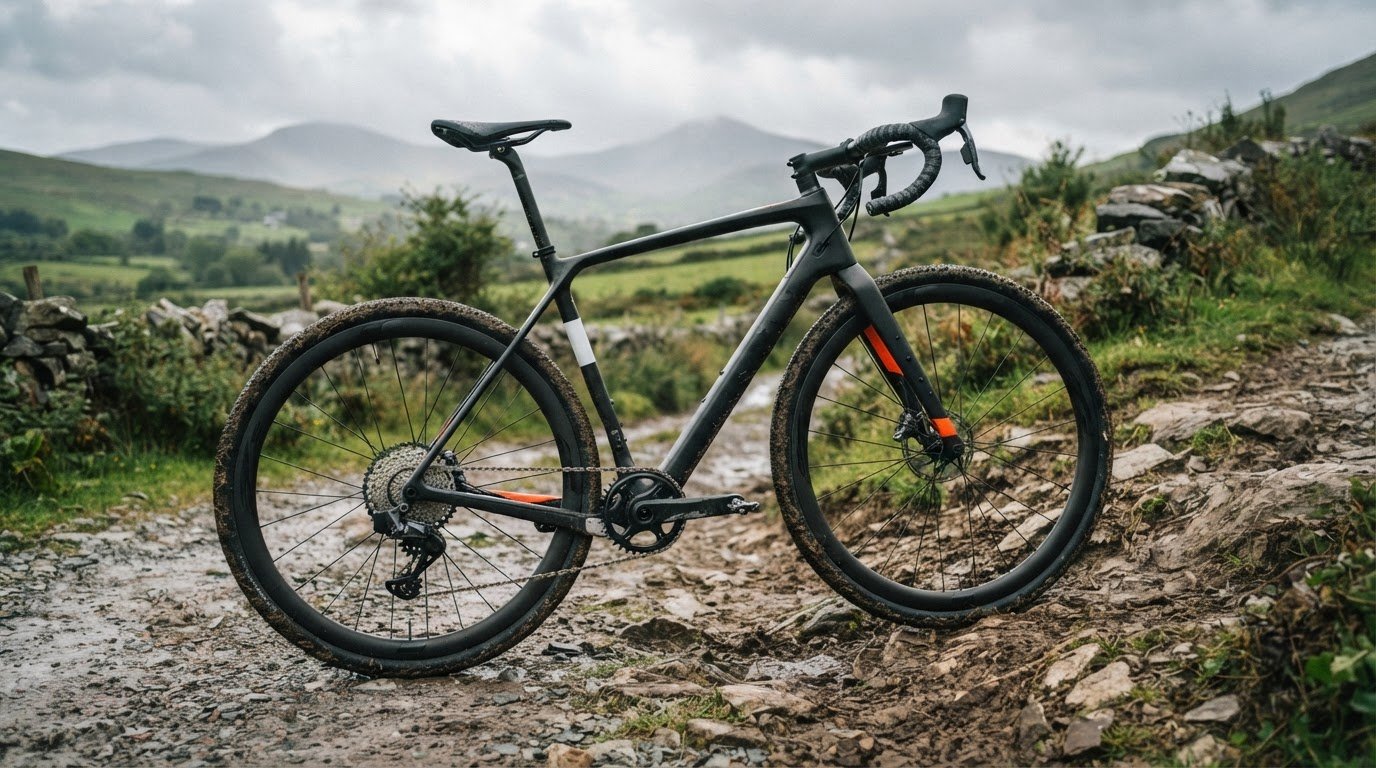
For a gravel bike setup for racing, choose 1x for simpler shifting and chain retention on rough, muddy courses; choose 2x for tighter gear steps and a broader range when the route mixes road and gravel. For varied terrain, match your cassette’s climbing gears to the steepest sections, then set tubeless pressure to balance grip, comfort and speed. Tyres around 35-45 mm wide suit 700c wheels across mixed surfaces.
It’s tempting to focus on the biggest gear or lightest wheelset, but the best gravel bike setup for racing depends on the course beneath your tyres. Loose climbs, smooth tarmac and hard-packed tracks each place different demands on gearing and wheels.
This guide will help you decide between 1x and 2x, select a cassette range that keeps you turning the pedals, and find a sensible starting pressure for tubeless tyres. You’ll also learn how to match wheel size and tyre width to the terrain, so your setup feels composed where grip matters and efficient where speed counts.
Key Takeaways
- Choose 1x for straightforward shifting and chain retention on rough routes, or 2x when closer gear steps suit a mix of road and gravel.
- Set tubeless pressure around the surface and your need for grip, comfort or speed; use a sensible starting point, then fine-tune how the bike feels.
- Match your cassette’s easiest gear to the steepest climbs so you can keep pedalling smoothly when the terrain gets demanding.
- Consider 700c wheels for faster mixed-terrain riding and 650b wheels when technical trails call for wider tyres and added comfort.
- Prioritise a comfortable cockpit and tyre choice that fits the course, rather than copying another rider’s race setup.
Gearing: Is Your Gravel Setup Fast Enough for Road?
- Set your cockpit around a comfortable, repeatable position, not a theoretical aerodynamic ideal. For gravel riding, handlebar width should generally match your shoulder width; a bar that feels too wide can make a low road position harder to hold. A 380 mm handlebar is one race setup example, not a universal fit. Check that your hands sit securely on the hoods and drops, with room to steer over rough ground. Comfort matters because endurance riding makes small pressure points increasingly distracting.
- Test stem length before committing to an integrated cockpit. Gravel stems may be 70 or 80 mm long to help steering on awkward trails and reduce effective reach. The example rider tested four stem lengths over the last half a year, showing how small changes can alter both position and control. If your bike allows it, keep an adjustable external cockpit for around 10,000 miles before switching to a one-piece or fully integrated setup. The author rode for four years before making that change.
- Balance wheel aerodynamics against crosswind control on Ireland’s exposed roads. A deeper rim can support a more aerodynamic setup, but gusts may influence steering, particularly when riding along open coast or farmland. Choose a wheel profile you can control with relaxed hands, rather than chasing speed alone. The road-bike advantage becomes meaningful above 38-40 kph on flat terrain; below that, position, tyres and pacing also matter. Practise holding your line before taking an unfamiliar wheel setup into a fast group ride.
- Assess your gravel bike’s geometry on both tarmac and loose ground. Stable steering can help on broken tracks, while a relaxed position may feel less immediate during quick changes of direction on the road. Ride the same bike on a smooth road and a rough lane, then compare how easily you can hold the hoods, look ahead and turn. A shorter stem can reduce reach and help on awkward trails, but it also changes steering response. Make one adjustment at a time and repeat the same route.
- Practise handling skills that road speed alone won’t teach. On loose corners, look through the turn and steer smoothly instead of making sudden corrections. On descents, control your speed before the corner, then ease off the brakes as you turn. On seated climbs, keep pedal pressure steady to preserve rear-wheel traction. Repeat these drills on a quiet gravel track before race day. Practice helps your cockpit position and wheel choice work together as the surface changes.
Tyre pressure for tubeless gravel tyres on tarmac
Tubeless tyres use sealant instead of an inner tube, which can seal some small punctures but won’t prevent every puncture. For Irish routes, choose tyre width, tread and pressure to suit the actual mix of tarmac, mud, stones and distance.
-
Choose tyre width and tread
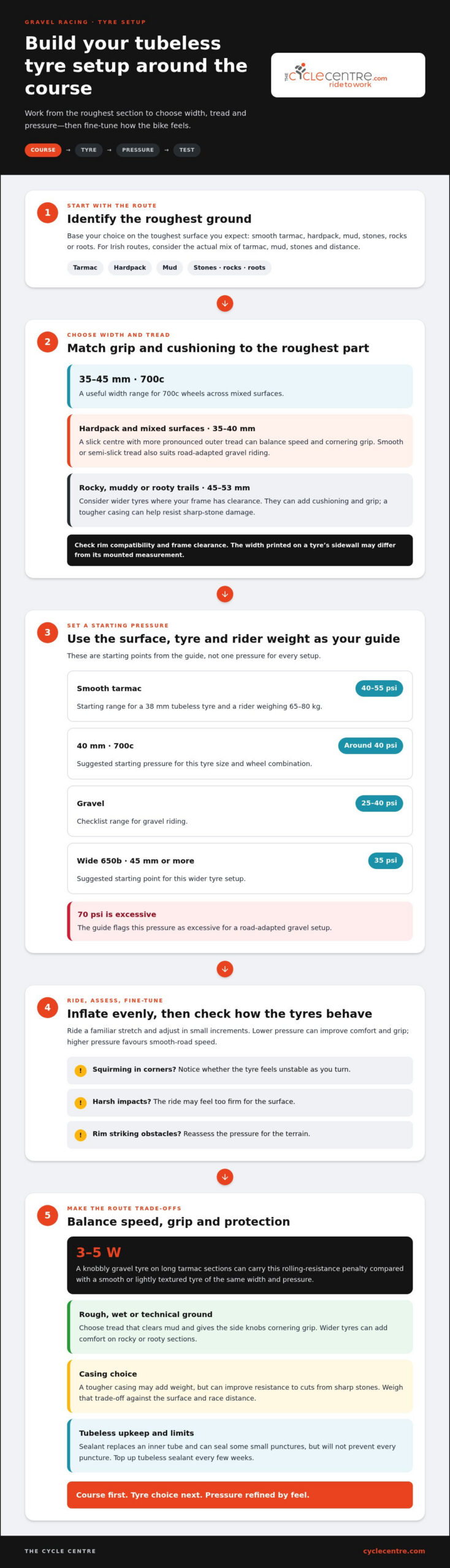
Start by matching tyre width and tread to the roughest part of your route. For hardpack and mixed surfaces, 35-40 mm tyres with a slick centre and more pronounced outer tread can balance speed and cornering grip. A 35-40 mm smooth or semi-slick tyre also suits a gravel bike adapted for road riding.
For rocky, muddy or rooty trails, consider 45-53 mm tyres where your frame has clearance. Wider tyres can offer more cushioning and grip, while a tougher casing helps resist damage from sharp stones. Check the tyre’s stated width against rim compatibility and frame clearance; the width printed on the sidewall may differ from its mounted measurement.
-
Set pressure for tarmac
Begin with a pressure suited to tyre width, rider weight and surface. For a 38 mm tubeless tyre and a rider weighing 65-80 kg, 40-55 psi is a starting range for smooth tarmac. A 40 mm 700c tyre has a suggested starting pressure of around 40 psi. By contrast, 70 psi is excessive for a road-adapted gravel setup.
On gravel, the checklist range is 25-40 psi. A wide 650b tyre of 45 mm or more has a suggested starting point of 35 psi. Lower pressure can improve comfort and grip, whilst higher pressure favours smooth-road speed. Inflate both tyres evenly, ride a familiar stretch, then adjust in small increments. Watch for squirming in corners, harsh impacts or the rim striking obstacles.
-
Adapt tyres to route conditions
For wet, muddy gravel, favour tread that clears debris and gives the side knobs grip when cornering. On rocky or rooty sections, a wider tyre can add comfort and help maintain control. Use pressure low enough for the tyre to follow the ground, but not so low that it folds in turns or bottoms out on impacts.
On a route with long tarmac sections, a knobbly gravel tyre can carry a 3-5 W rolling-resistance penalty compared with a smooth or lightly textured tyre of the same width and pressure. A tougher casing may add weight, but can improve resistance to cuts; choose the trade-off around the surface and race distance. Top up tubeless sealant every few weeks. Compare gravel bike options against your tyre-clearance needs.
Cassette range and gearing for varied terrain
Choose gearing around the steepest climb and fastest road section on your course. A gravel bike setup for racing should balance climbing range, cadence and the choice between 1x and 2x.
-
Choose race gearing and drivetrain
Pick 1x for simpler shifting, lower weight, better chain retention and fewer chainrings to collect mud and debris. It suits rough gravel races where dependable gear changes matter. Choose 2x if the course combines road and off-road sections: two chainrings can provide a wider range and tighter gear jumps. That can make it easier to hold a comfortable cadence as speed changes. Neither option is automatically optimal; compare the course profile with the gears you use most.
On a mixed route, test both your easiest climbing gear and the shifts between adjacent sprockets. Avoid gearing that leaves you grinding uphill or searching between awkwardly spaced gears on faster sections.
-
Set cassette range for varied terrain
Match the cassette’s largest sprocket to the steepest climbs you expect. An 11-42T or 10-50T cassette can help on steep or off-road climbs, letting riders keep spinning and maintain traction. Many gravel bikes have a lowest gear ratio of 1:1 or lower. For a 1x setup, consider whether that climbing range still gives you useful steps on flatter terrain.
A 10-45t cassette has smaller gear jumps than a 10-51t cassette, which can help maintain cadence when pace changes are subtle. A wider-range cassette offers an easier low gear, but its larger jumps may feel more noticeable. A mullet setup pairs a gravel-style front drivetrain with a wide-range mountain-bike cassette; check that the derailleur and drivetrain are designed to work together.
-
Select chainring size
Choose the chainring after deciding on cassette range, rather than judging its tooth count alone. A larger ring makes each gear harder and can help on faster terrain; a smaller ring reduces effort on climbs. One first-time racer used a 46t chainring with a 10-51t cassette, while another rider’s setup changed from 42t to 46t. These examples show how course demands can shape gearing.
For double setups, Shimano GRX offers a 48/31t combination, while SRAM Wide Force and Rival chainsets use 43/30t rings. Compare the easiest combination for climbing and the hardest for road speed. Keep the full range usable for the conditions you’ll actually race.
-
Match gearing to road speeds
Check that your hardest gear lets you pedal comfortably on the course’s fastest road sections. A 40t or 42t chainring with an 11-28 or 11-32 cassette can cover most road rides up to 50 kph in a sprint. That example is a reference point, not a target every gravel racer needs to match.
For routes with long tarmac stretches, prioritise closer gear steps and a suitable high gear. On rolling or steep terrain, preserve your climbing range. Test the gearing on a familiar loop with a climb and a fast section. Note where your cadence feels strained, then adjust the chainring size or cassette range to suit your gravel bike setup for racing.
Wheel choice for wide gravel tyres
Treat the applicable race regulations as the authority on permitted equipment. The recommendations below are performance guidance, not universal UCI or Irish rules. Match rim width, wheel size and tyre clearance to your route before choosing a race wheelset.
-
Match wheels to wide gravel tyres
Pair 35-45 mm tyres with 700c wheels for faster riding across mixed surfaces. For 47-53 mm tyres, 650b wheels suit technical trails and can provide greater comfort. Before buying, check your frame’s tyre clearance and the rim’s internal width: gravel rims commonly measure 23-27 mm internally. A rim that is too narrow or too wide for the tyre can affect its shape and support, so check that both components are compatible.
Use the intended tyre, not just its sidewall width, to guide the match. A 45 mm tyre may measure differently once fitted to a particular rim.
-
Choose gravel race wheelsets
Choose a gravel race wheelset to suit the course’s roughest surfaces and your preferred tyre width. A sturdy, compatible setup matters more than a claimed weight saving when loose stones or rough tracks dominate the route. Check the rim’s internal width, the tyre’s recommended fit and the frame’s clearance together. These determine whether the tyre is properly supported and can be used as intended.
For example, gravel rims with 23-27 mm internal widths cover a useful range of tyre choices. Consider the full race load, including a bottle and any carried repair kit, when assessing how the wheels handle impacts. Prioritise predictable control over a wheel choice made solely for smooth tarmac.
-
Consider road-optimised wheelsets
If your gravel race includes substantial road riding, consider a road-optimised wheelset with 35-50 mm depth and 23 mm internal width. Rim depth can support aerodynamic performance, but a deeper profile may feel more affected by crosswinds. Choose a setup you can control on exposed roads, rather than selecting depth by appearance alone.
The 105% rule describes an aerodynamic guideline: the rim should be at least 105% of tyre width to gain aerodynamic benefits. Treat this as a design consideration, not a guarantee of faster riding. Compare tyre width with rim shape, then test handling on the surfaces you expect during your race.
-
Select between 650b and 700c wheels
Choose 700c for 35-45 mm tyres when speed across mixed terrain is the priority. Select 650b for 47-53 mm tyres when technical trails and comfort weigh more heavily. A 650b wheel is equivalent to a 27.5-inch mountain-bike wheel, which can help when comparing wheel sizes. Check your frame clearance before changing wheel diameter or tyre width.
For a road-leaning gravel race, 700c may suit the mix of tarmac and hard-packed tracks. For rougher routes, a 650b setup can accommodate wider tyres. Test the complete wheel-and-tyre combination before race day, including braking and cornering on familiar surfaces.
Racing-oriented gravel bike setup
There’s no single competitive weight or typical cost that defines a race-ready bike in Ireland. Frame material, wheels, tyres, drivetrain and carried kit all affect weight, while component choices shape the overall cost. Build around the course and your priorities rather than a headline figure.
- Start with the race route. For hardpack and mixed surfaces, 35-40 mm tyres can balance rolling resistance, grip and comfort. Rougher sections may call for more volume and traction, provided your frame has clearance. A 40 mm setup is a useful reference for mixed terrain, not a universal answer. Note the surface, climbs and tarmac sections on the course map, then choose the parts that address its biggest demands.
- Prioritise handling over shaving weight from every component. A 380 mm handlebar is one example of a race setup, while a 5’4” rider used 167.5 mm cranks for a first gravel race. These are examples, not prescriptions. Choose cockpit and crank dimensions around your fit and control. If you can hold a comfortable position and steer confidently over rough ground, you’re better prepared for sustained cycling than with an uncomfortable lightweight build.
- Balance carbon components against the risk of knocks on race day. A carbon frame or wheelset may suit riders prioritising low weight, but the course, tyre support and handling remain central. On rocky routes, consider whether a more robust tyre casing is worth the extra weight. Check the full build, including pedals, bottles and repair essentials, rather than comparing bare-bike figures. Carried items affect the weight you’ll actually race with.
- Test traction and gearing under load before race day. Ride a familiar loop with a climb, loose corner and fast road section, then note where the bike slips or your cadence feels strained. A 1x setup can simplify shifting on rough terrain; a 2x drivetrain offers closer gear steps for changing pace. Adjust one component at a time, so you can identify what improves control or efficiency.
- Make the final choice as a complete system. A 38-45 mm tyre range is commonly used by gravel racers, depending on terrain; check tyre clearance, wheel compatibility and intended pressure together. For a wet or rocky event, prioritise traction and puncture resistance over a small weight saving. Browse gravel and adventure bikes as you compare a race-ready platform with your route and preferred equipment.
The Cycle Centre: Bike to work
The Cycle Centre offers Gravel and Adventure Bikes for riders choosing a bike for training, racing or mixed-terrain rides. Once you’ve settled on the tyre clearance, gearing and wheel size your routes demand, comparing suitable gravel bikes is a practical next step. The Cycle Centre also offers Cycle to work, which may be relevant if you’re considering a bike for regular commuting alongside weekend rides. Its range includes other bike categories too, such as Electric Mountain Bikes and E-city bikes, for different riding needs. Keep your intended use in mind: a race-focused gravel bike and a commuter setup serve different priorities. For information about bikes and Cycle to work, visit cyclecentre.com.
Take your race setup from plan to practice
A gravel bike setup for racing takes shape through considered test rides, not guesswork. Before your next event, take the bike on familiar roads and trails, then note what feels secure and what distracts you. Observations about comfort, confidence and control can help you decide what to adjust next. Keep changes focused so you can tell which ones make a difference.
If you’re choosing a gravel bike or considering how to buy one, The Cycle Centre offers Bike to Work, Cycle to Work and Ride to Work, alongside Gravel and Adventure Bikes. Bring your route plans and riding priorities to the search, then use the free, no-obligation Bike Smart Search to get a bike quote.
Contact The Cycle Centre for setup advice and take the next step towards a bike that feels ready for your ambitions.
Frequently Asked Questions
1X or 2x?
Choose 1x if you want simpler shifting and fewer front-chainring decisions on rough, changeable ground. A 2x setup suits riders who value closer gear steps across alternating road and gravel. Think about the course and how you ride under fatigue: if you prefer one control for shifting across the range, 1x may feel more straightforward; if maintaining a steady cadence through changing speeds matters most, consider 2x. Practise the shifting before race day.
Gravel Racing 101: How to Prepare for Your First Event?
Prepare by building up gradually and practising on surfaces similar to the event route. Gravel races can start at 50 km, whilst some exceed 150 km; beginner riders can build long rides from 1-2 hours. A practical training pattern is riding 3-5 times per week, adjusted around recovery and your experience. Practise eating and drinking during training, and use familiar food on race day rather than trying something new.
What’s the best wheel size for gravel riding: 650b or 700c?
Choose 700c for a faster feel across mixed terrain, and consider 650b for technical riding where wider tyres and comfort matter more. Before deciding, check that the frame can accommodate your chosen wheel and tyre combination. Also consider the bike’s intended use: a route with long smooth stretches may favour one setup, whilst rough, tight trails can make a more compact wheel and wider tyre appealing.
What gravel bike geometry and frame features suit racing?
Look for geometry that feels stable on loose descents yet responsive enough for quick changes of direction. A longer wheelbase can contribute to a settled feel, while reach and head-tube position affect how stretched or upright you feel. Check tyre clearance against the surfaces you expect and make sure the frame accommodates your preferred wheel and tyre combination. A frame that suits your fit and handling needs is more useful than one chosen by appearance alone.
What gravel bike tyre width, tread and pressure are best for racing?
For hardpack and mixed surfaces, 35-40 mm tyres with a slick centre and more pronounced outer tread can balance rolling speed and cornering grip. For rougher routes, choose width and tread for the rocks, mud or roots you expect. Set pressure according to tyre width, rider weight and surface. As a reference, a 38 mm tubeless tyre for a 65-80 kg rider has a 40-55 psi starting range on smooth tarmac.
What gearing and gear ratios are recommended for gravel racing?
Choose a low gear that lets you pedal smoothly on the steepest climb, then make sure your highest gear suits faster sections. The gear ratio compares the chainring’s teeth with the rear sprocket’s: a smaller front ring or larger rear sprocket makes climbing easier. Test the combination on a climb similar to your event, especially if you expect loose ground where steady pedalling helps maintain traction.
What gravel bike components and accessories are essential for racing?
Carry a helmet, puncture-repair kit, pump or inflator, and a multi-tool suited to your bike’s fasteners. With tubeless tyres, plugs can help with some punctures; a spare inner tube is another repair option. Take food and water appropriate to the event, packed so they’re easy to reach while riding. Before setting off, check your bike’s brakes, tyres and gears.
How should a gravel bike be fitted and positioned for racing?
Start with a saddle position that lets you pedal smoothly without rocking your hips, then assess your reach to the controls. You should be able to hold the hoods and drops comfortably and look ahead without straining your neck. Test the position on a longer ride that includes rough ground, not just a brief spin. If discomfort builds or control feels compromised, adjust one point at a time and reassess.