


A bike size chart is a useful starting point, but it may not tell the whole story. An online bike size calculator estimates a frame size from your height and inseam. The result depends on accurate measurements and selecting the right bike category, so treat the suggested size as a guide rather than a final fit.
It’s sensible to look for a clear answer before choosing a bike, particularly because frame sizing varies between styles. Height gives you a starting point, while inseam helps account for your proportions. This guide explains how to measure your inseam, how calculator inputs affect the result and how to use the suggested size as a practical guide. You’ll also see how mountain bike sizing differs from road and everyday bikes, and what to consider if the calculator places you between sizes. By the end, you’ll know what frame size range to explore and how to judge whether the recommendation suits your riding position and intended use.
Key Takeaways
- Measure your height and inseam carefully to get a more useful frame-size estimate.
- Use a calculation suited to your bike type, as road, everyday and mountain frames are sized differently.
- Treat the result as a starting point, then consider how the frame’s proportions affect your riding position.
- For mountain bikes, weigh frame size alongside wheel size and the kind of ride you want.
What bike size do I need?
Estimate your frame size using your inseam and bike type, then compare the result with the relevant size chart. Height adds context, but the estimate is a starting point, not a final fit.
-
Measure your inseam
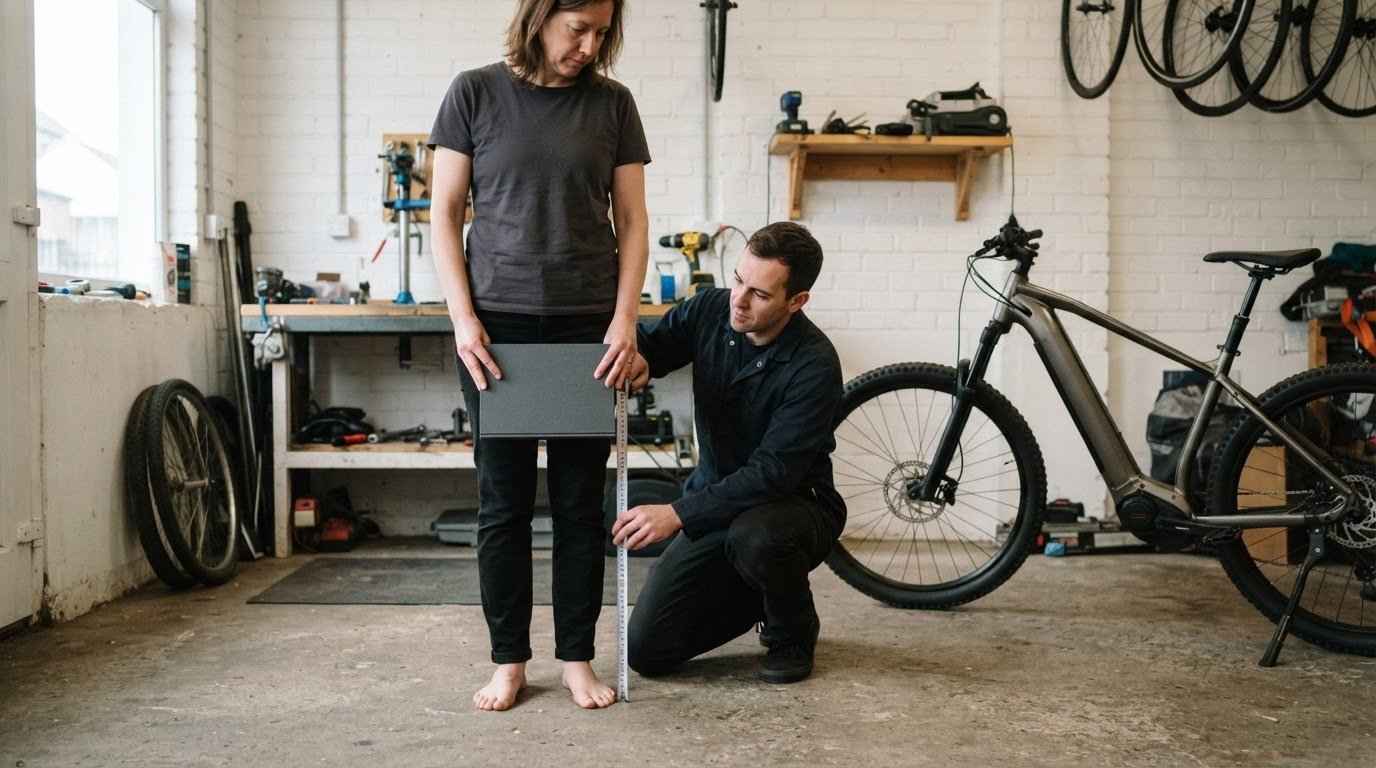
Stand barefoot with your feet 15-20 cm apart, hold a book firmly between your legs, and measure from the floor to its top edge. This gives the inseam measurement used in a basic frame size calculation. For city or trekking bikes, multiply inseam in centimetres by 0.64. For a road bike, a commonly used calculation multiplies it by 0.66; another estimate uses 0.67, so treat the answer as a guide.
-
Estimate frame size from your measurements
Enter your height and inseam into an online bike size calculator, selecting the bike category before reading its recommendation. Inseam is around 47% of height on average, but individual proportions vary, which is why both measurements matter. If you fall between chart sizes, consider the riding position you prefer. A smaller frame can give a sportier position; a larger one can feel more upright. A frame that feels cramped or forces an excessive reach may be too small; difficulty reaching the ground or controlling the bike can indicate a poor size match.
-
Check the relevant frame size chart
Match your estimate to a chart for the exact bike type and model. For touring or trekking bikes, a rider 150-160 cm tall has a suggested frame range of 42-47 cm; at 170-175 cm, it is 52-54 cm. For road or cyclocross bikes, the corresponding ranges are 47-49 cm at 155-160 cm, 53-55 cm at 170-175 cm, and 60-62 cm at 185-190 cm. Brands and models can differ in geometry and size labels, so compare their own charts rather than assuming one chart applies universally.
-
Convert frame measurements
Check whether a frame is measured Centre-to-Centre or Centre-to-Top before comparing sizes. Centre-to-Centre runs from the centre of the bottom bracket to the centre of the top tube; Centre-to-Top runs to the top of that tube. A 54 cm frame is approximately 21 inches, but measurements alone don’t establish equivalent fit across models. After choosing a size, adjust saddle height so your leg has a slight bend at the bottom of the pedal stroke; then set reach and handlebar position for a comfortable, controlled posture.
What’s the Best Bike Fit Calculator?
Choose a tool that uses measurements you can take consistently and lets you select a bike type. Height and inseam provide a useful starting point; some fit tools request additional measurements to refine their recommendation.
-
Gather the measurements needed for bike fit
Measure your height and inseam, then choose the bike category you’re considering. Height helps place you in a size range, while inseam gives the calculator another measure of your proportions. Some fit tools ask for shoulder width or other body measurements to assess your position. Use these additional inputs only if the calculator explains how they affect its recommendation.
Shoulder width can help assess handlebar position. Measure across your shoulders and enter the result only if requested. Don’t substitute clothing size or an estimate, since inaccurate inputs can shift the suggested fit.
-
Measure your inside leg and inseam height
Stand barefoot on a level floor and place a book firmly between your legs, as if it were a saddle. Measure from the floor to the top of the book to record your inseam. Keep the tape measure straight and repeat the measurement; use a consistent result rather than guessing from your trouser length.
Enter the measurement in the units requested by the tool. In bike sizing, inseam or inside leg usually means the floor-to-crotch measurement, not the length of your trousers.
-
Compare available retailer calculators
Look for sizing tools from Irish or UK retailers and bicycle brands. Calculators can use different inputs and show results in different ways, so there is no single standard tool. Choose one that lets you select the right bike type and enter both height and inseam, then compare its recommendation with the size chart for the model you’re considering.
For a more detailed estimate, use a tool that explains any additional measurements it requests, such as shoulder width. An online bike size calculator is a useful starting point, but its result depends on your inputs and the bike geometry covered by the tool. If two calculators disagree, check whether they use different bike categories or measurement methods.

Mountain bike sizing
Select the bike category before comparing size estimates. Mountain, road, gravel, and city or trekking bikes have different geometries and riding positions.
- Choose the category that matches your intended riding. Mountain bikes are designed for off-road use, while road and gravel bikes have their own frame shapes and riding positions. City or trekking bikes are designed for a more upright posture. As a result, the same height and inseam can produce different frame recommendations across categories.
- Enter your height and inseam for a mountain bike estimate, and make sure the calculator is set to mountain rather than road or city. Inseam can help estimate mountain bike frame size, but check the model’s sizing information as well. Mountain bike frames are roughly 10-12 cm smaller than road frames for the same rider, so don’t compare their frame numbers as if they were interchangeable.
- Use height charts as a cross-check alongside the inseam result. For a rider 168-175 cm tall, a mountain bike starting frame-size range is 17-18 inches. Charts can show ranges rather than one exact size because frame geometry differs between models. Check the intended bike category and the model’s sizing information before settling on a frame.
- Consider wheel size as well as frame size. Mountain bikes are available with 26-inch, 27.5-inch and 29-inch wheels, including different wheel options at the same frame size. An adult mountain bike frame estimate can be paired with a 27.5-inch or 29-inch wheel. For road and gravel fit, use the relevant category and measurements; a road or gravel frame recommendation doesn’t automatically translate to mountain geometry.
- Compare the estimated size with the way you plan to ride. A mountain bike’s geometry and wheel choice affect how it feels, while a city or trekking bike’s more upright position serves a different purpose. Use the calculator’s result as a starting point, then consult the sizing information for the specific model.
Online bike size calculator inputs and outputs
Treat the result as an estimate, not a complete fit assessment. What the calculator can tell you depends on the measurements entered and the bike’s geometry.
-
Enter the calculator inputs
Select a bike category, then enter your height and inseam in the requested units. These measurements help the tool estimate a frame size for that category. If it asks for additional details, such as riding position or preferred bike type, answer accurately rather than choosing an option to force a particular result.
Children can use sizing guidance, but wheel size is a key part of choosing their bike. One chart maps an inseam of 35-43 cm to a 12-inch wheel, while an inseam of 60-72 cm maps to a 24-inch wheel. A child should be able to stand over the bike with feet flat on the ground.
-
Review the calculator outputs
Read the suggested frame size and note whether the result is a range, a measurement in centimetres or inches, or a label such as small or medium. Check that it corresponds to your selected category. Mountain, road, and gravel bikes use different geometry, so their frame measurements aren’t directly interchangeable.
Some tools also show a size chart or explain the position associated with their recommendation. Treat saddle height and reach as separate fit adjustments: a frame-size estimate doesn’t determine either setting. A smaller frame can affect reach and position, so consider the bike’s overall geometry rather than relying on the size label alone.
-
Check how the calculator works and its accuracy
Check which measurements and bike category the tool uses. Most calculators apply those inputs to a sizing formula or chart, so the result reflects only the information entered and the geometry represented by the tool. Accurate measurements help, but a general calculator may not capture every detail of a specific model.
Compare the recommendation with the specific bike’s size chart and frame measurements. If a calculator gives a road-bike result, don’t assume it also identifies the correct mountain-bike size. For a practical next step, explore suitable bike options and compare their sizing information with your estimate.
Cyclecentre.com
Once your calculator result has narrowed the options, Cyclecentre.com can help you compare bike types and frame sizes. Use the estimate as a starting point, then compare it with the sizing information for the specific model and category you’re considering. Road and mountain bikes have different geometry, so check that the recommendation matches your intended riding.
For road riding, explore Road Performance Bicycles; for off-road routes, consider Electric Mountain Bikes. Cyclecentre.com also offers gravel and adventure bikes, e-city bikes, and kids’ bikes for different kinds of cycling. If you’re considering a bike through Bike to Work or Cycle to Work, the right category and fit are still important parts of your decision.
If you’d like help narrowing down your options, contact Cyclecentre.com.
Make your next bike choice with confidence
A size estimate is most useful when it helps you make a practical choice. Before deciding, consider the rides you plan to take, the riding position that feels natural and whether the specific bike’s shape suits your proportions. An online bike size calculator can narrow your options; the next step is to compare its estimate with the bike you’re considering.
If you’re still deciding on a frame size or bike type, discuss your measurements and intended riding with the Cycle Centre team. Clarifying your priorities can help you focus on suitable options instead of getting stuck on a size label.
Ask Cyclecentre.com about your bike fit, and take the next step towards a bike that feels right for your plans.
Frequently Asked Questions
How do I measure my height and inseam to choose a bike size?
Measure your height barefoot, standing upright against a wall, and record it in centimetres. For inseam, stand barefoot with your feet 15-20 cm apart and hold a book firmly between your legs. Measure from the floor to the book’s top edge. Take each measurement carefully and use the same units requested by the sizing tool, rather than estimating from clothing measurements.
What bike frame size should I choose based on height and inseam?
Use both measurements with a chart for your chosen bike type, rather than selecting a frame from height alone. For example, a city-bike estimate for someone 183 cm tall with an inseam of around 81 cm is 52 cm. Treat that as a starting point: frame shapes and sizing labels vary by model, so the same nominal size may not give the same riding position across different bikes.
What measurements do bike size calculators need for road, mountain, and hybrid bikes?
Most basic tools ask for height, inseam and bike category. Select road, mountain or hybrid as appropriate, since the category affects the frame-size estimate. Some fit calculators also ask for measurements such as shoulder width, but this is an additional input, not a substitute for height and inseam. Enter each value in the units shown and don’t mix centimetres with inches.