


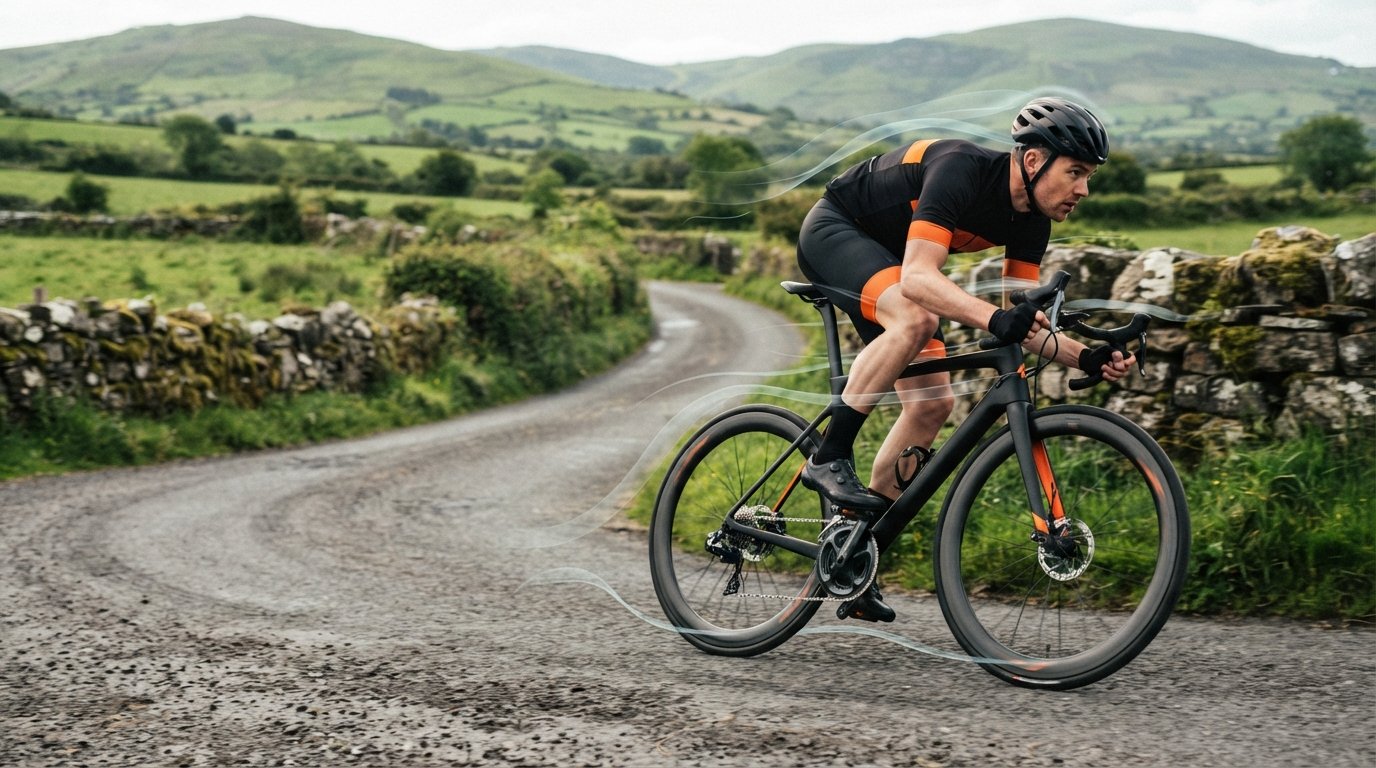
Did you know that at speeds over 30 km/h, your body is responsible for roughly 80% of the aerodynamic drag holding you back? It’s incredibly frustrating to pour every ounce of effort into the pedals only to see your average speed plateau, especially when high-end cycling gear often carries a daunting price tag. You likely feel that despite your fitness gains, your equipment isn’t quite translating that hard work into pure pace. This guide reveals the professional secrets to how to make a road bike faster by focusing on mechanical precision, aerodynamic optimisation, and strategic upgrades that offer the best return on investment.
We’ll explore the latest 2026 technical standards, including the new UCI regulations for handlebar widths and rim depths that are now shaping the Irish cycling market. You will learn why switching to 30mm tyres at lower pressures actually reduces rolling resistance on rough local tarmac and how a simple shift to hot-melt chain waxing can save you significant wattage. From the “Rule of 105” in wheel selection to the hidden benefits of a professional Shimano-accredited service, we provide a methodical roadmap to help you find more speed without needing a professional team’s budget.
Key Takeaways
- Learn how to eliminate hidden mechanical drag through professional drivetrain maintenance and the significant efficiency benefits of immersive chain waxing.
- Discover why modern 28mm to 30mm tyres running at lower pressures offer superior speed and reduced rolling resistance on unpredictable Irish road surfaces.
- Master the 80/20 rule of aerodynamics to understand how to make a road bike faster by refining your riding posture and cockpit setup.
- Identify the most cost-effective hardware upgrades and how to utilise the Cycle to Work scheme to fund high-performance carbon wheelsets.
- Understand how a Shimano-accredited Gold Service acts as a comprehensive speed tune-up by ensuring every bearing and component operates with total precision.
Eliminating Mechanical Drag: The Foundation of Speed
Speed is often viewed through the lens of fitness or expensive carbon frames, yet the most immediate hurdle to your performance is often the friction hiding in plain sight. Every rotation of your pedals involves dozens of moving parts, and if these components aren’t operating with surgical precision, you’re fighting your own equipment. Understanding how to make a road bike faster begins with a commitment to mechanical hygiene. Road grit and grime act as an abrasive grinding paste, accelerating wear and significantly increasing bicycle mechanical efficiency and power losses across your entire drivetrain.
Friction isn’t limited to a dirty chain. It resides in the dry bearings of your hubs, a gritty bottom bracket, or even a headset that has lost its smooth rotation. A misaligned derailleur is another common culprit, forcing the chain to run at an inefficient angle and wasting precious watts through constant lateral friction. By identifying and neutralising these small pockets of resistance, you create a baseline of efficiency that allows every other upgrade to actually work.
The Impact of a Professional Workshop Service
While basic home maintenance is essential for day-to-day riding, it rarely matches the depth of a Shimano accredited service. Our workshop professionals use specialised diagnostic tools to identify bearing play and component fatigue that the naked eye often misses. Think of a Workshop Gold Service not as a simple repair, but as a comprehensive speed tune-up designed to restore your bike to its peak factory condition. Installing fresh, low-friction cables and precisely indexing your gears ensures that every watt you generate is transferred directly to the rear wheel without hesitation. This professional oversight eliminates the “ghost” drag that makes your bike feel sluggish despite your best efforts.
Drivetrain Efficiency: The 10-Watt Gain
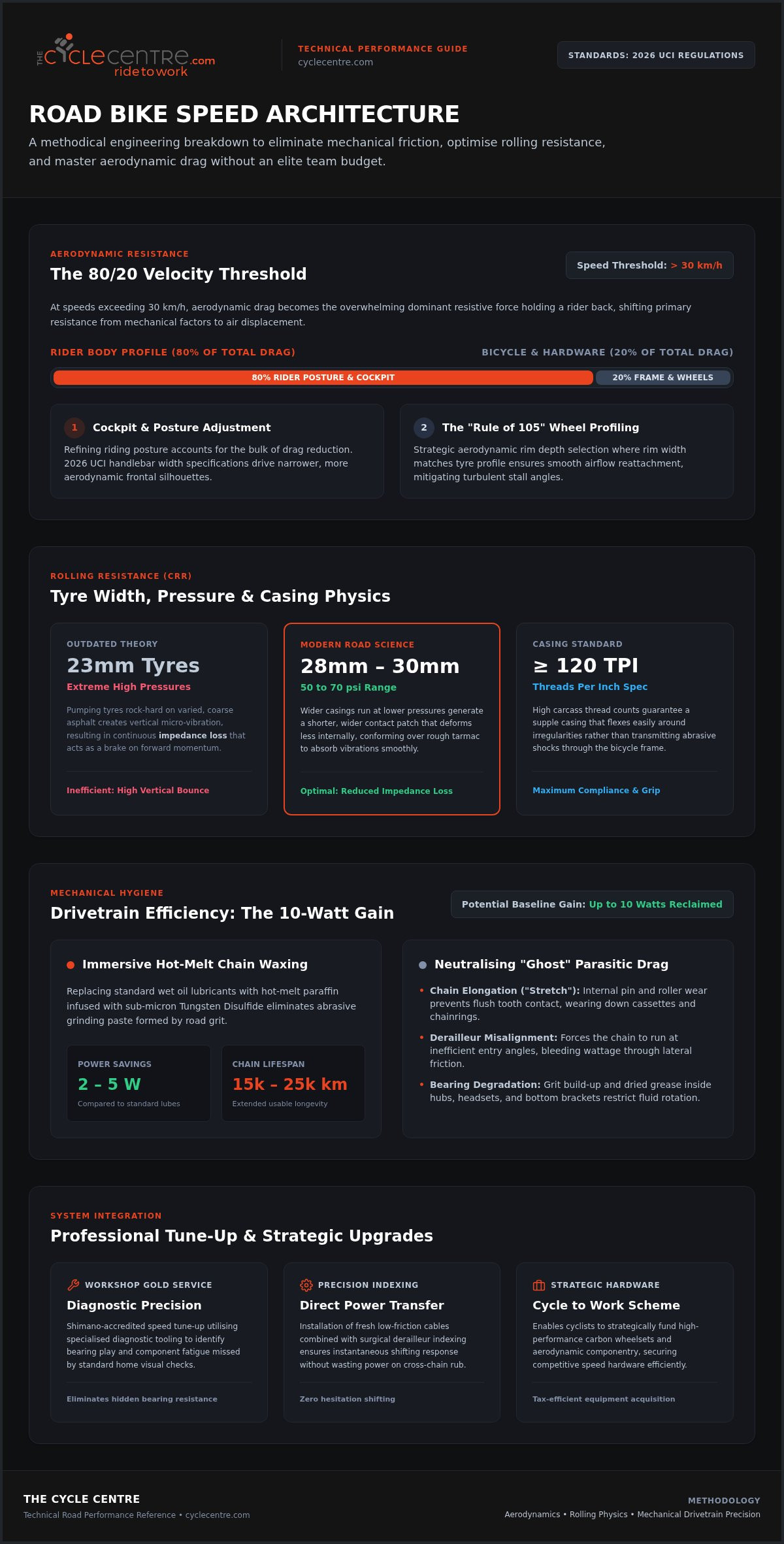
The drivetrain is the heart of your speed, yet it’s also where most power is lost. Chain elongation, commonly called “chain stretch,” occurs when the internal pins and rollers wear down, causing the chain to sit poorly on the gear teeth. This doesn’t just feel slow; it actively destroys your cassette and chainrings. Moving beyond simple degreasing to a deep-clean protocol can reclaim significant energy. Many performance cyclists in Ireland are now moving toward hot-melt chain waxing as a high-performance alternative to traditional oils. A properly waxed chain, treated with sub-micron Tungsten Disulfide, can save between 2 and 5 watts compared to standard lubricants. Beyond the speed gains, a waxed drivetrain can extend your chain’s usable life to between 15,000 km and 25,000 km, making it one of the most cost-effective ways to maintain a fast, silent, and efficient machine.
Rolling Resistance: Choosing the Right Tyres and Pressures
If you want to know how to make a road bike faster, you must look past the weight of your components and focus on rolling resistance, known as Crr. While many riders obsess over saving grams, the energy lost through tyre deformation is a far more significant drain on your average speed. For decades, the cycling world believed that narrow 23mm tyres pumped to rock-hard pressures were the fastest option. Modern science has thoroughly debunked this myth. On the varied and often coarse asphalt found across Ireland, high pressures cause the bike to vibrate vertically. This translates into wasted energy known as impedance loss, which effectively acts as a brake on your momentum.
Transitioning to 28mm or even 30mm tyres allows you to run lower pressures, typically between 50 and 70 psi, without increasing the risk of pinch flats. This setup allows the tyre to absorb micro-vibrations rather than bouncing over them, keeping your forward momentum intact. The relationship between tyre pressure and rolling resistance is a delicate balance; a wider tyre at a lower pressure actually creates a shorter, wider contact patch that deforms less than a narrow tyre, resulting in lower internal friction. If you’re looking to refresh your setup for the season, exploring our range of Road Performance Bicycles can help you identify frames designed specifically to accommodate these faster, wider tyre clearances.
Tyre Construction: TPI and Compounds
The quality of your tyre carcass is measured in Threads Per Inch (TPI). A high TPI, often 120 or above, indicates a more supple tyre that conforms to the road surface with minimal energy loss. While heavy puncture-resistant tyres are excellent for winter training, they utilise thick rubber layers that increase rolling resistance. For pure speed, racing-specific compounds are essential. These advanced materials provide superior grip and lower Crr, ensuring that your power isn’t swallowed by a stiff, unresponsive casing.
Tubeless vs. TPU Tubes: The Internal Friction Battle
Internal friction is the silent speed killer. Standard butyl tubes suffer from significant hysteresis loss, which is the energy dissipated as heat when the tube and tyre rub against each other during every wheel revolution. Tubeless setups eliminate this friction entirely, often saving between 6.7 and 10.5 watts per tyre. If you aren’t ready to go tubeless, Thermoplastic Polyurethane (TPU) tubes are a game-changer. Weighing just 20 to 35g, they reduce rotating weight by up to 90g per wheel and offer rolling resistance that rivals latex, providing a noticeable boost to your acceleration and sustained speed.
Aerodynamics: Optimising the Rider-Machine System
When exploring how to make a road bike faster, many cyclists instinctively look at the machine. However, the rider’s body represents approximately 75% to 85% of total aerodynamic resistance at speeds above 30 km/h. This is the 80/20 rule of aerodynamics in practice; the bike itself is only a small fraction of the hurdle. Reducing your frontal area is the most effective way to slice through the air. Simply tucking your elbows inward and lowering your torso can save more watts than upgrading to a premium aero frame. Even your clothing choice plays a massive role. A loose, flapping rain jacket can create as much drag as a set of shallow aluminium wheels, whereas a form-fitting jersey allows air to stay attached to your body longer, reducing the low-pressure wake behind you.
Cockpit organisation is another vital area for aerodynamic marginal gains. Tidying exposed cables, using integrated computer mounts, and narrowing your hand position significantly cleans up the air hitting the front of the bike. Under the 2026 UCI regulations, the minimum spacing between the innermost points of your brake hoods is now set at 280 mm. Maximising this allowable inboard angle helps you maintain a narrow, efficient profile without compromising the safety or control of the bicycle.
The Science of Body Position
While the drops were traditionally seen as the fastest position, modern testing shows that holding the ‘aero hoods’ with horizontal forearms is often more efficient for long durations. This position reduces your vertical profile while keeping your chest open for better breathing. Maintaining this posture requires more than just a fast bike; it demands core strength and hamstring flexibility. A professional bike fit is essential here, as it ensures you can sustain an aerodynamic tuck without causing long-term injury or sacrificing power output. If your position is too aggressive, you’ll likely spend more time sitting upright to catch your breath, which instantly negates any hardware advantages.
Aero Accessories: Helmets and Socks
An aerodynamic helmet is arguably the most cost-effective hardware upgrade you can make. It’s the first point of contact for the air moving over your body, and a well-designed lid can save between 10 and 15 watts at race speeds. Note that 2026 regulations now require road helmets to have at least three air inlet vents, effectively banning the completely closed TT-style shells from mass-start events. Don’t overlook your lower limbs, either. Aero socks, which feature textured vertical ribbing to trip the boundary layer of air, provide a surprising gain for a relatively small investment. These small adjustments to your apparel and accessories create a cohesive system that minimises drag across every centimetre of the rider-machine unit. For those looking to innovate further with bespoke, lightweight components, you can discover 3D Printing Canada for the specialist equipment and materials needed to prototype your own custom aerodynamic solutions.
Once you have refined your riding position and mechanical efficiency, the conversation regarding how to make a road bike faster naturally shifts to hardware. The most impactful investment you can make is a high-quality carbon wheelset. Swapping standard shallow aluminium rims for mid-to-deep carbon aero wheels, typically between 45mm and 60mm in depth, can yield a power saving of 15 to 20 watts at 45 km/h. This isn’t just about weight; it’s about how the rim manages airflow. On rolling Irish terrain, the aerodynamic advantage of a deeper rim almost always outweighs the minor weight penalty on climbs.
Choosing the right depth is a strategic decision. While deeper is generally faster, stability in crosswinds is vital for Irish coastal riding. For 2026, the UCI has capped mass-start rim depths at 65mm, which reflects the industry’s move toward balancing speed with predictable handling. To achieve the best results, remember the ‘Rule of 105’. This states that your external rim width should be at least 105% of your actual mounted tyre width to ensure airflow reattaches smoothly to the rim surface, reducing turbulence and drag.
Deep-Section Wheels: The Ultimate Upgrade
We recommend performance wheelsets from established brands like Giant and Cube, which are engineered to provide the ‘sail effect’. This phenomenon occurs when the wheel generates forward lift at specific wind angles, effectively pushing you forward. These manufacturers have refined their carbon layups to ensure that even a 50mm rim remains manageable when the wind picks up on the coast. Many riders now utilise the Cycle to Work scheme to fund these high-end wheelsets, making premium carbon performance far more accessible for club riders and racers alike.
Optimising the Small Details
Beyond wheels, smaller components offer the final percentages of speed. Electronic shifting systems provide millimetre-perfect precision, ensuring you never waste energy on a hesitant gear change or a misaligned chain. You might also consider an Oversized Pulley Wheel System (OSPW). While these offer a modest saving of roughly 0.5 to 1.5 watts, they represent the pinnacle of drivetrain optimisation for those chasing every marginal gain. Even your choice of water bottles matters; aero-profiled bottles and lightweight thru-axles help clean up the air moving around your frame. Finally, integrating a power meter is a transformative step. It allows you to pace your efforts scientifically, ensuring you maintain a higher average speed without burning out early. If you’re ready to transform your ride, explore our latest range of Road Performance Bicycles to find the perfect platform for your speed goals.
The System Approach: Professional Support and Financial Planning
Speed is rarely the result of a single, isolated purchase. It is the outcome of a cohesive system where your fitness, equipment, and maintenance schedule work in harmony. Many riders fall into the trap of ‘guessing’ their next upgrade, often spending hundreds on components that offer minimal real-world gains. A ‘Smart-bike Search’ is a far more effective strategy. It involves a methodical evaluation of your current setup and goals to identify the specific bottlenecks in your performance. Whether it’s a frame with better compliance for Irish roads or a more integrated cockpit, professional guidance ensures your investment actually translates into pace. Understanding how to make a road bike faster requires this holistic view, moving beyond parts to look at the entire machine as a performance unit.
Preserving that speed requires a disciplined approach to maintenance. A bike that is fast in April will feel sluggish by October if the bearings are neglected or the drivetrain is allowed to accumulate grit. Speed decays when mechanical resistance is ignored. For those who find the physical demand of maintaining high average speeds on hilly Irish routes a barrier, transitioning to an E-road bike offers a modern solution. These machines provide a natural, assisted pace that keeps you in the group and extends your range, all whilst maintaining the traditional handling and feel of a high-performance road bicycle.
Tax-Efficient Upgrades
One of the most significant advantages for Irish cyclists is the ability to utilise the Bike to Work scheme Ireland. This government-backed initiative can save you up to 52% on the cost of a new performance bike through salary sacrifice. It’s a common misconception that the scheme is only for entry-level commuting. In reality, it is the perfect vehicle for funding high-end road bicycles, aerodynamic helmets, and essential safety components. By navigating the online application for a no-obligation quote, you can spread the cost of your speed journey over 12 months whilst enjoying substantial tax, PRSI, and USC savings. It’s the most financially intelligent way to access the marginal gains discussed in this guide.
Expert Guidance and Community
Choosing where you source your expertise is as important as the gear itself. While ‘big box’ retailers offer convenience, they often lack the technical depth required to truly optimise a performance machine. Visiting an independent specialist allows you to leverage decades of industry evolution. Our Shimano accredited workshop provides bespoke advice that considers your specific riding style and local conditions. We focus on the granular details that make a difference, from bearing tolerances to precise gear indexing. To ensure your machine is operating at its absolute limit, Book your Gold Service today and let our experts perform a comprehensive speed tune-up on your pride and joy.
Unlocking Your Peak Performance on the Road
True speed is the result of a deliberate synergy between a well-maintained machine and an aerodynamically efficient rider. As we’ve explored, the most significant gains often come from addressing the invisible hurdles, such as internal drivetrain friction and high-pressure rolling resistance on coarse Irish tarmac. Mastering how to make a road bike faster requires this multi-faceted approach, balancing technical precision with smart financial planning to ensure every watt you generate translates into forward momentum.
Our team stands ready to support your journey toward a new personal best. As Cycle to Work scheme experts, we can help you access high-end performance upgrades in a tax-efficient manner. Our Shimano Accredited Workshop offers dedicated Silver and Gold Service packages to ensure your bicycle remains at the pinnacle of efficiency throughout the season. Discover our range of Performance Road Bicycles and Workshop Services to find the perfect combination of hardware and expertise for your specific goals. There’s no better feeling than a bike that responds instantly to your effort; it’s time to experience that freedom on your next ride.
Frequently Asked Questions
Is a lighter bike always faster than an aerodynamic one?
Aerodynamics is almost always more important than weight on flat or rolling terrain. Drag accounts for the vast majority of resistance at speeds over 30 km/h, meaning a heavier aero bike will likely outperform a lightweight climbing bike on most routes. Weight only becomes the primary factor on steep gradients where gravity takes over. For Irish cycling, reducing your frontal area is the most effective way to maintain pace.
How much faster will I be with deep-section carbon wheels?
Deep-section carbon wheels can save you approximately 15 to 20 watts at high speeds compared to standard aluminium rims. This is due to their superior ability to manage airflow and create the ‘sail effect’ in crosswinds. While the exact gain depends on the wind angle and your speed, they are a transformative upgrade for anyone researching how to make a road bike faster on rolling coastal roads.
Does tyre pressure really make a difference to my average speed?
Yes, tyre pressure is a critical factor in managing rolling resistance and impedance losses. Running excessively high pressures on coarse asphalt causes the bike to vibrate vertically, which wastes energy. Dropping to a lower pressure with wider 28mm or 30mm tyres allows the rubber to absorb road imperfections. This keeps your momentum moving forward rather than bouncing upward, leading to a faster and more comfortable ride.
Can I use the Cycle to Work scheme to upgrade my current bike’s components?
The scheme is primarily for the purchase of a new bicycle and essential safety equipment. Most employers don’t allow it for standalone component upgrades like wheels or groupsets. However, you can use the scheme to invest in a brand-new performance machine that already features these high-end parts. This allows you to save up to 52% on the total cost whilst enjoying a significantly faster ride.
How often should I service my road bike to maintain maximum speed?
We recommend a professional Gold Service at least once a year, or more frequently if you’re a high-mileage rider. Regular maintenance prevents the build-up of grit and grime that creates mechanical drag. A Shimano accredited workshop can identify ‘hidden’ friction in your bearings and ensure your drivetrain is perfectly indexed. Consistent servicing preserves the marginal gains you’ve invested in and keeps your bike feeling factory-fresh.
Is an electronic drivetrain faster than a mechanical one?
Electronic drivetrains improve your average speed by providing perfect shifting precision and eliminating mechanical hesitation. These systems ensure that every gear change is instantaneous, even when you’re putting maximum power through the pedals. Because they eliminate cable stretch, your gears stay perfectly indexed for thousands of kilometres. This reliability is a key component in how to make a road bike faster and more efficient over challenging terrain.
What is the most cost-effective upgrade I can make for speed?
The most cost-effective upgrades are often those that involve your body position and basic maintenance. Optimising your tyre pressure costs nothing but provides immediate rolling resistance gains. Beyond that, investing in high-quality racing tyres or a professional bike fit offers a massive return on investment. These changes focus on the rider, who accounts for the vast majority of aerodynamic drag, rather than just the machine.
Will an aero helmet make a difference at speeds under 30km/h?
Yes, aerodynamic benefits are present at all speeds, although they become more significant as your velocity increases. Since air resistance is the primary force you’re fighting, even at 25 km/h, an aero helmet reduces the effort required to maintain your pace. It’s one of the most affordable hardware changes you can make to clean up the airflow around your head and shoulders.