

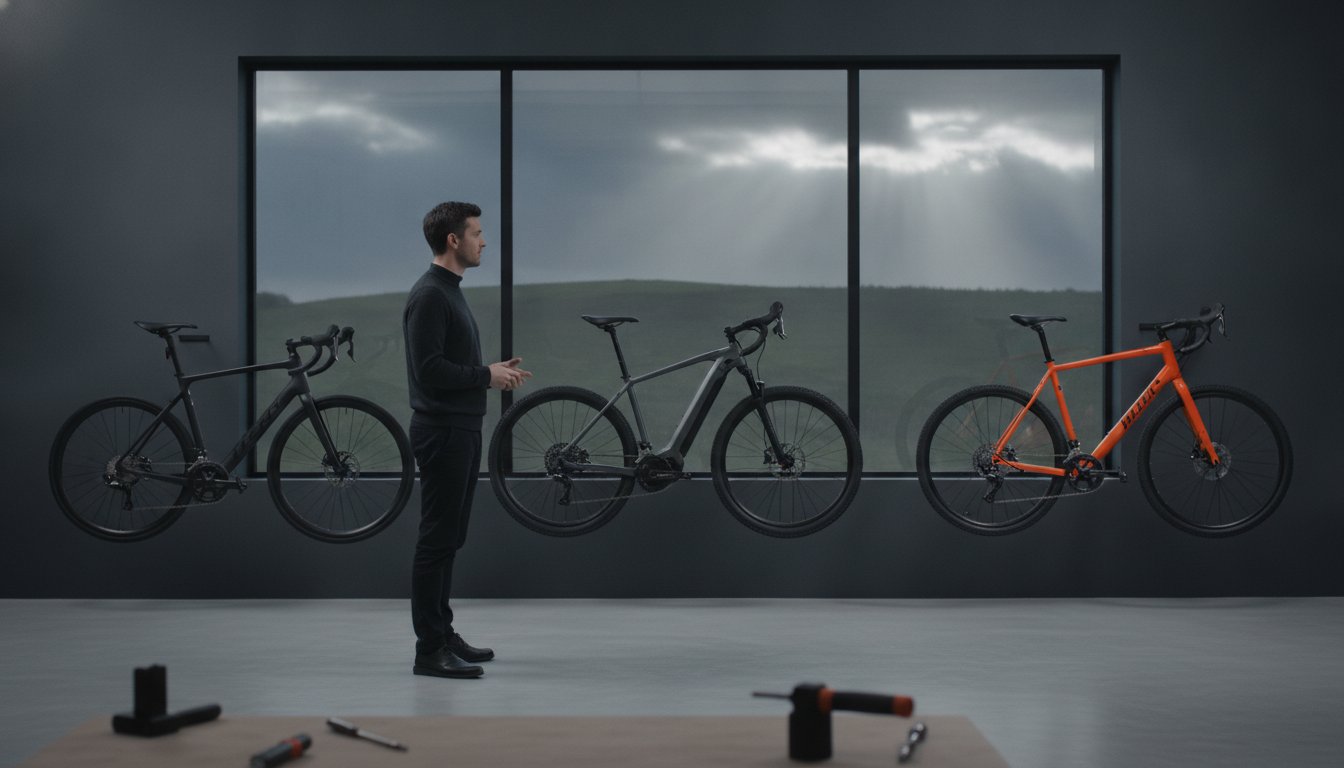
What if the most expensive carbon-fibre machine in the showroom is actually the worst possible choice for your daily routine? It’s a common worry, especially when you’re faced with a wall of technical jargon about groupsets and frame geometry that feels more like a physics lecture than a fun hobby. You don’t want to spend thousands of Euro on a bicycle that eventually just gathers dust in the shed because it doesn’t suit the Irish roads or your physical comfort. We understand that uncertainty, particularly when you’re trying to decide if an e-bike is “cheating” or if a gravel bike can truly handle our unpredictable weather and coastal grit.
Our goal is to help you find the right bike by cutting through the noise with a practical, experience-based framework. This guide will show you how to narrow your choices down to one or two perfect categories, whether you’re eyeing a sleek road bike or a robust electric mountain bike. You’ll discover how to use national tax-free schemes to save significantly on your purchase and why professional assembly is vital for long-term reliability. By the end, you’ll have the confidence to choose a bike that isn’t just a transaction, but a gateway to years of dependable service and weekend exploration.
Key Takeaways
- Utilise the Smart-bike Search tool to match your specific terrain and daily mileage with the ideal bicycle category for your lifestyle.
- Learn how to find the right bike by comparing the speed of performance road bicycles with the versatile, all-weather stability of gravel and adventure models.
- Determine if an e-bike is your best fit by exploring how E-city and E-MTB motors can transform your commute into a sweat-free, car-replacement alternative.
- Maximise your budget by taking advantage of the national Cycle to Work scheme for significant tax-free savings on high-quality brands like Giant and Cube.
- Ensure long-term safety and performance by prioritising professional assembly and maintenance from a Shimano Accredited Workshop.
Defining Your Riding Style: The First Step to Finding the Right Bike
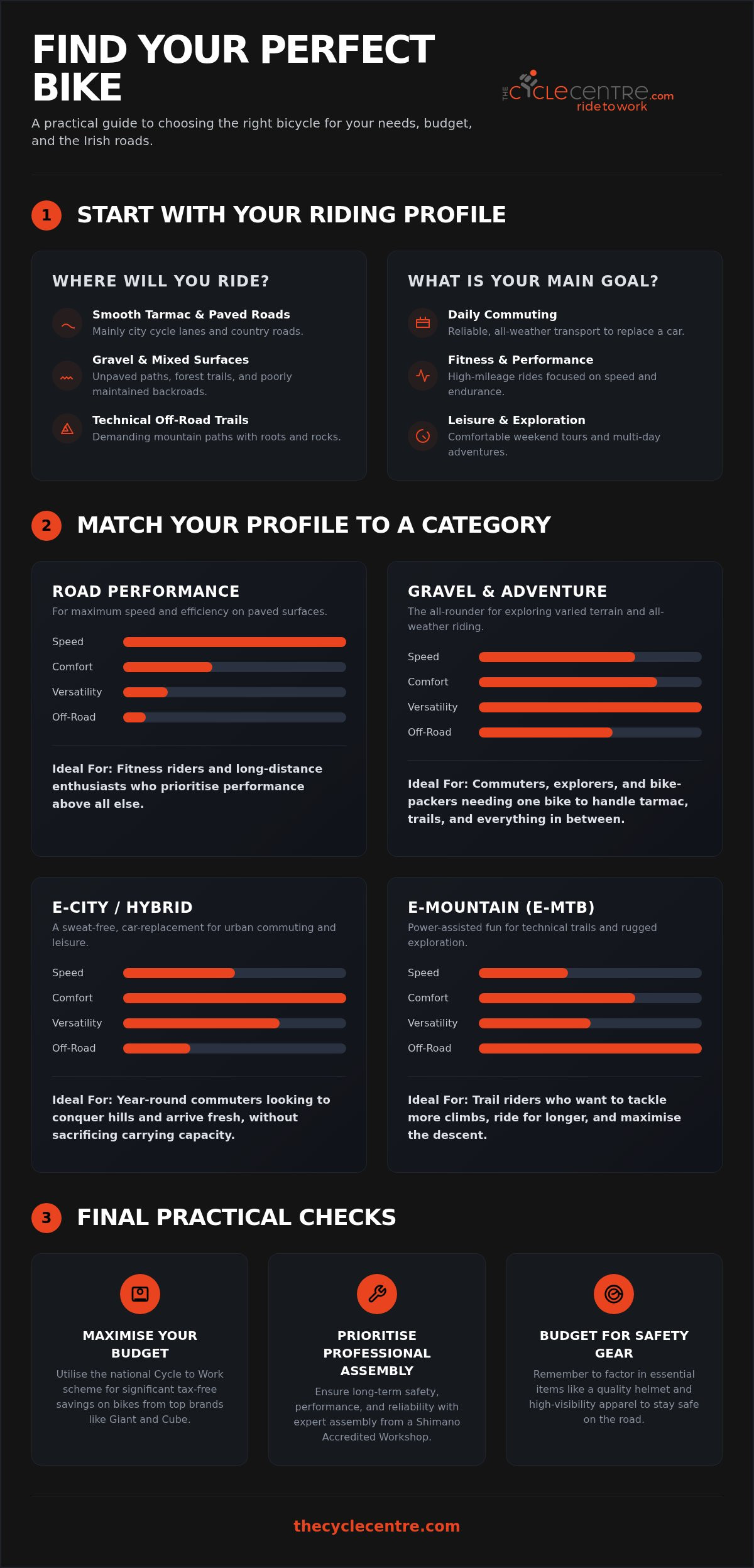
Before you walk into a showroom or browse online, you need to be honest about your intentions. Many cyclists buy a bike for the person they want to be on a sunny Sunday, rather than the person they are on a wet Tuesday morning. To find the right bike, you must first define your specific riding profile, which is the intersection of where you intend to go and how often you plan to get there.
The “Where” and “How Often” Framework
A riding profile acts as your personal blueprint, combining the physical terrain of your local area with the frequency of your trips. If you’re a year-round commuter in Ireland, your requirements are vastly different from a fair-weather leisure rider. You’ll need to account for the relentless Irish wind and steep gradients that can make a heavy, poorly geared bike feel like a burden. Consulting a comprehensive guide to bicycle types can help you understand how different frames handle these forces, but your daily reality is the best teacher. Are you tackling the smooth tarmac of city cycle lanes or the loose grit of the Great Western Greenway? High-mileage weekend tours require comfort-focused geometry, whilst short city hops prioritise agility and ease of locking.
Setting a Realistic Budget for 2026
It’s tempting to opt for the lowest price point, but the cheapest bikes often incur higher maintenance costs within the first twelve months due to lower-grade components. As we move through 2026, the sweet spot for value usually lies where durability meets weight. Investing slightly more upfront ensures your gears stay indexed and your brakes remain responsive in damp conditions. It also ensures your machine is compatible with expert care from a Shimano Accredited Workshop, which is vital for long-term safety. Don’t forget to set aside a portion of your budget for safety and visibility. You’ll need to factor in essentials like cycling helmets Ireland and high-visibility apparel to stay safe on our shared roads.
Think about your primary destination. Is it the office, the gym, or the peak of a forest trail? Commuting requires reliability and mudguard clearance. Fitness riding often leans towards Road Performance Bicycles that reward effort with speed. If you’re looking for off-road exploration, you’ll need the tyre clearance found in Gravel and Adventure Bikes or the suspension of an E-MTB. To find the right bike, you need to balance these desires against your actual storage capacity and the time you can realistically dedicate to maintenance. Whilst the “N+1” rule suggests the ideal number of bikes is always one more than you currently own, practicality must win. Consider your storage space and the financial reality of maintaining multiple machines before committing to a fleet.
Exploring Primary Categories: From Performance Road to Rugged Mountain Bikes
Once you’ve defined your riding profile, the next step to find the right bike is understanding how specific categories translate to the road or trail. Road Performance Bicycles are the traditional choice for speed, featuring lightweight frames and narrow tyres designed for maximum efficiency on smooth tarmac. However, the rise of Gravel and Adventure Bikes has changed the landscape, offering a more versatile alternative for those who find themselves on mixed surfaces or poorly maintained backroads.
Road vs Gravel: Which Drop-Bar Bike is for You?
The primary difference between these two popular categories lies in tyre clearance and frame geometry. Gravel bikes feature significantly wider tyres and a longer wheelbase to provide stability on loose chippings and unpaved paths. For many local riders, endurance road bikes Ireland are the perfect middle ground; they offer a more upright, comfortable position than a dedicated racing frame, making them ideal for long days in the saddle across varied Irish counties. Adventure bikes take this versatility further by adding multiple mounting points for racks and bags, which is essential if you’re planning multi-day bike-packing tours or self-supported expeditions.
Mountain Bikes: Hardtail or Full-Suspension?
If your goal is technical off-road exploration, you’ll need to choose between a hardtail (front suspension only) or a full-suspension model. Hardtails are generally lighter and require less maintenance, making them excellent for climbing and smoother forest tracks. In contrast, full-suspension bikes offer superior shock absorption for technical descents and rocky terrain, though they come with a weight and maintenance trade-off. Brands like Giant and Cube lead the market in frame durability, ensuring your investment stands up to the rigours of local trail centres. It’s important to match your suspension travel to the specific trails you frequent to avoid carrying unnecessary weight on flatter routes.
For those navigating urban environments, Hybrid and City Bikes remain the most practical choice. These models prioritise an upright seating position and comfort, allowing you to keep a clear eye on traffic whilst moving through the city. They often include integrated mudguards and pannier racks, making them ready for the daily commute from day one. To narrow down these options with expert precision, you can use our Smart-bike Search tool to filter by your specific requirements and find the right bike for your lifestyle.
The Electric Revolution: Should You Choose a Traditional or E-Bike?
The choice between a traditional bicycle and an electric model often comes down to your specific lifestyle goals. Whilst a standard bike offers simplicity and a lower entry price, the electric revolution has opened doors for those who previously found hills or distance to be a barrier. To find the right bike, you need to evaluate if you’re looking for a pure workout or a versatile transport solution that can handle the practicalities of daily life.
The “Sweat-Free Commute” is now a reality for thousands of Irish riders. For journeys under 15km, an e-bike is a genuine car replacement. You can navigate city traffic and arrive at your destination without the need for a change of clothes or a shower. We see this most often with E-city bikes, which provide a smooth, intuitive assist that makes head-on Atlantic winds feel like a gentle breeze rather than a physical hurdle.
Modern systems from Bosch, Shimano, and Yamaha offer distinct riding sensations. Bosch motors are known for their robust torque and reliability, whilst Shimano systems often feel more natural to those coming from a traditional cycling background. Before you buy, it’s essential to understand the electric bike laws Ireland enforces. These regulations ensure that your assist cuts out at 25km/h, maintaining the safety and legal status of your bicycle on public roads without the need for tax or insurance.
E-MTB and E-Road: Extending Your Adventures
Using the Smart-bike Search Tool
With so many motor and battery combinations available, narrowing down your options can feel overwhelming. Our proprietary Smart-bike Search tool allows you to filter by motor type, battery capacity, and brand favourites like Giant, Cube, and Romet. This helps you find the right bike by matching technical specs to your intended daily mileage. Every motor has a unique behaviour and power delivery curve. We always recommend a test ride to see which system feels most intuitive to your personal pedalling style and cadence.
Sizing, Comfort, and Financial Savvy: Making the Practical Choice
Selecting a frame based on aesthetics alone is a recipe for a bike that eventually sits unused in the shed. To find the right bike, you must prioritise frame size as the single most important technical factor. A bike that doesn’t fit correctly will lead to knee strain, lower back pain, and general discomfort, turning a pleasant ride into a chore. Whilst manufacturer height charts offer a helpful starting point, they don’t account for individual limb length or flexibility. This is why a test ride is a non-negotiable part of the process. It’s the only way to ensure the machine responds intuitively to your movements and feels stable under your specific body proportions.
Finding the Perfect Fit
There are three primary measurements you need to understand: stand-over height, reach, and saddle position. Stand-over height is vital for safety, ensuring you can comfortably straddle the top tube when stopped at traffic lights. Reach determines the distance to the handlebars; if it’s too long, you’ll overstretch your shoulders, whilst a reach that’s too short will leave you feeling cramped. Sizing is not universal across the industry. A “Medium” frame from Cube may feel entirely different to one from Giant due to variations in geometry. For those looking to kit out the whole family, our kids bike size guide Ireland offers a dedicated framework for younger riders.
Maximising Tax-Free Savings
You can significantly boost your budget by leveraging the bike to work scheme Ireland. Whether your workplace refers to it as the Cycle to Work or Ride to Work scheme, the underlying financial benefit is excellent. By paying for your bicycle through a salary sacrifice arrangement, you effectively save on income tax, PRSI, and USC. The practical result is that a higher-spec bike with more durable components often costs less in real terms than a basic model purchased with after-tax income. High-quality components don’t just perform better; they last longer in the Irish climate, providing better value over the bike’s lifespan.
Organising your application is a methodical process that starts with a no-obligation quote. You can use our online system to generate a fast, professional quote to present to your employer’s HR or accounts department. This ensures all the technical details and official procedures are handled correctly from the outset. To begin your journey and find the right bike with the support of a trusted local expert, request your professional quote today and see how much you can save on a world-class machine.
Expert Support and Reliability: Why Your Purchase is Just the Start
The journey to find the right bike doesn’t end when you leave the showroom with your new machine. In fact, the long-term reliability and safety of your bicycle depend heavily on the support network you choose at the point of purchase. Whilst direct-to-consumer models might appear cost-effective initially, they often lack the professional assembly and rigorous safety checks that only an independent bike shop can provide. Since 1974, The Cycle Centre has served the local community, ensuring that every bicycle we sell is built to withstand the specific demands of Irish roads and our unpredictable coastal weather.
Specialist E-Bike and Road Maintenance
Modern cycling technology requires more than just a basic set of spanners. Systems from Bosch and Yamaha are sophisticated pieces of engineering that need regular firmware updates and specialised diagnostic tools to perform at their peak. As a Shimano Accredited Workshop, we have the certified technicians and official software required to maintain these complex motors and electronic shifting systems. For those riding at a competitive level, our high end road bike service Ireland provides the precision tuning necessary for performance athletes. Using genuine Shimano spare parts is equally vital; it ensures the longevity of your drivetrain and maintains the smooth, reliable shifting you expect from a premium machine.
Planning your maintenance schedule is the best way to protect your investment. We generally recommend a Workshop Silver Service within the first six months or after your first 1,000km to check for cable stretch and bolt torque. As you approach the 2,000km mark, a Workshop Gold Service provides a more comprehensive deep-clean and bearing inspection. This methodical approach to care prevents small issues from becoming expensive repairs, keeping you on the road and out of the workshop.
Your Next Steps to Discovery
Now that you have the framework to find the right bike, it’s time to move from research to reality. Use this final checklist to ensure you’ve covered all the essential bases before making your final decision:
- Riding Style: Have you identified your primary terrain and frequency?
- Budget: Are you factoring in essential safety gear and visibility apparel?
- Scheme Eligibility: Have you requested your Cycle to Work quote to maximise savings?
- Fit: Have you booked a test ride to confirm your frame size and comfort?
Our team is always available for a personalised consultation to help you navigate these choices with confidence. Once your new machine is ready, you’ll be part of a vibrant community exploring the vast network of national cycling routes and greenways. Whether it’s a quiet morning commute or a rugged weekend on the forest trails, the right support ensures your focus remains entirely on the experience of discovery, not the equipment.
Your Journey to Better Cycling Starts Here
Deciding to find the right bike is the first step towards a more active and sustainable lifestyle. Throughout this guide, we’ve explored how matching your machine to your specific terrain and ensuring a perfect frame fit can prevent long-term discomfort. By leveraging the national Cycle to Work scheme, you can access world-class brands like Giant and Cube whilst making significant tax-free savings on your investment. It’s a practical way to ensure you’re riding a bicycle that’s built for the long haul.
Your purchase is the beginning of a long-term relationship with the road. Our family-owned business has provided expert guidance since 1974, and our Shimano Accredited Gold Service Workshop ensures your bicycle remains safe and efficient for every journey. Whether you’re navigating the morning commute or exploring rugged forest trails, having a reliable support network behind you makes all the difference. Take the next step with confidence and start your discovery today; and for those who require the same level of expert support in the digital realm, discover NB eCommerce & Design.
Find your perfect match with our Smart-bike Search tool and discover how the right equipment can transform your daily routine. We look forward to helping you get on the road with a machine that perfectly suits your life.
Frequently Asked Questions
How do I know what size bike I need if I am between two sizes?
If you find yourself between two sizes, the decision usually rests on your reach and flexibility. Sizing down typically offers a more agile, nimble feel, whilst a larger frame provides increased stability for long-distance cruising. You can adjust a smaller bike with a longer stem or saddle position, but a frame that is too large is difficult to correct. We always recommend a test ride to ensure the geometry aligns with your specific body proportions.
Is an electric bike worth it for a 5km commute?
An electric bike is absolutely worth considering for a 5km commute if you want to arrive at your destination without needing a shower or a change of clothes. Whilst the distance is short, an E-city bike removes the mental hurdles of headwinds and steep inclines. This consistency helps you find the right bike for a car-free lifestyle, ensuring you choose the bicycle over the car even on days when your energy levels are low.
Can I use the Cycle to Work scheme for a second-hand bike?
No, the national Cycle to Work scheme is specifically designed for the purchase of new bicycles and safety equipment from approved retailers. This regulation ensures that every machine meets current safety standards and is supported by a manufacturer’s warranty. By choosing a new model from world-class brands like Giant or Cube, you benefit from the full tax-free savings whilst ensuring your investment is protected by professional assembly and long-term workshop support.
What is the difference between a gravel bike and a hybrid bike?
The primary difference lies in the handlebar style and riding position. A gravel bike features drop bars and a more aerodynamic geometry, designed for speed across mixed surfaces like forest tracks and tarmac. A hybrid bike utilises flat handlebars and an upright position, prioritising comfort and visibility for urban navigation. Whilst both handle light off-road paths well, the gravel bike is built for endurance and adventure, whereas the hybrid is the ultimate city commuter.
How often does a high-end road bike need a professional service?
A high-end road bike typically requires a professional service every 1,000km to 2,000km, depending on the weather conditions and intensity of your riding. Frequent riders should aim for a Workshop Silver Service twice a year to check for chain wear and cable tension. For performance machines, an annual Workshop Gold Service is vital to strip, clean, and regrease bearings, ensuring that your drivetrain remains efficient and your electronic shifting systems stay updated with the latest firmware.
Are Giant and Cube bikes better than cheaper supermarket alternatives?
Yes, brands like Giant and Cube offer significantly better frame engineering, lighter components, and superior long-term serviceability. Cheaper supermarket alternatives often use non-standard parts that are difficult to repair or replace when they fail. A high-quality bicycle is a better investment because it maintains its performance over thousands of kilometres. Reputable brands are fully supported by our Shimano Accredited Workshop, ensuring you have access to genuine spare parts and expert technical care.
What accessories are included in the Cycle to Work scheme budget?
The scheme covers a wide range of essential safety equipment alongside your bicycle. You can include cycling helmets, lights, bells, mirrors, and locks to secure your investment. Practical additions like mudguards, pannier racks, and even specialised clothing with reflective elements are also eligible. Including these items in your initial application allows you to maximise your tax-free savings, ensuring you have everything required for a safe and comfortable journey from your very first ride.
Do I need a special licence to ride an e-bike in Ireland?
You do not need a licence, insurance, or road tax to ride a standard “pedal-assist” e-bike in Ireland, provided the motor output does not exceed 250W and the assistance cuts out at 25km/h. These bicycles are legally treated the same as traditional pedal bikes. It is important to find the right bike that complies with these specific regulations to ensure you can continue to use cycle lanes and enjoy the freedom of the road without administrative hurdles.