


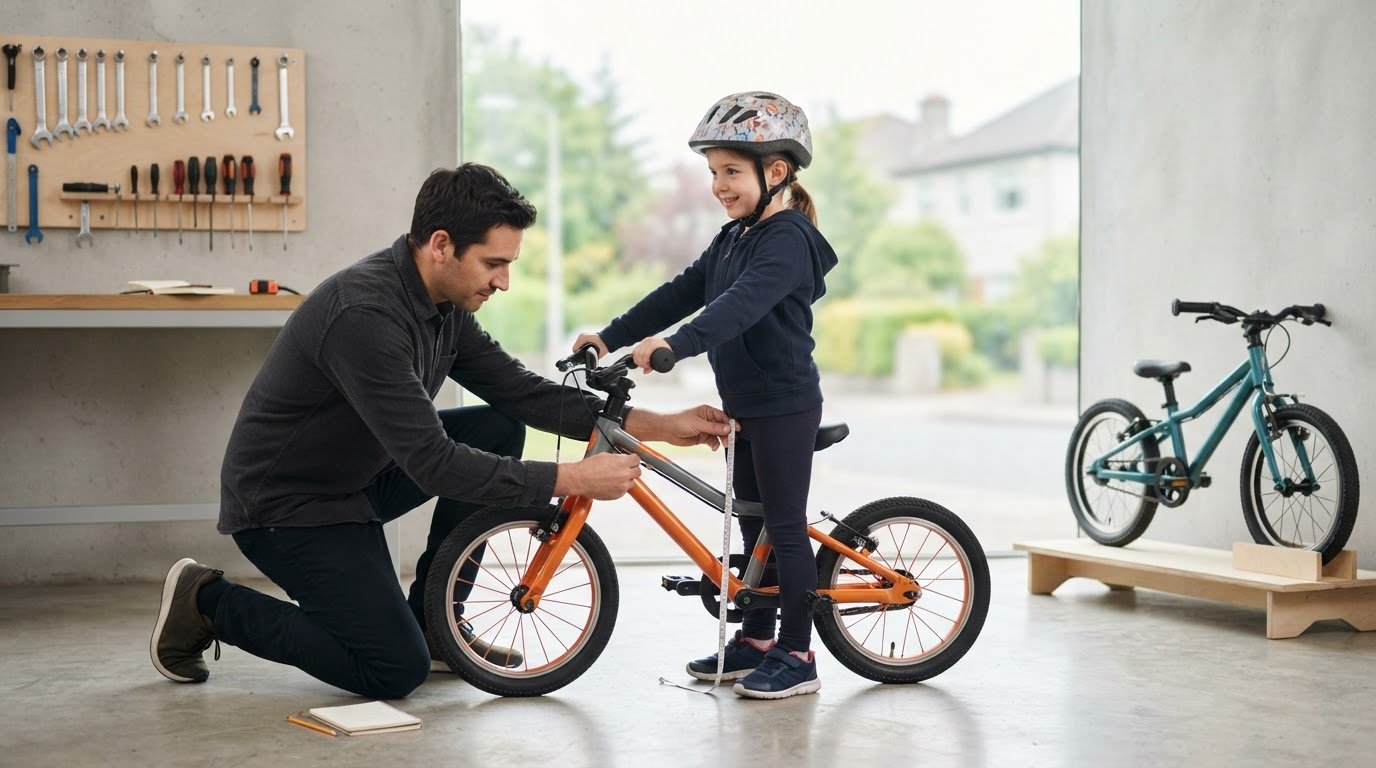
The bike your child can grow into may be the one they struggle to ride today. If you’re asking what size bike for my child, it’s easy to get caught between wheel-diameter labels, age ranges and height charts. Choosing a larger bike for extra growing room can make steering, braking and getting on or off more difficult.
A good fit helps your child feel in control from the first ride. Age can offer a rough starting point, but your child’s measurements and how the bike feels beneath them are more useful guides.
This practical guide shows you how to measure your child’s height and inside leg, compare both with a manufacturer’s sizing chart, and check the fit when they sit on and ride a bike. You’ll also learn what to look for in reach, balance and control, so you can choose a children’s bike that suits them now rather than one they have to grow into.
Key Takeaways
- Age labels are only a rough guide; the right size is the one your child can handle with confidence.
- Measure height and inside leg in your child’s usual riding footwear, then compare both with the manufacturer’s sizing chart.
- Wheel diameter helps categorise children’s bikes, but reach and control are important fit checks too.
- When asking “what size bike for my child”, consider the bike style before judging foot contact, as riding position affects how a good fit feels.
- If two sizes seem suitable, compare how comfortable and confident your child feels sitting on and trying each bike.
What size bike for my child? Start with fit, not age
Age labels can be a useful first clue, but they’re only a rough starting point. Children of the same age can differ in height, leg length and proportions, so the number on a sizing chart won’t tell you on its own whether a bike will feel manageable. A correctly sized bike lets your child steer and use the brakes without struggling.
Age alone can’t determine bike fit because children grow at different rates and bikes with similar labels can feel different to ride. If you’re wondering what size bike for my child, use their measurements and the fit of the individual model to narrow down the options. Don’t choose by age alone or buy a larger bike just to allow for growth.
Why children’s bike sizes can feel confusing
Children’s bikes are commonly grouped by wheel diameter, measured across the wheel, rather than by frame size as on many adult bikes. The wheel-size label helps you compare broad categories, but it doesn’t describe the whole bike or guarantee that two models will fit your child in the same way.
Frame shape and proportions also affect how a bike feels. Reach, for example, is the distance from the saddle area towards the handlebars. For a technical overview, see this explanation of bicycle frame geometry. Manufacturers may give wheel-size labels, height ranges or model-specific sizing charts, so use the guidance for the exact bike you’re considering.
What a good fit should help your child do
A suitable bike should let your child get on and off without awkwardness, start moving without feeling overwhelmed, and stop with control. They should reach the handlebars without an uncomfortable stretch and steer without the bike feeling too heavy or unwieldy.
Check that they can reach and operate the brake levers, especially if they have small hands. On a test ride, look for relaxed steering and controlled stops, not just whether your child can sit on the saddle. Foot contact with the ground is another useful check, but the right expectation depends on the bike’s style and intended riding position.
Resist choosing the largest option simply to allow for growth. If a bike feels difficult to steer or stop, your child may be hesitant to ride it. A manageable fit gives them a better chance to build confidence. Start by taking accurate measurements and comparing them with the manufacturer’s chart.
How to measure your child before choosing a bike size
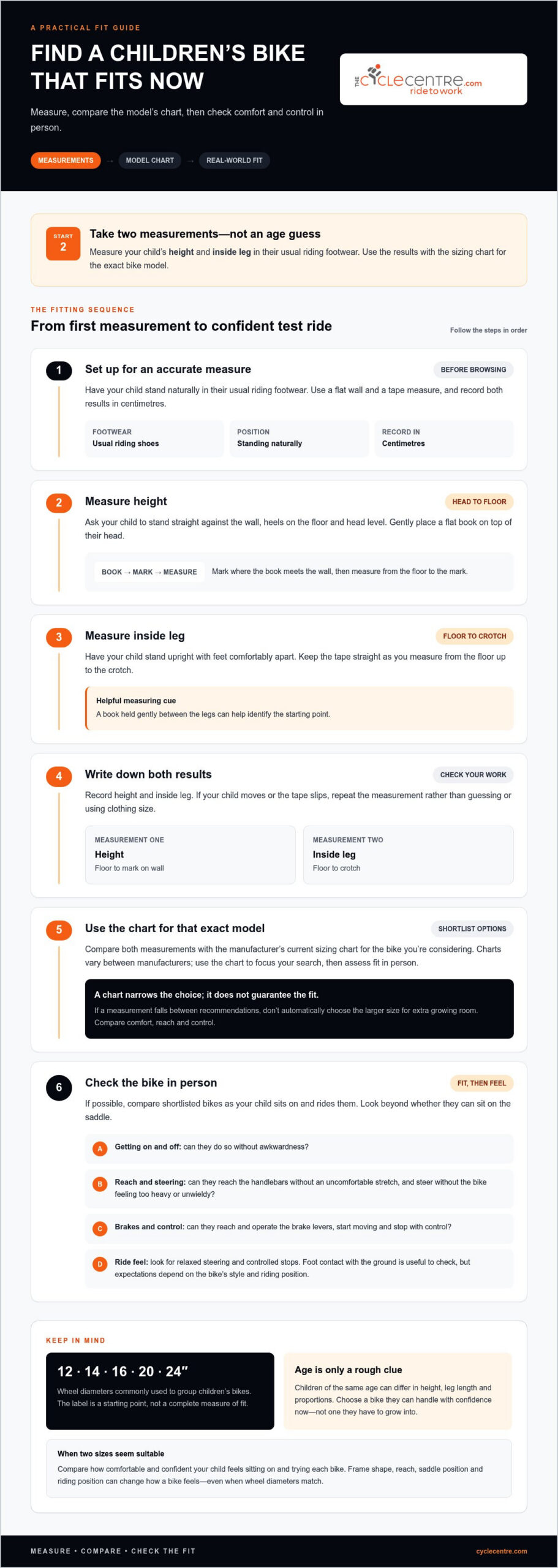
Two measurements give you a more useful starting point than an age estimate: your child’s overall height and inside-leg measurement. Take both before browsing, then compare them with the sizing guidance for the specific bike model. Charts vary between manufacturers, so there isn’t one measurement that determines the right size for every children’s bike.
Measure height and inside leg accurately
Measure in your child’s usual riding footwear, with them standing naturally. Use a flat wall and a tape measure, and record both results in centimetres.
- Height: Ask your child to stand straight against the wall, with their heels on the floor and head level. Place a flat book gently on top of their head, mark where it meets the wall, then measure from the floor to the mark.
- Inside leg: Have them stand upright with their feet comfortably apart. Measure from the floor up to the crotch, keeping the tape straight. A book held gently between the legs can help you identify the starting point.
- Check the results: Write down both measurements. If your child moves or the tape slips, repeat the measurement rather than guessing or using their clothing size.
For another practical walkthrough, REI explains how to measure your child for a bike. Having clear measurements makes it easier to compare models consistently.
Use the manufacturer’s chart as a shortlist
Find the current sizing chart for the exact model you’re considering. Compare your child’s height and inside leg with the manufacturer’s guidance, noting whether it gives a recommended range or other fit details. Use the chart to shortlist options, then check how the bike feels in person.
Measurements help narrow the choice; age-based estimates can’t tell you how a particular bike will fit. If one measurement falls between chart recommendations, don’t automatically choose the larger size for extra growing room. Shortlist the sizes indicated by the manufacturer, then compare reach, control and comfort when your child tries them. The next section covers what to check on the bike.
There’s no guaranteed age-to-wheel-size rule: children of the same age can have different measurements, and models may fit differently. Once you’ve used the chart to focus your search, browse children’s bikes and keep fit and confidence at the centre of your choice.
Compare children’s bike sizes: wheel size, reach and control
Once you’ve checked your child’s measurements against a model’s chart, compare the shortlisted bikes in person if possible. Wheel diameter, shown in inches, helps organise children’s bikes, but it isn’t a complete measure of fit. Your child’s height and inside leg are recorded in centimetres, while frame shape, saddle position and handlebar reach all affect how a bike feels.
A manufacturer’s sizing chart is a model-specific guide, not a universal promise of fit. Use it to identify possible options, then assess how your child sits, steers and handles each one.
How wheel size helps narrow down the options
Children’s bikes are commonly grouped by wheel diameters such as 12, 14, 16, 20 and 24 inches. These labels help you compare the broad size of different bikes, but two bikes with the same wheel diameter may have different frame proportions or riding positions. Treat the label as a starting point, not a verdict.
| Wheel diameter | Likely riding stage | Fit checks |
|---|---|---|
| 12 or 14 inches | Often a starting point for early independent riding | Can your child mount, balance and steer without feeling overwhelmed? |
| 16 inches | May suit a rider developing confidence on a pedal bike | Can they reach the bars and operate the brakes comfortably? |
| 20 inches | Often found on bikes for more established young riders | Does the frame feel manageable, with a relaxed reach to the handlebars? |
| 24 inches | May suit a taller or more experienced child, depending on the model | Can they control the bike through turns and stops without stretching? |
These descriptions are general, not age or fit guarantees. Always compare your child’s measurements in centimetres with the current chart for the specific model.
Compare reach, saddle position and handling
Reach describes how far your child has to stretch from the saddle towards the handlebars. If they’re leaning forward with locked elbows or struggling to turn the bars, the position may be too long. A comfortable reach lets them keep a relaxed posture and steer smoothly.
Adjusting saddle height can fine-tune a suitable bike, but it can’t make an unsuitable frame the right size. Compare shortlisted options with the saddle at a sensible height, then notice how easily your child starts, steers and brakes. If you’re asking what size bike for my child, prioritise the bike they can control with confidence today, rather than the one that offers the most room to grow.
Check bike fit in person and avoid buying too large
A sizing chart helps you choose which bikes to try, but your child’s response on the bike matters too. Let them sit on it, practise getting on and off, and try steering and braking. Stay close as they test it, and watch for ease of movement rather than whether the bike looks as though it will last for years.
What to check when your child sits on the bike
Use this checklist to compare shortlisted bikes. Look for a natural, controlled position rather than a perfect pose:
- Reach: Your child can hold the handlebars without stretching excessively or locking their elbows.
- Mounting and dismounting: They can get on and off without awkward manoeuvring or feeling trapped by the frame.
- Braking: They can reach and operate the brake levers with confidence.
- Steering and stopping: They can turn and bring the bike to a controlled stop without it feeling unwieldy.
- Foot contact: Consider the bike’s style and intended riding position. A beginner may value being able to reach the ground while seated, but the right amount of contact can differ between bikes. Check the model’s guidance and whether your child can stop and dismount securely.
Notice your child’s body language as well as their position. Hesitation, over-stretching or difficulty handling the bars can indicate that the bike isn’t comfortable for them.
To compare options, explore children’s bikes with these fit checks in mind.
Why a bike to grow into can be difficult to ride
It’s understandable to hope a larger bike will postpone the next upgrade. But extra size can mean a longer reach and a bike that’s harder to manage, particularly when starting, stopping or steering slowly. If your child can’t handle it comfortably now, the promise of growing into it won’t make today’s ride easier.
Choose a bike that suits their current measurements and lets them ride with control, rather than pushing towards the largest size they might eventually fit. A saddle can be adjusted within its intended range, but adjustment can’t compensate for a bike that is fundamentally too large. As your child grows or their riding confidence changes, reassess their position and how easily they handle the bike. Their comfort now is a more useful guide than predicted growth.
Choose your child’s bike size with confidence
Choosing between children’s bikes is easier when you follow the same steps for each option: measure your child, check the chart for the specific model, then compare how the bike fits and handles in person. A wheel-size label or age estimate can help you start, but your child’s comfort and control should guide the final choice.
A quick decision checklist for parents
- Record both measurements: Have your child’s height and inside-leg measurement to hand, taken in their usual riding footwear.
- Check the model’s chart: Compare those measurements with the manufacturer’s current sizing guidance for the exact bike you’re considering.
- Assess their position: Look for comfortable reach to the handlebars and a saddle position that suits the model.
- Watch them handle the bike: Can they mount, dismount, steer and brake without struggling or seeming hesitant?
- Use comfort as the tie-breaker: If two shortlisted bikes seem suitable, favour the one your child handles with greater ease and confidence.
It’s natural to weigh up a slightly larger option against the prospect of needing another bike as your child grows. But if they’re noticeably stretched or find it hard to steer and stop, that extra room may come at the expense of control today. Choose a suitable present fit, then reassess as their height and riding confidence change.
Find a children’s bike for the next adventure
If you’re still asking, what size bike for my child, return to the essentials: accurate measurements, the specific model’s chart and a practical fit check. No chart can capture exactly how a bike feels to your child, so let their comfort and confidence make the final call.
The Cycle Centre’s children’s bike range is a practical next step once you know what to look for. Explore the children’s bikes and use your shortlist to focus on a bike your child can enjoy handling now. Take your time; a comfortable, manageable fit is a sound starting point for many happy rides.
Choose a bike your child can enjoy riding
If you’re still wondering what size bike for my child, keep the decision grounded in three things: accurate height and inside-leg measurements, the sizing chart for the specific model, and how comfortably your child can control the bike. Wheel size narrows the options, but a confident reach, manageable steering and reliable braking matter more than choosing a bike to grow into.
If you’re comparing a couple of suitable options, let your child’s comfort and confidence break the tie. The Cycle Centre is an independent, family-owned retailer with children’s bikes as part of its range.
Explore children’s bikes at The Cycle Centre and take the next step towards a bike your child can ride with confidence. Here’s to many happy adventures together.
Frequently Asked Questions
What size bike should I get for my child?
Choose a bike your child can handle comfortably now, using their height and inside-leg measurement as your starting point. Compare both with the manufacturer’s current chart for the specific model, then check how your child reaches the handlebars, steers and brakes. Wheel diameter helps narrow the options, but it doesn’t confirm fit on its own. If you’re asking “what size bike for my child”, prioritise control over extra room to grow.
How do I measure my child for a bike?
Measure your child’s height against a flat wall and record it in centimetres. For inside leg, have them stand naturally in their usual riding footwear, then measure from the floor to the crotch. Repeat either measurement if your child moves or the result seems unclear; don’t estimate from clothing size. Use both figures to compare with the current manufacturer chart for the particular bike you’re considering.
Does a child’s age determine what size bike they need?
No. Age can offer a rough starting point, but it can’t account for differences in children’s height, leg length or proportions. Bike designs and sizing charts also vary, so the same age or wheel-size label won’t guarantee the same fit. Use your child’s measurements to shortlist suitable models, then assess reach, handling and braking. The manufacturer’s model-specific chart is more useful than relying on an age estimate alone.
Should my child be able to touch the ground while sitting on a bike?
Not necessarily with both feet flat. The amount of ground contact that feels suitable depends on the bike’s style, its intended riding position and your child’s experience. A beginner may feel reassured by being able to reach the ground more easily, while another bike may be designed to be ridden with the saddle higher. Check the model’s sizing guidance and make sure your child can stop, get off and handle the bike confidently.
Should I buy a bigger bike for my child to grow into?
It’s usually better to choose a bike your child can control comfortably now. A bike that’s too large may make reaching the handlebars, steering at low speed and stopping more difficult, which can affect confidence. Saddle adjustment can accommodate some growth, but it can’t make an oversized frame the right fit. Choose a suitable current size, then reassess the fit as your child grows or becomes more confident riding.
What should I do if my child is between two bike sizes?
Use the manufacturer’s chart for the exact model to identify which sizes suit your child’s measurements, then compare both in person if possible. Check whether they can reach the handlebars without stretching, steer smoothly and operate the brakes confidently. Don’t automatically choose the larger option for extra growing room. If both seem suitable, your child’s comfort and control can help break the tie.
Can I adjust a child’s bike to make the wrong size fit?
Small adjustments, such as setting the saddle at an appropriate height, can fine-tune a bike that is already the right general size. They can’t correct a frame that is too large or too small. If your child has to stretch to reach the handlebars, struggles to steer or can’t brake confidently, changing the saddle position won’t solve the underlying fit issue. Use the model’s chart and your child’s handling to choose a better-sized option.