

You could be overpaying by more than half for your daily commute if you aren’t leveraging the full potential of the Irish tax system. Whilst many people recognise the health benefits of cycling, the high upfront cost of a premium motor can feel like a significant hurdle. Choosing the right electric bikes for Bike to work scheme applications is about more than just picking a frame; it’s about matching technical motor performance to the statutory caps for genuine long-term value. We understand that the jump from a standard bicycle to a high-quality e-bike involves questions about battery longevity and professional maintenance.
It’s completely natural to feel confused by the distinction between the €1,500 limit for standard e-bikes and the €3,000 allowance for cargo models. This guide will show you exactly how to maximise your tax savings, providing a clear path through the 4-year rule and the technical specifications that matter. We’ll preview the best-performing models from world-class brands and explain how a Shimano accredited workshop ensures your investment remains reliable for years to come.
Key Takeaways
- Understand how the salary sacrifice model reduces your taxable income, allowing you to save up to 52% on your new purchase through gross salary deductions.
- Clarify the specific spending limits for 2026, including the €1,500 threshold for standard electric bikes for Bike to work scheme orders and the €3,000 allowance for cargo bikes.
- Learn how to select the ideal motor torque and battery range for your specific route terrain using our professional Smart-bike Search tool.
- Discover how to navigate the four-year eligibility rule and the administrative steps required to secure a formal quote for your HR department.
- Master long-term e-bike care with specialist maintenance tips and battery health strategies to ensure your bike performs reliably for years.
Understanding the Bike to Work Scheme for Electric Bikes in 2026
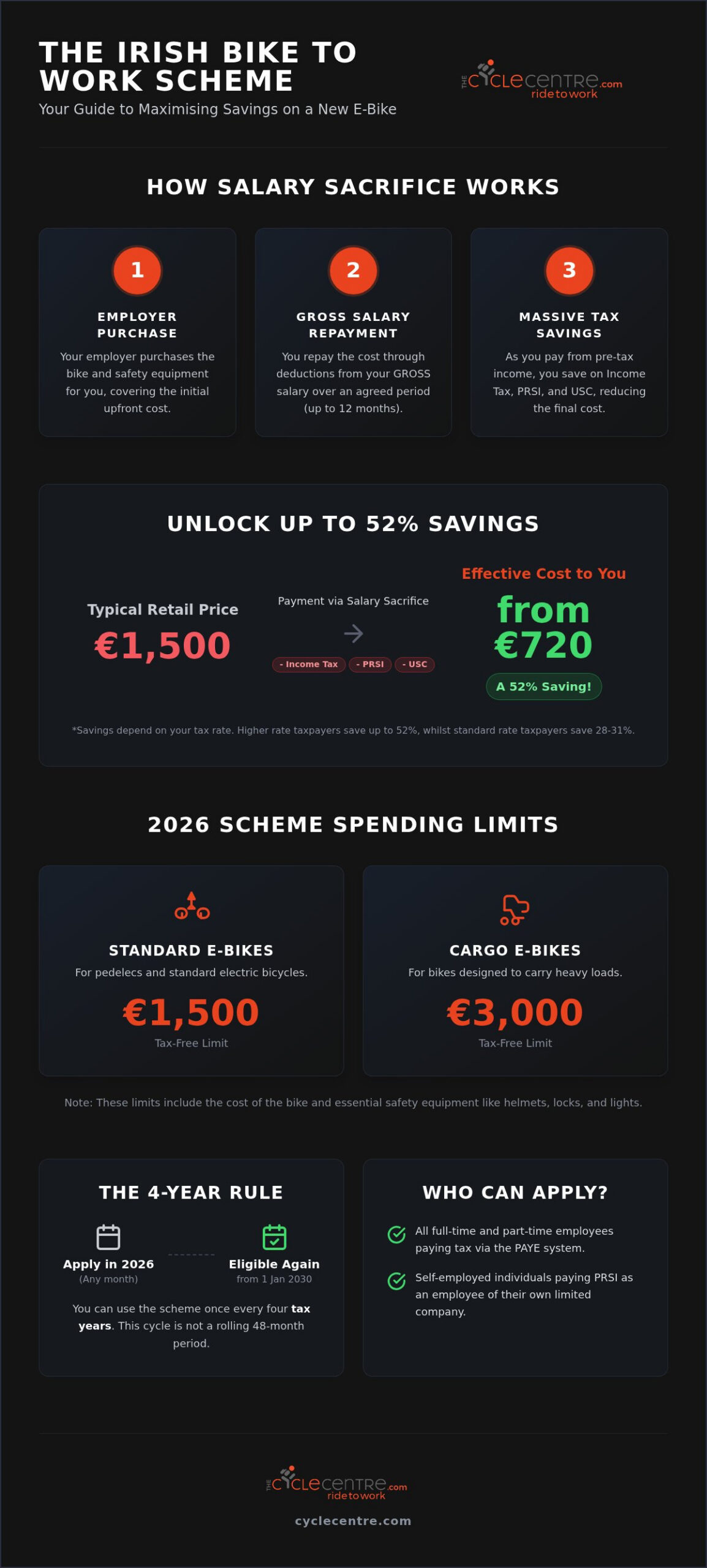
The Cycle to Work scheme remains one of the most effective ways for Irish employees to transition into sustainable commuting without the sting of a large upfront payment. It’s a government-backed tax incentive designed to reduce congestion and improve public health by making high-quality bicycles more accessible to the general workforce. Essentially, your employer purchases the bike and equipment on your behalf. You then repay the cost through a series of deductions from your gross salary over a period of up to 12 months. This allows you to spread the cost whilst benefiting from significant tax relief.
The Statutory Spending Limits for 2026
The government has set clear financial boundaries to guide these purchases and ensure they remain focused on commuting. For standard pedelecs and electric bikes, the tax-free limit is €1,500. If you require a cargo or e-cargo bike, perhaps for school runs or heavy deliveries, this limit increases significantly to €3,000. These caps include both the bike and essential safety equipment like helmets, lights, and locks. If your chosen e-bike exceeds these limits, you can still use the scheme; however, you’ll need to pay the remaining balance yourself using after-tax income, as the tax relief only applies up to the statutory cap.
Eligibility: Who can apply?
Most people working in Ireland can benefit from this initiative. The scheme applies to all full-time and part-time employees, provided they are paying tax through the PAYE system. Self-employed individuals can also participate if they are paying PRSI as an employee of their own limited company. Crucially, employers must offer the scheme to every member of their staff on equal terms. They cannot cherry-pick who gets to save, ensuring that everyone from the office junior to the senior director has the same opportunity to upgrade their commute. This universal access makes electric bikes for Bike to work scheme participants a common sight in Irish cities today.
Calculating Your Savings: Tax, PRSI, and USC
The financial appeal of the initiative lies in its simplicity. By opting for a salary sacrifice arrangement, you effectively pay for your bicycle from your gross income. This means the deductions occur before Income Tax, Pay Related Social Insurance (PRSI), and the Universal Social Charge (USC) are applied. For those on the higher tax rate, the total saving can be as high as 52%, essentially halving the cost of premium hardware. Even for basic-rate taxpayers, the savings remain substantial, typically ranging from 28% to 31% depending on your specific PRSI class. You can explore our detailed Guide to the Bike to Work Scheme Ireland 2026 to see how these figures apply to your specific salary bracket.
According to official Irish government guidance, the employer pays the supplier the full amount and recoups it from your wages over an agreed period. This structure makes investing in high-quality electric bikes for Bike to work scheme applications far more manageable than a single lump-sum purchase. Because the motor and battery technology in modern e-bikes represents a significant investment, these tax exemptions are vital for making top-tier brands accessible to the average commuter. It’s a logical solution to the high upfront costs that often deter people from upgrading their lifestyle.
The 4-Year Rule Explained
Eligibility for the scheme is refreshed every four years. It’s vital to understand that this is calculated by calendar tax years rather than a rolling 48-month period. If you purchase a bike in any month of 2026, you’re eligible to use the scheme again on January 1, 2030. Most employers organise the repayment over a 12-month term. If you happen to leave your job before the full balance is settled, the remaining amount is typically deducted from your final salary payment. This ensures the tax efficiency remains intact whilst closing the account with your employer.
Included Safety Equipment and Accessories
The scheme covers more than just the frame and motor. You can include essential safety gear within your €1,500 or €3,000 limit. Given the higher speeds and value of e-bikes, investing in a high-quality helmet and a robust, insurance-approved lock is a sensible move. Staying comfortable in the unpredictable Irish weather is also a priority, so you should consider adding waterproof gear to your application. You might find our resource on Cycling Apparel Ireland helpful when selecting garments that balance breathability with weather protection. If you’re unsure which accessories are compatible with your chosen model, feel free to request a tailored quote from our expert team.
Choosing the Best Electric Bike for Your Commute
Selecting the right frame and motor combination is the most critical step in your journey. Whilst the official guidelines for the Cycle to Work Scheme provide the financial framework, the technical choice depends entirely on your daily route and personal fitness goals. If your commute involves the rolling hills of the Irish countryside, motor torque becomes your primary concern. Mid-drive motors provide superior torque for steep gradients by leveraging the bike’s gears, whilst hub motors are often better suited for flatter, urban sprints. Reliability is paramount. We focus on world-class brands like Giant and Cube because they integrate high-end systems from Bosch, Shimano, and Yamaha. This ensures that your investment in electric bikes for Bike to work scheme applications is backed by global engineering standards rather than unbranded, generic alternatives.
Battery capacity should never be an afterthought. Irish weather and terrain can be demanding. A higher Watt-hour (Wh) rating ensures you aren’t left pedalling a heavy frame without assistance on a windy Tuesday evening. Most modern riders find that a 500Wh or 625Wh battery provides the perfect balance between weight and range for a typical return commute. Using a Smart-bike Search tool helps narrow these technical variables into a practical list of options tailored to your specific needs. This longevity is further supported by our Shimano accredited workshop, where we specialise in the diagnostic care and firmware updates required for these complex electrical systems.
E-City vs E-Road vs E-MTB
E-city bikes are the stalwarts of urban transport, featuring upright riding positions and integrated racks for your work bag. They prioritise comfort and visibility in heavy traffic. If your commute is longer or you value speed, E-road bikes offer a lightweight, performance-oriented experience that feels much like a traditional racer with a hidden boost. Alternatively, some commuters opt for an E-MTB. These mountain bikes provide incredible versatility, allowing you to tackle rougher paths or kerbs with confidence whilst benefiting from the same tax-efficient savings. Each style offers a different solution to the daily grind.
The Rise of the E-Cargo Bike
The €3,000 limit for e-cargo bikes has changed the game for families and small business owners. These frames are designed to carry significant loads, whether that is the weekly shop or two children on the way to school. Whilst they require more storage space than a standard bicycle, their ability to replace a second family car is unmatched. The assistance from a powerful mid-drive motor makes a fully loaded cargo bike feel surprisingly nimble, even on an incline. It is a proactive, solution-oriented choice for those looking to decarbonise their family logistics.
The Application Process: A Step-by-Step Guide
Securing a new e-bike should be a logical, stress-free process. It starts with an initial consultation where we help you narrow down your choices based on your specific route and storage needs. Using our Smart-bike Search tool, you can filter through various motor types and battery capacities to find a perfect match. This stage is vital for ensuring that your chosen electric bikes for Bike to work scheme purchase provides the reliability you need for a daily commute. Don’t rush this stage; the right fit makes all the difference to your long-term comfort.
After you’ve selected your bike, we issue a formal quote for your employer’s HR department. This document acts as the foundation for the entire transaction. Once your employer approves the quote and settles the payment, you’ll sign a salary sacrifice agreement. This contract allows the cost to be deducted from your gross salary over a period of up to 12 months, maximising your tax efficiency. Finally, you’ll visit us for a professional collection where we ensure the bike is perfectly adjusted to your height and riding style.
Avoiding Common Application Mistakes
Precision is key when dealing with tax-incentive paperwork. One common pitfall is failing to match the invoice to the correct scheme category. For instance, an e-cargo bike must be clearly identified to qualify for the €3,000 limit rather than the standard €1,500 e-bike cap. Timing also matters. You should coordinate with your company’s payroll department to ensure the application is processed before their monthly cut-off date. Most importantly, never purchase the bike yourself with the intention of claiming the money back later. Revenue rules are strict; the employer must pay the supplier directly for the tax exemption to apply.
The Importance of Professional Assembly
Receiving a “bike in a box” might seem convenient, but it carries significant risks for high-torque electric motors. These machines require specialist knowledge to ensure the drivetrain and electrical firmware are correctly configured. Our Shimano accredited workshop technicians perform a rigorous Pre-Delivery Inspection on every Bosch, Shimano, and Yamaha system. This technical precision is the same standard we apply to our High-End Road Bike Service in Ireland, guaranteeing that your new investment is safe and efficient from the very first mile. To begin your journey, view our eligible e-bike range and request your formal quote today.
Long-Term Value: Maintenance and E-Bike Care
Investing in a high-quality motor and battery system is a significant commitment. Whilst the tax savings make the initial purchase much easier, the true value of electric bikes for Bike to work scheme participants is realised through years of trouble-free commuting. An e-bike is a sophisticated vehicle that requires more than just a basic tyre pressure check. To protect your investment, you need a partner with the technical expertise to handle complex electrical diagnostics. We position ourselves as that partner, providing the professional backup you need from the moment you leave the showroom. Our Shimano accredited workshop is specifically equipped to handle the nuances of modern e-bike systems, ensuring your commute remains efficient and safe.
Battery health management is perhaps the most critical aspect of e-bike longevity. Irish winters can be particularly demanding on lithium-ion cells, as extreme cold can temporarily reduce your range. We recommend storing your battery indoors during the height of winter and avoiding leaving it at 0% or 100% charge for extended periods of storage. Maintaining a charge between 30% and 80% when the bike isn’t in use will significantly prolong the life of the cells. Additionally, regular firmware updates are essential. These updates, performed in our workshop, can optimise motor efficiency and improve battery management software, effectively giving your bike a performance boost through code alone.
Specialist Motor Servicing
Our technicians possess deep expertise in Bosch, Shimano, Yamaha, and Bafang systems. Mid-drive motors, which are found on many premium Electric Mountain Bikes and E-city models, require specific attention to the drivetrain. Because the motor’s torque passes directly through the chain and cassette, these components experience higher wear than on a standard bicycle. We often suggest a Workshop Gold Service for high-mileage commuters to ensure the motor mounts are torqued correctly and the drive system is perfectly aligned. This proactive approach prevents small issues from becoming costly repairs down the line.
Next Steps: Get Your No-Obligation Quote
If you’re ready to transform your daily journey, the process is straightforward. You can use our online application tool to generate a fast, no-obligation quote for your HR department. This tool is designed to reduce friction, allowing you to see the potential savings immediately. We also encourage you to visit our showroom to test ride different motor systems. Feeling the difference between a high-torque mid-drive and a smooth hub motor is the best way to ensure you’re making the right choice for your specific route. Our team is always on hand to provide jargon-free guidance, moving you from uncertainty to informed confidence.
Request your Bike to Work quote from The Cycle Centre today and start your journey toward a more sustainable, cost-effective commute.
Upgrade Your Journey with Confidence
Transitioning to an e-bike is a practical solution to the rising costs and frustrations of daily travel. By utilising the tax-efficient framework of the Irish government, you can secure world-class engineering from brands like Giant and Cube whilst saving up to 52% on the total cost. We’ve explored how matching the right motor torque to your route and understanding the 2026 spending limits ensures you get the best value from the four-year rule. It’s a logical step that balances financial savvy with a genuine improvement in your daily quality of life.
As an independent family business serving the community since 1974, we don’t just sell you a frame; we facilitate a better lifestyle. Our Shimano Accredited Workshop provides the technical backup required for high-torque systems, ensuring your investment remains a reliable companion for years. Choosing the right electric bikes for Bike to work scheme applications is the first step toward a healthier, faster, and more enjoyable commute. We’re here to guide you through every technical specification and administrative detail.
Apply for your tax-free Electric Bike quote here and let our experts help you find the perfect fit. Your new road ahead starts with a single, smart decision.
Frequently Asked Questions
Can I get an electric bike over €1,500 on the scheme?
You can certainly choose a model that exceeds the €1,500 limit, but the tax exemptions only apply to the first €1,500 of the purchase price. Any remaining balance must be paid directly to the retailer using your own after-tax funds. This is a common approach for riders seeking premium electric bikes for Bike to work scheme applications where the motor or battery specifications command a higher price point.
How much exactly can I save on an e-bike through tax relief?
Savings typically range between 28% and 52% depending on your personal tax bracket and PRSI class. Higher-rate taxpayers benefit the most because the salary sacrifice reduces the portion of income otherwise taxed at 40%. Because the deductions happen before USC and PRSI are calculated, the efficiency of the scheme makes high-quality e-commuting significantly more affordable than a standard retail purchase.
What happens to the bike if I leave my job before it is paid off?
If you change employers before the 12-month repayment term concludes, the outstanding balance is typically settled through a final deduction from your last net salary payment. Once this final payment is made, you retain full ownership of the bicycle. It’s a straightforward process that ensures the financial commitment to your employer is cleared whilst you keep your transport.
Can I use the Bike to Work scheme for an electric scooter?
How often can I upgrade my bike using the scheme in Ireland?
You are eligible to avail of the scheme once every four years. This is calculated by calendar years rather than the specific date of your last purchase. For example, if you utilised the scheme at any point during 2026, you would be eligible to apply again on January 1, 2030. This cycle allows commuters to keep pace with evolving battery and motor technology.
Does the scheme cover the cost of e-bike battery replacements?
The scheme doesn’t cover the purchase of individual spare parts or replacement batteries. It’s designed for the initial acquisition of a new, complete bicycle and essential safety equipment. Whilst the scheme itself won’t fund a new battery later, choosing electric bikes for Bike to work scheme orders from reputable brands ensures you have access to professional battery health diagnostics in our workshop in the future.
Is insurance for my e-bike covered under the scheme?
No, the cost of insurance cannot be included in your salary sacrifice agreement. The scheme is strictly for the purchase of the bicycle and specific safety accessories like helmets, lights, and locks. We highly recommend arranging separate insurance for your e-bike to protect against theft or accidental damage, as these premium machines represent a significant personal investment.
Can I buy two bikes at once if the total is under the limit?
Yes, you are permitted to purchase two bicycles as part of a single application, provided the combined total does not exceed the statutory limit. This is often helpful for commuters who might want a folding bike for city hops and a standard e-bike for longer journeys. Both bikes must be purchased in the same transaction to qualify for the tax relief.