

What if the biggest barrier between you and a premium electric bike isn’t the price tag, but simply not knowing how much you could save? For anyone considering electric bikes for the Cycle to Work Scheme in 2026, that saving can be genuinely significant, with higher-rate taxpayers potentially reducing their costs by up to 52% through tax-free salary sacrifice.
You’re not alone if the whole thing feels a little overwhelming. Rising fuel and parking costs are squeezing commuter budgets harder than ever, and the rules around tax-free price caps, battery range, and long-term maintenance can make an already exciting purchase feel unnecessarily complicated. It’s a lot to unpick.
That’s exactly why we’ve put this guide together. By the time you’ve finished reading, you’ll know precisely how much you can save, which e-bikes represent the best value under the current 2026 scheme limits, and how to choose a model backed by the kind of specialist technical support that keeps you riding confidently for years to come. We’ll walk you through the scheme rules, the smartest bike choices, and everything in between.
Key Takeaways
- Higher-rate taxpayers can save up to 52% on electric bikes for the Cycle to Work Scheme through salary sacrifice, making premium models far more accessible than many riders realise.
- The 2026 scheme operates under specific Revenue expenditure limits, with separate thresholds for standard e-bikes and cargo models — knowing which category applies to you directly affects how much you can spend tax-free.
- Choosing the right e-bike isn’t simply about budget; motor torque, battery range, and terrain compatibility all play a critical role, particularly for hilly Irish commutes.
- The application process is more straightforward than it appears, but getting your quote and employer approval in the right order is essential to avoid unnecessary delays.
- With over 50 years of specialist experience and a Shimano-accredited workshop, The Cycle Centre offers dedicated scheme support — including a Smart-bike Search tool — to help you find and maintain the ideal ride with confidence.
Understanding the Cycle to Work Scheme for Electric Bikes in 2026
The Cycle to Work scheme is a government-backed salary sacrifice initiative that lets Irish employees acquire a bike entirely free of income tax, PRSI, and USC. Rather than purchasing a bike from your own take-home pay, your employer buys it on your behalf and you repay the cost from your gross salary over an agreed period, typically twelve months. The result is a genuine, measurable reduction in what you actually pay, because the repayments are deducted before tax is calculated.
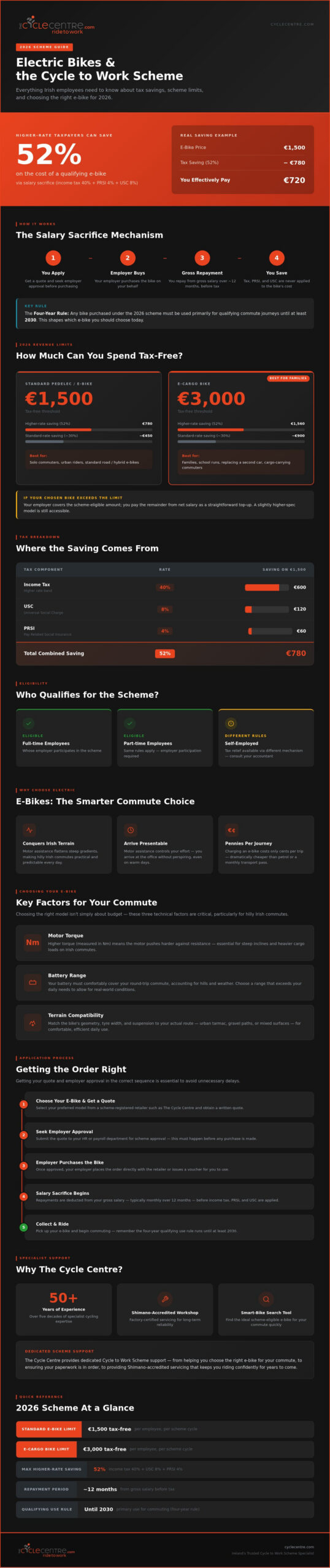
For 2026, the Revenue limits stand at €1,500 for standard electric bikes and €3,000 for cargo e-bikes. These thresholds make electric bikes for the Cycle to Work Scheme far more compelling than they were in earlier years, when lower caps pushed many quality e-bikes out of reach. A higher-rate taxpayer combining income tax at 40%, PRSI at 4%, and USC at 8% can reduce their effective cost by up to 52%. That’s not a rounding error; on a €1,500 e-bike, that’s a potential saving of up to €780.
Why Electric Bikes are the Smarter Commute Choice
Irish terrain doesn’t always cooperate with traditional cycling ambitions. Steep gradients, unpredictable weather, and longer commute distances have historically made daily cycling impractical for many people. A quality e-bike changes that calculation entirely. Motor assistance flattens the hills, controls your effort, and means you arrive at the office presentable rather than perspiring. Charging an e-bike typically costs a matter of cents per journey, making it dramatically cheaper than petrol or even a monthly public transport pass when calculated over a full working year.
Eligibility Rules for Irish Employees
Both full-time and part-time employees are eligible, provided their employer participates in the scheme. There’s one critical rule to understand before you commit: the four-year rule. Any bike purchased under the 2026 scheme must be used primarily for qualifying journeys until at least 2030. This isn’t a technicality to gloss over; it directly shapes which e-bike you should choose today.
Self-employed individuals can also access tax relief on qualifying cycling equipment, though the mechanism differs from the standard employee scheme. If you’re operating as a sole trader or through a limited company, it’s worth discussing the specific options with your accountant before proceeding.
Electric bikes for the Cycle to Work Scheme represent one of the most straightforward tax efficiencies available to Irish employees in 2026. The rules are clear, the savings are real, and the right bike choice makes the whole arrangement work for years to come.
Financial Limits and Savings: What Can You Spend?
The 2026 Revenue limits are straightforward once you know which category applies to you. Standard pedelecs and electric bicycles fall under a €1,500 tax-free threshold, whilst e-cargo bikes attract a significantly more generous €3,000 allowance. These aren’t soft guidelines; they’re the figures confirmed by Ireland’s official Cycle to Work scheme guidelines published by Revenue, and they determine exactly how much of your salary sacrifice is protected from income tax, PRSI, and USC.
The cargo bike limit deserves particular attention. At €3,000, it makes a genuinely capable family commuter bike accessible in a way that simply wasn’t possible under earlier scheme iterations. If you’re replacing a second car for the school run or carrying cargo regularly, this threshold changes the entire cost conversation. It’s a figure that competitors frequently overlook, yet it’s arguably the most transformative aspect of the 2026 scheme for families.
What if your preferred electric bike for the Cycle to Work Scheme exceeds the applicable limit? You can still proceed. Your employer covers the scheme-eligible amount, and you pay the remainder from your net salary as a straightforward top-up. It’s not ideal, but it means a slightly higher-spec model isn’t automatically out of reach.
Calculating Your Total Savings
Salary sacrifice reduces your taxable income directly, meaning every euro repaid to your employer comes from gross pay rather than take-home pay. A higher-rate taxpayer combining 40% income tax, 4% PRSI, and 8% USC saves up to 52% on the scheme value. A standard-rate taxpayer saves less, typically in the region of 28% to 31%, depending on their USC band. On a €1,500 e-bike, that’s still a meaningful reduction in real cost.
Don’t overlook the indirect savings either. Reduced fuel consumption, lower parking costs, and fewer kilometres on a private vehicle add up considerably over a full commuting year. For many riders, those secondary savings alone justify the switch.
Included Safety Equipment and Accessories
The scheme covers more than just the bike itself. Helmets, lights, locks, and commuter apparel, including waterproof cycling jackets suited to the Irish climate, all qualify under the allowance. This matters practically. Always maximise your voucher value by bundling high-quality security gear into your purchase. A robust lock in particular is a sound investment; it protects an asset you’ll be relying on for four years or more.
If you’d like to explore which e-bikes and accessories fall within your specific budget, the Smart-bike Search tool at The Cycle Centre makes it easy to filter by scheme limit and spec requirements from the outset.
Choosing the Right E-Bike for Your Commute Style
Picking the wrong e-bike is a surprisingly easy mistake to make. A model that performs brilliantly on flat Dublin city streets can feel underpowered and frustrating on the kind of rolling suburban gradients you’d find approaching Rathfarnham or Stillorgan. Before you commit your scheme allowance, three variables deserve honest attention: your route distance, the incline profile, and the surface types you’ll actually encounter.
Distance determines battery requirements. A round trip of 20km on relatively flat ground is a very different proposition to a 15km commute with sustained climbs. For the latter, motor torque becomes the deciding factor. A mid-drive motor producing 75Nm or more will handle Irish suburban gradients with genuine composure; a lower-torque hub motor may leave you working harder than you’d like on the way home. If you want to understand how the Cycle to Work scheme works in Ireland and which bike categories qualify, Citizens Information provides a clear, government-backed breakdown worth reading before you finalise your choice.
Battery capacity is equally critical. A 500Wh battery will comfortably cover most urban commutes, but if your route involves significant climbing or you’re commuting in cold weather (which reduces range noticeably), stepping up to a 625Wh or 750Wh pack is a sensible investment. For deeper technical comparisons across motor systems and battery specifications, the Ultimate Guide to Electric Bikes in Ireland 2026 covers the detail comprehensively.
E-City and Hybrid Bikes: The Urban Workhorses
For most commuters, an e-city or hybrid model is the most practical choice available under electric bikes for Cycle to Work Scheme budgets. These bikes are purpose-built for daily use: integrated mudguards, rear racks, upright riding geometry, and reliable gearing systems that handle stop-start urban traffic without complaint. Giant and Cube both engineer city and hybrid models with the kind of component quality that holds up across four-plus years of daily riding, which matters considerably given the scheme’s usage requirements. Hybrids in particular strike the right balance between efficiency and comfort, making them the most consistently popular category amongst commuters.
E-MTB and Gravel E-Bikes: Beyond the Tarmac
Not every Irish commute follows a smooth cycle lane. If your route includes gravel paths, forest tracks, or poorly surfaced rural roads, an electric mountain bike or gravel e-bike changes the experience entirely. E-MTBs offer suspension and tyre volume that absorb rough terrain without drama, whilst gravel e-bikes deliver a faster, more efficient ride across mixed surfaces without the weight penalty of a full mountain bike. They’re also increasingly popular for riders who want one bike that handles both the commute and weekend adventure riding. Explore the range of Electric Mountain Bikes available for trail and road use to see which specification suits your specific route demands.
The honest answer is that there’s no universally correct choice. Match the bike to your actual route, not an idealised version of it.
The Application Process and Long-Term Maintenance
The application process for electric bikes for the Cycle to Work Scheme is genuinely more straightforward than most people expect, provided you follow the steps in the correct order. Skipping ahead or reversing the sequence is the most common cause of unnecessary delays.
The process unfolds in four clear stages:
- Step 1: Select your bike and request a formal scheme quote. Identify the e-bike and any qualifying accessories you’d like to include, then request a written quote from your chosen retailer. At The Cycle Centre, this can be done through the Smart-bike Search tool, which filters by scheme limit and specification from the outset, making the quote process clean and efficient.
- Step 2: Submit the quote to your HR or finance department for approval. Your employer needs a formal invoice or quote to process the salary sacrifice arrangement. Don’t purchase anything before this approval is confirmed in writing; doing so disqualifies the purchase from the scheme entirely.
- Step 3: Employer payment and the issuance of your collection voucher. Once approved, your employer pays the retailer directly and issues you with a letter or voucher of collection. This document is your authorisation to collect the bike; treat it accordingly.
- Step 4: Final fit-out and collection from your chosen specialist centre. A good specialist will fit the bike to your measurements, check tyre pressure, adjust saddle height, and walk you through the motor assist settings before you leave. Don’t rush this stage; a properly fitted e-bike is a safer, more comfortable one.
E-Bike Specific Servicing: Protecting Your Investment
Standard bicycle servicing simply isn’t sufficient for a modern e-bike. Bosch, Shimano, and Yamaha motor systems each require specialist diagnostic tools to identify faults accurately and safely. Firmware updates are equally important; manufacturers release these regularly to optimise battery management, improve motor efficiency, and extend the usable lifespan of the system. Neglecting them isn’t just an inconvenience, it can meaningfully shorten battery life over a four-year scheme cycle. A Shimano-accredited workshop, like The Cycle Centre’s, is essential because it guarantees technicians are trained and equipped to service these systems to the manufacturer’s own safety standards, rather than relying on generalised mechanical knowledge.
Battery Care for the Irish Climate
Cold temperatures reduce lithium-ion battery capacity noticeably, which is a practical reality for Irish winters. A few straightforward habits protect your battery across the full scheme period:
- Store the battery indoors overnight during cold spells rather than leaving it attached to the bike in an unheated garage or shed.
- Avoid charging immediately after a cold ride; allow the battery to return to room temperature first.
- Keep the charge level between 20% and 80% for everyday storage, reserving full charges for longer rides only.
- If the bike won’t be used for an extended period, store the battery at approximately 50% charge in a cool, dry location.
These aren’t overly cautious habits; they’re the difference between a battery that performs confidently in year four and one that’s lost a significant portion of its range. For a full overview of legal requirements and compliance considerations, review the Electric Bike Laws in Ireland guide before your first commute.
The scheme gets you on the right bike. Proper servicing and battery care keep you there. Book a service consultation with The Cycle Centre’s Shimano-accredited workshop to keep your e-bike performing at its best throughout the full scheme cycle.
Why The Cycle Centre is Ireland’s Trusted Scheme Provider
There’s a meaningful difference between buying a bike and choosing the right one with confidence. Since 1974, The Cycle Centre has been helping Irish cyclists do exactly that, building five decades of specialist knowledge that no high-street chain or generalist retailer can replicate. That heritage isn’t simply a number on a wall; it’s the accumulated experience of thousands of bike fits, scheme applications, and technical consultations that inform every recommendation made today.
For anyone exploring electric bikes for the Cycle to Work Scheme, that depth of experience matters more than it might initially appear. The scheme’s four-year usage requirement means your choice needs to perform reliably across years, not just weeks. Getting it right from the outset is far less costly than discovering a mismatch six months into your commute.
The Smart-bike Search tool reflects exactly this philosophy. Rather than presenting an overwhelming catalogue and leaving you to work it out alone, the tool filters by scheme limit, motor specification, and riding style from the start. It removes the guesswork and surfaces genuinely suitable options quickly, so you arrive at a shortlist that already makes sense for your route, your budget, and your employer’s scheme parameters.
Long-term care is equally considered. The Cycle Centre’s Silver and Gold workshop service packages are designed specifically around the demands of modern e-bike ownership, covering the kind of specialist motor diagnostics and firmware servicing that standard bicycle workshops simply aren’t equipped to provide. Whether your motor is Bosch, Yamaha, or Bafang, the Shimano-accredited workshop has the tools and training to service it correctly.
Expert Guidance vs. High-Street Retail
Buying an e-bike from a generalist retailer often means speaking to someone whose knowledge stops at the sales floor. At The Cycle Centre, the conversation goes considerably further. Advisors understand the performance differences between mid-drive and hub-drive systems, can discuss gravel geometry versus hybrid geometry with genuine authority, and offer personalised fitting services that ensure your bike is ergonomically correct before you leave. National support covers all major brands stocked, including Giant, Cube, and Romet, so you’re not limited by what happens to be on display locally.
No-Obligation Quotes and Easy Applications
Employer compliance is one of the quieter friction points in the scheme process. The Cycle Centre’s online application system generates transparent, itemised invoices that satisfy Revenue requirements without requiring your HR department to chase for missing documentation. It’s a small detail that saves real time.
Choosing the right provider for electric bikes for the Cycle to Work Scheme is as important as choosing the right bike. Get your no-obligation Cycle to Work quote today and let Ireland’s most experienced specialist team guide you from first enquiry to first ride.
Your Next Commute Starts Here
Electric bikes for the Cycle to Work Scheme represent one of the most practical financial decisions an Irish commuter can make in 2026. The savings are real, the application process is straightforward, and the right e-bike genuinely transforms a daily commute into something you’ll look forward to rather than endure.
Three things matter most: understanding which Revenue threshold applies to you, matching your bike to your actual route rather than an idealised one, and choosing a provider with the specialist knowledge to support you long after your first ride. Get those three things right, and the scheme works exactly as it should.
With over 50 years serving Irish cyclists, a Shimano-accredited workshop, and a premium range including Giant, Cube, and Romet, The Cycle Centre has the expertise and the brands to make your scheme purchase count. Don’t leave significant savings on the table because the process felt complicated.
Start your Cycle to Work application and get a free quote today. The right bike is closer than you think.
Frequently Asked Questions About Electric Bikes for the Cycle to Work Scheme
How much can I save on an electric bike through the scheme in 2026?
Your savings depend on your tax rate. Higher-rate taxpayers combining income tax at 40%, PRSI at 4%, and USC at 8% can save up to 52% on the scheme value. Standard-rate taxpayers typically save between 28% and 31%, depending on their USC band. The saving is applied directly through salary sacrifice, so the reduction comes from your gross pay rather than your take-home income.
Can I buy an e-bike that costs more than the €1,500 scheme limit?
Yes, you can. If your preferred electric bike for the Cycle to Work Scheme exceeds the applicable Revenue threshold, your employer covers the scheme-eligible portion and you pay the difference from your net salary as a straightforward top-up. It’s not the most tax-efficient outcome, but it does mean a higher-specification model isn’t automatically out of reach if your route genuinely demands it.
What is the difference between the Bike to Work and Cycle to Work schemes?
In practice, they refer to the same government-backed salary sacrifice initiative. “Bike to Work” and “Cycle to Work” are simply different names used interchangeably across Revenue documentation, employer HR systems, and retailers. The rules, Revenue thresholds, and eligibility criteria are identical regardless of which label your employer or provider uses. If you see both terms, don’t let it cause confusion; they describe the same arrangement.
How often can I use the Cycle to Work scheme for a new e-bike?
The scheme operates on a four-year cycle. Once you’ve made a claim, you must wait four years before accessing it again for a new bike. This is directly tied to the usage requirement: any bike purchased under the current scheme must be used primarily for qualifying commuting journeys until the four-year period concludes. Planning your purchase carefully from the outset is therefore important, since you’re committing to that bike for a meaningful period.
Are electric cargo bikes eligible for a higher tax-free limit?
Yes. Electric cargo bikes attract a significantly more generous Revenue threshold of €3,000, compared to €1,500 for standard e-bikes. This makes a genuinely capable cargo model accessible to families replacing a second car or commuters carrying equipment regularly. It’s one of the most compelling aspects of the 2026 scheme for riders with practical load-carrying needs, and it’s a threshold that’s often overlooked when people first start researching their options.
What happens to the bike if I leave my job before the repayments are finished?
This is a question worth raising with your HR department before you sign any salary sacrifice agreement, as the terms can vary between employers. In most cases, any outstanding repayment balance becomes immediately due and is typically deducted from your final salary. Some employers may handle this differently, so reviewing the specific wording of your agreement before committing is a sensible step rather than an afterthought.
Does the scheme cover second-hand or used electric bikes?
No. Revenue’s guidelines require that bikes purchased under the scheme are new. Second-hand or refurbished electric bikes don’t qualify, regardless of their condition or price. This is a firm requirement rather than a grey area, so any purchase needs to be from a registered retailer supplying new stock. It’s one reason why choosing a reputable specialist with a properly documented invoicing process matters for scheme compliance.
Is safety equipment like helmets and locks included in the tax-free price?
Yes, qualifying accessories are covered within your scheme allowance. Helmets, lights, locks, and commuter apparel including waterproof cycling gear all count towards your tax-free limit. If your e-bike purchase comes in under the applicable threshold, it’s worth bundling in quality safety equipment to maximise the full value of your allowance rather than purchasing those items separately from your net pay afterwards.