


Imagine you are halfway through your 20km commute, leaning into a headwind on a damp Tuesday morning, when the familiar hum of your motor suddenly vanishes. It is a sinking feeling that many of us have experienced, especially as e-bikes become our primary tools for navigating Irish roads. You might worry that your bike has reached its end, but the reality is often less terminal than it first appears. Most common e-bike motor problems stem from simple connectivity issues, faulty sensors, or software glitches rather than a total mechanical failure of the drive unit itself.
We understand the frustration of seeing a cryptic error code when you just want to get to work without a struggle. This guide provides a clear diagnostic path to help you troubleshoot these issues at home, whilst teaching you exactly when it is time to seek a professional workshop service. We will look at everything from the impact of our local climate on electrical connections to the latest performance updates for Bosch and Yamaha systems. By the end, you will have the knowledge to resolve minor hiccups yourself and the confidence to make informed decisions about more complex repairs.
Key Takeaways
- Learn to decode unusual acoustic signatures, such as grinding or high-pitched whining, to determine if your motor is facing a minor glitch or a mechanical failure.
- Understand how the damp Irish climate and daily wear contribute to common e-bike motor problems, including seal degradation and internal gear fatigue.
- Gain brand-specific insights into Bosch, Shimano, and Yamaha systems to help you navigate cryptic error codes and sensor alignment quirks with ease.
- Master a step-by-step home troubleshooting routine to resolve simple connectivity and alignment issues before they disrupt your daily commute.
- Identify the precise moment to seek professional specialist intervention through dedicated workshop services to ensure the long-term reliability of your drive unit.
Recognising the Symptoms: Is Your E-Bike Motor Actually Failing?
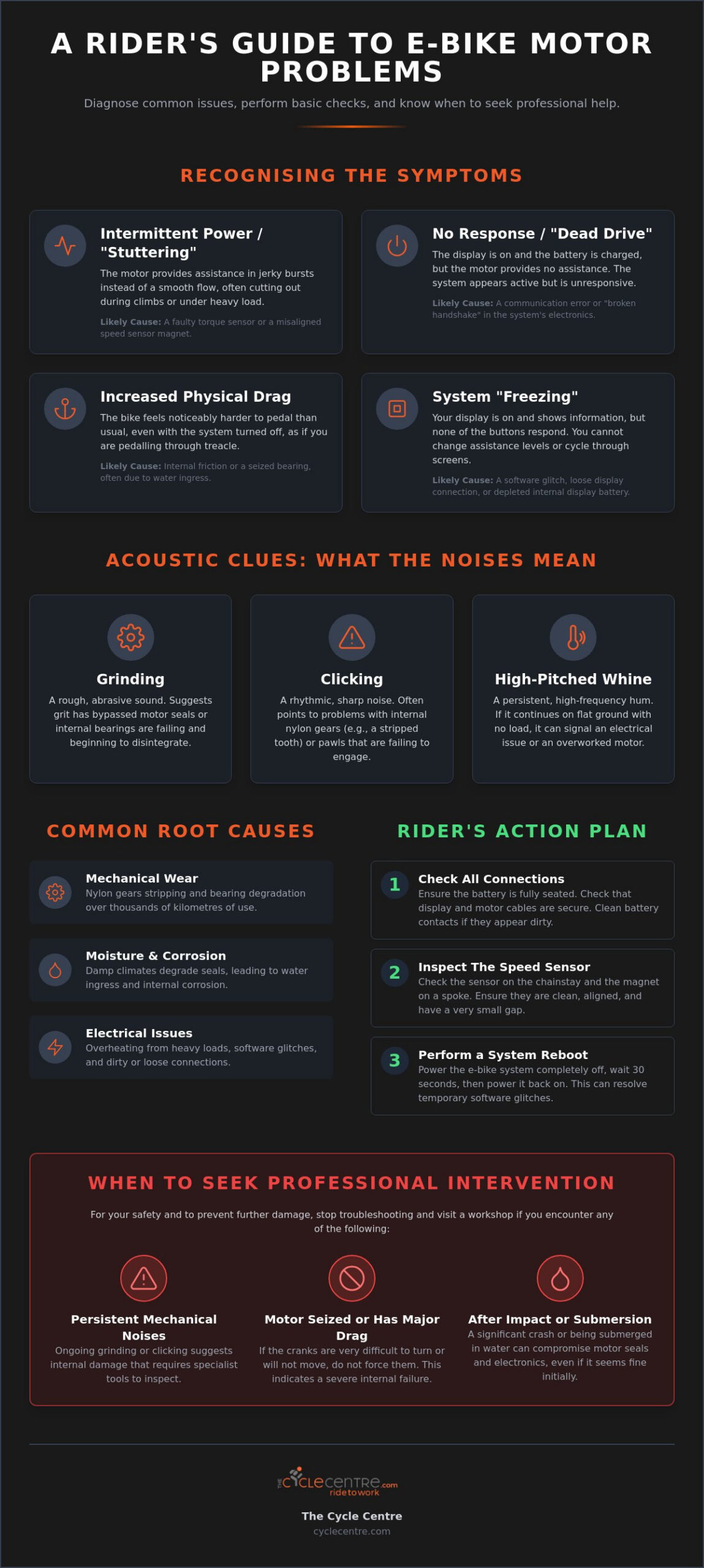
Identifying whether you are facing a terminal motor failure or a simple sensor misalignment is the first step toward getting back on the road. When your assistance starts to “stutter” during a climb, or if the motor feels unresponsive despite a fully charged battery, it’s easy to assume the worst. However, many common e-bike motor problems are actually communication errors between the various electric bicycle components rather than a mechanical death knell.
A frequent frustration for riders is the “stuttering” effect. This happens when the motor provides power in short, jerky bursts rather than a smooth flow. It’s often caused by a torque sensor struggling to read your input or a speed sensor magnet that has shifted slightly out of alignment. You might also encounter the “Dead Drive” scenario. Your display powers up, the battery shows four bars, but the motor remains stubbornly silent. This usually indicates a broken handshake in the system’s electronics.
Another red flag is unexpected physical resistance. If it feels like you are pedalling through treacle whilst the system is off, you aren’t just imagining things. While some motor designs have natural drag, a sudden increase in resistance often suggests internal friction or a bearing that has seized due to water ingress. Look out for these key signs:
- Intermittent assistance that cuts out during high-torque moments.
- A motor that remains unresponsive despite a healthy battery connection.
- Noticeable drag that makes the bike harder to pedal than a standard bicycle.
- System “freezing” where the display is active but buttons don’t respond.
Acoustic Clues: What Those Noises Really Mean
Your ears are often your best diagnostic tool for common e-bike motor problems. Grinding sounds are a classic warning; they usually suggest that grit has bypassed the seals or that the bearings are failing. Clicking noises are more specific. They often point to internal nylon gear issues or pawls that aren’t engaging correctly. A high-pitched whining, while common under heavy load, can signal an electrical frequency issue or an overworked motor if it persists on flat ground. Understanding these sounds helps you decide if a simple clean is enough or if a specialist needs to look inside the casing.
Error Codes and Display Warnings
Modern displays act as the system’s brain. The “handshake” between the display and the drive unit must be perfect for the bike to function. In 2026, Bosch and Shimano systems have refined their error reporting, but codes like “E010” can still be vague. Don’t panic if your screen goes blank. It doesn’t always mean a dead motor. It’s frequently caused by dirty contact points on the battery mount or a depleted internal battery in the display unit itself. Checking these simple connections can often save you an unnecessary trip to the workshop.
The Root Causes: Why E-Bike Motors Develop Problems
Understanding why your drive unit has faltered is the first step toward preventing a repeat performance. While modern systems are engineered to rigorous e-bike safety standards, they are not invincible. The specific conditions we face in Ireland, from coastal salt air to persistent Atlantic rain, create a unique set of challenges that contribute to common e-bike motor problems. Identifying these root causes helps you distinguish between a simple maintenance task and a deeper mechanical issue.
Mechanical wear and tear is an inevitable part of e-bike ownership. Inside most mid-drive units, a combination of metal bearings and nylon gears works to provide that smooth assistance you’ve come to rely on. Nylon is chosen for its quiet operation and lightweight properties, but it has a finite lifespan. Over time, or under extreme stress, these teeth can strip. Similarly, bearings are designed to spin freely for thousands of kilometres, but they rely on internal lubrication that can eventually degrade or become contaminated.
Electrical overheating is another factor that often goes overlooked. If you frequently tackle steep inclines in the highest assistance mode whilst carrying heavy panniers, the motor generates significant heat. Most high-quality systems have thermal cut-offs to prevent permanent damage, but repeated exposure to these limits can eventually cause internal components to fail prematurely.
Moisture and Corrosion: The Silent Killers
Ireland’s damp climate is perhaps the greatest adversary of the electric motor. It isn’t just the rain; it’s the fine road grit and winter salt that act as an abrasive paste. Using a high-pressure hose to clean your bike might seem like a good idea, but it’s often the quickest way to ruin motor gaskets. The pressure forces water past the seals and into the delicate electronics. Once moisture is trapped amongst the internal circuit boards, corrosion begins its slow work. For those interested in how high-performance coatings protect against such damage in heavy industry, check out BIS Group. Always ensure your connectivity ports are dry and clear of debris before plugging in your charger.
Torque Sensor Malfunctions
Precision is key to a natural riding feel. Most e-bikes utilise a Hall effect sensor to measure exactly how much force you are applying to the pedals. If this sensor becomes contaminated or the software encounters a glitch, the power delivery will feel erratic. A very frequent cause of system shut-downs is actually the simplest: a misaligned speed magnet on the rear wheel spokes. If the magnet isn’t perfectly positioned, the motor “loses track” of how fast you are going and cuts power as a safety measure. If you find yourself constantly adjusting your settings to get a response, it might be time to book a professional diagnostic check to rule out hardware failure.
Brand-Specific Issues: Bosch, Shimano, and Yamaha Compared
While many issues are universal, the “Big Three” manufacturers each have their own technical idiosyncrasies. Identifying these quirks is essential for any rider trying to diagnose common e-bike motor problems without unnecessary stress. Bosch, Shimano, and Yamaha have dominated the Irish market for years, and our workshop has seen the evolution of their specific failure patterns first-hand. Understanding these brand-specific traits helps you decide whether you need a simple software patch or a more involved mechanical repair.
Bosch Performance Line motors are celebrated for their power, yet they aren’t without their vulnerabilities. A frequent point of discussion amongst enthusiasts is the bearing protection ring. This small component is designed to shield the main bearing from the road grit and moisture we discussed earlier. However, if this ring becomes compromised or is poorly maintained, it can lead to a distinct grinding noise. It is a classic example of a protective measure that requires its own periodic inspection to prevent a larger failure.
Shimano STEPS systems often present the infamous “E010” error code. This is frequently a communication error or a “handshake” failure rather than a hardware catastrophe. It’s often resolved by cleaning the battery contact points or ensuring the speed sensor magnet is perfectly aligned. Unlike some other brands, Shimano motors are often treated as sealed units. This makes precise diagnostics with official Shimano tools even more critical before you consider the expense of a replacement. Yamaha PW-Series motors are remarkably robust, though some riders report a specific noise during clutch engagement. This is often a normal characteristic of the drive’s mechanical take-up rather than a fault, though a sudden change in this acoustic signature should be investigated.
Mid-Drive vs Hub Motor Reliability
Mid-drive systems place significantly more stress on your chain and internal nylon gears because they route power through the bicycle’s drivetrain. This makes them superior for climbing but more prone to internal gear fatigue. Hub motors are simpler but have their own weaknesses, particularly cable vulnerability near the axle and heat dissipation challenges in 2026 models. If you are commuting daily, a mid-drive is often easier to service at a specialist workshop because the motor is more accessible for diagnostic equipment.
Firmware Glitches vs Hardware Faults
Always start with a software check. It is surprising how often a “dying” motor is simply a system running outdated firmware that cannot process sensor data correctly. Modern e-bikes rely on complex code to manage power delivery. Using Shimano accredited diagnostic tools allows a technician to see the “health” of each component. This ensures we don’t perform mechanical surgery when a simple digital update or a sensor recalibration would solve the problem.
Troubleshooting and Prevention: A Rider’s Action Plan
Finding yourself stranded with a motor that won’t engage is a scenario every commuter dreads. Before you assume the worst, it’s helpful to remember that many common e-bike motor problems are actually external to the drive unit itself. Developing a systematic approach to troubleshooting can save you time and money, whilst a solid preventative maintenance schedule keeps your bike reliable through the harshest Irish winters. However, there is a clear “Warranty Red Line” you must respect. Never attempt to unscrew the motor casing or tamper with internal wiring. Drive units are precision-engineered, sealed environments. If you break that seal, you immediately void your manufacturer’s warranty and risk exposing delicate electronics to the elements.
The 5-Minute Home Diagnostic
Start with the basics. Check the speed sensor magnet on your rear wheel spokes. It’s often knocked out of place by road debris or during a wheel change. If it isn’t perfectly aligned with the sensor on the frame, the system won’t know you’re moving and will cut power as a safety precaution. Next, inspect the battery contact points. In our damp climate, carbon buildup or moisture on these pins can interrupt the flow of electricity. Clean them gently with a dry cloth or specialised contact cleaner to ensure a solid connection. Finally, perform a system reset. Power the bike down, remove the battery for sixty seconds, and then restart. This simple “off and on again” routine often clears minor software hang-ups that mimic a terminal failure.
Protecting Your Investment
Longevity is built through mechanical sympathy. When washing your bike, avoid high-pressure hoses at all costs. Water forced into the motor gaskets is a leading cause of common e-bike motor problems. Instead, use a bucket of warm soapy water and a soft brush, being careful around the motor and battery housing. Your riding style also plays a role. Using the correct gear whilst climbing reduces the high-torque strain on internal nylon gears and prevents the overheating issues mentioned earlier. Try to maintain a higher cadence rather than grinding in a high gear. To ensure your bike remains in peak condition, we recommend organising a professional Workshop Silver Service every six months. This allows a technician to catch minor bearing wear or seal degradation before it becomes a major expense, keeping your commuter tool ready for any Irish weather.
Professional E-Bike Servicing at The Cycle Centre
When home diagnostics reach their limit, the value of a professional workshop becomes clear. We have spent decades evolving alongside the cycling industry, and our status as a Shimano accredited centre reflects that commitment to technical excellence. Dealing with common e-bike motor problems requires more than just a set of spanners; it demands specialised digital interfaces and a deep understanding of internal drive logic. Our team provides that seasoned authority, ensuring your commuter tool or weekend explorer returns to peak performance without compromising your manufacturer’s warranty.
Professional intervention is about more than just fixing a fault; it is about preservation. Modern e-bikes are sophisticated machines that rely on a delicate balance of software and hardware. By choosing a specialist workshop, you ensure that every update is applied correctly and every internal component is handled with the precision it deserves. This methodical approach reduces the risk of recurring issues and provides you with the confidence to explore further, knowing your motor is in optimal condition.
Specialist Motor Repairs and Diagnostics
Our workshop utilises official diagnostic software to pinpoint internal electrical faults that are invisible to the naked eye. Whether you are riding a Bosch, Shimano, Yamaha, or Bafang system, we can generate a comprehensive “health certificate” for your drive unit. This report is invaluable, as it tracks battery cycles, identifies intermittent sensor errors, and confirms that your firmware is up to date. We prioritise sourcing genuine spare parts, which is essential for maintaining the long-term reliability of your motor. Using non-standard components can lead to compatibility issues and may lead to a total system failure under high-torque conditions.
Book Your Specialist E-Bike Service
Our Workshop Silver Service provides a comprehensive check-up for regular commuters, ensuring every bolt is torqued and every sensor is calibrated. For those who push their bikes to the limit on mountain trails or long-distance tours, the Workshop Gold Service offers a deeper level of mechanical scrutiny. We don’t just fix the immediate fault; we look for the subtle signs of wear that lead to future common e-bike motor problems. Our team supports riders from across the country with high-end repairs, transitioning your bike from a problematic state back to a peak-performance ride. Don’t let a minor glitch turn into an expensive replacement. Book your specialist e-bike service today and let our trusted experts restore the freedom and joy of your electric cycling experience.
Keep Your E-Bike Moving with Expert Care
Maintaining your motor’s performance in the face of the Irish elements doesn’t have to be a source of anxiety. By understanding the acoustic and digital signals of common e-bike motor problems, you can address simple alignment issues at home before they escalate. Remember that a seemingly unresponsive motor is often just a system in need of a firmware update or a sensor recalibration rather than a total mechanical failure.
When technical challenges move beyond a simple reset, the value of professional expertise is unmatched. Since 1974, we have supported the Irish cycling community through every major shift in technology. As a Shimano Accredited Workshop with deep expertise in Bosch, Yamaha, and Bafang systems, we combine over 50 years of experience with the latest diagnostic tools to protect both your investment and your warranty.
Explore our Specialist E-Bike Repair Services to ensure your daily commute or weekend adventure remains uninterrupted. Trust in a legacy of service and quality to keep you riding with confidence.
Frequently Asked Questions
Can I wash my e-bike motor with a power washer?
You should never use a power washer on your e-bike motor. High-pressure water can easily penetrate the protective gaskets and force moisture into the delicate internal electronics. This is a leading cause of corrosion and terminal failure. Instead, use a bucket of warm soapy water and a soft brush to clean around the motor housing safely whilst avoiding direct pressure on the seals.
How long should an e-bike motor typically last before needing a service?
We recommend a professional inspection every 1,000 to 2,000 kilometres or at least once a year. Regular commuters in Ireland often require more frequent checks due to the impact of road salt and persistent rain on external seals. A preventative service helps catch bearing wear before it develops into one of the more common e-bike motor problems that could leave you stranded.
Will my e-bike motor still work if the speed sensor magnet falls off?
Your motor will usually stop providing assistance if the speed sensor magnet is missing or misaligned. Most modern systems, including those from Bosch and Shimano, require a constant speed signal to operate safely. Without this handshake, the motor cannot determine your velocity and will cut power to prevent an unregulated surge, often resulting in a specific error code on your display.
Why does my e-bike motor make a grinding noise when I pedal hard?
A grinding noise under load often indicates that grit has bypassed the internal seals or that the main bearings are starting to fail. High-torque moments, such as climbing steep hills, place maximum stress on these components and make mechanical friction more audible. If you hear this sound, it’s vital to stop riding and seek a professional diagnostic check to prevent permanent internal gear damage.
Can cold weather affect the performance of my e-bike motor?
Cold weather primarily impacts the battery’s range, but it can also affect the motor’s responsiveness. In freezing temperatures, the lubricants inside the drive unit can become more viscous, which may lead to a slight increase in internal resistance. Always store your bike in a temperate environment when possible to keep the electrical connections and mechanical parts in peak condition throughout the winter months.
Does a motor error code always mean I need a replacement?
An error code is rarely a death sentence for your motor. Many codes are triggered by simple issues like a loose battery connection, a dirty sensor, or a software glitch that requires a simple firmware update. Professional diagnostic tools can pinpoint the exact source of the error, often revealing that a minor adjustment or a cable replacement is all that’s needed to restore full functionality.
How much does it cost to repair an e-bike motor in Ireland?
The cost of resolving common e-bike motor problems varies significantly depending on whether the fault is electronic or mechanical. Simple sensor realignments or software updates are relatively affordable, whilst internal bearing replacements or full drive unit swaps involve higher costs. It’s always best to get a formal diagnostic report from an accredited workshop before committing to a repair path to ensure you aren’t overspending.
Is it possible to “reset” an e-bike motor at home?
You can often perform a basic system reset by powering the bike down and removing the battery for about sixty seconds. This can clear temporary software hang-ups or communication errors between the display and the motor. However, a reset won’t fix physical hardware issues like stripped nylon gears or damaged cables. If the problem persists after a reset, it’s a clear signal that the system requires professional attention.