


Did you know that by 2026, half of all people in Ireland still cite our unpredictable weather as the primary reason they avoid cycling to the office? It is a relatable hurdle, especially when you are also trying to navigate the technicalities of the €1,250, €1,500, and €3,000 statutory limits. Choosing a Commuter Bike for the Cycle to Work Scheme should feel like an invitation to freedom, not a complex administrative chore that leaves you worried about picking a frame that is too heavy or components that won’t survive a wet winter.
We understand that you want a reliable companion that stands up to the elements and requires minimal maintenance. This guide is designed to help you master the selection process, ensuring you find a durable, tax-free bicycle perfectly suited to your specific route and lifestyle. We will clarify the latest tax savings for 2026, explain which specifications offer the best longevity, and provide a step by step look at how to secure your new ride with total confidence. From understanding the refreshed four-year eligibility rule to selecting essential safety gear, we have covered every detail to ensure your transition to two wheels is seamless and rewarding.
Key Takeaways
- Understand the 2026 statutory limits of €1,250, €1,500, and €3,000 to ensure you choose a bike category that fits your budget and tax-saving goals.
- Master the art of Choosing a Commuter Bike for the Cycle to Work Scheme by matching frame geometry and tyre clearance to the unique demands of your daily route.
- Identify the essential components, such as mudguards and weather-sealed bearings, required to keep your bicycle running smoothly through the unpredictable Irish winter.
- Learn how to use the Smart-bike Search tool to simplify the administrative process and generate a valid quote for your employer in just a few clicks.
- Discover why regular maintenance at a Shimano accredited workshop is the most effective way to protect your new investment and maintain peak performance year-round.
The Value of the Cycle to Work Scheme in 2026
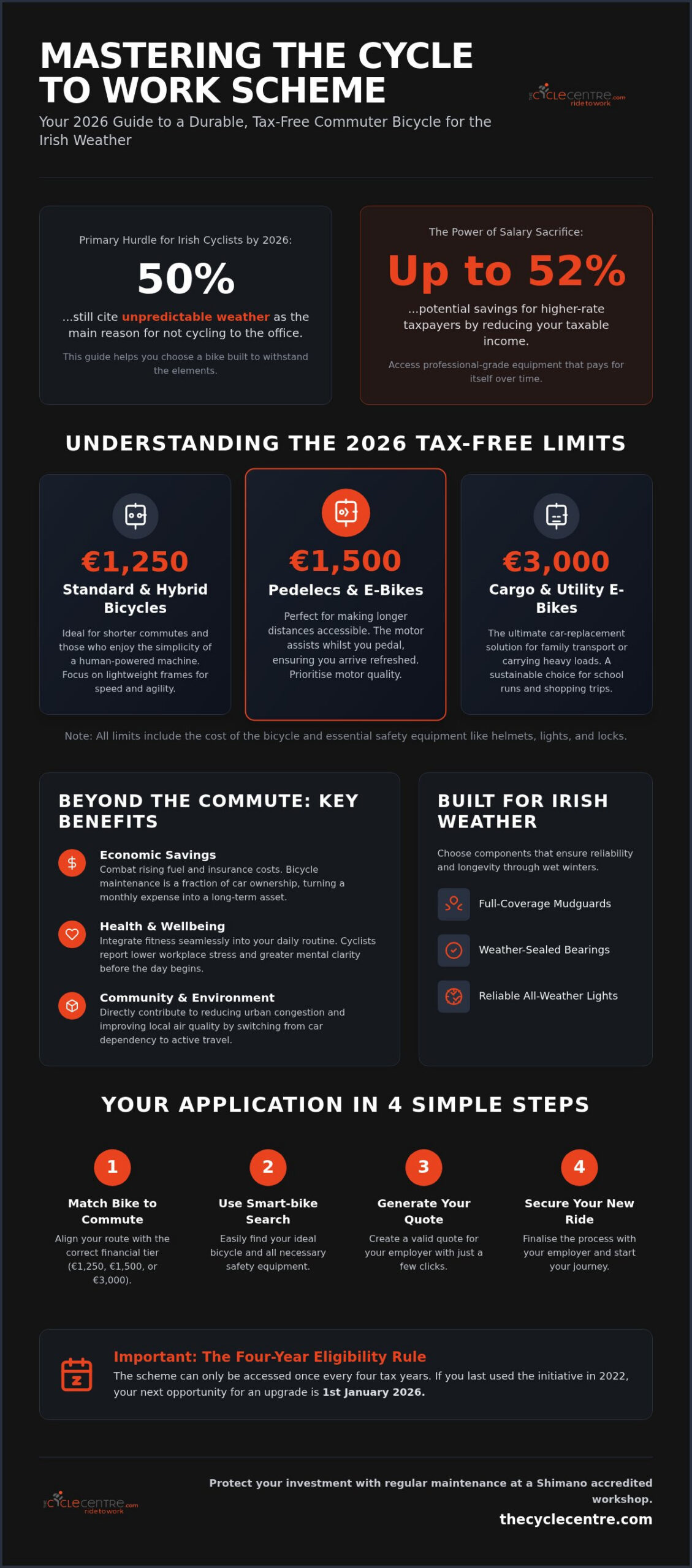
The Irish commute is undergoing a significant transformation. While 2024 data showed that 71.3% of trips were still made by car, the appeal of active travel is growing as national infrastructure improves. Transitioning from car dependency to a premium bicycle in 2026 is a strategic decision for your finances and your physical health. By opting for a greener commute, you are directly contributing to the reduction of urban congestion whilst improving the air quality in your local community. The government’s tax incentive serves as the primary facilitator for this change. If you last utilised the initiative in 2022, the four-year tax year rule means that 1 January 2026 is your next opportunity for a technology upgrade. This Cycle to Work Scheme overview shows how the programme has evolved to support modern Irish commuting needs.
The Economic Case for Cycling to Work
Rising fuel costs and insurance premiums are constant pressures on the household budget. Investing in a high-quality brand like Giant or Cube offers a reliable alternative that effectively pays for itself over time. The salary sacrifice mechanism is the engine of these savings; your employer pays for the bike and equipment upfront, and you repay the cost from your gross salary. This process reduces your taxable income, which can result in savings of up to 52% for higher-rate taxpayers. Choosing a Commuter Bike for the Cycle to Work Scheme allows you to access professional-grade equipment that might otherwise feel out of reach, turning a monthly expense into a long-term asset. Maintenance costs for a bicycle are also a fraction of those for a car, especially when you factor in the longevity of high-end components found on premium models.
Health and Mental Well-being Benefits
Finding time for the gym is a common struggle. Cycling to work solves this by weaving fitness into your existing schedule. A 2026 survey found that only 3% of the Irish population cycles daily, yet those who do report lower levels of workplace stress. The mental clarity gained from an outdoor morning commute provides a vital buffer against the pressures of the office. This integration of activity into the day helps combat the sedentary nature of modern office behaviour, fostering a sense of accomplishment before the working day even begins. E-bikes are playing a massive role in this shift. They made up 18% of bicycle sales in 2023, proving that they are a popular choice for those who previously found distance or hills a deterrent. Choosing a Commuter Bike for the Cycle to Work Scheme with electric assistance ensures you arrive at your desk feeling refreshed rather than exhausted, making a healthy routine sustainable for the long haul.
Understanding the Tax-Free Limits: E-Bikes, Cargo, and Standard Cycles
Before you begin browsing frames and component groups, you must identify which financial tier applies to your needs. The Revenue Commissioners have established three distinct statutory thresholds that determine your maximum tax-free allowance. These limits include both the bicycle and any necessary safety equipment, such as helmets, lights, and mudguards. It is vital to consult the official Revenue guidelines to confirm your specific eligibility, as the scheme can only be accessed once every four tax years. Choosing a Commuter Bike for the Cycle to Work Scheme starts with matching your journey requirements to one of these three primary categories.
The €1,250 Tier: Standard Bicycles and Hybrids
This threshold is perfectly suited for traditional road performance bicycles and versatile hybrids. If your commute is relatively short or you enjoy the mechanical simplicity of a purely human-powered machine, this tier offers exceptional value. We recommend focusing on lightweight frames that prioritise speed and agility. Brands like Giant and Cube provide robust options in this bracket that balance high-end performance with daily durability. Remember that all your essential safety gear must fit within this €1,250 cap to remain entirely tax-free.
The €1,500 Tier: Pedelecs and E-Bikes
Electric city bikes have revolutionised the mid-range commute, making longer distances accessible to a wider range of people. The €1,500 limit is specifically designed for pedelecs, where the motor provides assistance only whilst you are pedalling. When selecting an e-bike, prioritise motor quality from reputable manufacturers like Bosch, Shimano, or Yamaha. The additional €250 allowance over standard bikes is critical for accommodating the cost of high-capacity batteries and sophisticated drive units. If you find yourself worried about arriving at work too hot, this category is your logical solution.
The €3,000 Tier: Cargo and E-Cargo Bikes
For those looking to replace a second car, the €3,000 tier for cargo and e-cargo bikes is a significant facilitator of change. These machines are engineered for high-payload stability, making them the ultimate tool for heavy grocery hauls or the morning school run. Because these bikes feature reinforced frames and heavy-duty braking systems, they carry a higher price point that the government acknowledges through this expanded limit. This tier offers the most significant potential tax saving for families. If you select a model that exceeds these caps, you can still participate; however, you will simply pay the balance using your own after-tax income.
To help you narrow down the options within these specific financial brackets, you can use our Smart-bike Search tool to filter current stock by scheme eligibility.
Matching Your Commute to the Right Bike Category
Every journey between home and the office presents a unique set of challenges. Choosing a Commuter Bike for the Cycle to Work Scheme requires a cold-eyed analysis of your daily route. Are you navigating the smooth tarmac of a city centre or the potholed backroads of a rural townland? Do you need to climb significant elevation, or is your path largely flat? Understanding these variables is the first step toward finding a ride that you will actually use. A professional bike fit is equally essential; even the most expensive frame will lead to discomfort if the geometry doesn’t match your physical proportions.
Hybrid and City Bikes: The All-Rounders
If your commute involves heavy traffic, a hybrid bicycle is often the most practical choice. These bikes offer an upright riding position that improves your visibility amongst motorists and reduces strain on your neck and back. In contrast to aggressive road frames, the geometry here prioritises stability and comfort. Wide tyres are a standard feature, providing a necessary cushion against vibrations from uneven road surfaces. Most city-focused models come pre-equipped with mounting points for racks and mudguards, making them incredibly versatile for carrying panniers or shielding your professional attire from road spray.
Gravel and Adventure Bikes: The Versatile Choice
Gravel bikes have quickly become the favourite for Irish commuters who need to transition from rough rural roads to urban streets. These machines apply the durability of off-road components to a road-going frame, offering a ruggedness that standard road bikes lack. You get the aerodynamic efficiency of drop bars combined with significant tyre clearance, allowing you to run wider, puncture-resistant rubber. This category is perfect for those who want one bike that can handle the Monday morning rush and a weekend exploration on forest trails.
E-Bikes: Effortless Speed for Longer Distances
For those with a commute exceeding 20km, electric assistance is a complete game changer. E-city and E-road models allow you to cover significant distances without arriving at your destination exhausted or in need of a shower. When selecting an e-bike, look for mid-drive motors that provide a natural-feeling boost whilst you pedal. Managing your battery life becomes a simple part of your weekly routine, ensuring you always have power for the final climb home. Since these bikes represent a higher technical investment, regular maintenance at a Shimano accredited workshop is essential for long-term reliability. Reviewing how to apply for the scheme ensures you are prepared before visiting the shop. Choosing a Commuter Bike for the Cycle to Work Scheme with a motor removes the physical barriers that often stop people from ditching the car.
Optimising Your Bike for the Irish Climate and Longevity
Surviving the Irish winter requires more than just a waterproof jacket. It demands a machine built to withstand constant moisture and road grit. Choosing a Commuter Bike for the Cycle to Work Scheme isn’t just about the initial purchase; it’s about ensuring that investment lasts for years. 50% of people in 2026 cite poor weather as a major deterrent to cycling. By selecting the right components from the start, you can remove this barrier and ensure your bike remains a reliable tool for your daily journey.
Engineering for the Elements
Hydraulic disc brakes are non-negotiable for year-round riding in Ireland. Unlike traditional rim brakes, they offer consistent, powerful stopping power regardless of how much rain is falling. Internal cable routing is another feature to prioritise. It shields your gear and brake cables from the corrosive effects of road salt and grime, keeping your shifting crisp for longer. We also recommend tyres with a reinforced puncture-protection layer. Winter roads often hide debris under puddles, and a robust tyre will save you from a cold, wet roadside repair when you’re already running late for a meeting.
Mudguards play a dual role in protecting both the rider and the drivetrain. They prevent grit from being sprayed directly onto your chain and derailleurs, which significantly extends the life of these expensive components. Similarly, selecting lights that meet high lumens standards and include reflective gear ensures you remain visible during dark winter mornings. The scheme covers these essential accessories, so it’s wise to include them in your initial quote to maximise your tax savings.
The Importance of a Professional Service Schedule
A professional service schedule is the final piece of the longevity puzzle. Your bike undergoes a bedding-in period during its first few months of use. A Workshop Gold Service package after the first 500km is vital to check spoke tension and cable stretch. For those on e-city bikes, specialist care for motors from brands like Bosch or Bafang ensures the electronics remain as reliable as the mechanical parts. Choosing a Commuter Bike for the Cycle to Work Scheme is a long-term commitment to your health, and regular maintenance protects that commitment.
Our Shimano accredited technicians possess the technical precision required to keep performance road bikes and rugged gravel machines in peak condition. They understand the specific wear patterns caused by our local climate and can spot potential issues before they become costly repairs. This level of expert care is your best ally in ensuring your bicycle remains as efficient as the day you first rode it away from the shop.
Protect your investment by booking a Workshop Gold Service with our accredited team.
A Step-by-Step Guide to Your Scheme Application
Once you have identified your journey requirements and understood the statutory tax tiers, the next step is moving from research to reality. The administrative journey is often where potential commuters feel the most hesitation. We have refined this process to ensure it is as methodical and reassuring as the bikes we sell. Since 1974, we have helped thousands of riders transition to two wheels; we understand that a seamless application is just as important as a well-indexed drivetrain. The process starts with a precise selection and concludes with you collecting a machine that is perfectly prepared for your first commute.
Using the Smart-bike Search Tool
Navigating hundreds of potential models can be daunting. Our Smart-bike Search tool simplifies Choosing a Commuter Bike for the Cycle to Work Scheme by allowing you to filter specifically by the €1,250, €1,500, and €3,000 price tiers. You can narrow your search by world-class brands like Giant, Cube, and Romet, ensuring you only see bicycles that are currently in stock and eligible for the scheme. This tool also accounts for practical factors like your height and preferred riding style. Whether you need a performance-oriented road frame or a relaxed upright city posture, the search tool ensures you find a match that balances technical specifications with your personal comfort.
Securing Your No-Obligation Quote
After you have selected your bicycle and essential safety gear, you need a formal quote for your employer. Our online application process is designed to be efficient and transparent. You simply add your chosen items to the quote tool, and we provide a professional document that your HR department can use to approve the salary sacrifice. This quote includes all the information your employer needs to facilitate the payment directly to the retailer. For those who wish to explore the finer points of the legislation, we have published The Ultimate Guide to the Bike to Work Scheme Ireland 2026, which provides deeper policy details and compliance information.
Once your employer issues the voucher and the payment is processed, we coordinate the final steps. You can choose to collect your bike in person or organise national delivery. Every bicycle we provide undergoes a rigorous pre-delivery inspection by our technicians to ensure it is road-ready from the moment you receive it. Choosing a Commuter Bike for the Cycle to Work Scheme is a significant step toward a healthier lifestyle, and we are here to ensure the paperwork never stands in your way.
Your Journey to a Better Commute Starts Today
Transitioning to a bicycle commute in 2026 is one of the most impactful changes you can make for your health and your wallet. By navigating the statutory limits of €1,250, €1,500, or €3,000 and matching your frame to your specific route, you transform a daily chore into a genuine moment of freedom. Choosing a Commuter Bike for the Cycle to Work Scheme is a strategic investment that pays dividends in mental clarity and physical fitness whilst reducing your reliance on the car.
As an independent family business established in 1974, we bring decades of expertise to every conversation. We are proud to be an authorised Giant and Cube dealer, offering machines that are engineered for performance and longevity. Our Shimano Accredited Workshop stands ready to maintain your investment, ensuring your drivetrain remains crisp and reliable through every Irish season. We are here to facilitate your journey from the initial application to your very first ride.
Ready to make the switch? Get a Free No-Obligation Quote for Your New Bike and start your next chapter on two wheels today. We look forward to seeing you out on the road, enjoying the fresh air and the freedom of the cycle lane.
Frequently Asked Questions
Can I use the Cycle to Work scheme for an electric bike in 2026?
Yes, you can absolutely use the scheme for an electric bike in 2026. The statutory limit for pedelecs and e-bikes is €1,500, which includes both the bicycle and any related safety equipment. Choosing a Commuter Bike for the Cycle to Work Scheme within this bracket allows you to tackle longer distances and steeper gradients without physical exhaustion or the need for a shower upon arrival.
What is the maximum I can spend on a cargo bike under the scheme?
The maximum tax-free limit for cargo and e-cargo bikes is €3,000. This higher threshold acknowledges the specialised engineering required for high-payload stability and car-replacement utility. If your chosen cargo bike exceeds this amount, you can still proceed with the purchase by paying the remaining balance directly to the retailer using your own after-tax funds. This tier offers the most significant potential tax savings for families.
How often can I apply for the Cycle to Work scheme in Ireland?
You can avail of the scheme once every four years. This period is calculated by tax year rather than the anniversary of your last purchase. For example, if you last used the scheme at any point in 2022, you are eligible to apply again from 1 January 2026. This cycle ensures you can regularly upgrade to the latest technology whilst maintaining the tax efficiency of your commute.
Does the scheme cover cycling helmets and safety apparel?
Yes, the scheme covers a wide range of safety equipment alongside the bicycle. This includes helmets, lights, locks, bells, mirrors, mudguards, and reflective clothing. It is highly recommended to include these items in your initial quote to maximise your savings. However, the scheme does not cover second-hand equipment, bicycle parts, child seats, or general sportswear that does not serve a specific safety purpose for your journey.
Can I buy a bike that costs more than the scheme limit?
You can certainly choose a bike that costs more than the statutory limits. In this scenario, your employer will facilitate the tax-free portion up to the relevant cap, and you will pay the surplus balance yourself. This allows you to invest in premium world-class brands like Giant or Cube whilst still benefiting from the maximum available tax relief through the standard salary sacrifice process at your workplace.
Is the Cycle to Work scheme available to self-employed people?
The scheme is primarily designed for employees who pay tax via the PAYE system. If you are a self-employed sole trader, you cannot currently use the scheme as there is no employer-employee salary sacrifice relationship. However, if you are a director of your own limited company and pay yourself as an employee, you are eligible. We recommend checking with your accountant to confirm your specific tax status.
What happens if I change jobs before the bike is paid off?
If you change jobs before the salary sacrifice period is complete, the remaining balance is usually deducted from your final net salary payment. The bicycle then becomes your property. Because the deduction from your final pay is taken from your net income rather than your gross, you may lose the tax benefit on that final lump sum. It is best to discuss this with your HR department.
Do I own the bike immediately after the salary sacrifice begins?
Technically, the bicycle is owned by your employer during the salary sacrifice period, which usually lasts up to 12 months. Once the full cost has been repaid through your gross salary deductions, the ownership is transferred to you. During this time, you have full and exclusive use of the bike for your qualifying journeys. Choosing a Commuter Bike for the Cycle to Work Scheme is essentially a hire agreement facilitated by tax incentives.