


Could your morning commute actually be the most profitable part of your working day? For many professionals across Ireland, the prospect of a tax-free bike is often overshadowed by a mountain of confusing paperwork and shifting regulations. You probably agree that navigating the intricacies of salary sacrifice feels more like a chore than a benefit, especially when you’re trying to figure out the current Cycle to work Eligibility rules or the specifics of the four-year renewal cycle.
This guide promises to clear the fog. You’ll discover exactly how to qualify for the scheme, how the 2026 rules impact your next upgrade, and how to secure the maximum savings of up to 52% on your new ride. We’ll preview the essential steps to managing your application, explain the updated spending limits of €1,250 for standard bikes, €1,500 for e-bikes, and up to €3,000 for cargo models, and highlight why choosing a performance brand like Cube or Giant ensures your investment stands the test of time. It’s time to stop second-guessing the system and start planning your route to a better, more affordable commute.
Key Takeaways
- Learn which employment statuses qualify for the scheme, including the specific rights of PAYE employees and company directors to access these benefits equally.
- Understand how the four-year tax cycle dictates your Cycle to work Eligibility and how to time your next upgrade to align with the 2026 regulations.
- Identify which safety accessories are tax-deductible and which specific items, such as child seats, are strictly excluded from the government’s approved list.
- Follow a streamlined, step-by-step checklist to organise your salary sacrifice agreement and secure a no-obligation quote with minimal administrative friction.
- Discover why investing in premium brands like Giant or Cube provides a superior long-term return on investment for the unique demands of an Irish commute.
Who is Eligible for the Cycle to Work Scheme in Ireland?
At its heart, urban mobility is about reclaiming your time and finding a sense of freedom in the daily commute. Adopting a “can-do” approach to your morning journey starts with understanding Cycle to work Eligibility. This government-backed initiative isn’t a complex legal maze; it’s a practical solution designed to get more people onto high-quality bikes while reducing the financial burden of the initial purchase. Whether you’re eyeing a robust Cube hybrid or a sleek Giant road bike, the first step is confirming your status within the Irish tax system.
The scheme is primarily built for individuals who pay tax through the Pay As You Earn (PAYE) system. Because the benefit operates via a salary sacrifice agreement, you must have a recurring gross salary from which the cost of the bike can be deducted. This structure ensures that your Cycle to work Eligibility translates into real-world savings, as the deductions happen before income tax, PRSI, and USC are applied. It’s a straightforward exchange that benefits both your physical health and your monthly budget.
Employees, Directors, and the PAYE Requirement
Eligibility extends to all civil service and private sector employees, including those working on part-time or seasonal contracts. The only caveat for part-time staff is that the salary sacrifice must not push your take-home pay below the National Minimum Wage. Company directors are fully eligible for the scheme as long as they pay PRSI under Class A or Class S and receive their remuneration through the PAYE system. Unfortunately, if you’re a sole trader or a partner in a business and don’t pay yourself through PAYE, you cannot currently avail of the scheme because there’s no mechanism for a salary sacrifice from a gross wage. However, for those who do qualify, the scheme must be offered to all staff members equally; an employer cannot cherry-pick who gets to participate.
Employer Participation: Is Your Company Registered?
While the scheme offers significant advantages, it’s a voluntary programme. Employers aren’t legally mandated to participate, but most are eager to do so because it’s a cost-neutral benefit for them. In fact, businesses actually save money through the scheme, as they don’t have to pay employer’s PRSI (up to 11.05%) on the portion of the salary you sacrifice. If your company isn’t currently active, it’s often a case of the HR department needing a nudge. Highlighting the PRSI savings and the boost to staff well-being is usually enough to get the gears turning. Once they’re on board, you’re free to choose the equipment that best suits your route, from gravel bikes for the backroads to e-city bikes for the urban sprawl.
The 4-Year Rule and 2026 Spending Limits Explained
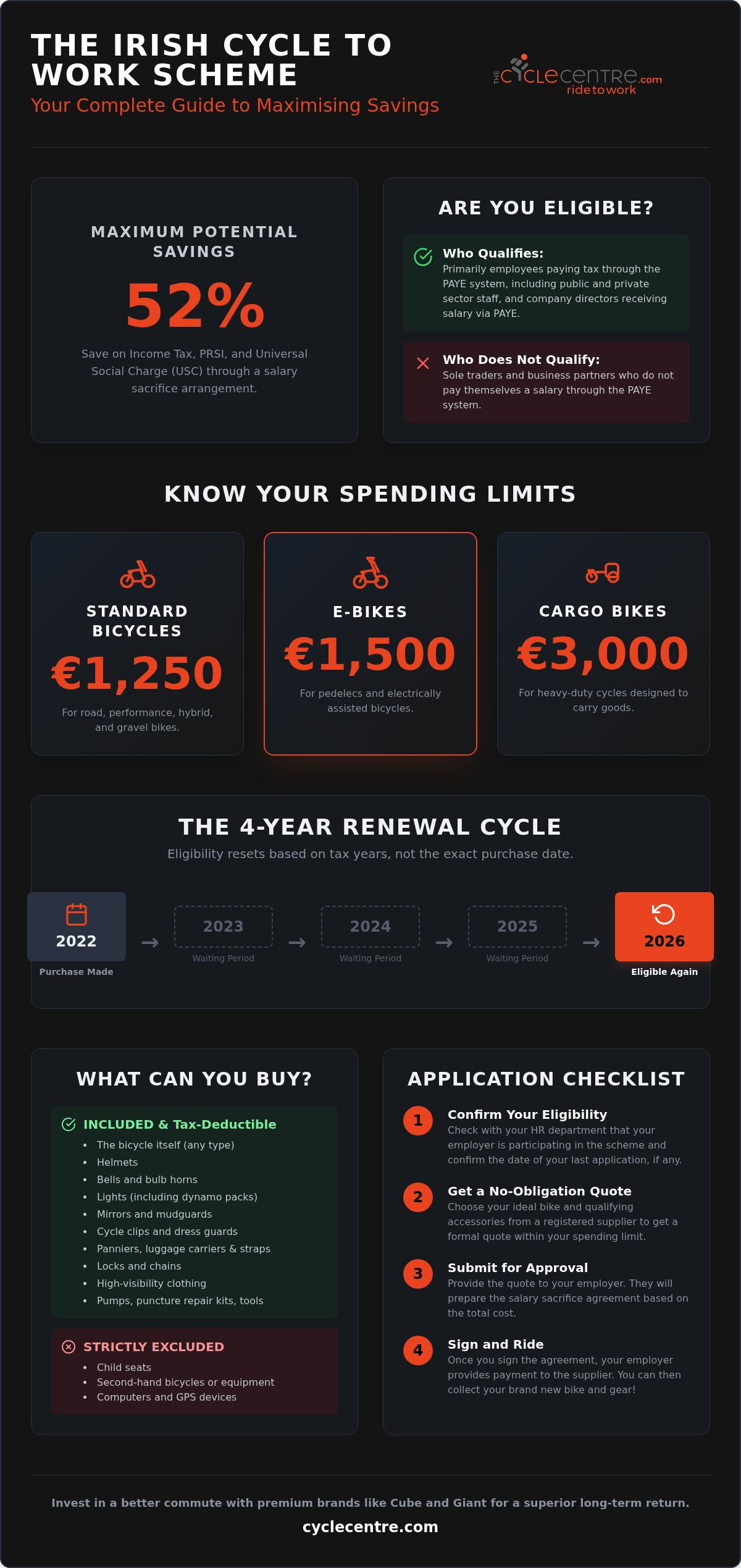
One of the most frequent questions we encounter at The Cycle Centre relates to the timeline for upgrading. The Revenue Commissioners define Cycle to work Eligibility based on a four-year cycle, but it’s vital to understand that this refers to tax years rather than a strict 48-month anniversary. Essentially, if you participated in the scheme at any point during 2022, you become eligible again on the 1st of January 2026. This nuance often means you can start your next cycling chapter sooner than you might have anticipated.
This “tax year logic” is designed to keep the process simple for payroll departments and ensures that commuters can stay equipped with the latest technology. Whether your current bike has seen better days or you’re ready to transition from a manual frame to an e-bike, understanding these calendar windows is the key to maximising your benefits.
Calculating Your Next Eligibility Date
Let’s look at a practical scenario. If you secured a new road performance bicycle in November 2022, you don’t need to wait until November 2026 to apply again. Because the legislation tracks calendar years, your four-year window includes 2022, 2023, 2024, and 2025. As soon as the clock strikes midnight on New Year’s Day 2026, your eligibility resets. It’s always wise to verify your last application date with your HR department or the Revenue Commissioners to ensure your timeline is accurate before you start browsing for a new frame.
Spending Caps: Standard vs. E-Bikes vs. Cargo
The financial limits reflect the diverse ways people now choose to commute. For standard bicycles, including road performance and gravel bikes, the spending cap is €1,250. If you’re looking to electrify your journey with an E-city bike or an E-MTB, the limit increases to €1,500. The most significant allowance is reserved for cargo bikes, which have a cap of €3,000 to support families and those replacing car journeys with heavy-duty utility cycles. These figures include both the bike and any qualifying safety equipment.
If your chosen bike exceeds these caps, you can still proceed with the purchase. You’ll receive the full tax relief on the amount up to the relevant limit, and you simply pay the remaining balance directly from your net income. This allows you to invest in premium engineering from brands like Cube or Giant while still enjoying the substantial savings the scheme provides. To see how these figures translate into your monthly take-home pay, you can request a no-obligation quote from our expert team today.
Qualifying Equipment: What Can You Actually Buy?
Securing your Cycle to work Eligibility is only the first half of the journey. To truly transform your commute, you need a setup that handles the practicalities of daily life on two wheels. The scheme allows you to bundle a wide array of safety equipment into your application, ensuring you’re not left out of pocket for the extras that make cycling viable in all conditions. It’s about building a complete mobility solution rather than just buying a frame and wheels.
Revenue guidelines are quite generous regarding what constitutes ‘safety equipment’, but they are also very specific. You can include essentials that protect both the rider and the bicycle. High-visibility clothing, helmets, and lighting systems are the obvious choices, but the list extends to the practical hardware needed for a professional commute. By planning your quote carefully, you can ensure every Euro of your allowance is used effectively.
Essential Safety Gear and Accessories
The core of your equipment list should focus on road safety and bicycle longevity. Helmets that meet the EN 1078 standard are a primary requirement, alongside front and rear lights, bells, and mirrors. Beyond these basics, the scheme covers the following items:
- Mudguards and specialised luggage carriers
- Panniers and support racks for carrying work essentials
- Locking systems to protect your investment
- Pumps, puncture repair kits, and multi-tools
Panniers and mudguards are often overlooked by newcomers, yet they are essential for anyone arriving at an office environment. Mudguards prevent road spray from ruining your professional attire, while panniers allow you to carry a laptop or change of clothes without the discomfort of a backpack. Shimano-approved components and tool kits are vital for long-term maintenance, ensuring your drivetrain remains responsive and reliable over years of heavy use.
Apparel and Weather Protection
Performance gear makes the difference between a damp, miserable ride and a comfortable arrival. By including cycling apparel in your application, you can access professional-grade waterproofs and breathable layers that would otherwise be a significant standalone expense. Choosing fabrics that offer both thermal protection and moisture management is particularly important for the Irish climate, where you might face four seasons in a single thirty-minute trip.
Reflective clothing is another critical inclusion for those commuting during the winter months. Be aware that there are firm boundaries on what is permitted. Items like child seats, trailers, and sophisticated GPS cycle computers are strictly excluded from the scheme. We recommend focusing your remaining allowance on high-grade security. A Sold Secure rated D-lock is a non-negotiable addition to any quote, providing peace of mind when your bike is parked in urban centres.
Organising Your Application: A Step-by-Step Checklist
Moving from the research phase to actually riding your new bike requires a methodical approach. Once you’ve confirmed your Cycle to work Eligibility, the logistical steps are designed to be straightforward; however, they do require a specific sequence to ensure compliance with Revenue regulations. It’s about moving through the administrative process with informed confidence, knowing that each step brings you closer to a more efficient commute.
Securing Your No-Obligation Quote
A professional quote is the foundation of a successful application. It serves as a clear roadmap for your employer’s payroll department, detailing exactly what is being purchased and ensuring all items fall within the government’s approved categories. Using an online system to request a no-obligation quote online is the most efficient way to start. This document should include your chosen frame, such as a Cube hybrid or a Giant road bike, along with all necessary safety gear like helmets and high-grade locks. Having a precise, itemised quote reduces friction with your HR department and speeds up the internal approval process.
The Salary Sacrifice Agreement
This is the mechanism that generates your savings. A salary sacrifice agreement is a legally binding contract where you agree to forego a small portion of your gross salary in exchange for the bike and equipment. This deduction typically happens over a 12-month period, though some employers may offer shorter terms. Because the cost is taken from your salary before Income Tax, USC, and PRSI are calculated, the actual reduction in your take-home pay is significantly lower than the monthly instalment might suggest. For most employees on the higher tax bracket, this equates to a saving of up to 52% on the total cost of the package.
Once the agreement is signed and your employer approves the quote, they must pay the retailer directly. Revenue rules are very strict on this point; you cannot pay for the bike yourself and claim the money back later. After the payment is processed, we’ll notify you that your bike is ready for collection or delivery. Our workshop team, including our Shimano accredited specialists, will have the bike fully assembled, safety-checked, and tuned to your specific requirements. This ensures that from the very first pedal stroke, your new commute is a high-performance experience rather than a logistical hurdle.
Choosing Your Perfect Commuter with The Cycle Centre
Selecting the right hardware is where your Cycle to work Eligibility truly pays dividends. Since 1974, we’ve seen that the best return on investment comes from brands that prioritise engineering over marketing fluff. Names like Giant and Cube lead the industry because their frames are built to withstand the rigours of daily use, ensuring your commute remains a pleasure rather than a maintenance struggle. It’s about finding a bike that matches your specific route and riding style, rather than just settling for what’s in stock.
Our role as a trusted local expert is to help you navigate these choices with informed confidence. We understand the practical empathy required when you’re facing challenging weather conditions on your commute. The right bike doesn’t just save you money; it provides a sense of freedom and exploration that a car or bus simply cannot match. Whether you’re looking for a lightweight road frame or a robust E-MTB, your Cycle to work Eligibility is the gateway to professional-grade performance.
Performance Road and Gravel Options
Road surfaces aren’t always smooth, and our weather demands a certain level of resilience from a bike. For those with a clear run on the open road, endurance road bikes offer a sophisticated balance of speed and ergonomic comfort. These models are designed to soak up road vibrations, making them ideal for longer commutes. If your route involves towpaths, canal ways, or cracked urban surfaces, gravel bikes provide the necessary versatility. These machines handle mixed terrain with ease, allowing you to explore new shortcuts whilst maintaining a high pace.
Electric and Cargo Bike Innovation
The most significant shift in urban mobility is the rise of electric bikes. Modern electric bike technology has effectively flattened the hills and countered the persistent headwinds that once discouraged long-distance commuting. E-city models are particularly popular amongst urban professionals who want to arrive at the office fresh and ready for the day. Our Smart-bike Search tool is designed to filter through these options instantly, matching your needs to a model that fits within your spending cap. This ensures you find a qualifying bike without any administrative guesswork.
Your journey doesn’t end when you wheel the bike out of our shop. As a Shimano accredited workshop, we specialise in the intricate Bosch, Shimano, and Yamaha motors found in premium e-bikes. This level of technical expertise ensures your post-purchase care is as professional as your initial consultation. By choosing a retailer with half a century of heritage, you’re securing a reliable partner for every mile of your new commuting lifestyle.
Take the Next Step Toward a Better Commute
Navigating the details of Cycle to work Eligibility is the first step toward a healthier, more cost-effective daily journey. By understanding the four-year tax cycle and the 2026 spending caps, you’re now equipped to maximise your savings on a high-performance machine. Whether you’re opting for a versatile gravel bike or a state-of-the-art e-bike, the scheme remains Ireland’s most effective way to access premium engineering from brands like Giant and Cube without the heavy upfront cost.
At The Cycle Centre, we’ve been helping commuters find their perfect ride since 1974. As an independent, family-owned business and a Shimano Accredited Workshop, we provide the seasoned expertise needed to keep your bike in peak condition for years to come. Don’t let administrative uncertainty hold you back from the freedom of two wheels. Request your free, no-obligation Cycle to Work quote today and start planning your route with confidence. It’s time to swap the traffic for the open road and enjoy a commute that actually works for you.
Frequently Asked Questions
Can I use the Cycle to Work scheme for an electric bike?
Yes, you can absolutely use the scheme for an electric bike. The government provides an increased spending limit of €1,500 specifically for pedelecs and electric road bikes to encourage greener commuting. This higher cap reflects the investment required for high-quality battery and motor technology, ensuring urban professionals can access premium E-city or E-MTB models that make longer journeys more manageable.
What happens if I leave my job before the bike is paid off?
If you leave your employment before the salary sacrifice agreement concludes, you are responsible for paying the outstanding balance immediately. This remaining amount is typically deducted from your final net salary payment. It is important to remember that because this final deduction is taken from your net income rather than your gross, you will lose the tax savings on that specific portion of the purchase.
Is there a minimum number of days I must cycle to work?
There is no legally mandated minimum number of days or miles you must complete to maintain your Cycle to work Eligibility. The legislation requires that the bicycle is used primarily for qualifying journeys, such as your daily commute or travelling between different work locations. Revenue focuses on your intent to use the bike for commuting rather than tracking your specific weekly mileage or frequency.
Can I buy two bikes at the same time on the scheme?
You are permitted to purchase two bicycles at once, provided the combined cost of both frames and all safety accessories remains within your relevant spending limit. This is a practical solution for commuters who might require a folding bike for public transport links and a standard road bike for the final leg of their journey, or for those who want a dedicated backup for winter riding.
Does the Cycle to Work scheme cover second-hand bicycles?
No, the scheme is strictly reserved for the purchase of new bicycles and equipment from a registered retailer. Second-hand or used bikes do not qualify for the tax relief because your employer must pay the retailer directly based on a formal invoice. This requirement ensures that all equipment meets modern safety standards and provides a clear paper trail for the Revenue Commissioners.
How much money will I actually save on my salary?
Most Irish employees save between 28% and 52% on the total cost of their cycling package. The exact percentage depends on whether you pay the standard or higher rate of income tax. Because the repayments are deducted from your gross salary before Income Tax, PRSI, and USC are calculated, the reduction in your monthly take-home pay is significantly less than the actual cost of the bike.
What is the 4-year rule for the Cycle to Work scheme?
The 4-year rule means your Cycle to work Eligibility resets every four calendar years. This is calculated by tax year rather than a strict 48-month anniversary. For example, if you participated in the scheme at any point during 2022, you become eligible for a new application on the 1st of January 2026, regardless of which month your original purchase took place.
Can I use the scheme if I am self-employed?
Self-employed individuals operating as sole traders or partners cannot currently avail of the scheme because they do not pay themselves through the PAYE system. The salary sacrifice mechanism requires a gross wage deduction that only the PAYE structure provides. However, if you are a company director and pay yourself as an employee under PRSI Class A or S, you are fully eligible to participate.