

What if the only thing standing between you and a premium electric cargo bike is a calendar date you’ve already passed? Many Irish commuters feel stuck in a cycle of uncertainty, wondering if they’ve waited long enough since their last purchase or if the latest government thresholds even apply to the high-performance road bikes they actually want. It’s perfectly natural to feel a bit of anxiety about how salary sacrifice impacts your PRSI and USC, especially when the rules seem to shift every few years.
This guide is designed to give you total clarity on Bike to work Eligibility in 2026. We’ll help you discover exactly where you stand with the four-year reset rule and how to maximise your tax-free savings on everything from standard commuters to the €3,000 limit for electric cargo models. We will break down the technicalities of the application process and explain how the tax year cycles affect your next upgrade. By the end of this article, you’ll know your exact status and have a clear, simple path to getting a formal quote for your employer.
Key Takeaways
- Learn why being a PAYE employee or a company director is your first step towards maximising tax savings you’ll actually notice.
- Understand how the four-year reset rule works so you can time your 2026 application perfectly for a fresh upgrade.
- Discover the current spending limits, including the €1,500 threshold for e-bikes and the €3,000 allowance for electric cargo bikes.
- Confirm your Bike to work Eligibility by checking the specific Revenue requirements for qualifying journeys and essential safety equipment.
- Simplify the entire application process by using our Smart-bike Search to find the perfect model and generate a no-obligation quote.
Understanding the Cycle to Work Scheme and Basic Eligibility
The Cycle to Work Scheme is more than just a simple tax break; it’s a proactive government initiative designed to transform the daily commute into something healthier and more sustainable. By removing the upfront cost barrier of high-quality bicycles, the programme encourages a shift away from car dependency. For a comprehensive Cycle to Work Scheme overview, it’s helpful to see how these initiatives have evolved across different regions to prioritise environmental goals and public health. In Ireland, this has become one of the most effective ways for professionals to access premium cycling technology without the immediate financial sting.
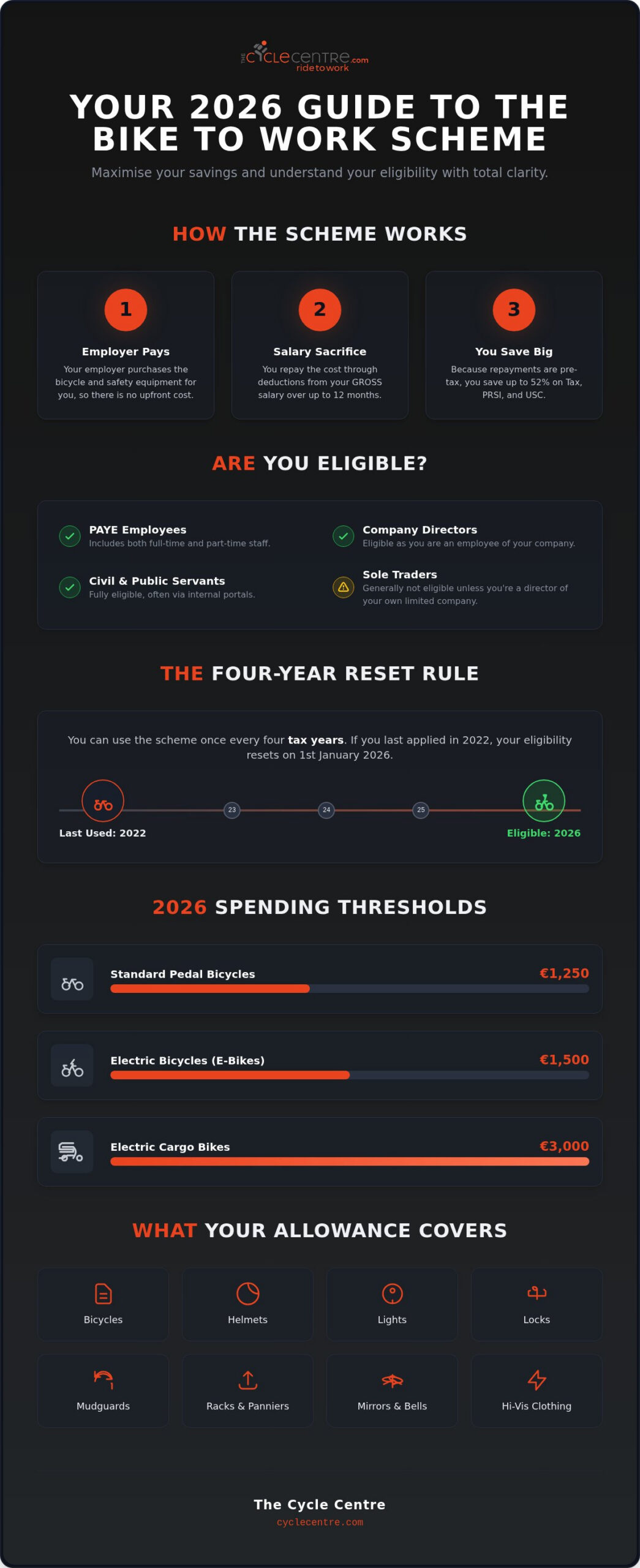
The core of the scheme lies in a “salary sacrifice” mechanism. Your employer purchases the bicycle and any necessary safety equipment on your behalf. You then repay the cost through regular deductions from your gross salary over a period of up to 12 months. Because these deductions happen before your income tax, PRSI, and USC are calculated, your taxable income is lower. This effectively means the government is subsidising your purchase. Depending on your marginal tax rate, you can often save up to 52% on the retail price of the bike.
As we move through 2026, the scheme has become even more pivotal. With the increased thresholds for electric and cargo models, it’s now the primary way for commuters to upgrade to high-performance e-bikes. These machines, featuring advanced motor technology from brands like Giant and Cube, allow for longer commutes and easier hill climbs, making the bicycle a genuine alternative to the second family car.
Who Can Qualify for the Scheme?
To determine your Bike to work Eligibility, you must first be a PAYE employee or a director of a company. This includes both full-time and part-time staff, provided your employer is willing to facilitate the scheme. Civil and public servants are also fully eligible, though they often need to select from specific supplier lists or use internal departmental portals to process their applications. If you’re an employee who pays Irish income tax, you’re likely in a strong position to apply and start saving immediately.
The Self-Employed and the PRSI Requirement
Confusion often arises for those who work for themselves. Pure sole traders generally don’t qualify for the standard version of the scheme because the mechanism requires a salary sacrifice from a PAYE income. If you don’t pay yourself through a payroll system that handles PRSI and USC, there’s no “gross salary” from which to deduct the cost. However, many business owners operate as directors of their own limited companies. In this scenario, because you’re technically an employee of your company, you can utilise the scheme just like any other staff member. If you’re a sole trader, it’s often more effective to categorise a bicycle purchase as a company asset for business use, though you should always consult your accountant to ensure compliance with current Revenue guidelines.
The Four-Year Rule: Timing Your 2026 Application
Timing is often the most confusing part of the process. You might have a perfectly functional bike, but if you want to upgrade to a modern e-bike or a high-capacity cargo model, you need to know exactly when the clock resets. Revenue rules state that you can avail of the scheme once every four years. However, this is not calculated from the specific date you signed your last piece of paperwork. Instead, the period is based strictly on the tax year. This means that if you used the scheme at any point during 2022, whether it was January or December, your Bike to work Eligibility resets on 1st January 2026.
This nuance is vital for those looking to maximise the current thresholds. For official confirmation on these timelines, you can refer to Citizens Information on eligibility, which details how the four-year span is counted by the calendar. It is always worth checking your records before visiting a shop to ensure you are within the legal window to claim the tax exemption again.
Calculating Your Next Eligibility Window
To avoid disappointment, follow this simple calculation before you start browsing for a new model. First, identify the tax year of your last purchase. If that year was 2022, you count four full tax years: 2023, 2024, 2025, and 2026. This means you are fully eligible to apply again as of January 2026. If your last purchase was in 2023, you will become eligible again on 1st January 2027. If you’re unsure of your last date, a quick email to your HR department will usually clear things up, as they keep precise records of the salary sacrifice agreements for audit purposes.
What Happens if You Change Jobs?
Moving between companies adds a layer of complexity. While your eligibility is tied to you as an individual, the financial agreement is with your specific employer. If you leave your job before the salary sacrifice is complete, you must pay the outstanding balance from your final net salary. The tax exemption only applies while you are employed by the company that purchased the bike. Once you move to a new company, you don’t automatically get a “fresh start” if you’ve used the scheme within the last four tax years. You must still wait for that four-year window to close before applying again with your new employer. It’s a good idea to check current stock levels early if you know your window is about to open, ensuring you get the best performance model for your new commute.
Financial Thresholds: How Much Can You Spend in 2026?
Determining your Bike to work Eligibility involves more than just a calendar check; you also need to understand the financial tiers available to you. The Official Revenue Guidelines for the Cycle to Work Scheme currently define three specific spending caps based on the type of bicycle you choose. For a standard mechanical bicycle and its associated safety gear, the tax-free limit is €1,250. E-bikes, which include more complex battery and motor technology, have an increased threshold of €1,500. The most significant allowance is reserved for cargo and e-cargo bikes, which carry a limit of €3,000 to encourage their use for school runs and local deliveries.
A common point of confusion is what happens when a bicycle exceeds these thresholds. Unlike some rigid grant systems, this scheme allows for flexibility. You can choose a high-performance bike that costs €2,500, but the tax relief will only apply to the first €1,500 if it’s an e-bike. You simply pay the balance yourself. This allows you to access premium brands like Giant or Cube without being restricted solely to the government’s ceiling. It’s a practical way to ensure you get the right tool for your commute rather than just the cheapest one.
The 52% Saving: Breaking Down the Tax Brackets
The level of your saving depends on your marginal tax rate. If you’re a higher-rate taxpayer, you could save approximately 52% of the cost. This includes the 40% income tax rate plus PRSI and USC. For lower-rate taxpayers, the saving is closer to 31%. This is why premium electric road bikes are such a popular choice for those wanting to max out the €1,500 e-bike limit; they represent the best value for money when the government effectively covers half the cost. You aren’t just buying a bike; you’re investing in a more efficient lifestyle.
Employer PRSI Savings
It’s not just the employee who wins. Employers also save money through the scheme. For every euro sacrificed from an employee’s salary, the company doesn’t have to pay Employer PRSI, which is typically 10.75%. This makes the scheme a zero-cost benefit that actually improves the company’s bottom line whilst fostering a healthier, more punctual workforce. It’s a rare “win-win” in the corporate world. Most organisations are very happy to facilitate the process because it demonstrates a commitment to sustainability without requiring a massive capital outlay.
Eligible Equipment: What Can You Include?
When assessing your Bike to work Eligibility, it is a mistake to focus solely on the frame and wheels. The scheme is designed to facilitate a complete commuting solution, which means a significant portion of your tax-free allowance can be used for essential accessories. Revenue guidelines are quite specific about what qualifies, prioritising items that enhance safety and utility. This includes the “Big Three” for every Irish cyclist: a high-quality helmet, a set of reliable lights, and a robust lock. Beyond these, you can also include mudguards, panniers, and luggage carriers, which are practically mandatory for anyone facing the unpredictable Irish elements on a daily basis.
It is equally important to understand what you cannot include. The scheme is strictly for commuting, so high-end racing components or “luxury” electronics are generally excluded. You cannot use the tax exemption for GPS cycle computers, power meters, or sophisticated heart rate monitors. Similarly, second-hand bikes or equipment do not qualify. By staying within the approved list of safety and maintenance gear, you ensure your application moves through HR without any administrative hitches.
Essential Safety and Maintenance Gear
High-performance bicycles require a higher standard of security. When choosing a lock, we recommend selecting one that meets “Sold Secure” ratings, as this is often a prerequisite for bicycle insurance policies. Visibility is another critical factor. Including reflective cycling apparel in your quote ensures you remain seen during those dark winter mornings and evenings. You should also consider the practicalities of the road; essential maintenance items like floor pumps, puncture repair kits, and multi-tools are all eligible for the tax-free deduction. These small additions make the difference between a reliable commute and being stranded on the side of the road with a flat tyre.
Selecting the Right Bike Category
The type of bike you choose should reflect your specific journey. For those with longer commutes on paved roads, endurance road bikes offer the perfect balance of speed and comfort. Alternatively, gravel bikes have seen a massive rise in popularity as the ultimate “do-it-all” commuter, capable of handling rougher backroads whilst still being fast on the tarmac. To maintain your Bike to work Eligibility, the bicycle must be used mainly for “qualifying journeys.” This means the whole or part of a trip between your home and workplace. There is no minimum number of days you must cycle, but the intent must be for commuting rather than purely leisure. To get started on your setup, you can browse our range of eligible safety equipment and bikes online today.
How to Apply: The Cycle Centre Seamless Process
Removing administrative friction is our priority. Since 1974, we’ve helped thousands of commuters transition from four wheels to two, and we understand that the paperwork can often feel more daunting than the cycle itself. Our role is to act as your knowledgeable mentor, guiding you through the technicalities of the scheme whilst ensuring you select a high-performance machine from trusted brands like Giant, Cube, or Romet. By the time you reach out to your HR department, you’ll have a clear, professional quote that satisfies every Revenue requirement.
Determining your Bike to work Eligibility is just the first step. Once you know your window is open, our Smart-bike Search tool allows you to filter specifically for models that meet the government’s 2026 thresholds. This ensures you don’t fall in love with a bike that doesn’t fit your specific tax bracket or intended use. Whether you’re looking for an e-city bike for the daily grind or a gravel bike for weekend adventures, we facilitate the entire journey from initial discovery to that first 500km check-up in our Shimano accredited workshop.
Step-by-Step Quote Application
The process begins on our website, where you can browse an extensive range of road, gravel, and e-bikes. It’s a simple, methodical path. First, use our search filters to find a model that fits your needs. Once you’ve made your choice, don’t forget to add your “Big Three” safety accessories: a helmet, lights, and a secure lock. When your selection is complete, you can use our no-obligation online quote tool. This generates a formal document that includes all the necessary technical descriptors your employer will need to process the salary sacrifice correctly. It is a proactive way to ensure your application is handled rapidly and without errors.
Finalising with Your Employer
After you receive your formal quote, the next stage involves your payroll or HR manager. Present them with the document and sign the salary sacrifice agreement. It’s important to remember that the cost of the bike is typically repaid over a maximum 12-month term, though some employers may offer shorter windows. Once your company has completed the payment, we’ll notify you to collect your new bike. Our relationship doesn’t end at the shop door. We pride ourselves on being a constant, reliable presence in your cycling life. Every bike we sell through the scheme comes with the peace of mind of expert workshop support, ensuring your new investment remains in peak condition for years to come.
Your Path to a Tax-Free Upgrade in 2026
Transitioning to a more sustainable commute is a significant lifestyle shift. By understanding your Bike to work Eligibility and the specific 2026 thresholds, you’ve already handled the most complex part of the process. Whether you’re timing your four-year reset or looking to invest in a high-performance e-bike, the path forward is now clear. You don’t have to navigate the technicalities alone when you have a mentor to guide your selection.
Since 1974, our family-owned business has been a constant, reliable presence for Irish cyclists. We’ve modernised our approach whilst helping you avoid administrative friction. You can use our free Smart-bike Search tool to find the perfect model and then rely on our Shimano Accredited Workshop for long-term maintenance. Request Your No-Obligation Bike to Work Quote Today and take the first step toward a healthier, more liberating commute. We look forward to helping you find the perfect ride for the years ahead.
Frequently Asked Questions
Can I use the Bike to Work scheme for a second-hand bike?
No, the scheme strictly applies to new bicycles and equipment purchased directly from a retailer. Revenue requirements ensure that every piece of equipment is in safe, roadworthy condition at the point of sale. This rule excludes private sales or second-hand shop purchases entirely. Choosing a new model from our range also ensures you benefit from a full manufacturer warranty and our workshop’s initial 500km safety check for long-term peace of mind.
Is there a minimum distance I must cycle to be eligible?
There is no legally defined minimum distance or specific number of days you must cycle to maintain your Bike to work Eligibility. The primary requirement is that the bicycle is used mainly for “qualifying journeys,” which includes travel between your home and workplace. Whether your commute is two kilometres or twenty, you’re entitled to the same tax-free benefits as long as the intent is for commuting rather than purely for leisure purposes.
Can I buy two bikes at once on the scheme if they are under the limit?
Yes, you can purchase two bicycles at once, provided the combined total of the bikes and safety accessories doesn’t exceed the relevant threshold. This is a practical option if you need a road performance bike for fair weather and a sturdy gravel bike for winter conditions. Your employer will simply process the total amount as a single salary sacrifice agreement within the standard limits, allowing you to maximise your savings in one go.
What happens to the bike if I leave my job before the 12 months are up?
If you leave your employment before the salary sacrifice term is complete, the remaining balance is deducted from your final net salary. The tax exemption only applies to the repayments made whilst you were an active employee. Once you leave, the outstanding amount is paid without the benefit of tax, PRSI, or USC relief. You’ll essentially pay the full retail price for that remainder, as the benefit cannot be transferred between different companies.
Does the scheme cover electric scooters in 2026?
No, electric scooters are not covered by the scheme in 2026. Despite their popularity for short urban travel, the government’s tax exemption is specifically targeted at bicycles, e-bikes, and cargo bikes. This exclusion also extends to mopeds and motorbikes. If you’re looking for a motorised commuting solution, an e-city bike or an e-MTB remains the only eligible way to access these significant tax-free savings through your employer.
Can I get a bike for my child through the Cycle to Work scheme?
No, you cannot use the scheme to purchase a bicycle for a child or another family member. The legislation is clear that the bicycle must be for the personal use of the employee to facilitate their commute. Attempting to use the scheme for a third party would violate the terms of the salary sacrifice agreement. It could lead to issues with Revenue during a company audit, so the bike must be sized and intended for you.
Do I need to prove that I am using the bike for work?
You aren’t required to maintain a logbook or provide physical proof of your cycling mileage to your employer. However, when you apply, you sign a formal declaration stating that the bicycle is for your own use and will be used primarily for qualifying journeys. While individual monitoring is rare, the scheme operates on a basis of trust and compliance. You must ensure you follow these official Revenue guidelines to protect your tax-free status.
Can I use the scheme if I am on a temporary contract?
Yes, employees on temporary or fixed-term contracts can access the scheme, provided their employer agrees to facilitate the process. The main hurdle is ensuring the repayment period fits within the duration of your contract. Most salary sacrifice agreements are structured over 12 months, so as long as your remaining contract covers this period, your Bike to work Eligibility remains intact. This allows you to start saving on a high-performance model regardless of your employment length.