



You’re halfway through a scenic coastal loop or navigating a busy evening commute when you notice the battery indicator on your display begin its rhythmic, dreaded flash. Suddenly, the joy of the ride is replaced by a cold calculation of whether your legs can haul a 25kg machine the rest of the way home. Many Irish riders feel this same tension, often referred to as electric bike range anxiety, which can make even a short trip feel like a gamble. It’s perfectly natural to worry about the gap between a manufacturer’s optimistic range claims and the reality of a stiff Atlantic headwind or a sudden incline. We understand that your bike should be a source of liberation, not a source of stress about battery degradation or being stranded whilst out on the road.
This guide will help you master your battery’s potential and reclaim the freedom that first drew you to electric cycling. We’ll explore the technical factors affecting your power, such as motor efficiency and terrain, whilst providing practical maintenance tips to ensure your battery remains a reliable companion. You’ll gain the confidence to plan longer routes and understand how to get the most out of every charge, drawing on our fifty years of cycling heritage to keep you moving with ease.
Key Takeaways
- Learn why electric bike range anxiety is often a psychological barrier and discover the “EV Fallacy” that helps reframe your perspective on battery life.
- Understand the specific impact of Irish environmental factors, including heavy headwinds and cold temperatures, on your battery’s discharge rate and chemistry.
- Move beyond optimistic manufacturer claims by using the “Watt-Hour Rule” to calculate a more accurate and reliable real-world range for your specific journeys.
- Discover how simple changes to your riding behaviour, such as maintaining a higher cadence and selecting the correct gears, can significantly reduce motor strain.
- Explore how regular firmware updates and professional motor diagnostics from a Shimano accredited workshop ensure your e-bike operates at peak efficiency.
What is Electric Bike Range Anxiety and Why Does it Happen?
Many new and seasoned riders ask, What is range anxiety? In the context of cycling, it is that nagging psychological barrier that whispers you might not make it to your destination. It prevents people from venturing onto a new forest trail or taking the long way around the coast. This electric bike range anxiety isn’t just about the battery; it’s about the fear of losing the “e” in e-bike and being left with a heavy frame to pedal manually. It turns a leisure activity into a series of stressful calculations about volts and watts.
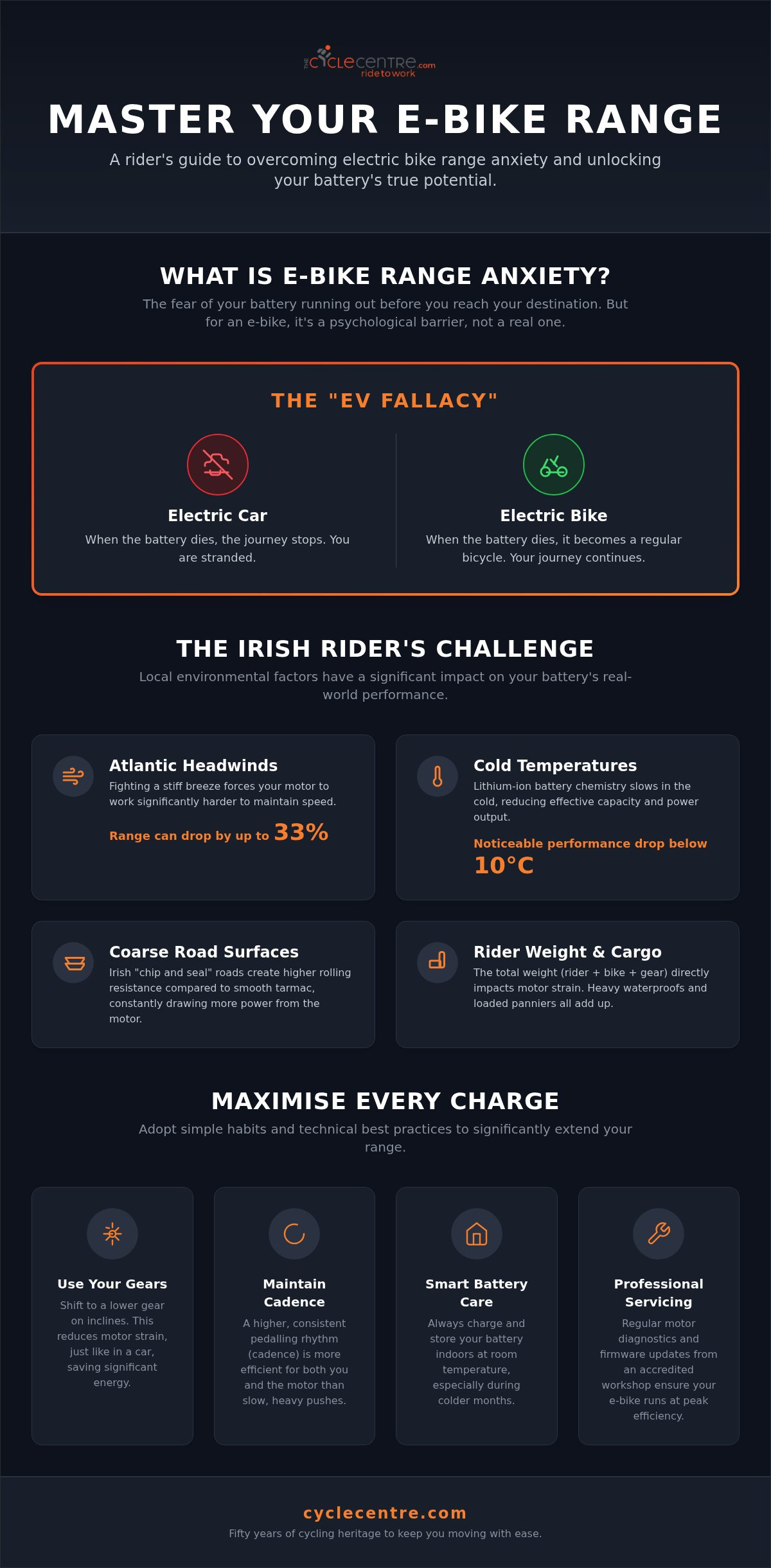
We often hear the term applied to electric cars, but applying the same logic to bicycles is what we call the ‘EV Fallacy’. If an electric car runs out of charge, it becomes a stationary ornament. If your e-bike runs out of power, it simply reverts to being a standard bicycle. You’re never truly stranded. You’re just working a bit harder. Common triggers for this stress include unfamiliar routes where elevation is unknown, biting Irish headwinds that drain power faster, or carrying heavy cargo that increases motor torque requirements. The ultimate goal for every rider is to move from this state of worry into ‘Range Confidence’.
The Psychology of the Battery Percentage
Watching the ‘bars’ on a display can create unnecessary stress. Many modern systems show an ‘Estimated Range’ based on your last few minutes of riding behaviour. If you’ve just climbed a steep incline, that estimate will plummet, causing a flash of panic. As you gain experience, you’ll learn the difference between what the computer says and your actual range. You’ll soon realise that two bars might look low, but they’re often plenty for the flat miles ahead. Understanding your bike’s personality is the best cure for display-induced anxiety.
Mechanical Safety Nets: You Are Never Truly Stranded
It’s vital to remember that underneath the motor and battery, you are riding a high-quality piece of engineering. For instance, modern electric road bikes are designed with efficiency in mind. They feature lightweight frames and low-resistance tyres that allow them to glide comfortably even when the motor is switched off. If you do run out of juice, your bike’s gearing system becomes your best friend. Dropping into a lower gear allows you to maintain a steady rhythm without overexerting yourself. You might move a little slower, but the journey continues. This mechanical safety net is your built-in insurance policy against being stuck.
The Irish Context: Environmental Factors That Drain Your Battery
The Irish landscape offers breathtaking views, but it also presents a unique set of challenges for your battery. Unlike the flat, sheltered cycle paths of the Netherlands—home to the world-renowned ‘bike and barge’ holidays offered by Bike Planet Tours—Irish riders often contend with relentless headwinds coming off the Atlantic. These winds significantly increase the motor torque required to maintain a steady pace, which is a primary driver of electric bike range anxiety. When you fight a stiff breeze, your motor works significantly harder, and your total mileage can drop by a third compared to a calm day.
Road surfaces also play a significant role. Our “chip and seal” roads are notoriously coarse compared to smooth European tarmac. This rough texture increases rolling resistance, meaning your motor must consistently output more power just to overcome the friction of the road. Additionally, the weight of essential Irish cycling gear, such as heavy-duty waterproofs and loaded panniers for unpredictable weather, adds to the total mass the motor must propel. Understanding these environmental factors is the first step to overcoming electric bike range anxiety and planning your trips with confidence.
This awareness of battery limitations is shared across the wider electric transport community, where specialists like UK Mobility Batteries provide essential guidance on maintaining performance and understanding the costs associated with mobility scooter power cells.
Lithium-ion batteries are sensitive to the cold. Once the mercury dips below 10 degrees Celsius, the chemical reactions inside the cells slow down, increasing internal resistance and reducing effective capacity. To combat this, you should always store and charge your battery indoors at room temperature during the winter months. Bringing a cold battery straight onto a frosty morning commute will result in a noticeable drop in performance. Thermal management for e-bike batteries involves maintaining an optimal internal temperature range to ensure consistent energy discharge and long-term cell health.
Terrain and Elevation Gain
Frequent stop-start cycling in urban environments is far more taxing than steady cruising on open roads. Every time you accelerate from a standstill at a junction, the motor draws a peak burst of current. On hilly terrain, the relationship between gradient and drain is even more pronounced; a 10% incline can consume power at several times the rate of a flat road. If you live in a particularly undulating area, using our Smart-bike Search can help you identify models with higher torque motors specifically designed for climbing. To ensure you are getting the most from your investment, consider a professional motor diagnostic at our Shimano accredited workshop.
How to Calculate Your Real-World E-Bike Range
Manufacturer brochures often boast of distances “up to 100km” or more, but these figures are typically generated in laboratory conditions with a lightweight rider on perfectly flat ground with zero wind. For the average Irish cyclist, these numbers can feel like a work of fiction, which often contributes to electric bike range anxiety when the battery depletes faster than expected. To find your true distance, you need to understand the relationship between your battery’s capacity and the demands you place upon it. Factors such as your total weight, including gear, and the assist level you select will dictate how far you can actually go.
A simple rule of thumb for mixed Irish terrain is the “Watt-Hour Rule”. Think of Watt-Hours (Wh) as the size of your fuel tank. On average, you will consume approximately 8 to 12Wh per kilometre. If you have a 500Wh battery, you can reasonably expect 40 to 60km of range in typical conditions. However, a rider using “Turbo” mode for a steep climb will drain that tank significantly faster than someone staying in “Eco” on the flats. By calculating your range based on your own habits, you can eliminate the guesswork and ride with certainty.
A Five-Step Range Audit for New Riders
Instead of relying on estimates, we recommend conducting a personal range audit. This gives you empirical data based on your specific riding style and local environment.
- Step 1: Charge your battery to 100% and reset your trip computer before you set off.
- Step 2: Ride a typical 10km loop that includes the hills or junctions you normally encounter, using your favourite assist mode throughout.
- Step 3: Note the percentage drop on your display after the loop; if you used 20%, your theoretical maximum for that mode is 50km.
- Step 4: Subtract a 15% safety buffer from that total to account for unexpected headwinds or physical fatigue.
- Step 5: Use this adjusted figure as your “Range Confidence” limit for future route planning.
Understanding Watt-Hours vs Amp-Hours
Technical specifications can be confusing, especially when comparing Amp-Hours (Ah) and Watt-Hours (Wh). Whilst Ah measures the charge capacity, Wh provides the total energy available, making it the most useful metric for managing electric bike range anxiety. It’s also important to note that a 500Wh battery on a highly efficient motor system can sometimes outperform a larger 625Wh battery on a less refined setup. Keeping your system running smoothly through professional bike servicing ensures that every watt is converted into movement rather than lost to mechanical friction. Regular maintenance prevents the gradual decline in range that many riders mistakenly attribute to battery age alone.
Practical Habits to Extend Your E-Bike Range
Whilst the technical specifications of your bike are fixed, your riding behaviour is entirely within your control. Mastering a few simple habits is the most effective way to reduce electric bike range anxiety and ensure you never find yourself pedalling a heavy frame without assistance. The most significant factor is your cadence. Mid-drive motors are engineered to operate most efficiently when you maintain a steady rhythm of 70 to 90 revolutions per minute (RPM). If you pedal too slowly in a high gear, you force the motor to work harder, which drains the battery and generates excess heat. It’s much like a car engine; keeping it in the right power band saves fuel.
Gear selection plays a supporting role in this efficiency. Always shift into a lower gear before you come to a complete stop at a junction. This allows you to pull away smoothly without the motor drawing a massive burst of current to overcome inertia. You should also avoid ‘cross-chaining’, where the chain sits at an extreme angle between the front and rear cogs. This creates unnecessary mechanical friction. Additionally, don’t overlook your tyres. Keeping them inflated to the manufacturer’s recommended pressure is the simplest way to gain 5 to 10% more range. Lower pressure increases the rolling resistance that your motor must fight against on every single metre of the journey.
Mastering the Assist Modes
Your assist modes are tools, not just speed settings. A common mistake is staying in ‘Turbo’ for the entire ride. Instead, try the ‘Momentum Rule’. Use a higher assist level to reach your cruising speed quickly, then drop down to ‘Eco’ or ‘Tour’ once you’ve established a steady pace. This preserves energy for the moments you truly need it, such as steep inclines or heavy headwinds. If your bike features ‘Auto’ or ‘Smart’ modes from Bosch or Shimano, use them. These systems use internal sensors to manage power delivery in real-time, providing a seamless balance between support and battery conservation without you having to touch the controller.
Route Planning and Energy Conservation
Energy management starts before you even turn the pedals. Use GPS tools to scout for routes with less elevation gain, as avoiding one major hill can save more power than miles of careful pedalling on the flat. Practise ‘momentum cycling’ by reading the road ahead. If you spot a red light or a hazard, stop pedalling early and coast. This prevents you from wasting energy that you’ll only immediately lose to your brakes. For longer weekend adventures, consider carrying a compact charger. A thirty-minute top-up during a lunch break can provide just enough juice to eliminate any lingering electric bike range anxiety during the final leg of your trip. To ensure your motor and battery are in top condition for these longer rides, consider a professional motor diagnostic at our Shimano accredited workshop.
Technical Solutions: Professional Servicing and Battery Care
While riding habits are vital, the underlying health of your bike’s electrical and mechanical systems is equally critical. To truly conquer electric bike range anxiety, you must move beyond simple pedalling techniques and look at the technical condition of your machine. Modern e-bikes are sophisticated computers on wheels. Just as your smartphone requires software updates to optimise battery life, your motor system relies on firmware updates to refine power delivery and manage energy consumption. These updates can recalibrate how the motor reacts to your pedalling input, often unlocking efficiency gains that were previously unavailable through hardware alone.
Entrusting your bike to a Shimano accredited workshop ensures you have access to official diagnostic tools used by Bosch, Shimano, and Yamaha. These tools can identify ‘parasitic’ battery drains, which are small electrical faults that sap energy even when the bike is stationary. Beyond the electronics, mechanical resistance is a silent range killer. A stretched chain or a worn drivetrain increases the friction the motor must overcome, forcing it to draw more current for the same speed. Our Workshop Gold Service package is specifically designed to eliminate these mechanical inefficiencies, restoring your bike to its peak state and effectively reclaiming lost range.
Diagnostic Software and Motor Calibration
Professional diagnostic software allows technicians to see exactly how your motor is performing under load. It can pinpoint sensor errors or calibration issues that might be causing the motor to work harder than necessary. Regular motor calibration ensures that the assistance you receive is perfectly synchronised with your effort, preventing wasted energy. By aligning your drivetrain and motor settings to factory standards during a Gold Service, we can ensure every watt of power translates directly into forward momentum.
Long-Term Battery Health (SOH)
Every lithium-ion battery has a ‘State of Health’ (SOH) which tracks its capacity to hold a charge over time. Premium batteries are designed to last for hundreds of full charge cycles, but poor maintenance can accelerate degradation. One common mistake is ‘deep discharge’, where the battery is left at 0% for extended periods; this can permanently damage the internal cells. Conversely, you should occasionally leave your battery on the charger for a few hours after it hits 100% to allow for ‘cell balancing’, which ensures every internal cell is equally charged and healthy.
If your current battery no longer meets your needs, you might consider upgrading your technology. The Bike to Work scheme Ireland offers a tax-efficient way to access the latest high-capacity battery systems, which have seen significant advancements in energy density for 2026 models. Whether you’re riding a high-end E-MTB or an E-road bike, professional oversight is the best way to ensure your investment remains reliable. Book your E-bike service today to ensure your range is fully optimised for the season ahead.
Reclaim Your Freedom on the Open Road
Mastering your e-bike is about more than just pedalling; it’s about understanding the synergy between your riding habits and your machine’s technical health. By adopting a higher cadence and conducting your own range audit, you can effectively eliminate electric bike range anxiety from your cycling experience. Remember that professional care is the foundation of reliability. As a Shimano Accredited Workshop and Bosch and Yamaha motor specialists, we’ve been helping Irish riders explore with confidence since 1974. Whether you’re navigating coastal headwinds or tackling steep inland climbs, the right technical support ensures your battery remains a powerful asset rather than a source of worry. To extend your adventures beyond the local trails, you can explore Sale of VW campervans and bespoke conversion services from Route 300 Campers to find the ideal transport for your next big trip.
Don’t let the fear of a flat battery limit your horizons. With the right preparation and a well-maintained bike, every trail and commute becomes an opportunity for discovery. Explore our range of high-capacity Electric Bikes and master the road today. We’re here to support your journey every step of the way, ensuring you have the power to go further and see more of what Ireland has to offer.
Frequently Asked Questions
How many miles can an electric bike go on one charge?
Most e-bikes achieve between 30 and 120 kilometres on a single charge. This wide range exists because your total distance depends on the battery’s Watt-hour capacity and how much assistance you demand from the motor. A 500Wh battery might cover 60km on rolling hills but significantly more on flat urban routes. Factors such as rider weight and tyre pressure also play a significant role in the final tally.
Does pedalling an e-bike charge the battery?
Standard mid-drive systems from Bosch or Shimano do not charge the battery whilst you pedal. These motors are designed for efficient power delivery rather than energy recovery. While some hub motors offer regenerative braking, the weight and complexity usually outweigh the minimal energy gains. Instead of worrying about charging on the move, focus on using efficient gear selection to preserve the power you already have.
What happens if my e-bike battery runs out while I’m riding?
If your battery depletes, your e-bike functions exactly like a standard bicycle. You won’t be stranded, but you will notice the extra weight of the motor and battery, especially on inclines. Modern e-road and e-city bikes are engineered with low-resistance drivetrains to ensure they remain manageable without power. Simply shift into a lower gear to maintain a comfortable cadence until you reach your destination or a charging point.
Why does my e-bike range decrease in cold weather?
Cold temperatures increase the internal resistance of lithium-ion cells, which reduces their ability to discharge energy efficiently. When the mercury drops below 10 degrees Celsius, you might notice a 20% reduction in your usual distance. This is a common cause of electric bike range anxiety during Irish winters. Storing and charging your battery indoors at room temperature helps maintain its chemistry and ensures you start your journey with maximum potential.
Can I upgrade my e-bike battery to a higher capacity?
Many modern motor systems allow you to swap your existing battery for a higher-capacity version, such as moving from 400Wh to 625Wh. You should always check compatibility with your specific motor brand and frame mount. If an upgrade isn’t feasible for your current frame, the Cycle to Work scheme in Ireland provides a tax-efficient way to invest in a new model featuring the latest high-capacity battery technology.
How can I tell if my e-bike battery is wearing out?
You may notice a significant and permanent drop in your maximum range or find that the battery charges much faster than it used to. These are signs that the cells are reaching the end of their lifecycle. For a definitive answer, a professional diagnostic at our Shimano accredited workshop can provide a ‘State of Health’ report. This technical assessment reveals exactly how much capacity remains compared to when the battery was new. Such detailed analysis is vital for all electric transport, and for those also managing larger vehicles, EVdiagnostika.si provides licensed, independent testing for electric and hybrid vehicle batteries.
It is perfectly fine to charge to 100% for regular use, as this allows the internal management system to perform ‘cell balancing’. However, if you plan to store the bike for several weeks, it’s better to keep the battery at around 60%. Leaving a battery at 100% or 0% for long periods can cause unnecessary stress on the cells. Following these simple storage rules will help extend your battery’s long-term health.
How much does it cost to charge an e-bike in Ireland?
Charging an e-bike is remarkably affordable. Based on August 2026 rates, a full charge for a 500Wh battery costs approximately 21 cents at a standard rate of 42.02c per kWh. If you utilise an EV night rate of 10.89c per kWh, that cost drops to just over 5 cents. This incredible efficiency makes electric cycling one of the most cost-effective ways to manage electric bike range anxiety whilst commuting across Ireland.