

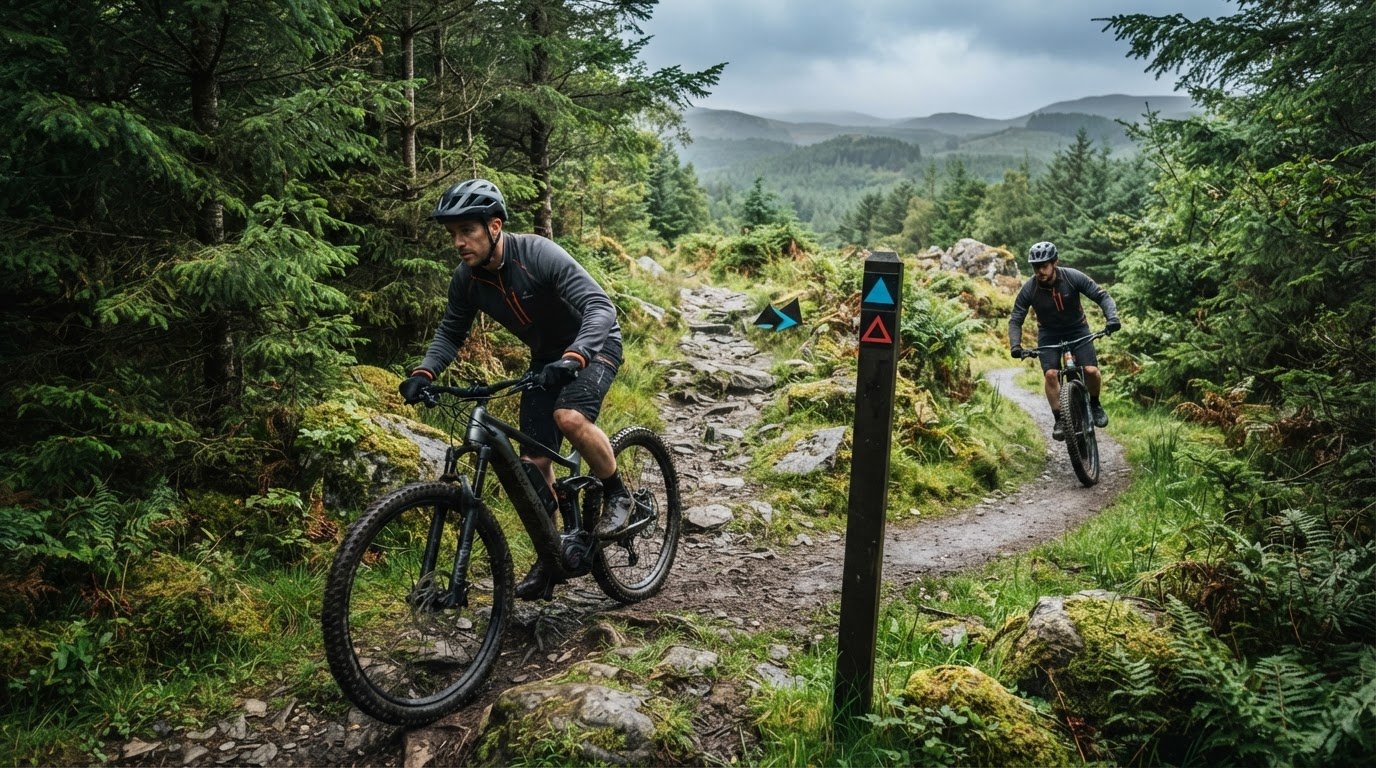
eMTBs aren’t automatically allowed on every European trail. For e-MTB-friendly trails in Ireland, access depends on local rules and trail signage; EU e-bikes are limited to a maximum continuous motor power of 250 watts, with assistance ceasing at 25 km/h. Those limits don’t replace the need to understand access restrictions for each route.
It’s easy to see a trail grade or familiar route name and assume it suits your bike and experience. But the surface, climbs, technical features and access rules all shape the ride. A little preparation can make the difference between a rewarding day out and a route that isn’t right for you.
This guide explains how eMTB access varies across Europe and what to look for when choosing Irish trails. You’ll find practical ways to read difficulty grades and signage, compare routes around Dublin and Wicklow, and prepare your bike and kit for the conditions ahead.
Key Takeaways
- EU motor limits don’t automatically grant access to every trail; local rules and signs determine where you can ride.
- Choose a route by considering its grade alongside the terrain, technical features and your experience.
- Plan Dublin and Wicklow rides around the network and route that best match your ability and available time.
- Prepare for changing trail conditions by planning your route and carrying what you need for the ride.
1. Mountain bike trail difficulty and rider preparation
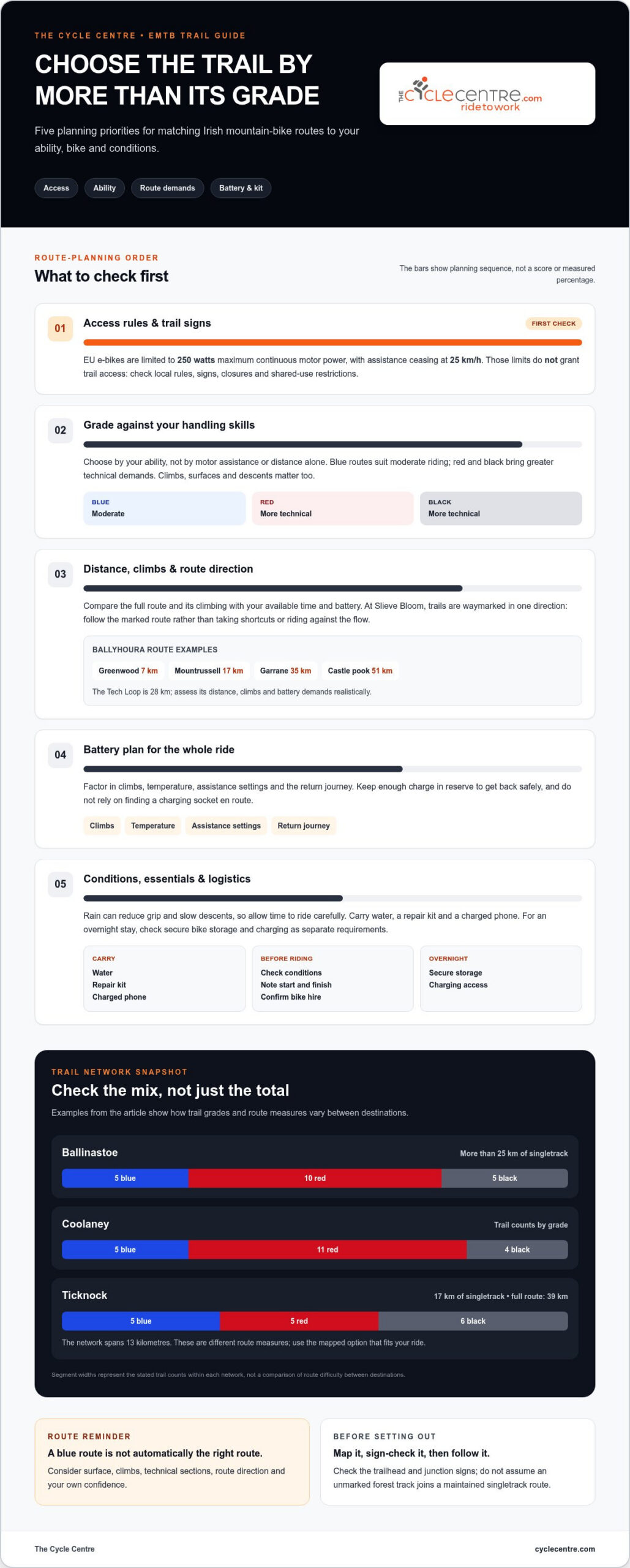
Strong starting points for e-MTB-friendly riding include Ballinastoe, Coolaney, Slieve Bloom and Ballyhoura. Ballinastoe has 5 blue, 10 red and 5 black trails; Coolaney has 5 blue, 11 red and 4 black. The European Union limits e-bikes to a maximum continuous motor power of 250 watts. That specification doesn’t decide trail access, so read local signs before riding.
Match the grade to your handling skills, not just your motor’s assistance. Blue routes suit riders seeking moderate terrain; red and black trails bring greater technical demands. Slieve Bloom’s trails are waymarked in one direction, so follow the marked route rather than improvising shortcuts. Ballyhoura’s 28 km Tech Loop calls for a realistic assessment of distance, climbs and battery use. Its listing includes two blue-grade routes, giving riders a less demanding option.
Plan battery use for the whole ride, taking account of climbs, temperature, assistance settings and the return journey. Don’t rely on finding a charging socket along the way. For an Amflow electric mountain bike, compare the model’s published battery capacity, motor output and weight with your route’s demands. Carry water, a repair kit and a charged phone, and keep enough battery in reserve for a safe return.
When choosing accommodation for a mountain-bike trip, check whether it allows secure bike storage and charging. Treat these as separate needs when planning an overnight stay. A trailhead is a useful starting point for estimating distance, but it doesn’t guarantee bike hire or charging. Confirm hire arrangements before planning around a rental bike, and identify your start and finish points before setting out.
2. Are eMTBs allowed on trails in Europe?
Across Europe, permission to ride an e-MTB depends on local trail rules, not one universal access rule. In the EU, e-bikes are limited to a maximum continuous motor power of 250 watts, and assistance must cease once the bike reaches 25 km/h. Those limits don’t grant automatic trail access. Riders looking for e-MTB-friendly trails in Ireland should read signs and route conditions for each forest, park or trail.
Use the trail network’s map alongside its signs. Check the route direction, grade, surface and any closures, then compare the distance and climbs with your battery plan. Rain can reduce grip and slow descents, so allow time to ride carefully. Maps help you plan, but follow the signs at the trailhead and junctions.
Ballyhoura offers five routes, including the 7 km Greenwood, 17 km Mountrussell, 35 km Garrane and 51 km Castlepook loops. Its listing includes two blue routes and three red routes. Rostrevor’s 27 km Red Loop starts and finishes at the Rostrevor MTB Trailhead in Kilbroney Forest Park. Check the marked sections and plan for the route’s terrain before setting out.
In France, Alpe d’Huez has 16 routes described as suitable for eMTBs, while Morzine has 22 e-bike-friendly routes. These examples show why riders comparing e-MTB-friendly trails in Ireland should assess each route separately. Near Clonmel, plot your route before riding, note junctions and trailhead access, then follow signs. Don’t assume an unmarked forest track joins a maintained singletrack route.
Choose a route based on more than distance. A blue loop may suit moderate riding, while steep descents and technical sections call for stronger handling skills, whatever assistance setting you use. Check access at the entrance, then respect closures, direction markers and shared-use signs.
3. Dublin and Wicklow mountain biking
Ticknock Mountain Bike Trails gives Dublin riders a mountain biking network about thirty minutes by car from the city centre. The network spans 13 kilometres, with 17 kilometres of singletrack and a full mountain-bike route measuring 39 km. These figures describe different route measures, so use the mapped option that matches your planned ride rather than treating them as interchangeable.
At Ticknock, the trail network includes 5 blue, 5 red and 6 black trails. Eight singletrack routes sit near the start, offering a way to shape a shorter outing before committing to a longer loop. The 100-space car park helps with arrival planning, but allow time to prepare your electric mountain bike and check the route signs before riding.
For a larger Wicklow forest adventure, Ballinastoe has more than 25 km of singletrack and lies 45 minutes from Dublin city centre. Its mountain bike trails include 5 blue, 10 red and 5 black routes. Choose a grade based on your handling ability, then consider how repeated climbs and technical sections will affect your pace and battery use.
The Dublin Mountains also offer different riding styles. The GAP network has 13 trails ranging from intermediate to expert, while the GAP in Glencullen has over 35 downhill mountain bike trails. Read the route description carefully: a downhill focus can mean a very different ride from a forest loop with sustained climbs.
Before setting out, choose a trailhead, check the route direction and note where your loop finishes. Follow waymarking, respect closures and don’t assume electric bikes are permitted on every track. Kinnitty, in the Slieve Bloom area, is a separate mountain-biking destination, not part of the Dublin or Wicklow networks. Keeping these locations distinct helps you plan routes across Ireland.
4. Trail difficulty levels and signage
Trail grades help you judge technical difficulty, but colour alone can’t tell you everything about a climb, surface or descent. At Slieve Bloom, blue routes are moderate, while red routes are difficult or severe. The network is waymarked in one direction, so follow the arrows and don’t ride against the marked flow.
Beginners and families can start with a blue route rather than choosing by distance alone. Kinnitty Forest in Offaly has two blue-grade routes, and Ballyhoura has two blue routes. The Westport-to-Achill route is almost entirely paved and technically easy, making it a different option from challenging singletrack. Choose a route that suits everyone’s ability and confidence.
Read the signs at the trailhead before you set off. Check the route colour, direction markers, shared-use notices and closure information. At junctions, pause to compare the marker with your route plan; a wrong turn could take you onto a more difficult section. A guided ride can help newcomers learn trail etiquette and navigation, but it doesn’t replace reading signs or choosing a suitable grade.
Difficulty also depends on the conditions and the rider. Wet or loose surfaces can make braking and cornering harder, while repeated climbs can test fitness and battery planning. On an e-MTB, assistance helps with pedalling, not balance, line choice or braking. Approach unfamiliar descents at a controlled pace, and walk sections beyond your comfort or skill level.
Before riding with children, check that the chosen trail’s surface, technical features and length suit the least experienced person. At Slieve Bloom, follow the one-way markings and respect Leave No Trace principles. For a suitable bike, explore electric mountain bikes and consider how the bike’s handling will suit the trails you plan to ride.
The Cycle Centre: Bike to work
The Cycle Centre can help you explore Electric Mountain Bikes and the Cycle to Work option as you plan more rides. If trail grades, climbs or battery planning have you weighing up an e-MTB, consider how you’ll use the bike, the routes you enjoy and the assistance you need. That gives you a practical starting point for choosing a bike that suits your riding.
The Cycle to Work scheme may suit you if you’re considering cycling to work as well as riding for leisure. The right bike depends on how you’ll use it, whether for trails, everyday journeys or both. Keep your routes and riding preferences in mind as you consider your next step.
Contact The Cycle Centre or visit cyclecentre.com to explore your options.
Make your next ride your own
Let your next ride guide your choice of bike and preparation. Think about the terrain you enjoy, the level of technical challenge that feels right, and whether you’ll use the bike for everyday journeys as well as trails. Your plans for e-MTB friendly trails in Ireland can then help you find a bike that suits you, rather than becoming a checklist to follow blindly.
The Cycle Centre offers electric mountain bikes and Bike to Work, Cycle to Work and Ride to Work options. These may suit you if you’re considering a bike for both leisure and commuting. Think about your intended use and riding preferences as you explore your options.
Contact The Cycle Centre for advice about your options. Take your time, choose a route that fits your ability, and look forward to discovering more of Ireland by bike.
Frequently Asked Questions
Are eMTBs allowed on trails in Europe?
Access depends on local trail rules, not just the bike’s specifications. The European Union sets a maximum continuous motor power of 250 watts for e-bikes, and assistance must cease once the bike reaches 25 km/h. Before riding in another country, check that route’s access signs and local regulations. A compliant e-bike isn’t automatically permitted on every path.
Are e-MTBs allowed at Ireland’s mountain bike trail centres?
There isn’t one access rule for every Irish trail centre. Permission depends on the centre’s conditions and the signs for each route. At the entrance, look for e-bike restrictions, closures and shared-use instructions. If a sign prohibits motorised bikes, don’t ride that route on an e-MTB; choose one where access is permitted instead.
What are the trail difficulty ratings, distances, and elevation gains at Irish MTB centres?
Grades and route lengths differ between centres and loops. Ballyhoura’s trail listing gives 9 blue, 20 red and 6 black trails, while Slieve Bloom currently comprises 35 km of trails, with plans for 100 km eventually. Elevation gain is route-specific, so compare the climb profile for your chosen loop rather than relying on a centre-wide figure.
How much does it cost to ride or rent an e-MTB at Irish trail centres?
Costs depend on what you need: riding access, parking and bike hire may be charged separately. Rental charges vary according to the bike and hire arrangement, so include the hire period and any required equipment in your plans. Don’t assume trailhead parking includes riding access or bike hire.
Are there guided e-MTB tours or trail maps for Ireland?
Trail maps help you plan self-guided rides by showing route options, direction and trailhead access. Use them alongside signs on the ground, as closures or conditions may affect your planned route. For a guided ride, choose one that explicitly accepts e-MTBs and suits your group’s ability and preferred level of technical challenge.