

Your choice of e-bike isn’t just a purchase; it’s a long-term relationship defined by the reliability of its motor and the support of an authorised service centre rather than just the initial price tag. It’s perfectly natural to feel overwhelmed by the technical jargon of the 2026 market, from the endless Bosch versus Shimano debate to the persistent worry of range anxiety. You likely want a ride that fits your physical frame and your unique lifestyle without the stressful guesswork or the fear of making a costly mistake.
This guide provides a definitive expert framework on how to choose an electric bike, helping you master the technical specifications and find a high-performance model that truly delivers. We will break down motor performance, clarify complex sizing requirements, and explain how to utilise tax-free cycle to work schemes to make your ideal ride significantly more affordable. By the end of this article, you will have the confidence to select a bike that matches your riding style whilst ensuring every penny is well spent on quality components and professional engineering.
Key Takeaways
- Understand the functional differences between mid-drive and hub motors to ensure your power delivery feels natural on every terrain.
- Master a reliable framework on how to choose an electric bike by aligning motor torque and battery capacity with your specific commuting needs.
- Learn how to find your ideal fit by focusing on reach and stack measurements, which are more critical for e-bike comfort than traditional frame sizes.
- Identify the best ways to utilise the Cycle to Work scheme to make premium models from world-class brands like Giant and Cube more affordable.
- Recognise the importance of long-term workshop support and regular software updates to keep your motor and battery running at peak efficiency.
Understanding the E-Bike Revolution: Why Switch in 2026?
In 2026, the perception of e-bikes has shifted dramatically. They’re no longer viewed as mere “assisted cycles” for those who find hills a struggle; they’ve become the primary mode of transport for thousands of commuters looking to escape the rising costs and congestion of car ownership. Switching to an e-bike offers a clear path toward financial freedom and environmental responsibility. You can bypass gridlock, eliminate parking fees, and significantly reduce your carbon footprint without sacrificing the speed of your daily commute. It’s a practical solution that addresses the frustrations of modern urban living whilst providing a sense of exploration.
Beyond personal commuting, the rise of electric-assisted transport is transforming how we experience cities as tourists and locals alike; for instance, you can visit VIP Pedicab to discover how professional pedicab services are leading the way in sustainable urban mobility.
Deciding on a specific model involves more than just picking a colour. Learning how to choose an electric bike starts with understanding that modern engineering has finally solved the historical issues of weight and battery aesthetics. Modern Electric bicycle technology has reached a pinnacle of integration. Gone are the days of heavy, bolt-on battery packs that ruined a bike’s balance. Today’s high-performance e-bikes feature slimline batteries hidden within the downtube. This design doesn’t just look better; it lowers the centre of gravity, making the bike feel stable and nimble. By removing the psychological “barrier of effort”, these machines encourage you to choose the two-wheeled option even on days when you feel tired or the wind is against you.
Health and Wellness Without the Burnout
Riding an e-bike offers a unique form of low-impact cardiovascular exercise. You can adjust the level of assistance to suit your energy levels, ensuring you stay within a healthy aerobic zone without the risk of burnout. This is particularly beneficial for those returning to fitness or managing joint issues. For riders who want to look and feel their best during these health-focused journeys, REP Store provides high-performance apparel that supports an active lifestyle. The “sweat-free commute” is perhaps the most practical advantage for the modern professional. You can glide through traffic and arrive at your workplace feeling energised and sharp, rather than needing an immediate shower. The mental clarity gained from a morning ride amongst nature often outweighs the physical benefits, providing a quiet moment of reflection before the workday begins.
Navigating the 2026 Legal Landscape
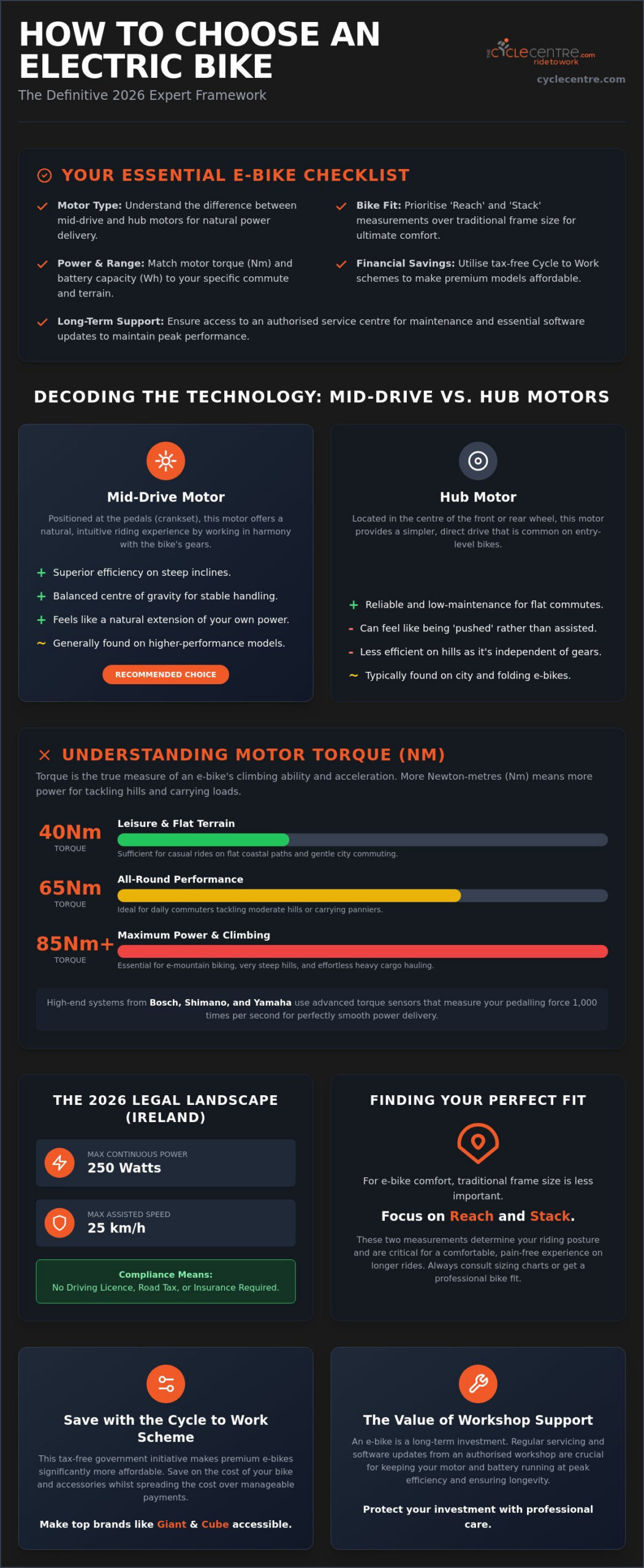
Understanding the local regulations is a critical step when you are researching how to choose an electric bike. In Ireland, the law is quite specific about what qualifies as a “pedelec”. Your motor must not exceed 250 watts of continuous power, and the electrical assistance must automatically switch off once you hit 25km/h. These rules ensure that e-bikes can be used on cycle paths and in parks without the need for a driving licence or road tax. Staying within these limits is essential for your safety and legal compliance. If you’re looking for more detail on these regulations, our Electric Bike Laws in Ireland guide covers everything from safety standards to age requirements.
Decoding the Technology: Motors, Batteries, and Drive Systems
Understanding the internal mechanics is often the most daunting part of learning how to choose an electric bike. It isn’t just about the motor’s power; it’s about how that power is delivered to the road. Mid-drive motors, positioned at the pedals, offer the most sophisticated experience because they work in harmony with your gears. This makes them significantly more efficient on steep inclines and provides a balanced centre of gravity. In contrast, hub motors are often found on entry-level city models. They’re reliable for flat commutes but can feel like they’re pushing you rather than assisting your natural cadence. Reviewing the Best Electric Bikes of 2026 shows that mid-drive systems have become the gold standard for high-performance riding.
Torque, measured in Newton-metres (Nm), is the true indicator of climbing ability. Whilst a motor with 40Nm might suffice for a leisurely ride along a flat coastal path, those tackling steep inclines or carrying heavy cargo will find that a motor with 65Nm to 85Nm provides the necessary grunt to make the journey effortless. This is where brand-name electronics like Bosch, Shimano, and Yamaha prove their worth. These manufacturers invest heavily in torque sensors that measure your pedalling force 1,000 times per second, ensuring the assistance feels like a natural extension of your own legs rather than a sudden surge of power.
The Motor: The Heart of Your E-Bike
The Bosch Performance Line and Shimano Steps systems dominate the market for a reason: reliability. Bosch is often favoured for its robust power delivery and extensive service network, whilst Shimano is celebrated for its lightweight design and seamless integration with electronic shifting. Yamaha motors provide exceptional reliability, particularly in mountain bike applications, whereas Bafang offers a versatile alternative for various frame styles. Investing in these established brands ensures your bike remains serviceable for years. If you’re feeling overwhelmed by the specifications, our Smart-bike Search tool can help you filter models by motor type and performance.
Battery Life and Range Anxiety
Battery capacity is measured in Watt-hours (Wh), and in 2026, 500Wh has become the baseline. However, the reality of range depends on more than just the number on the casing. Your weight, the terrain, and even the tyre pressure will influence how far you can travel on a single charge. To maximise your lithium-ion battery’s lifespan over five years, avoid leaving it at zero per cent for long periods and store it at room temperature. For long-distance adventurers, dual-battery options are now common, allowing you to double your range for weekend explorations without the fear of running out of juice mid-climb.
Matching the Bike to Your Lifestyle: E-City, E-MTB, or E-Road?
Selecting the right category is the most personal part of learning how to choose an electric bike. It requires a realistic assessment of your primary terrain. If your journeys are strictly urban, a comfort-oriented frame is ideal. However, many riders now opt for the “SUV” e-bike. These versatile crossover models combine the robust suspension of a mountain bike with the practical accessories of a city cruiser. They’re perfect for the modern rider who wants to navigate potholed city streets during the week and explore forest tracks at the weekend. This versatility ensures you aren’t limited by your equipment when the urge for adventure strikes.
Frame geometry plays a vital role in your long-term satisfaction. A comfort-focused upright posture is excellent for visibility in traffic and reduces strain on your neck and back. In contrast, an aggressive, performance-focused geometry is designed for aerodynamics and speed, which is typical for e-road bikes. You should also consider the physical weight of the machine. Whilst the motor makes the weight unnoticeable whilst riding, you may still need to lift the bike onto a car rack or into a hallway. Most high-performance e-bikes weigh between 20kg and 25kg, so ensure your storage and transport solutions are up to the task.
Urban Commuting and E-City Bikes
For the daily grind, practicality is the priority. Step-through frames have gained massive popularity because they make mounting and dismounting easy, even when the rear rack is loaded with heavy panniers. In the unpredictable Irish climate, integrated mudguards and high-visibility lights aren’t just accessories; they are essential safety features. Arriving at your destination clean and visible is the hallmark of a well-chosen commuter. To stay comfortable in all conditions, pairing your bike with the right Cycling Apparel Ireland is a wise investment for any year-round rider.
Adventure and Performance: E-MTB and E-Road
When it comes to high-performance motor integration, brands like Giant and Cube lead the field. Their E-MTB models are engineered to handle technical climbs that would be impossible on a traditional bike. Meanwhile, gravel and adventure e-bikes have become the “do-it-all” solution for the Irish landscape. They offer the speed of a road bike with the durability to handle gravel paths and rough backroads. If you’re focused on long-distance efficiency, exploring our range of Endurance Road Bikes Ireland will help you find a model that balances speed with all-day comfort.
Practical Steps: Sizing, Testing, and Financial Savings
Once you have narrowed down the technical specifications, the physical reality of the bike becomes the next hurdle. Many riders assume that their traditional frame size will translate perfectly to an e-bike, but the added weight of the motor and battery changes the handling dynamics. When you are learning how to choose an electric bike, you must prioritise the “reach” and “stack” measurements. These figures determine how far you lean forward and how high the handlebars sit. Because e-bikes often encourage longer rides, finding a posture that prevents wrist and lower back strain is essential for long-term comfort.
A test ride is the only way to truly gauge these factors. During the first five minutes, pay close attention to how the motor engages when you pull away from a standstill. It should feel smooth and intuitive, not like a sudden jolt. Test the braking power too; high-quality hydraulic disc brakes are a necessity for safely stopping a 25kg machine in damp conditions. Handling a heavier bike at low speeds requires a bit of practice, so ensure the frame feels manageable during tight turns. If you are shopping for the whole family, our Kids Bike Size Guide Ireland offers similar practical advice for younger riders.
Finding the Perfect Fit
Adjusting the saddle height and handlebar reach is a matter of ergonomic safety. Whilst an online calculator can provide a rough starting point, it cannot account for your specific limb length or flexibility. This is why professional in-store sizing is superior. An expert can observe your pedalling motion and make micro-adjustments to the seat post and stem to ensure your knees and back are protected. If you want to see how different frame styles feel in person, you can book a test ride at our showroom to experience the geometry firsthand.
The Cycle to Work Scheme Advantage
The most significant breakthrough in how to choose an electric bike in 2026 is the increased accessibility through financial incentives. In Ireland, the Cycle to Work scheme remains the most effective way to lower your investment. You can save up to 52% on the total cost through tax and PRSI relief, depending on your tax bracket. Crucially, the 2026 limit for electric bikes is €3,000, allowing you to purchase a premium model with a high-torque motor and long-range battery without the full upfront cost. For a step-by-step breakdown of the application process, consult The Ultimate Guide to the Bike to Work Scheme Ireland 2026.
The Long-Term View: Maintenance and Workshop Support
Choosing your e-bike is a significant investment, but the longevity of that investment depends entirely on the quality of aftercare you receive. An e-bike is a sophisticated piece of machinery, closer to a high-performance vehicle than a traditional bicycle. When you are finalising how to choose an electric bike, you must consider who will look after it when the motor needs a software update or the sensors require calibration. Regular maintenance isn’t just about keeping the chain oiled; it’s about ensuring the complex electronics remain efficient and safe. Our Workshop Silver Service and Workshop Gold Service packages are designed specifically to address these technical requirements, providing the peace of mind that your ride will remain reliable for years to come.
Software updates are a critical but often overlooked aspect of e-bike ownership. Manufacturers frequently release firmware that improves battery efficiency, refines motor response, or fixes minor bugs. Without these updates, your bike may not be performing at its peak potential. We treat every service as an opportunity to optimise your machine, ensuring the hardware and software work in perfect harmony. This methodical approach reduces friction in your daily life, turning a potentially complex technical chore into a seamless part of your cycling journey.
Shimano Accredited Workshop Excellence
Modern motors from brands like Bosch and Yamaha are closed systems that require specialist diagnostic tools for even basic troubleshooting. Without these tools, a standard mechanic cannot access the battery’s health reports or install critical firmware updates that optimise power delivery. Being a Shimano accredited workshop means we have the professional training and equipment to handle these intricate repairs. This level of care is also a vital factor for resale value; a documented service history from a recognised centre makes your bike a far more attractive prospect on the second-hand market. For those riding premium setups, our High-End Road Bike Service in Ireland provides the precision tuning required for elite performance.
The Cycle Centre Experience
We have been supporting the Irish cycling community since 1974, and our heritage is built on a foundation of reliability and deep-rooted expertise. We don’t just sell bikes; we facilitate experiences. Our unique Smart-bike Search tool allows you to filter through world-class brands like Giant, Cube, and Romet to find the exact motor and battery combination that fits your daily route. From your first enquiry to your annual Gold-level service, our team maintains a proactive, “can-do” attitude to ensure your journey is as smooth as possible. We have seen the industry evolve over five decades, and we remain committed to providing the same high standard of service that has made us a trusted local expert for generations of riders. Learning how to choose an electric bike is simpler when you have a mentor to guide you through every technical detail.
Your Journey Toward Two-Wheeled Freedom Starts Here
Mastering how to choose an electric bike is the first step toward a more efficient and enjoyable lifestyle. You now understand the critical balance between motor torque and battery capacity, whilst also recognising the significant financial advantages of the Cycle to Work scheme. Remember that the best e-bike is one that fits your physical frame perfectly and receives the ongoing support of a specialist workshop. By prioritising quality brands and professional sizing, you ensure your new ride remains a reliable companion for years to come.
As an official Giant and Cube dealer established in 1974, we take pride in our heritage and our status as a Shimano accredited workshop. We are here to guide you through the technical jargon and help you make an informed decision with confidence. Our team is ready to provide the seasoned authority and welcoming support you need to transition from a casual observer to a confident e-bike owner. Find your perfect ride with our Smart-bike Search and take the first step toward your next adventure. We look forward to seeing you on the road.
Frequently Asked Questions
How much can I save on an e-bike using the Cycle to Work scheme?
You can save up to 52% on the total cost of your e-bike through tax, PRSI, and USC relief. In 2026, the limit for electric bikes under the scheme is €3,000, which allows you to invest in a high-performance model whilst spreading the cost through salary sacrifice. This makes premium engineering from world-class brands much more accessible for the average commuter.
Do I need a driving licence or insurance to ride an e-bike in Ireland?
No, you don’t need a driving licence, road tax, or compulsory insurance to ride a standard e-bike in Ireland. As long as your bike is a “pedelec” with a motor under 250 watts that cuts out at 25km/h, it is legally treated as a regular bicycle. However, it’s always a sensible idea to have personal liability insurance for peace of mind whilst navigating busy urban centres.
How long does an electric bike battery typically last before replacement?
A high-quality lithium-ion battery typically lasts between three and five years or approximately 500 to 1,000 full charge cycles. You will likely notice a gradual decrease in range rather than a sudden failure. To maximise its life, store the battery at room temperature and avoid leaving it completely discharged for long periods. Professional diagnostic tools in our workshop can provide a health report on your specific battery cells.
Can I ride my electric bike in the rain and through puddles?
Yes, you can ride your e-bike in the rain and through shallow puddles because the electrical components are designed to be water-resistant. However, you should never submerge the motor or battery in deep water. After a particularly wet ride, it is best to wipe down the electrical contact points and dry the bike to prevent long-term corrosion or electrical issues.
What is the difference between a mid-drive motor and a hub motor?
The primary difference lies in the placement of the motor and how it delivers power to the road. A mid-drive motor is located at the pedals and works through the bike’s gears, providing a natural feel and superior climbing ability. A hub motor sits in the centre of the wheel and provides a “pushing” sensation. Understanding this distinction is vital when learning how to choose an electric bike for hilly terrain or heavy loads.
How often should I have my e-bike serviced at a specialist workshop?
You should have your e-bike serviced at a specialist workshop every six to twelve months, or approximately every 1,000 kilometres. Because e-bikes are heavier and faster than traditional cycles, components like brake pads and chains wear down more quickly. A professional service also includes critical software updates and motor diagnostics that you cannot perform at home.
Can I still ride the bike if the battery runs out of power?
Yes, you can still pedal your e-bike if the battery runs out of power, as it will function just like a standard bicycle. You will, however, notice the additional weight of the motor and battery, which can make hills more challenging. Most modern systems provide a “limp home” mode that keeps the integrated lights functioning even after the motor assistance has stopped.
Which is better for commuting: a folding e-bike or a city e-bike?
A folding e-bike is the superior choice if you need to take your bike on a train or store it in a small flat. However, if your commute is longer and you have ample storage, a dedicated e-city bike offers better stability and comfort due to its larger wheels and longer wheelbase. Your decision on how to choose an electric bike should always prioritise your specific storage constraints and daily route.