


The most significant hurdle to your next cycling adventure isn’t the steepness of the Wicklow Mountains or the weight of your frame; it’s a phantom fear borrowed from the world of motorcars. We understand why electric bike range anxiety feels so real when you’re staring at a digital display whilst miles from home. You might worry about being left to lug a heavy machine up a coastal incline with nothing but your own tired legs for power. It is a common concern that often keeps brilliant bikes tucked away in sheds rather than out on the open road.
The good news is that by 2026, technology and infrastructure have evolved to ensure you’re never truly stranded. We’ll show you why the fear of a dead battery is the biggest myth in e-biking and how you can master your range for limitless Irish adventures. You will learn how to interpret real-world range data, manage battery health over time, and select a bike that delivers on its promises. By the end, you’ll have the confidence to plan those ambitious weekend tours without ever glancing nervously at your battery bars.
Key Takeaways
- Understand why electric bike range anxiety is largely a psychological carryover from the automotive world and how to shift your mindset for more confident riding.
- Learn how to account for the unique variables of the Irish landscape, such as hills and wind, to accurately predict your real-world battery performance.
- Discover the “pedal safety net” and how modern clutch technology ensures you are never truly stranded, unlike in a traditional electric car.
- Master practical techniques like cadence management and strategic assist selection to maximise your distance on every single charge.
- Find out how to leverage professional diagnostics and the Cycle to Work scheme to maintain peak battery health and afford higher-capacity equipment.
Understanding Electric Bike Range Anxiety: Fact vs Fiction
The term Range anxiety first entered our lexicon through the electric car industry, where the prospect of a flat battery meant an expensive tow truck and a ruined afternoon. When translated to cycling, however, the term is often misapplied. We define electric bike range anxiety not as a mechanical failure, but as a psychological barrier that prevents riders from enjoying the full potential of their machines. In 2026, technology has reached a point where being truly stranded is almost impossible for the average commuter or weekend explorer. Unlike the all-or-nothing nature of a car, an e-bike offers a gradual transition. If the motor stops, the wheels keep turning. You’re riding a bicycle, not a locked-out motorcar.
Why We Worry: The Psychology of the Battery Bar
The stress often stems from the human element of watching a digital percentage tick downwards. It triggers a primitive worry about being stuck or failing to reach a destination. Modern e-bike systems now combat this with dynamic range software. These displays don’t just show a static percentage; they calculate your remaining distance based on your current pedalling effort, the terrain, and the assist mode you’ve selected. This real-time data provides a clearer, more honest picture of your journey. Crucially, we must dispel the myth that a dead battery equals a dead bike. Modern motors are designed with internal clutches that disengage when the power is off, meaning you can pedal home without fighting the motor’s resistance.
The Reality of Modern E-Bike Range in 2026
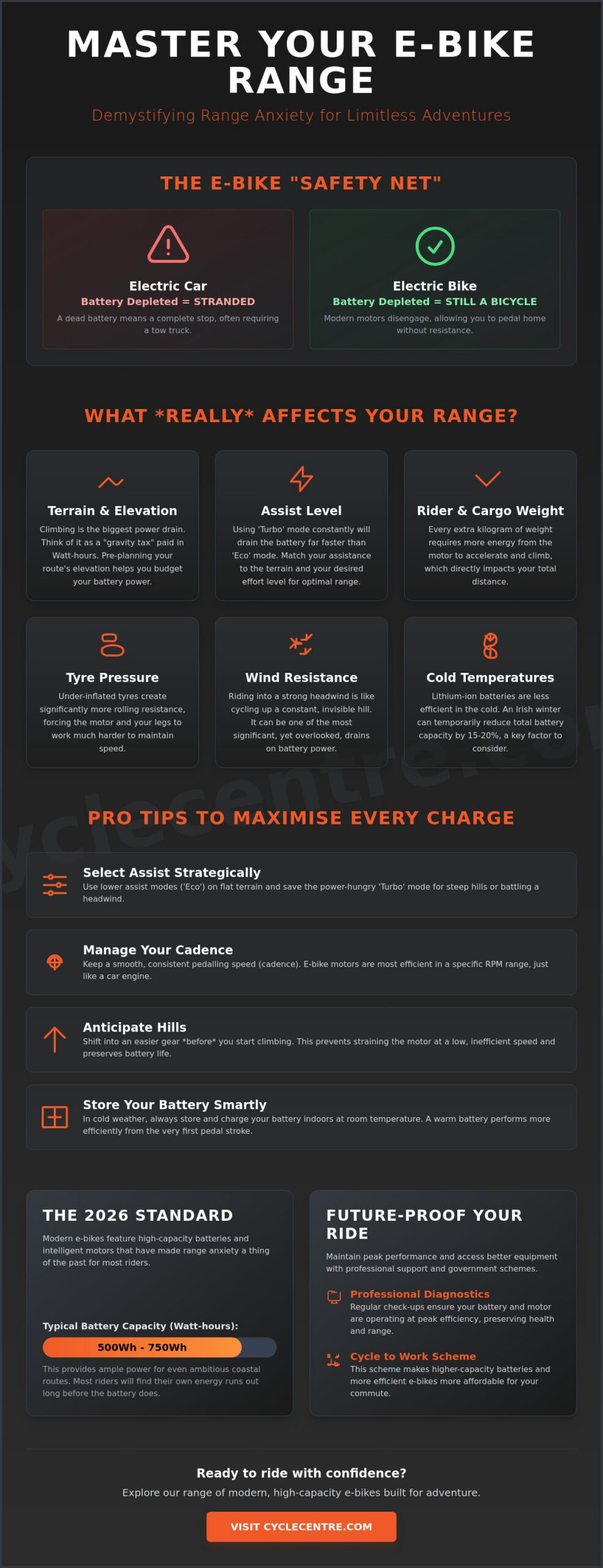
The standard for battery capacity has shifted significantly over the last few years. Most quality mid-drive systems now come with 500Wh to 750Wh units as standard, providing ample power for even the most ambitious Irish coastal routes. To put it simply, Watt-hours are the fuel tank of the e-bike world; the higher the number, the more energy you have stored for the road ahead. Efficiency has also improved alongside capacity. Industry leaders like Bosch and Shimano have refined their motor algorithms to squeeze every last kilometre from the cells. These 2026 systems are smarter and more efficient than anything we saw five years ago. For the vast majority of riders, you’ll likely find your own legs run out of steam long before the battery does.
The Variables of Distance: Why Range is Not a Fixed Number
When you see a sticker on a new frame claiming a “100km range,” it’s vital to remember that this figure was likely achieved on a perfectly flat track in 20-degree weather with a lightweight rider. Real-world electric bike range anxiety often stems from the gap between these laboratory estimates and the reality of a wet Tuesday in Galway. Your range isn’t a fixed number; it’s a sliding scale influenced by the environment, your luggage, and even the direction of the breeze. Understanding these variables is the first step toward mastering your machine.
Ireland’s unique geography plays a massive role in how quickly your battery depletes. A stiff Atlantic headwind can sap your power as effectively as a steep incline, forcing the motor to compensate for the extra drag. Similarly, rider weight and cargo must be considered. If you’re using Gravel and Adventure Bikes loaded with heavy panniers for a weekend tour, your energy draw will naturally increase. Every extra kilogram requires more torque from the motor to maintain pace, especially when pulling away from a standstill at traffic lights or junctions.
Terrain and Elevation: The Gravity Tax
Climbing is the single biggest drain on your battery cells. Think of it as a “gravity tax” that you pay in Watt-hours. Whilst you gain some of that energy back on the descent by coasting, the net loss is always present. To save juice, we suggest dropping into a lower gear before the incline actually begins. This keeps the motor spinning in its most efficient RPM range rather than straining at a low cadence. Before heading out on a new route, use a mapping tool to check the total elevation gain. Knowing there’s a 300-metre climb at the end of your journey allows you to budget your power accordingly.
Weather and Temperature: The Irish Context
Lithium-ion batteries are chemically sensitive to the cold. In the depths of an Irish winter, you might notice a 15% to 20% drop in total capacity because the chemical reactions inside the cells occur more slowly. We always recommend storing your battery indoors at room temperature overnight. Starting a ride with a warm battery ensures better efficiency from the very first pedal stroke. Don’t forget tyre pressure either. Softer tyres provide more grip on wet Irish roads, but they also create more rolling resistance. This forces the motor to work harder to maintain speed, so keep your tyres inflated to the recommended PSI for the best balance of safety and range.
The EV Comparison Myth: Why You Can Never Truly Be Stranded
The comparison between electric cars and e-bikes is perhaps the most misleading aspect of the current conversation around electric bike range anxiety. If a Tesla or a Nissan Leaf runs out of juice, you are truly stranded, likely waiting for a recovery vehicle on the hard shoulder of a motorway. An e-bike operates on an entirely different set of rules. You are the backup motor. This “Pedal Safety Net” means that the worst-case scenario isn’t a breakdown; it’s simply a slightly more strenuous workout. By 2026, motor technology has advanced to include sophisticated internal clutches. These components disengage the motor entirely when the power is off, allowing for drag-free pedalling that feels remarkably similar to a traditional bicycle.
Shifting your mindset is the most effective way to conquer your fears. Instead of viewing the motor as a requirement for movement, try viewing it as a bonus that enhances your natural ability. This psychological shift changes the “empty” battery from a catastrophe into a manageable inconvenience. Even in that unlikely scenario where you hit 0%, your bike remains a functional tool for transport. Safety is also prioritised in these designs. Most modern systems reserve a tiny fraction of energy specifically for your integrated lights. Even when the motor stops assisting your legs, your 1% charge can often power your front and rear lamps for several hours, ensuring you remain visible on dark Irish country roads.
Mechanical Efficiency vs Motor Dependence
High-end brands like Giant and Cube have spent years perfecting frame geometry to ensure their e-bikes aren’t just motorised platforms, but balanced cycles. They optimise the riding position so that you can produce power efficiently through the pedals without relying on the drive unit. The role of gear ratios is equally vital here. Modern drivetrains offer a wide range of gears that make even a heavy E-MTB manageable on flat ground or gentle inclines without any assistance at all. It’s a simple reality that an e-bike with a dead battery is simply a slightly heavier bicycle. If you’re still deciding which motor system best suits your riding style, our in-depth guide to Bosch vs Shimano e-bike motors breaks down exactly how each system performs on Irish terrain.
The ‘Limp Mode’ Feature
Smart battery management systems are now standard, featuring what many riders call “limp mode.” As your battery nears the 5% mark, the software automatically scales back the power delivery, dropping you into a low-consumption state to preserve those final kilometres. This “reserve tank” allows you to reach your destination whilst minimising the physical effort required. To ensure these safety features and power-save modes are functioning correctly, we recommend a periodic visit to a Shimano accredited workshop. Professional calibration ensures your system accurately predicts when to trigger these reserves, giving you total peace of mind on long-distance weekend rides.
Mastering Your Battery: Pro Tips for Maximising Every Charge
Mastering your battery isn’t about riding in the lowest assist mode until your legs give up. It’s about being a smart operator of the technology beneath you. Whilst some suggest staying in Eco at all costs, we’ve found that using Turbo for short, sharp bursts to crest a hill can actually be more efficient than struggling in a lower mode for several minutes. By clearing the obstacle quickly, you return to a steady pace sooner, reducing the total time the motor is under heavy load. This proactive approach is the ultimate antidote to electric bike range anxiety.
The “Cadence Secret” is perhaps the most overlooked factor in battery longevity. Electric motors are most efficient when spinning at a higher rate, typically between 70 and 90 revolutions per minute (RPM). If you pedal slowly in a high gear, the motor has to work much harder to provide assistance, which drains the cells rapidly. Think of it like a car engine; you wouldn’t try to pull away in fifth gear. Shifting early to keep your legs moving fast keeps the motor in its optimal power band and extends your distance significantly.
Small mechanical drag adds up over a long journey. A gritty, unlubricated chain or under-inflated tyres can easily rob you of 5 to 10 miles of potential range. If your bike is feeling sluggish, it might be time for a professional tune-up. You can book a Workshop Gold Service to ensure every component is running with minimal resistance.
Optimising Your Riding Style
Success on the road comes down to momentum management. Every time you brake unnecessarily, you lose energy that the motor must then replace through acceleration. Look ahead and anticipate traffic or corners to maintain a smooth, rolling pace. We also suggest utilising route-planning apps to find the most energy-efficient paths. Avoiding a single unnecessary steep valley can save more juice than ten miles of careful pedalling on the flat. If you’re still in the market for a new ride, use our Smart-bike Search tool to find models that offer the best range-to-weight ratio for your specific needs.
Charging Habits for Longevity
How you treat your battery at home is just as important as how you use it on the road. Following the 20-80 rule is a great way to preserve cell health. Unless you’re planning a massive trek, try to keep your charge between 20% and 80%. Storing a battery at 100% for weeks at a time can lead to faster degradation. For those on long-distance weekend tours, embrace “opportunity charging.” A quick 45-minute top-up whilst you enjoy a coffee at a mid-ride stop can add enough capacity to ensure you finish your journey with a comfortable margin. It’s a simple habit that turns a long day into a worry-free adventure.
Future-Proofing Your Ride: Maintenance and the Cycle to Work Scheme
The journey toward total confidence doesn’t end once you’ve mastered your riding style. Long-term peace of mind comes from knowing your equipment is technically sound and capable of performing year after year. While we’ve discussed how to manage your energy on a single trip, true electric bike range anxiety is often rooted in the fear of battery degradation over time. By combining professional technical support with the right financial incentives, you can ensure your e-bike remains a reliable tool for exploration for many seasons to come.
Choosing the right machine for your specific lifestyle is the first step in this process. An E-city bike might be perfect for the flat streets of Dundalk, but if your weekend plans involve the rugged trails of the Cooley Mountains, an E-MTB or a versatile Gravel and Adventure bike will provide the torque and battery capacity you actually need. Our team provides the independent expertise required to match your typical mileage with the correct motor system, ensuring you never feel underpowered or limited by your equipment. If you’re at the beginning of your ownership journey, our comprehensive guide to help you buy electric bike Ireland models covers everything from motor comparisons to maximising your tax savings under the 2026 Cycle to Work regulations.
The Role of the Shimano Accredited Workshop
Modern e-bikes are sophisticated pieces of hardware that require more than just a bit of oil on the chain. Our Workshop Silver and Gold service packages are designed to look deep into the system’s “brain.” Specialist technicians can perform firmware updates that often improve motor efficiency and battery management, effectively increasing your range through software optimisations. These diagnostics are also essential for identifying “phantom” battery drains. If a sensor is misaligned or a connection is loose, the system might waste energy without you ever knowing. Professional calibration keeps the “fuel tank” honest and the motor running smoothly.
Investing in Quality for Peace of Mind
Reliability is built into the DNA of world-class brands like Giant and Cube. These manufacturers use high-density cells that are designed to withstand hundreds of charge cycles before showing any significant loss in capacity. Investing in this level of quality is the best way to reduce long-term anxiety. Fortunately, the bike to work scheme Ireland makes these premium, long-range models significantly more accessible. By utilising the scheme, you can often afford a bike with a higher-capacity 750Wh battery for a lower monthly cost than a budget model bought outright.
The road is yours to explore. With the right maintenance schedule and a bike built for your specific adventures, the fear of being stranded becomes a thing of the past. Trust in your equipment, understand your machine, and enjoy the freedom that only an e-bike can provide. Whether the battery is full or you’re finishing the last mile on leg power alone, the adventure is always worth the effort.
Take Control of Your Next Adventure
By now, it’s clear that the tools and technology of 2026 have effectively dismantled the old myths of the industry. You’ve learned that modern clutch systems ensure your bike remains a functional bicycle even without power, and that mastering your cadence can significantly extend your journey. Overcoming electric bike range anxiety isn’t about luck; it’s about making informed choices regarding your riding style and maintenance habits. Whether you’re navigating the daily commute or exploring hidden coastal paths, the power to go further is already in your hands.
We’ve been a constant presence in the Irish cycling community since 1974, helping riders transition from uncertainty to confidence. As a Shimano Accredited Workshop and official stockists of world-class brands like Giant, Cube, and Romet, we provide the technical expertise and premium equipment you need for total peace of mind. Our team is here to help you navigate the technical and financial aspects of your upgrade. Apply for a Cycle to Work quote and upgrade your range today. The road ahead is open, and with the right support, you’ll never have to worry about the distance again.
Frequently Asked Questions
How far can an electric bike really go on a single charge in Ireland?
Most modern e-bikes equipped with a 500Wh to 750Wh battery typically achieve between 50km and 120km on a single charge. In Ireland, your actual distance is heavily influenced by the Atlantic winds and the rolling terrain of areas like the Boyne Valley. Whilst manufacturers provide “best-case” figures, we suggest budgeting for the mid-range to ensure you always have a comfortable power reserve for those final coastal inclines.
What happens if my e-bike battery runs out whilst I am riding?
If your battery reaches zero per cent, the motor assistance will simply stop, but the bike remains a fully functional bicycle. You won’t be stranded; you’ll just need to use your own leg power to finish the journey. Modern drive units from reputable brands are designed to disengage internally when the power is off, ensuring that you aren’t fighting against any mechanical motor drag as you pedal home.
Do e-bike batteries lose range in cold Irish weather?
Lithium-ion batteries are chemically sensitive to the cold, which can reduce their efficiency by approximately 15% to 20% during a typical Irish winter. To combat this, we recommend storing your battery indoors at room temperature rather than in a cold shed. Starting your ride with a “warm” battery helps maintain optimal chemical reactions, which is a simple and effective way to reduce electric bike range anxiety during the colder months.
Can I pedal an e-bike normally if the battery is dead?
Yes, you can pedal an e-bike normally without any power, though you will notice the additional weight of the motor and battery. Quality frames from brands like Giant or Cube are engineered with efficient geometry to ensure the bike remains manageable on flat ground. Using your lower gears effectively will help you maintain a steady pace even without the motor’s help, effectively turning the machine into a traditional, slightly heavier bicycle.
How long does it take to charge an e-bike battery at a cafe?
A standard 4A “Fast Charger” can typically add about 20% to 30% capacity during a 45-minute coffee stop. This “opportunity charging” is a fantastic habit for long-distance weekend tours, as it can provide an extra 15km to 25km of range whilst you rest. Many cafes and cycling hubs across Ireland are becoming increasingly welcoming to riders looking for a quick top-up, provided you bring your own charging cable.
Is it worth carrying a second battery for long-distance cycling?
For the vast majority of Irish commuters, a single high-capacity battery is more than sufficient for daily needs. However, if you are planning multi-day adventures or carrying heavy cargo, a second battery or a “range extender” can be a valuable investment. Carrying a spare is a definitive cure for electric bike range anxiety on remote routes where charging points might be scarce, though it does add extra weight to your setup.
How can I check the health of my e-bike battery?
The most accurate way to check your battery’s health is through a professional diagnostic report. At our Shimano accredited workshop, we can plug your system into specialised software to see the exact number of charge cycles and the remaining health percentage of the internal cells. This data provides a clear picture of how much life is left in your battery and can help identify any “phantom” drains before they become a problem.
Does the Cycle to Work scheme cover spare e-bike batteries?
The Cycle to Work scheme is primarily designed to cover the bicycle itself and essential safety equipment like helmets and lights. Whilst some employers may permit the inclusion of a spare battery as a “commuting accessory,” this depends entirely on your specific company’s policy. We always recommend checking with your HR department or scheme provider first to confirm which specific components and accessories are eligible under your workplace agreement.