

Did you know that a higher rate taxpayer can effectively save up to 47% on a premium e-bike or road machine by navigating just a few pages of paperwork? It is a significant saving, yet the actual cycle to work scheme application often feels like a daunting hurdle of confusing tax jargon and rigid payroll rules. You likely want the freedom of a new ride but feel hesitant about how a salary sacrifice impacts your take-home pay or whether those essential safety accessories are even covered under the 2026 regulations.
We believe that upgrading your commute should be an exciting milestone, not a chore involving endless administrative hurdles. This guide is designed to help you master the cycle to work scheme application process in Ireland with total confidence, ensuring you maximise your tax savings whilst securing the perfect gear for your lifestyle. We will walk you through the current 2026 limits, clarify the rules for high-performance e-bikes, and provide a clear, step-by-step path from your initial quote to that first morning ride.
Key Takeaways
- Understand how the salary sacrifice model works to maximise your budget and unlock savings of up to 52% on your new equipment.
- Navigate the three distinct 2026 financial tiers to ensure your cycle to work scheme application covers both your bicycle and essential safety gear.
- Learn how to select the right bike for your Irish commute, from high-performance road models to versatile electric mountain bikes.
- Follow a clear, frictionless path from securing a professional quote to final employer approval and bike collection.
- Leverage expert guidance to simplify the paperwork whilst ensuring you meet all current Revenue requirements and safety standards.
Understanding the Cycle to Work Scheme Application Process
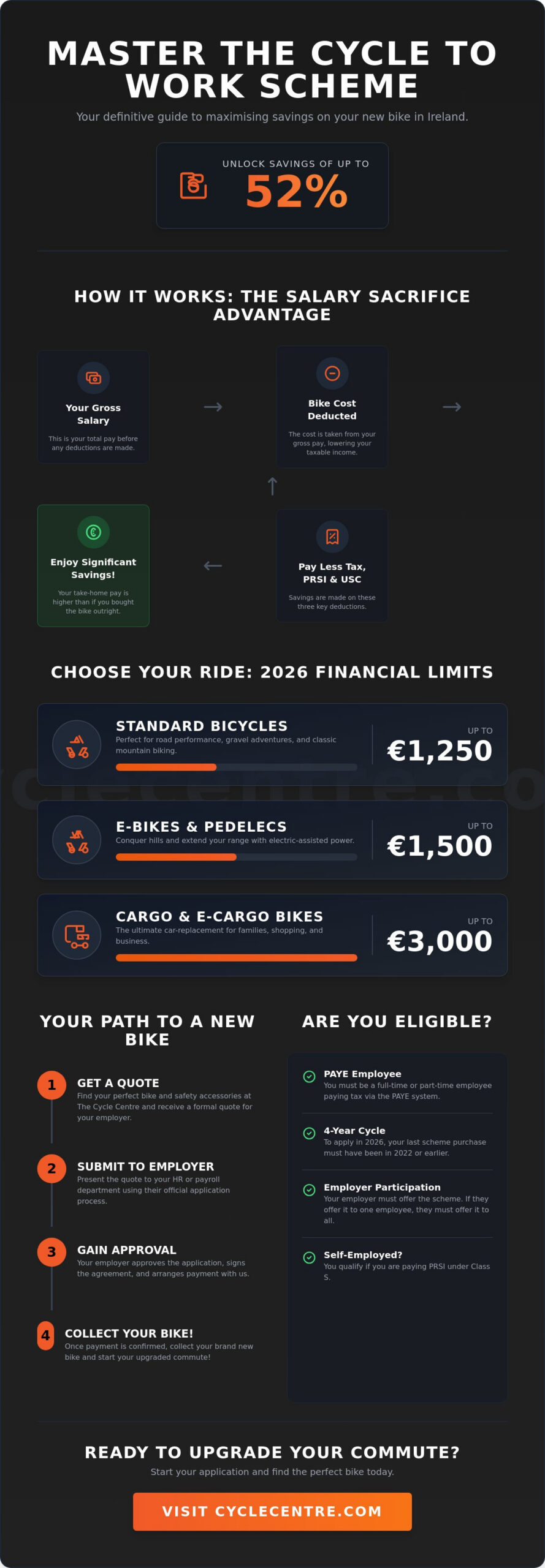
The Cycle to Work scheme is a government-backed initiative designed to make high-quality cycling equipment more affordable for everyone. At its core, the scheme functions as a salary sacrifice arrangement. This means your employer purchases the bicycle and safety gear on your behalf, and you repay the cost through regular deductions from your gross salary over an agreed period, usually 12 months. Because these deductions occur before income tax, PRSI, and USC are applied, the “real” cost to you is significantly lower than the retail price. When you initiate a cycle to work scheme application, you aren’t just buying a bike; you’re choosing a more tax-efficient way to fund your commute.
One of the most compelling reasons to apply is the potential for massive savings. Depending on your specific tax bracket, you can save up to 52% on the total cost of your gear. Your employer plays a vital role in this journey. They facilitate the payments and handle the payroll adjustments, ensuring the process remains compliant with Revenue rules. It’s also vital to remember the “once every four years” rule. In 2026, you’re eligible to apply if your last scheme purchase was in 2022 or earlier. This four-year window applies regardless of whether you’ve changed jobs during that time, so keeping track of your previous application dates is essential for a smooth approval.
The Financial Logic: Tax, PRSI, and USC
The magic of the scheme lies in how it interacts with your payslip. By deducting the bike cost from your gross salary, you effectively lower your taxable income. This results in direct savings on your income tax (at either 20% or 40%), your Pay Related Social Insurance (PRSI), and the Universal Social Charge (USC). For many Irish employees, this triple-tax saving makes premium e-bikes or road performance bicycles far more accessible. If you want to see exactly how these percentages translate into monthly take-home pay, our guide on the Cycle to Work Scheme: How It Works provides deeper financial examples and breakdown tables.
Who is Eligible to Apply?
The scheme is remarkably inclusive, covering both full-time and part-time employees in Ireland. As long as you’re paying tax through the PAYE system, you’re generally eligible to submit a cycle to work scheme application. For self-employed individuals, the rules are slightly different; you must be paying PRSI under Class S to qualify for the benefits. A key rule for businesses is that if an employer offers the scheme to one member of staff, they must make it available to all employees. This ensures fairness across the workforce, allowing everyone from the office floor to the executive suite to enjoy the benefits of a healthier commute.
Financial Limits and Eligibility for Your 2026 Application
Understanding the financial boundaries of your cycle to work scheme application is the first step toward a successful commute upgrade. Revenue has established clear spending tiers to reflect the varying costs of modern cycling technology. These limits aren’t just arbitrary numbers; they define the maximum amount you can sacrifice from your gross salary to achieve those significant tax savings. If you choose a bike that costs more than your specific tier, you can still proceed by paying the balance directly to the retailer. Only the portion within the threshold qualifies for tax relief, but this allows you to access premium models whilst still benefiting from the scheme’s core advantages.
The 2026 regulations continue to support the shift toward sustainable transport by offering higher limits for specialised frames. Whilst the UK Government Cycle to Work Scheme Rules provide a useful benchmark for how salary sacrifice logic functions across borders, the Irish thresholds are specifically designed to make e-mobility more affordable. For a comprehensive breakdown of how these Irish-specific regulations apply to your commute, the ride to work scheme Ireland 2026 explainer covers every spending tier in detail. By matching your bike choice to the correct category, you ensure your application is processed without friction or unexpected tax liabilities.
The 2026 Thresholds: A Comparison
The current limits are divided into three distinct categories based on the type of bicycle you intend to use for your commute. Standard bicycles, which include road performance bicycles, gravel bikes, and traditional mountain bikes, carry a limit of €1,250. For those looking for an extra boost, e-bikes and pedelecs have a higher threshold of €1,500. The most significant allowance is reserved for cargo and e-cargo bikes, which now enjoy a €3,000 limit. This higher cap is a genuine game-changer for families, making it financially viable to replace a second car with a heavy-load frame capable of handling the school run and weekly groceries.
Eligible Safety Equipment and Accessories
Your cycle to work scheme application should always include the essential gear needed for a safe and practical journey. Revenue-approved items include helmets, lights, bells, mirrors, and mudguards. You can also include functional luggage solutions like panniers or racks. We strongly suggest prioritising high-quality locks and chains in your initial application to protect your new investment from the outset. However, be aware that certain items are strictly excluded from the scheme. You cannot use the tax-free allowance for child seats, trailers, GPS cycle computers, or action cameras. Focusing your budget on approved safety gear ensures your application meets all compliance checks immediately. You can browse our full range of cycling helmets and apparel to find the perfect additions to your 2026 package.
Choosing Between E-Bikes, Road Performance, and Cargo Models
Selecting the right machine for your cycle to work scheme application is a decision that impacts your daily comfort and long-term satisfaction. Ireland’s infrastructure is evolving, but commuters still face a varied mix of smooth urban lanes and weathered secondary roads. To ensure your investment stands the test of time, we recommend focusing on premium brands like Giant and Cube. These manufacturers offer superior frame geometry and component reliability, which is vital when you consider that the scheme usually limits you to one application every four years. A high-quality frame doesn’t just ride better; it requires less frequent maintenance and holds its value far longer than entry-level alternatives. For a curated selection of top-rated models across every category, our guide to the best bike for cycle to work scheme savings in 2026 breaks down the leading options by commute type and budget.
Matching your bike to your specific route is the secret to a sustainable cycling habit. If your journey involves canal paths or light forest trails to bypass city congestion, the rise of the E-MTB has provided a rugged, versatile solution. These bikes offer the stability of a mountain bike with the efficiency of electric assistance, making them perfect for mixed-terrain commuting. Regardless of the style you choose, ensuring the bike fits your physical dimensions and lifestyle needs is the most critical part of the selection phase.
Electric Bikes: The Commuter Advantage
Electric bikes have transformed the morning journey by significantly reducing the “sweat factor.” Using pedelec technology, these bikes provide motor assistance only when you pedal, making steep hills feel flat and heavy headwinds negligible. This allows you to arrive at the office feeling fresh and ready for the day rather than exhausted. If you’re curious about specific motor outputs or battery ranges, our detailed guide on Getting an Electric Bike on the Cycle to Work Scheme offers a deep dive into the technical specs. Most high-quality E-city models fit comfortably within the €1,500 threshold, providing a premium experience whilst staying within the tax-free limit.
Performance Road and Gravel Options
For those with longer commutes on tarmac, road performance bicycles remain the gold standard for speed and efficiency. However, gravel bikes are rapidly becoming the favourite amongst Irish road riders. Their wider tyres and robust frames are the “do-it-all” solution for navigating potholes and debris-strewn backroads whilst maintaining an impressive pace. Gravel bikes offer a more relaxed geometry than traditional road bikes, making them ideal for those who value comfort during a forty-minute ride. When finalising your cycle to work scheme application, remember to include technical apparel. High-performance waterproofs and breathable layers are essential for staying dry and comfortable during the unpredictable Irish winter.
Step-by-Step: How to Complete Your Cycle to Work Application
Completing a cycle to work scheme application is a methodical process that requires a small amount of preparation to ensure a frictionless experience. Before you begin browsing our showroom or online store, verify your employer’s participation in the scheme. Some companies use specific third-party providers with unique internal codes, whilst others handle the process directly through their own finance departments. Knowing these details upfront prevents administrative delays later. Once you have confirmed your eligibility and the specific provider your company uses, you can move from the aspirational phase of choosing a bike into the functional phase of securing your new ride.
Step 1: Secure Your Professional Quote
The foundation of every successful application is an accurate, itemised professional quote. You must select your bicycle and all intended accessories first, as your employer requires a final, exact figure for the salary sacrifice agreement. This quote needs to be precise, including the correct VAT rates and a clear breakdown of safety gear like locks and helmets. Many commuters find that using an online “no-obligation” quote tool helps speed up this stage, providing a clear document that HR departments can approve without back-and-forth queries. To get started, you can request a professional quote online to establish your exact savings today.
Step 2: Employer Approval and Payment
Once you have your quote, submit it to your HR or Finance department for internal review. Your employer then pays the bike shop directly. This is a significant benefit, as it means there is no out-of-pocket cost for you at the point of purchase. During this phase, you will sign a salary sacrifice contract. This legal document outlines how the cost is deducted from your gross pay, usually over a 12-month period. It is a straightforward agreement that formalises your tax savings whilst ensuring the repayments are manageable and transparent on your monthly payslip.
Step 3: Redemptions and Collection
After your employer completes the payment, you will receive a “Letter of Collection” or a digital voucher. This is your golden ticket. Bring this document to our shop to redeem your equipment. Before any bike leaves our floor, it undergoes a rigorous check in our Shimano accredited workshop. This final inspection ensures that every component, from the gears to the braking system, is tuned for safety and performance. We also recommend organising your first service at this stage. A quick check-up after your first six weeks of commuting ensures your new investment remains reliable and efficient for the thousands of kilometres ahead.
Start Your Application with The Cycle Centre
Choosing where to submit your cycle to work scheme application is just as important as the bicycle itself. At The Cycle Centre, we bring over 50 years of independent cycling expertise to every consultation, ensuring you don’t just get a bike, but the right bike for your lifestyle. We understand that the sheer volume of technical specifications can be overwhelming for newcomers. To simplify this, we offer our “Smart-bike Search” tool, designed to narrow down your options based on your specific commute length and terrain. Whether you are looking for the precision of a Giant road machine or the robust reliability of a Cube e-bike, our team is here to guide you through the selection process with seasoned authority.
Our commitment to your cycling journey extends far beyond the initial paperwork. As a trusted local expert, we operate a Shimano accredited workshop that provides the technical backbone for every ride we sell. By starting your cycle to work scheme application with us, you gain access to world-class brands like Giant, Cube, and Romet, whilst benefiting from a support system that values long-term quality over quick sales. We pride ourselves on being a constant, reliable presence in the Irish cycling community, helping you move from a state of uncertainty to one of informed confidence.
No-Obligation Quotes and Expert Support
We have refined our online application system to make securing a professional quote as frictionless as possible. You can browse our collection and generate a document that meets all Revenue requirements in just a few clicks. For those interested in electric models, our specialists provide tailored advice on the leading motor systems, including Bosch, Shimano, and Yamaha. We also maintain strong relationships with major third-party providers such as “Ride to Work” and “Bike to Work,” ensuring that your employer’s preferred system is fully supported. This proactive approach reduces administrative delays, getting you onto the road faster and with less stress.
Why Choose an Independent Specialist?
Opting for an independent specialist means you are building a relationship with a business that understands the local landscape. For those investing in high-end road performance or complex e-cargo frames, we highly recommend our Workshop Gold Service package. This comprehensive maintenance plan ensures your new investment remains in peak condition, regardless of the Irish weather. Our goal is to facilitate a seamless experience from your first enquiry to your thousandth kilometre. For a final check before you begin, consult our Ultimate Guide to the Bike to Work Scheme Ireland 2026 to ensure you have everything you need for a successful application.
Take the First Step Toward a Better Commute
Mastering the 2026 thresholds and navigating the salary sacrifice process ensures you don’t just save money; you invest in a lifestyle change that pays dividends every morning. By matching your specific route to the correct spending tier and securing a professional quote, you eliminate the friction that often stalls a cycle to work scheme application. Whether you’re eyeing a high-performance road machine or a versatile e-cargo bike, the right preparation allows you to maximise your tax relief whilst securing gear that stands the test of time.
At The Cycle Centre, we have been guiding Irish riders since 1974. As official stockists of Giant and Cube, we combine premium hardware with the technical precision of our Shimano Accredited Workshop. We are here to ensure your new bike is perfectly tuned and ready for the road from day one. Don’t let the paperwork hold you back from the freedom of the open road and the significant savings available to you.
Apply for your no-obligation Cycle to Work quote today and start your journey with a team that values quality and community above all else. We look forward to seeing you in the saddle.
Frequently Asked Questions
How do I start my cycle to work scheme application?
You start by confirming that your employer is registered for the scheme and identifying which provider they use. Once confirmed, visit a specialist retailer to select your bicycle and safety equipment to obtain a professional, itemised quote. Submit this document to your HR or Finance department for approval. They will then arrange the payment and provide you with a redemption voucher or letter of collection to secure your gear.
Can I apply for the cycle to work scheme if I am self-employed?
Yes, self-employed individuals can benefit if they are paying PRSI under Class S. In this scenario, you essentially act as both the employer and the employee for the purpose of the salary sacrifice. It’s a highly efficient way to reduce your tax liability whilst upgrading your transport. We recommend speaking with your accountant to ensure the internal bookkeeping correctly reflects the purchase as a business expense for tax relief.
What is the maximum limit for a cycle to work scheme application in 2026?
The 2026 thresholds are tiered based on the type of bicycle you choose for your cycle to work scheme application. Standard bicycles have a limit of €1,250, whilst e-bikes and pedelecs are capped at €1,500. If you are opting for a cargo or e-cargo bike, the limit increases significantly to €3,000. These limits include the cost of the bike and all eligible safety accessories like helmets and locks.
Can I get an electric bike through the cycle to work scheme?
You can certainly obtain an electric bike through the scheme, provided it meets the pedelec definition of having motor assistance that cuts out at 25km/h. E-bikes have a dedicated spending limit of €1,500, which is specifically designed to help commuters tackle longer distances and hilly terrain without arriving at work exhausted. This makes premium e-city bikes and e-MTB models much more accessible for the average Irish employee.
How often can I make a new cycle to work scheme application?
You are eligible to make a new cycle to work scheme application once every four years. This four-year period is calculated from the date of your last purchase, regardless of whether you’ve changed employers in the interim. This rule ensures the scheme remains focused on long-term commuting habits. If you last used the scheme in 2022, you are now eligible to refresh your gear and bike for the 2026 season.
Does the cycle to work scheme application cover second-hand bikes?
The scheme doesn’t cover second-hand or used bicycles. To qualify for the tax benefits, the equipment must be purchased as new from an approved retailer. This requirement ensures that all bikes meet current safety standards and are backed by a manufacturer’s warranty. This is particularly important for e-bikes, where battery health and motor reliability are essential for a consistent and safe daily commute.
What happens to my application if I leave my job before the bike is paid off?
If you leave your employment before the salary sacrifice period ends, the remaining balance is typically deducted from your final net salary. It’s important to understand that you’ll lose the tax benefit on this final lump-sum payment. The bike then becomes your property. Most HR departments will outline this process in the initial salary sacrifice agreement you sign during the application phase to ensure total transparency.
Can I buy just accessories without a bike on the scheme?
You can apply for safety accessories alone without purchasing a bicycle. This is a practical option if your current bike is in good condition but you need to refresh your helmet, lights, or locks. The same four-year rule and monetary limits apply to these applications. It allows you to maintain your safety and visibility on the road whilst still benefiting from the tax savings offered by the ride to work scheme Ireland government initiative.