


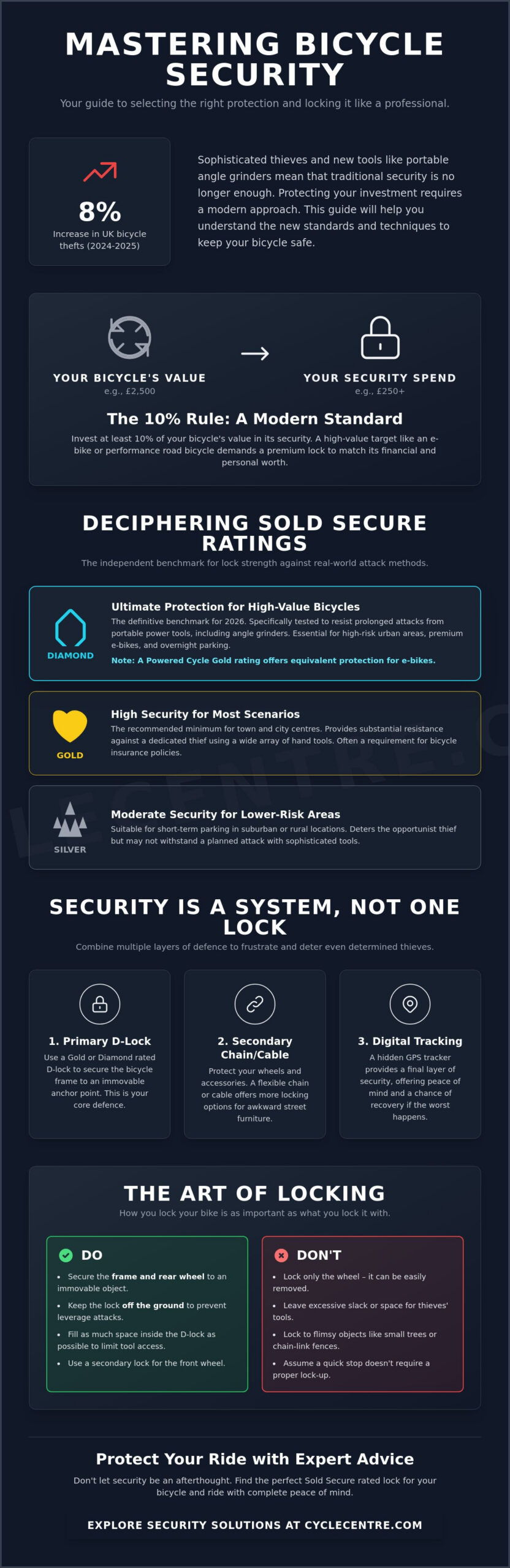
Did you know that bicycle thefts in the UK increased by 8% between 2024 and 2025? It’s a sobering statistic that highlights why choosing the right bicycle lock is more critical than ever for protecting your freedom on two wheels. We understand that returning to an empty bike rack is a cyclist’s worst nightmare, especially when you’ve invested in a high-quality machine for your daily commute or weekend adventures.
You’re likely looking for a way to secure your bike without carrying around a heavy, cumbersome weight that ruins your ride. We agree that the technical jargon surrounding security ratings can feel overwhelming. This guide promises to clear the confusion, helping you master the art of bicycle security so you can park with total confidence. We’ll explore the latest Sold Secure standards, discuss why specialised angle-grinder resistance is the new benchmark for 2026, and provide a clear framework for balancing protection with portability. By the end, you’ll know exactly how to apply the “10% rule” to safeguard your investment whilst maintaining your peace of mind.
Key Takeaways
- Learn why allocating at least 10% of your bicycle’s value towards security is the essential modern standard for protecting your investment.
- Understand the Sold Secure rating system to ensure you select a level of protection that matches your specific riding habits and parking locations.
- Identify whether a U-lock or a chain bicycle lock provides the best balance of portability and strength for your daily commute or weekend adventures.
- Master professional locking techniques that keep your equipment off the ground to neutralise common theft methods like leverage or impact attacks.
- Benefit from nearly fifty years of local expertise to find a security solution that offers true peace of mind without weighing you down.
Understanding the Reality of Bicycle Security in 2026
The landscape of bicycle theft has shifted dramatically over the last few years. Whilst older security methods relied on simple physical presence, 2026 brings more sophisticated challenges. Thieves now frequently use portable angle grinders that can slice through traditional cable locks in seconds. These flimsy cables are no longer sufficient; they’re merely a minor inconvenience rather than a true barrier. To understand the various mechanical options available, this Bicycle lock overview highlights how different designs have evolved to meet these modern threats.
A thief’s psychology is driven by time and noise. They want a quick, quiet exit. A high-quality bicycle lock forces them to spend more time on the street and create a significant racket, which increases their risk of being caught. By making your bike the most difficult one on the rack to steal, you’re effectively encouraging them to move on. We often advise our community to follow the “10% Rule.” It’s a simple but effective calculation: spend at least a tenth of your bike’s value on your security hardware. If you’ve invested in a premium e-MTB or a performance road bicycle, your bicycle lock should reflect that financial commitment. E-bikes are particularly high-value targets, and their rising resale price makes them attractive to organised criminals.
The Cost of Inadequate Protection
Choosing a cheap lock is a false economy. Beyond the immediate price of a replacement bike, you have to consider the loss of mobility and the frustration of dealing with insurance claims. Most specialised insurance policies are very specific about security requirements. Using a lock that doesn’t meet their mandated Sold Secure rating can completely void your cover. The emotional impact is also significant. Losing a favourite gravel or adventure bike that you’ve customised to your exact specifications is a heartbreak no cyclist wants to endure. It’s about protecting your freedom, not just your frame.
Bicycle Security as a System
Effective security isn’t just about one heavy piece of metal. It’s a layered system designed to frustrate even the most determined thief. We recommend a combination of tools to create a comprehensive defence:
- Primary D-Lock: Use this to secure the frame directly to a solid, immovable anchor point.
- Secondary Chain: This protects the wheels and offers flexibility amongst different types of street furniture or oversized racks.
- Digital Tracking: GPS units hidden within the frame provide peace of mind whilst your bike is out of sight.
Don’t forget that your hardware needs regular care. Grit and road salt can seize up even the best mechanisms over time. Regular visits to a Shimano accredited workshop ensure that your locking points and components remain in peak condition. This professional maintenance keeps your security system functional and reliable, ensuring you aren’t left struggling with a jammed key on a rainy evening.
Deciphering Sold Secure Ratings and Lock Technologies
Choosing a bicycle lock based on its appearance or price alone is a risky strategy. Instead, look for the Sold Secure seal of approval. This independent organisation subjects security products to rigorous, real-world attack tests to see how they hold up against professional tools. Their rating system is the most reliable way to judge the strength of your equipment before you commit to a purchase.
Bronze and Silver ratings are generally suitable for lower-risk environments, such as a locked shed or a quick stop at a rural cafe. However, if you’re parking in a town centre, you should look for Gold as your minimum requirement. By June 2026, the Diamond rating has become the definitive benchmark for high-value equipment. This tier specifically tests against more aggressive methods, including the use of portable power tools. For those riding e-bikes, the “Powered Cycle” designation is equally vital. A Powered Cycle Gold rating offers protection equivalent to a standard Pedal Cycle Diamond lock, ensuring your motor and battery remain secure. This illustrated guide to bicycle security provides a clear visual on how these ratings translate to physical security on the street.
The Rise of Angle Grinder Resistant Locks
Portable angle grinders have changed the game for thieves, allowing them to bypass traditional hardened steel in seconds. To counter this, 2026 has seen the widespread adoption of locks reinforced with graphene and ceramic compounds. These materials are incredibly hard; they’re designed to wear down multiple grinder discs before the shackle even begins to fail. Whilst these Diamond-rated locks are heavier, they’re the preferred choice for expensive E-MTBs and performance road machines. The slight increase in weight is a small price to pay for the security of your high-performance bicycle.
Keyed vs. Combination Locks
We always recommend keyed cylinders over combination dials for high-level security. Combination locks are often susceptible to “shimming” or simple trial-and-error by patient thieves. Modern disc-detainer cores, found in premium locks from brands like Giant and Cube, are much harder to pick or drill. These manufacturers also offer key replacement programmes, allowing you to order a new set using your unique code if you lose your originals. If you’re unsure which setup fits your daily commute, our team can help you select the right components or provide expert maintenance via our Workshop Gold Service to ensure your ride is in top condition.
Choosing the Right Bicycle Lock for Your Riding Style
Selecting a bicycle lock isn’t a one-size-fits-all decision. Your choice depends on where you park, what you ride, and how much weight you’re willing to carry. Whilst we previously discussed the importance of Sold Secure ratings, the physical form factor of your lock determines how easily you can secure your bike to various street fixtures. Not all environments are equal, and neither are the tools thieves use to navigate them.
U-locks, often called D-locks, remain the most popular choice for urban cyclists. They offer an excellent balance of high-level security and manageable weight. If you’re looking for specific model recommendations, Wirecutter’s best bike locks provides a detailed breakdown of the most resilient options currently on the market. For those who need more flexibility, chain locks are the answer. Their pliable nature allows you to loop them around oversized street furniture or secure multiple bikes together, though they are significantly heavier than their U-lock counterparts.
Folding locks provide a sleek, compact alternative for riders who prioritise aesthetics and want a lock that mounts discretely to the frame. However, don’t overlook home security. With 59% of bicycle thefts occurring in residential areas like garages and sheds, installing a ground anchor and a heavy-duty chain is a wise investment for your permanent storage setup. It creates a formidable physical barrier in the place where your bike spends the most time.
Security for Electric Bikes and E-Scooters
Electric bikes represent a significant financial investment, often making them primary targets for organised theft due to their high resale value. Because of this, we strongly advise using Diamond-rated locks that can withstand prolonged attacks from power tools. When you purchase a new electric bike, you must also consider the security of integrated components. Thieves aren’t just after the frame; they’re often interested in mid-drive motors and removable batteries. Ensure your locking strategy encompasses these high-value parts, perhaps by using a secondary cable or a lock specifically designed for e-bike frames.
The Commuter’s Dilemma: Weight vs. Protection
Carrying a three-kilogramme chain every day can be a chore. Many of our regular commuters solve this by using the “Stationary Security” strategy. This involves leaving a heavy, high-security chain permanently locked to the rack at your workplace, meaning you only need to carry a lighter U-lock for short stops along the way. If you must transport your lock, consider using dedicated frame mounts or pannier bags to keep the weight off your back. For those smaller items like saddles or helmets, a lightweight secondary bicycle lock can act as a quick deterrent whilst you pop into a shop.
The Art of Locking: Techniques to Prevent Theft
Even the most sophisticated hardware fails if you don’t apply the correct technique. A premium bicycle lock is only one half of the security equation; the other half is your behaviour on the street. We’ve seen countless riders invest in top-tier protection only to make simple errors that invite opportunistic theft. Mastering the art of locking is about making your bike a “hard target” that requires too much effort, noise, and time to bother with.
The “Golden Rule” is simple: always secure your frame to an immovable, solid object. Avoid street furniture that can be easily dismantled or cut through, such as thin signposts or wooden fences. When positioning your lock, keep it as far from the ground as possible. If a lock rests on the pavement, a thief can use the ground as an anvil to smash the shackle with a hammer or brace a pair of heavy-duty bolt croppers against it. Additionally, if you’re using a U-lock, try to fill as much of the internal space as possible. A “full” lock leaves no room for a thief to insert a hydraulic jack or leverage tools. If you’re unsure if your current setup is up to the task, our team at our Shimano accredited workshop can help you evaluate your security hardware whilst performing a safety check.
Five Steps to a Perfectly Locked Bike
Consistency is your best defence. Follow these five steps every time you park:
- Step 1: Choose a well-lit, high-traffic location. Thieves hate witnesses, so parking under CCTV or near a busy shop entrance provides a natural deterrent.
- Step 2: Capture the rear wheel and the frame. Use your primary bicycle lock to secure the rear wheel (inside the rear triangle) and the seat tube to the anchor point.
- Step 3: Secure the front wheel. Use a secondary cable or a smaller D-lock to ensure your front wheel doesn’t go missing.
- Step 4: Clear the decks. Remove all lights, computers, and bags. These are easy wins for petty thieves and can be expensive to replace.
- Step 5: The final tug. Always check that the lock is actually engaged and the anchor point is secure before you walk away.
Common Mistakes That Lead to Theft
The most frequent error we see is the “abandoned wheel” syndrome. This happens when a rider locks only the front wheel to a rack. A thief can simply operate the quick-release lever and walk away with the rest of the bike in seconds. Another common mistake is leaving the lock cylinder facing upwards. This allows rain, grit, and winter salt to collect inside the mechanism, which can lead to corrosion and a jammed key. Always point the keyhole downwards to protect the internal pins from the elements.
Investing in Quality Security with The Cycle Centre
Choosing the right protection for your ride is a serious decision that shouldn’t be left to guesswork. Since 1974, our team has been a constant presence in the Irish cycling community, witnessing every major evolution in security technology. We’ve seen theft methods grow more sophisticated, and we’ve curated our range of premium locks from brands like Giant, Cube, and Kryptonite to meet those modern threats head-on. Relying on an independent bike shop in Ireland ensures you aren’t just buying a piece of hardware; you’re gaining access to decades of practical expertise and the latest innovations in angle-grinder resistance.
One of the most effective ways to secure a high-quality bicycle lock is by including it in your tax-free Bike to Work scheme quote. Many cyclists don’t realise that security accessories are fully eligible under the scheme’s regulations. By bundling a Diamond-rated lock with your new performance road bike or e-city bike, you can save up to 52% on the total cost through salary sacrifice. It’s a sensible way to ensure your investment is protected from day one without a significant upfront expense. We can help you organise the paperwork to ensure your security gear is included in your official application.
The Benefit of Professional Consultation
Every bike frame is unique, and what works for a mountain bike might not fit the tight clearances of a Giant road performance bicycle. Our in-store experts provide personalised consultations to match your bicycle lock to your specific model’s geometry. We believe in a “hands-on” approach; we’ll demonstrate how to use folding locks effectively and show you the best positions for frame mounts. This ensures your security gear is always accessible and doesn’t rattle or interfere with your cables whilst you’re out on the road.
Taking the Next Step Toward Total Security
Don’t wait for a theft to occur before you upgrade your setup. We’re here to help you build a comprehensive security system that fits your budget and your lifestyle. Whether you’re a daily commuter or a weekend trail enthusiast, we can provide a no-obligation quote for a bike and security bundle tailored to your needs. This proactive approach turns a potential frustration into a state of informed confidence. View our range of high-security bicycle locks or request a quote today to ensure your ride stays exactly where you left it.
Securing Your Cycling Future
Protecting your machine in 2026 requires a blend of high-tech hardware and disciplined habits. By choosing a security setup that matches your parking environment and adhering to the “10% rule” for investment, you significantly reduce the risk of theft. Remember that even the strongest shackle depends on your locking technique; keep your gear off the ground and always prioritise the frame to neutralise leverage attacks.
We’ve been a family-owned institution since 1974, and we understand the peace of mind that comes with reliable protection. As a Shimano Accredited Workshop and a leading stockist of Giant and Cube, we provide the expert guidance needed to safeguard your performance road or electric mountain bike. Secure your ride with a premium bicycle lock from The Cycle Centre today. We’re ready to help you explore with total confidence.
Frequently Asked Questions
What is the most secure type of bicycle lock for a high-value E-bike?
A Sold Secure Diamond-rated, angle-grinder resistant D-lock is currently the most secure option for e-bikes. These locks utilise advanced materials like graphene or ceramic composites to destroy cutting discs upon contact. Because e-bikes are high-value targets, pairing this with a secondary Diamond-rated chain provides the necessary layered defence to deter professional thieves in high-risk urban areas.
Can I include a bicycle lock in my Cycle to Work scheme application?
Yes, you can absolutely include a high-quality bicycle lock as part of your tax-free application. Safety and security equipment are essential components of the scheme’s allowed items. This allows you to spread the cost of premium protection through salary sacrifice, making top-tier security much more affordable whilst ensuring your new ride is protected from the moment you collect it.
Is a Sold Secure Gold lock enough to satisfy my insurance company?
It depends entirely on the total replacement value of your bike and the specific terms of your policy. Whilst Gold was once the standard, many insurers now mandate Diamond-rated protection for bikes valued over a certain threshold. Always verify the specific rating required by your provider before purchasing a bicycle lock to ensure your theft cover remains valid and fully enforceable.
How do I maintain my bike lock to prevent the cylinder from jamming?
Regular lubrication with a dedicated lock spray or a dry Teflon-based lubricant is the best way to prevent seizing. Avoid using thick oils or WD-40, as these can attract grit and road salt that eventually gunk up the internal pins. A quick blast of compressed air can also help clear out debris that accumulates if you park your bike outdoors frequently.
What should I do if I lose the keys to my bicycle lock?
If you’ve registered your key code with the manufacturer, you can usually order a replacement set directly through their website or an authorised dealer. Brands like Kryptonite, Giant, and Cube offer these registration programmes for this exact reason. If you didn’t register the code and lose all copies, a professional locksmith or a specialist with an angle grinder may be required to remove the lock.
Are combination locks as secure as keyed locks for city parking?
Generally, keyed locks are more secure because they are less vulnerable to manipulation techniques like shimming or decoding. Combination locks are convenient for low-risk areas or shared family bikes, but they often lack the complex internal security found in high-end disc-detainer cylinders. For city parking where theft risk is higher, we always recommend a keyed D-lock for superior physical protection.
How do angle grinder resistant locks work and are they worth the extra cost?
These locks incorporate specialised materials that are harder than the abrasive discs used in portable power tools. Instead of being cut, the lock shackle actually wears down the thief’s cutting disc, forcing them to use multiple batteries and discs to succeed. For anyone owning a high-value e-bike or performance road machine, the extra cost is a small price for such a formidable deterrent.
Can thieves cut through Sold Secure Diamond rated chains?
Whilst no bicycle lock is 100% theft-proof given enough time and the right tools, Diamond-rated chains are designed to withstand significant attacks. They require heavy-duty hydraulic cutters or multiple angle grinder discs to defeat. The goal is to make the theft so loud and time-consuming that a thief chooses an easier target instead. Using a chain in combination with a D-lock creates the ultimate time-based barrier.