


Did you know that in 2025, Dubliners alone clocked up over 92 million bicycle trips? As cycling continues to surge across the country, more of us are braving the elements, which means our components are working harder than ever against the Irish rain and road grit. You likely know the frustration of a grinding chain or the subtle anxiety that your brakes mightn’t perform perfectly on a slick descent. This comprehensive bike servicing checklist Ireland cyclists need in 2026 will help you master the essential maintenance steps to keep your bicycle safe, smooth, and resilient.
Key Takeaways
- Master the systematic M-Check framework to perform a professional-grade safety inspection of your frame, wheels, and components in under five minutes.
- Protect your drivetrain from the “Irish Winter Tax” by following a bike servicing checklist Ireland focused that addresses the corrosive effects of road salt and grit.
- Understand the specialised maintenance needs of mid-drive e-bike motors and electronic groupsets to ensure your high-performance bicycle remains efficient and reliable.
- Learn to distinguish between routine home maintenance and technical tasks that require the diagnostic software and precision tools of a Shimano Accredited Workshop.
- Implement a seasonal maintenance calendar to help your bicycle transition smoothly from the harsh conditions of winter to the dust and heat of summer riding.
The 5-Minute Safety Check: The Professional M-Check Framework
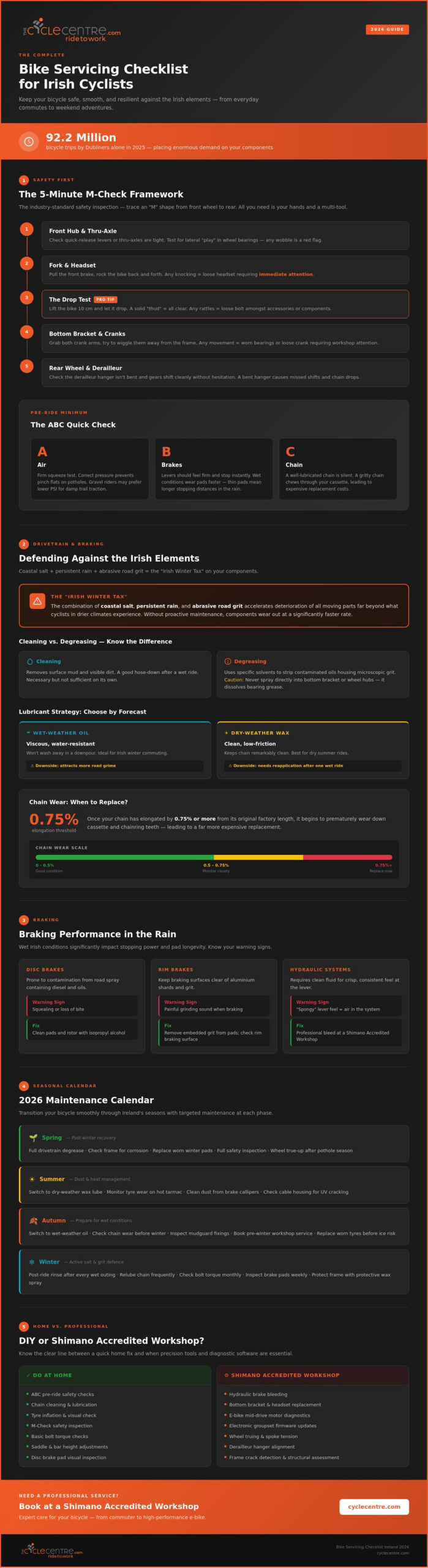
Safety starts before your wheels touch the tarmac. Whether you’re a daily commuter or a weekend enthusiast, a systematic approach ensures you aren’t caught out by a preventable mechanical failure. The M-Check is the industry standard for a reason; it’s a logical, front-to-back path that covers every critical safety point on your frame. Incorporating this into your bike servicing checklist Ireland routine saves time and prevents the “Irish winter tax” of premature component wear. You don’t need a full workshop of tools for this. Your eyes, hands, and a simple multi-tool are usually enough to spot a red flag before it becomes a roadside emergency.
Step-by-Step: Following the M-Path
Start at the front hub. Check that your quick-release levers or thru-axles are tight and that there’s no lateral “play” in the wheel bearings. Move up the fork to the headset. Pull the front brake and rock the bike back and forth; any knocking indicates a loose headset that needs immediate attention. The “drop test” is a classic mechanic’s trick: lift the bike ten centimetres and let it drop. A solid “thud” is perfect, but any rattles suggest a loose bolt amongst your accessories or components. Sweep down to the bottom bracket and grab both crank arms, trying to wiggle them towards and away from the frame. Any movement here indicates your bearings are worn or the crank is loose. Finish at the rear wheel to ensure the derailleur hanger isn’t bent and the gears shift cleanly without hesitation.
The Pre-Ride “ABC” Quick Check
If you’re short on time, the ABC check is your minimum viable safety net. It’s particularly vital given that cyclists in Dublin alone made 92.2 million trips in 2025, placing significant demand on both riders and infrastructure. High-traffic routes and variable weather mean your equipment must be reliable.
- Air: Give your tyres a firm squeeze. For Irish tarmac, you want enough pressure to prevent pinch flats on potholes, whilst gravel riders might prefer a lower PSI for better traction on damp trails. Maintaining correct pressure prevents the rim damage that often follows a flat tyre.
- Brakes: Pull your levers. They should feel firm and stop the bike instantly. In our wet climate, brake pads wear down faster. If your pads are thin, you’ll feel it immediately when the clouds open and stopping distances increase.
- Chain: A quick glance will tell you if your chain is dry or rusted. A well-lubricated chain is silent and efficient, whereas a gritty one will chew through your cassette, leading to an expensive replacement.
Drivetrain and Braking: Defending Against the Irish Elements
The Irish climate presents a unique set of challenges that can quickly turn a pristine bicycle into a grinding, inefficient machine. We often refer to this as the “Irish Winter Tax,” a reality where the combination of coastal salt, persistent rain, and abrasive road grit accelerates the deterioration of your moving parts. To combat this, your bike servicing checklist Ireland should prioritise a deep understanding of your drivetrain and braking systems. Whilst many riders believe a simple hosing down is enough, the distinction between cleaning and degreasing is vital. Cleaning removes surface mud, but degreasing involves using specific solvents to strip away contaminated oils that house microscopic grit. Be careful not to spray degreaser directly into your bottom bracket or wheel hubs, as this can dissolve the internal grease protecting your bearings.
Choosing the right lubricant is a strategic decision based on the weather forecast. Wet-weather oils are viscous and won’t wash away in a downpour, yet they attract more road grime. Dry-weather waxes keep your chain remarkably clean, but they often require reapplication after a single wet ride on Irish country lanes. Drivetrain wear is officially defined as the point when a chain has elongated by 0.75% or more compared to its original factory length, at which point it begins to prematurely wear down the cassette and chainring teeth.
Braking Performance in the Rain
Wet conditions significantly impact stopping power and pad longevity. Disc brake pads are prone to contamination from road spray containing diesel and oils; if your brakes squeal or lose bite, they likely need cleaning with isopropyl alcohol. For those with rim brakes, keeping the braking surface of the wheel clear of aluminium shards and grit is essential to stop that painful grinding sound. If your levers feel “spongy” rather than crisp, it’s a sign that air has entered the system. For a consistent, safe feel, you should consider booking a Workshop Silver Service to ensure your hydraulic lines are professionally bled and inspected.
Chain and Cassette Longevity
A simple chain checker tool is perhaps the best investment any cyclist can make. By replacing a chain before it reaches that 0.75% stretch mark, you can often get three or four chains out of a single cassette, saving you significant costs over the life of the bike. Look out for “shark-finned” teeth on your chainrings, where the metal has worn into a sharp, curved profile. This is a clear indicator that your drivetrain is past its prime. For daily commuters, a “clean-wipe-lube” routine every few days is the most effective way to keep the elements at bay.
Specialist Servicing for E-Bikes and Performance Road Bikes
Electric bikes have transformed the way we navigate Irish cities and hills, but that extra power comes with increased mechanical responsibility. Because a legal e-bike in Ireland provides up to 250 watts of continuous assistance, the torque applied to your chain and cassette is significantly higher than on a traditional bicycle. This extra force, combined with the typical 20-25kg weight of an e-city bike, means components wear out faster. Your bike servicing checklist Ireland must adapt to these stresses. Mid-drive systems from Bosch, Shimano, and Yamaha are robust, yet they require specific attention to ensure the seals remain intact against our horizontal rain. Integrating electric bike maintenance Ireland into your monthly routine will help you catch motor play or battery degradation before they lead to a costly failure.
Battery health is another critical factor in our temperate, damp climate. Extreme cold can temporarily reduce your range, whilst persistent moisture can lead to terminal corrosion on the contact pins. We recommend removing the battery and wiping the terminals with a dry cloth after particularly wet commutes. It’s a simple step that preserves the electrical integrity of your system. Always store your battery at room temperature when it’s not in use; leaving it in a freezing shed over a long Irish winter is a sure way to shorten its lifespan.
E-Bike Electrical System Checklist
Modern e-bikes are as much about software as they are about hardware. Digital updates are now a standard part of a professional service, often improving battery efficiency or motor engagement patterns. When performing your own checks, focus on these three areas:
- Motor Mounts: Use a torque wrench to ensure motor bolts haven’t vibrated loose. A shifting motor can damage the frame or cause erratic sensor readings.
- Contact Points: Inspect the battery cradle and display mounts for grit or green oxidation. A small amount of specialised contact cleaner can prevent power cut-outs.
- Firmware: Periodically connect your bike to the manufacturer’s app. These updates often fix bugs that aren’t immediately obvious during a ride.
High-End Road and Gravel Performance
For those riding performance road bicycles or gravel machines, the margin for error is much smaller. Carbon fibre components are incredibly strong but sensitive to crushing forces. Never adjust your seatpost or stem without a calibrated torque wrench; “tight enough” often leads to hairline fractures in the laminate. Gravel riders should also be mindful of their tubeless setup. In our climate, sealant can dry out or “ball up” every three to six months. If you haven’t heard the liquid sloshing lately, it’s time for a top-up. For precision calibration of electronic groupsets or hydraulic systems, refer to our guide on high end road bike service Ireland for professional standards.
The 2026 Seasonal Maintenance Calendar
A successful cycling year in Ireland is built on a proactive schedule that respects our changing seasons. Your bike servicing checklist Ireland shouldn’t just be a list of tasks; it should be a calendar that guides you through the year. Monthly attention is your first line of defence. For active riders, a monthly “Deep Clean” is essential to remove the build-up of fine road grit that acts like sandpaper on your moving parts. During this session, perform a systematic bolt check using a multi-tool to ensure that vibration from uneven road surfaces hasn’t loosened your mudguards, racks, or bottle cages. Safety is a habit, not a one-off event.
The annual “Full Reset” goes much deeper than surface cleaning. This is the time to inspect or replace internal bearings in your headset, bottom bracket, and hubs. In Ireland’s humid and salty air, internal cable housing should be replaced annually to prevent the slow ingress of moisture that causes shifting to become sluggish and imprecise. If your bike has endured a particularly harsh season, consider booking a Workshop Gold Service to give your machine the comprehensive refresh it deserves.
Spring and Summer: Preparing for Adventure
As the roads dry out and the days lengthen, your focus shifts toward efficiency and speed. Swap your heavy, puncture-resistant winter rubber for dry-weather tyres to enjoy lower rolling resistance and better cornering feel. This is also the time to inspect your frame thoroughly for stone chips or small cracks that may have been hidden under winter grime. Check your hydration mounts and accessory security; a loose bottle cage is a minor annoyance on a commute but can be a ride-ender during a long weekend epic in the Wicklow Mountains.
Autumn and Winter: The Survival Kit
Survival in the Irish winter is about visibility and protection. Install full-length mudguards to protect both yourself and your drivetrain from the constant spray of salty water. Clearance checks are vital here; ensure there’s enough room so that fallen leaves or winter slush don’t jam between the tyre and the guard. Conduct a thorough lighting audit to ensure your front and rear lamps are charging correctly and are bright enough for the shorter days. Finally, apply a dedicated anti-corrosion spray to exposed metal components like bolt heads and spoke nipples to prevent the unsightly “white rust” caused by road salt.
When to Visit a Shimano Accredited Workshop
Whilst completing your own bike servicing checklist Ireland is a fantastic way to stay connected to your machine, modern bicycle technology has reached a level of complexity where DIY has its limits. High-end groupsets and integrated cockpits require precision that often goes beyond the standard home tool kit. Attempting to service complex mid-drive motors or electronic shifting systems without the correct training can lead to costly mistakes or, in some cases, void your manufacturer’s warranty. A Shimano Accredited Workshop provides the peace of mind that comes from technicians who’ve spent years mastering these specific systems. They don’t just fix problems; they prevent them through calibrated expertise.
Choosing a gold bike service package offers a total performance reset that minor home tweaks simply can’t match. This involves a complete strip-down where every bearing is inspected and every thread is cleaned. Beyond the immediate mechanical benefits, regular professional servicing is a smart financial move. Just like a car, a bicycle with a documented service history from a reputable centre maintains a significantly higher resale value. It proves to any future buyer that the bike has been cared for by experts who understand the unique demands of the Irish environment.
Professional Diagnostics and Motor Tuning
E-bikes require a digital touch. Our workshop utilises proprietary software to provide comprehensive e-bike service Ireland motor reports, checking for torque sensor errors and battery cycle health. Beyond the electronics, we focus on the structural integrity needed for our local roads. Precision wheel truing using a spoke tension meter is the only way to ensure your wheels survive the inevitable Irish potholes without buckling. We also handle hydraulic brake bleeding with surgical precision, ensuring zero air bubbles remain in the system for maximum stopping power on wet descents.
The Financial Side: Cycle to Work and Servicing
A common question amongst our community is whether the Cycle to Work scheme covers maintenance. Under current regulations, the scheme is for the initial purchase of the bicycle and essential safety equipment like helmets, lights, and locks, rather than ongoing labour costs. However, keeping your bike in top condition is the best way to protect that tax-free investment. Many savvy riders use the savings from the scheme to fund a regular professional maintenance schedule. We recommend building a relationship with your local workshop for long-term support. Planning your major overhaul during the “off-season”, typically between November and February, is a clever way to avoid the spring rush. It ensures your bike is ready the moment the weather turns, moving you from a state of uncertainty to one of informed confidence.
Protect Your Investment and Your Ride
Mastering a bike servicing checklist Ireland cyclists can rely on is the first step toward a safer, more enjoyable journey. You now have the tools to identify wear before it leads to mechanical failure and the knowledge to protect your drivetrain from the unique challenges of our coastal climate. Whilst routine home maintenance is essential for daily reliability, the precision of a professional reset ensures your machine performs at its absolute peak. At the Cycle Centre, we’ve provided Dundalk-based expertise since 1974. As a Shimano Accredited Workshop, our technicians are specialists in Bosch, Yamaha, and Shimano E-bike motors, bringing decades of industry evolution to every repair and calibration.
Don’t leave your safety to chance. Our team provides a supportive, helpful atmosphere where your technical questions are met with seasoned authority and practical empathy. Book your Shimano Accredited Silver or Gold Service today to ensure your bicycle remains resilient against the elements. We’re here to help you stay on the road with informed confidence and a sense of total freedom. Happy cycling!
Frequently Asked Questions
How often should I service my bike if I cycle every day in Ireland?
You should aim for a professional service every six months if you are commuting daily in the Irish weather. The constant exposure to moisture and road grit accelerates wear on your drivetrain and bearings. Whilst a monthly deep clean helps, a biannual workshop visit ensures that internal components remain lubricated and safe. This frequency prevents minor issues from developing into expensive mechanical failures.
What is the most important part of an E-bike servicing checklist?
The most critical aspect of an e-bike inspection is the integrity of the electrical connections and motor mounts. Because e-bikes in Ireland provide up to 250 watts of assistance, the physical stress on the frame and drivetrain is much higher than a standard bike. Regularly checking for firmware updates and ensuring battery terminals are free from corrosion is essential for maintaining long-term motor reliability.
Can I use a pressure washer to clean my bicycle or E-bike?
You should avoid using a high-pressure washer on any bicycle or e-bike. The intense water pressure can force moisture past the delicate seals of your bottom bracket, headset, and motor units, washing away the vital grease that protects your bearings. Instead, use a bucket of soapy water and a low-pressure garden hose to rinse away road salt and grime without damaging internal components.
How do I know if my brake pads need replacing on a disc brake system?
You need to replace your disc brake pads when the braking material wears down to less than 1.5mm in thickness. If you notice a metallic screeching sound or a loss of “bite” during wet weather, it’s a clear sign the pads are spent. Inspecting them monthly as part of your bike servicing checklist Ireland routine ensures you maintain consistent stopping power on slick, damp roads.
Is it worth getting a professional bike service once a year?
A professional service is absolutely worth the investment for safety, performance, and preserving your bike’s resale value. Technicians have access to specialised diagnostic software and precision tools, such as spoke tension meters, that most home mechanics don’t own. A yearly workshop visit provides a comprehensive reset for your bicycle, ensuring that hidden issues like internal cable corrosion are addressed before they cause a failure.
What tools do I absolutely need for home bike maintenance in Ireland?
You absolutely need a high-quality hex key set, a floor pump with a pressure gauge, and a chain wear indicator tool. These allow you to perform the basic checks required to keep your bike roadworthy between professional services. Adding a dedicated bike wash and a bottle of wet-weather lubricant will help you protect your machine against the elements without needing a full workshop setup.
How does road salt affect my bike and how can I prevent damage?
Road salt acts as a highly corrosive agent that can pit aluminium frames and seize steel bolts in a single winter season. To prevent damage, rinse your bike with fresh water after every salty ride to neutralise the chemicals. Applying a light coating of anti-corrosion spray to bolt heads and spoke nipples creates a protective barrier that keeps your components looking and performing like new.
Does the Cycle to Work scheme cover replacement parts like tyres and chains?
The Cycle to Work scheme does not cover replacement parts or ongoing maintenance costs after the initial purchase. It is designed to help you buy a new bicycle and essential safety equipment, such as helmets and lights, through a tax-free salary sacrifice arrangement. You’ll need to budget for spare parts separately to ensure your commuter or e-MTB remains in top condition throughout the year.