
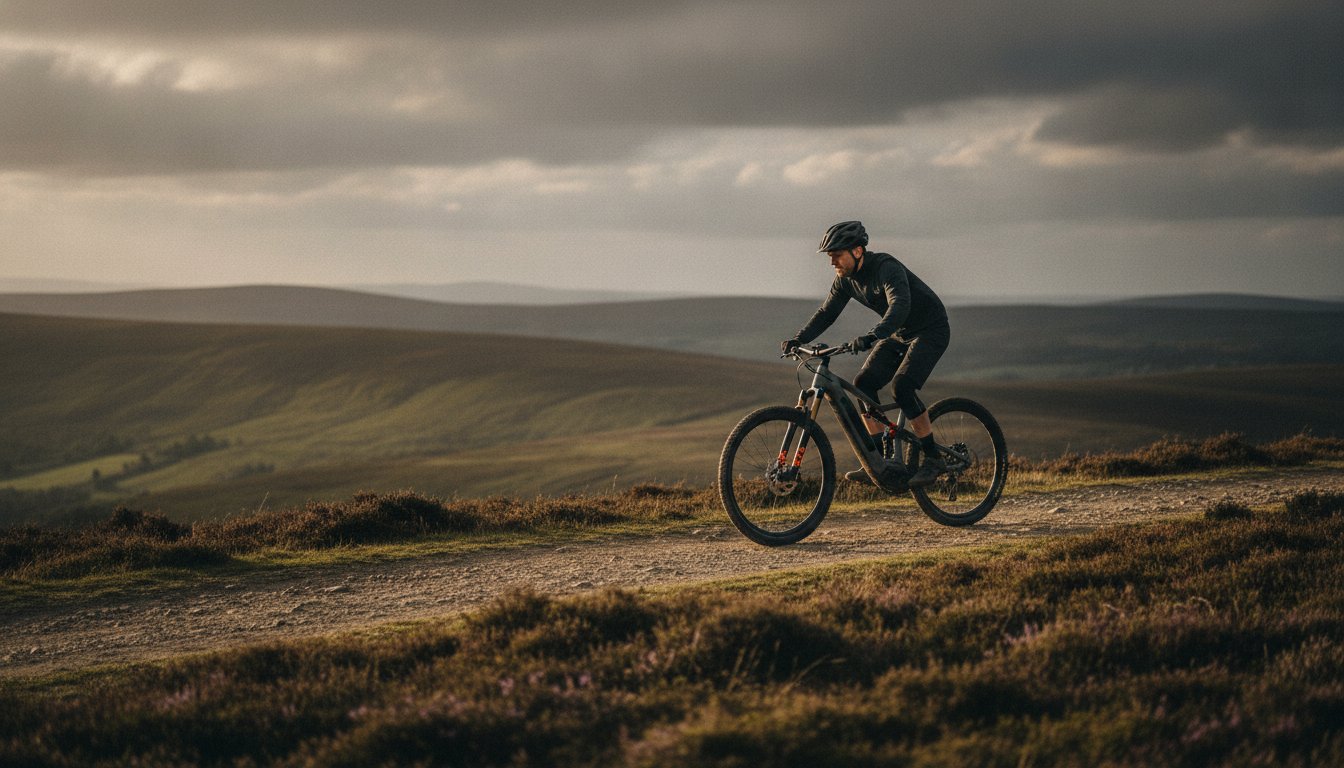
What if the steepest, muddiest climbs in the Wicklow Mountains were actually the highlight of your weekend rather than the part you dread? For many riders, finding the right electric mountain bike Ireland has to offer represents a total shift in how we experience the outdoors, turning gruelling slogs into exhilarating adventures. It’s natural to feel a bit of hesitation when you are looking at the technical jargon. You might worry about your battery cutting out whilst you’re deep in a remote forest trail, or perhaps you’re unsure if those sensitive electronics can truly withstand a proper Irish downpour.
We understand these frustrations because we’ve spent decades helping cyclists find their perfect setup. This guide promises to clear the fog, giving you the confidence to choose between mid-drive and hub motors whilst ensuring your battery range matches your ambition. You’ll discover the practical differences between hardtail and full-suspension frames for our rugged terrain. We will also explain how you can use the 2026 Cycle to Work scheme to save up to 52 per cent on your new purchase, making that premium ride much more accessible.
Key Takeaways
- Understand the nuances of pedal-assist technology and how modern torque sensors create a seamless, natural riding experience on rugged terrain.
- Gain confidence in selecting the right electric mountain bike Ireland setup by comparing mid-drive motor performance and battery range for long days in the hills.
- Determine whether a lightweight hardtail or a robust full-suspension frame is best suited for your favourite local trails and riding style.
- Protect your investment by mastering the specific maintenance requirements for Irish weather, including why you should never use a power washer on your motor.
- Learn how to successfully apply for the 2026 Cycle to Work scheme to significantly reduce the cost of your new high-performance E-MTB.
What is an Electric Mountain Bike (E-MTB)?
An electric mountain bike (E-MTB) is a purpose-built machine that uses a pedal-assist system to enhance your off-road experience. Unlike a motorbike, it requires rider input to activate the motor. This classification is often referred to as a “pedelec.” If you’re curious about the broader history and technology, you can read more about What is an electric bike? on Wikipedia. These bikes are specifically designed to handle the mud, rocks, and steep gradients we encounter across the Irish countryside.
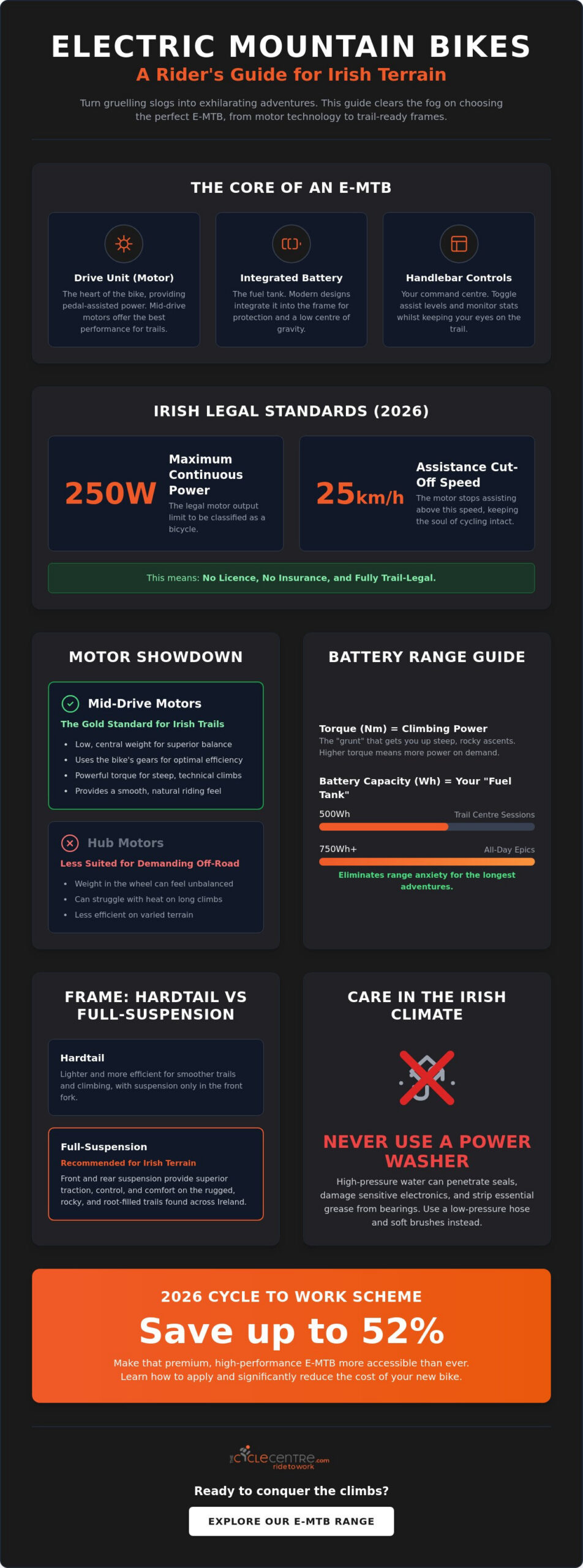
In Ireland, the 2026 regulations are clear. To remain legally classified as a bicycle, the motor must have a maximum continuous power of 250 watts and the assistance must cut off once you reach 25km/h. This ensures that your electric mountain bike Ireland setup remains trail-legal and doesn’t require a licence or insurance. It’s about providing a helping hand on the climbs whilst keeping the soul of traditional cycling intact.
The real magic lies in “climb mastery.” High-end motors now use sophisticated torque sensors that measure your pedalling force hundreds of times per second. This results in a “natural feel” where the power delivery is smooth and intuitive. Instead of a sudden jolt, you get a seamless boost that makes technical, rocky ascents feel like a fun challenge rather than an exhausting slog.
The Core Components of an Electric Mountain Bike
Every E-MTB is built around three fundamental elements. The drive unit is the “heart” of the bike, usually located at the crank (mid-drive) to keep the weight low and central. This is paired with a high-capacity battery, which modern designs often integrate directly into the down tube to protect it from the elements and improve the centre of gravity. Finally, you have the display or remote on the handlebars. This allows you to toggle through assist levels whilst keeping your eyes on the trail ahead.
Why E-MTBs are a Game Changer for Irish Riders
Forget the myth that riding an E-MTB is “cheating.” In reality, riders often find they get more exercise because they stay out longer and tackle more laps of their favourite trail centres. Whether you’re exploring the technical climbs of Ticknock or the sprawling loops of the Ballyhoura Mountains, an electric mountain bike Ireland allows you to master these sections with poise. It opens up the ability to explore remote mountain ranges amongst the most beautiful parts of the country, turning what used to be a punishing expedition into an enjoyable afternoon ride.
Understanding E-MTB Motors and Battery Range
Choosing an electric mountain bike Ireland riders can truly rely on often starts with a single question: how much power do I actually need? Whilst many beginners focus on the 250W motor limit mandated by law, the more important figure for trail performance is torque, measured in Newton-metres (Nm). Torque is the rotational force that allows you to accelerate and maintain momentum on steep, technical inclines. It is the “grunt” that gets you through a boggy section or up a rocky step when your legs are reaching their limit.
Modern motor systems from industry leaders like Bosch, Shimano, and Yamaha have refined how this power is delivered. Instead of a simple “on-off” switch, these motors use sophisticated sensors to match your pedalling input. This creates a natural experience where you feel like you have superhuman legs rather than a motorised engine. If you are looking to see how these different systems feel in practice, you can browse our current selection of Electric Mountain Bikes to compare the latest specifications.
Mid-Drive vs Hub Motors: Which is Best for Trails?
For serious off-road use, mid-drive motors are the gold standard. By positioning the motor at the crank, the weight is kept low and central, which is vital for maintaining a stable centre of gravity on technical descents. Mid-drive systems also drive the chain directly, allowing the motor to take advantage of the bike’s gear range. This means the motor can stay in its most efficient RPM range whether you are grinding up a vertical Wicklow climb or sprinting along a flat forest track. In contrast, hub motors (located in the wheel) can feel unbalanced and often struggle with the heat generated during long, slow climbs.
Calculating Your Battery Needs
Watt-hours (Wh) represent the total capacity of your battery, effectively acting as the fuel tank of your E-MTB. In 2026, battery technology has advanced significantly, with many premium models now offering 750Wh or even 800Wh capacities to eliminate range anxiety on all-day epics.
- 500Wh: Perfect for shorter, intensive trail centre sessions of roughly two to three hours.
- 625Wh: The versatile “sweet spot” for most weekend riders tackling varied Irish terrain.
- 750Wh+: Essential for riders planning remote mountain expeditions amongst the most rugged parts of the country.
Remember that your range is not just about the battery size. Your choice of assist mode plays a massive role; staying in “Eco” can often double your mileage compared to “Turbo.” Other factors, such as rider weight, tyre pressure, and even the consistency of the Irish mud, will all influence how many trail hours you get from a single charge. It is always better to have a little extra capacity in reserve than to find yourself pedalling a heavy bike home without assistance.
Hardtail vs Full-Suspension: Choosing for Irish Terrain
Deciding between a hardtail and a full-suspension frame is one of the most significant choices you will make. Irish terrain is notoriously varied; you might find yourself on a smooth forest fire road one minute and a technical, root-filled descent the next. Your decision impacts not just your comfort, but how effectively your electric mountain bike Ireland setup handles the added weight of the motor and battery. Because an E-MTB typically weighs over 23kg, the suspension system has to work much harder than on a traditional bicycle. This makes proper suspension tuning and the choice of “travel”—the distance the suspension moves—essential for a stable ride.
For most riders frequenting Irish trail centres, a bike with 130mm to 150mm of travel offers the best balance. If you’re primarily tackling the steep, rocky descents found in the Mournes or the Galtees, you might opt for a long-travel enduro setup with 160mm or more. The extra weight of the bike actually helps with stability, but only if the shocks are set up correctly. Without the right air pressure and rebound settings, a heavy E-MTB can feel cumbersome or unpredictable on technical sections.
When to Choose an Electric Hardtail
Electric hardtails, which feature suspension only at the front fork, are an excellent choice for riders who stick to fire roads and groomed forest trails. They are generally more budget-friendly and require significantly less maintenance because there are no rear shocks or complicated pivots to service after a muddy winter. If your riding style leans towards long-distance exploration on mixed surfaces, you might also find that electric road bikes in Ireland offer another perspective on assisted riding for extended distances.
The Case for Full-Suspension E-MTBs
If your goal is to master technical climbs and rugged descents, full-suspension is the clear winner. The rear shock does more than just provide comfort; it ensures the rear tyre stays in contact with the ground whilst you’re pedalling over wet roots and loose stones. This increased traction is a massive advantage when the motor’s torque is pushing you up a steep incline. On the way down, the rear suspension offers a level of “forgiveness” that allows you to maintain control of a 23kg bike amongst the most challenging mountain trails. It absorbs the harsh impacts that would otherwise fatigue your legs, allowing you to stay out on the hills for much longer.
Maintaining Your E-MTB in the Irish Climate
Owning an electric mountain bike Ireland riders use year-round means dealing with a constant influx of grit, mud, and moisture. The most critical rule for longevity is to never use a power washer. High-pressure water is designed to strip surfaces, but on an E-MTB, it can easily bypass the seals on your motor, battery housing, and bearings. This leads to internal corrosion that might not appear for weeks but will eventually cause a costly failure. Instead, stick to a low-pressure hose or a bucket of water and a soft brush to gently remove the grime.
After a particularly wet or muddy session, pay close attention to your battery contact points. Once you have removed the battery, wipe the terminals with a clean, dry cloth. Ensuring these points are free from moisture and grit prevents electrical arcing and oxidation, which can interfere with power delivery. Similarly, the high torque produced by E-MTB motors puts immense strain on your drivetrain. Chains and cassettes wear significantly faster than on traditional bikes, often requiring replacement every 1,000 to 1,500 kilometres. Regular cleaning and the application of a high-quality wet-weather lubricant will help extend the life of these expensive components.
Your tyre choice also plays a vital role in maintenance and safety. For the slick limestone and wet roots common in Irish forests, “soft compound” tyres are essential. Whilst these tyres wear down quicker than harder rubbers, the increased grip they provide is necessary to manage the weight of a 23kg bike on technical terrain. It is a trade-off that ensures you stay upright amongst the most challenging conditions.
E-Bike Specific Servicing Requirements
Your motor is as much a piece of software as it is a mechanical unit. Just like a laptop or smartphone, your E-MTB requires regular firmware checks to ensure the motor and battery are communicating efficiently. We apply the same meticulous high end road bike service Ireland specialists recommend to every electric bike that enters our workshop. Using a Shimano or Bosch accredited workshop is vital; these technicians have the diagnostic tools to identify internal errors before they become terminal problems.
Winter Proofing Your Ride
Cold temperatures can temporarily reduce your battery’s range by up to 20 per cent. To protect the lithium-ion cells, never leave your battery in an unheated shed or garage during a frost. Always store it indoors at room temperature. Fitting substantial mudguards is another practical step that protects the motor’s seals from direct spray whilst keeping your vision clear. Of course, your own comfort is just as important. Selecting the right cycling apparel Ireland offers for winter, such as waterproof trousers and thermal layers, ensures you can keep riding comfortably through the darkest months.
If you want to ensure your drive unit and battery are in peak condition for the season ahead, book a Workshop Gold Service to receive a full diagnostic health check and professional drivetrain clean.
How to Buy Your Electric Mountain Bike in Ireland
Investing in a high-performance electric mountain bike Ireland riders can rely on is a significant decision that deserves more than a simple online transaction. Whilst the convenience of “adding to cart” is tempting, an E-MTB is a complex machine that benefits greatly from specialist assembly and long-term technical support. Choosing an independent specialist ensures you have a point of contact for future motor diagnostics and warranty claims. We recommend using our Smart-bike Search tool to filter through our favourite brands based on your height, riding style, and budget, helping you narrow down the vast array of options available in 2026.
Because these bikes weigh significantly more than traditional mountain bikes, a professional fit is more important than ever. A bike that is slightly too large or small becomes much harder to manouevre when it weighs 23kg. Our team focuses on adjusting the reach, saddle height, and suspension sag to ensure the bike feels balanced and intuitive. This personalised approach reduces the risk of strain and ensures you can handle technical descents with confidence.
Using the Cycle to Work Scheme for E-MTBs
The 2026 Cycle to Work scheme remains the most cost-effective way to get on the trails. For electric bikes, the tax-free allowance is currently capped at €1,500. This means you can sacrifice a portion of your pre-tax salary to pay for the bike, resulting in savings of up to 52 per cent depending on your tax bracket. If the E-MTB you’ve chosen exceeds this limit, you can simply pay the balance directly to the shop whilst still enjoying the maximum tax relief on the first €1,500.
To start the process, you will need a formal quote to submit to your employer or third-party scheme provider. Remember that you can only avail of this benefit once every four years. For a deeper dive into the financial mechanics and eligibility, you can consult our comprehensive guide to the bike to work scheme Ireland. It covers everything from salary sacrifice periods to the specific safety equipment you can include in your application.
Selecting Your Brand: Giant, Cube, and More
When it comes to refined motor integration and frame geometry, certain brands stand out for Irish conditions. Giant is a perennial favourite amongst local riders, largely due to their Maestro suspension system. This design provides an active and efficient platform that handles the extra weight of an E-bike beautifully on rocky terrain. Alternatively, Cube E-MTBs are renowned for their exceptional value and German engineering, often providing high-spec Bosch motors and large batteries at a very competitive price point. We always recommend booking a test ride to feel the subtle differences in how each motor delivers its power before making your final choice.
Master the Irish Trails with Confidence
Choosing the right electric mountain bike Ireland riders need for our unique terrain is about more than just motor wattage. It’s about finding a balance between robust frame geometry, intuitive power delivery, and the practicalities of our damp climate. We’ve explored how the right torque settings can conquer technical climbs and why a professional fit is vital for managing a heavier E-MTB. By utilising the 2026 Cycle to Work scheme, you can access this high-level technology whilst making significant tax savings.
Established in 1974, we take pride in being a trusted facilitator of your outdoor experiences. Our Shimano Accredited Workshop provides the technical expertise needed to maintain your drive unit, whilst our Smart-bike Search tool helps you filter through the best brands with ease. Browse our full range of Electric Mountain Bikes and get a Cycle to Work quote today. There is a sense of freedom waiting amongst the peaks, and we’re here to help you find it.
Frequently Asked Questions
Is an electric mountain bike “cheating” for fitness?
Riding an E-MTB is not cheating; it is a way to manage your exertion whilst spending more time on the trails. Studies often show that E-bike owners ride more frequently and for longer durations than those on traditional bikes. You still have to pedal to engage the motor, meaning you can achieve a high heart rate and burn significant calories, especially on technical sections where you might otherwise have to walk.
How long does an E-MTB battery last on a single charge?
Most riders get between three and five hours of trail time from a single charge, depending on the battery capacity and the assist mode used. Factors like rider weight, the steepness of the terrain, and even the temperature will influence the total range. A 750Wh battery will naturally last longer on an epic mountain day than a standard 500Wh unit used in Turbo mode throughout the ride.
Can I ride my electric mountain bike in heavy Irish rain?
You can absolutely ride in the rain, as modern motors and batteries are designed with high-quality seals to withstand wet conditions. However, you should avoid submerging the motor in deep river crossings or using a high-pressure power washer to clean it. After a wet ride, it is good practice to dry the battery contact points to prevent long-term oxidation or electrical issues amongst the terminals.
How much does it cost to service an E-MTB motor?
The cost of servicing depends on whether you require a simple firmware update or a comprehensive mechanical overhaul of the drivetrain. Routine maintenance usually involves checking for software errors and ensuring the seals are intact. Because the motor is a sealed unit, internal repairs are generally handled under warranty or by specialist service centres rather than through standard workshop pricing.
What is the best motor for an electric mountain bike in 2026?
In 2026, the “best” motor often comes down to personal preference between the Bosch Smart System and Shimano’s latest drive units. Bosch is frequently praised for its raw power and sophisticated app integration, whilst Shimano is often the favourite for those seeking a lightweight, natural pedalling feel. Both systems are exceptionally reliable and well-supported by specialist workshops throughout the country.
Do I need a special licence to ride an E-MTB in Ireland?
You don’t need a licence, tax, or insurance to ride an electric mountain bike Ireland law classifies as a standard bicycle. To meet these criteria, the motor must be limited to 250 watts of continuous power and the assistance must cut off at 25km/h. It’s also important to remember that riders must be at least 16 years old to legally operate an e-bike on public roads.
Can I use the Cycle to Work scheme for a high-end E-MTB?
You can certainly use the Cycle to Work scheme to purchase a high-end E-MTB, applying the tax-free allowance to the first €1,500 of the purchase price. If the bike costs more than this limit, you simply pay the difference yourself. This remains an excellent way to save up to 52 per cent on the initial portion of your investment whilst upgrading to premium technology.
What happens if my E-MTB battery runs out while I am on a trail?
If your battery runs out, the bike will still function as a traditional bicycle, though it will be heavier to pedal. There is no resistance from the motor when the power is off, so you won’t be “braked” by the system. It is simply a matter of using your own leg power to get home, which is why monitoring your range during a ride is always a sensible habit.