
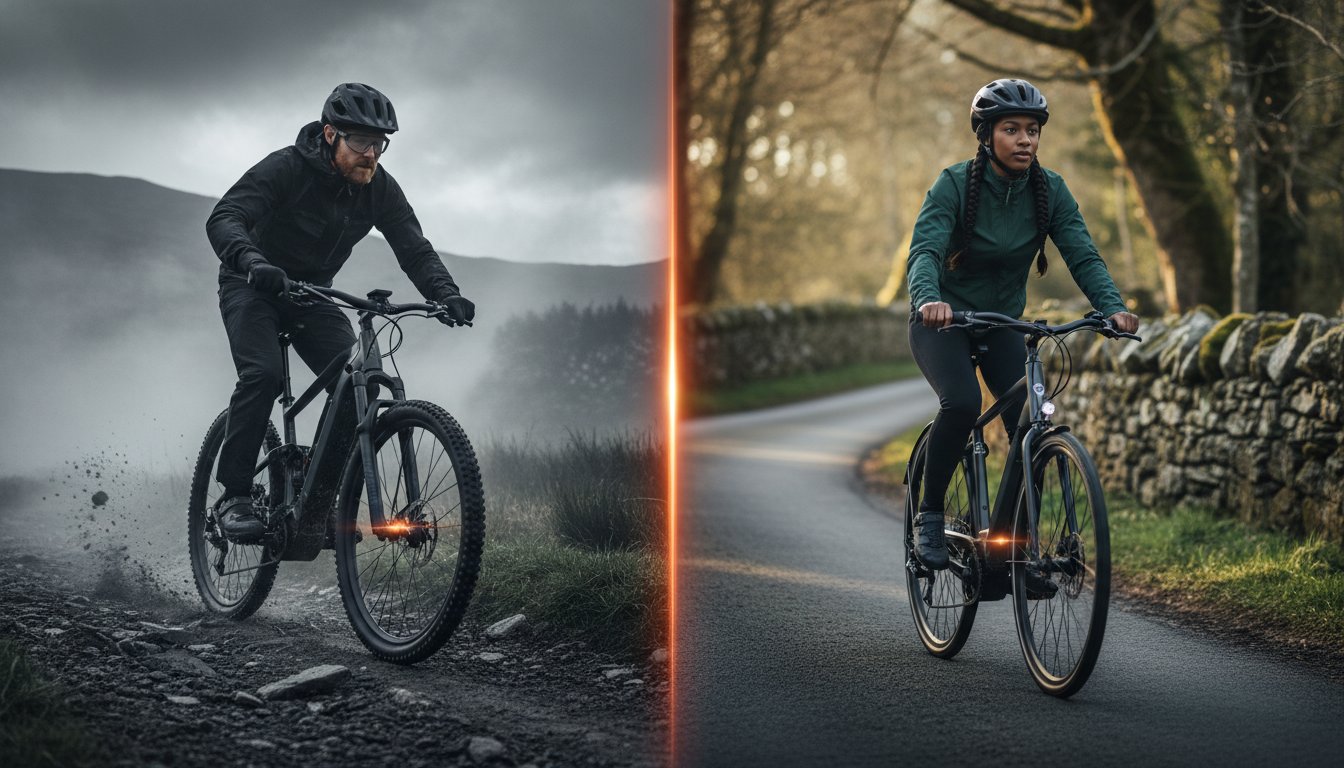
The highest torque rating on a spec sheet won’t tell you how a bike actually handles on a damp morning in the Irish countryside. Whilst it’s tempting to chase the biggest numbers, the real secret to a satisfying purchase lies in how the motor’s personality aligns with your own natural pedalling behaviour. Deciding between Bosch vs Shimano e-bike motors isn’t just a technical choice; it’s about finding a reliable partner for your daily commute or weekend trails.
For those interested in how specialist retailers curate their range globally, you can find out more about Retail Sales of Electric Bicycles and Accessories from experts like Electric Bikes Brisbane. Their long-standing commitment to quality mirrors our own approach to providing reliable technology.
We know that the fear of choosing an unreliable system or the confusion over torque and battery watt-hours can make the process feel daunting. It’s perfectly normal to feel a bit of anxiety about long-term maintenance or whether a motor will feel too robotic as you ride. This guide cuts through the 2026 jargon to compare the raw power of Bosch’s latest Drive Units against the intuitive, natural feel of Shimano’s EP801 and Di2 integration. You’ll gain the confidence to choose a system that fits your lifestyle, backed by the knowledge of how local service support keeps you moving for years to come.
Key Takeaways
- Understand why 85Nm of torque is the modern benchmark for performance and how it translates to real-world power on steep inclines.
- Compare the distinct ride personalities of Bosch vs Shimano e-bike motors to determine which system matches your natural pedalling style.
- Learn how to select the ideal motor for your favourite terrain, whether you are tackling technical mountain trails or smooth city streets.
- Discover why professional workshop servicing is the foundation of long-term motor reliability and performance in the Irish environment.
- Gain the technical confidence to evaluate battery capacities and system integration so you can make an informed investment with total peace of mind.
The Heart of Your E-Bike: Why Motor Choice Matters in 2026
Think of your electric bike as a single, living organism. The motor acts as both the heart that provides the pulse and the brain that interprets your every pedal stroke. In 2026, the debate surrounding Bosch vs Shimano e-bike motors has matured significantly. We’ve moved past a simple arms race for the highest torque figures. Today, the focus is on “Smart” ecosystems that blend raw power with sophisticated software. Your choice of motor dictates the entire geometry of the frame. It influences the bike’s weight distribution, its balance through tight corners, and the total range you can expect on a single charge. It’s the most critical decision you’ll make when selecting a new ride.
Understanding the E-Bike Ecosystem
An e-bike is a complex machine where the drive unit, battery, and display unit must work in total synchronisation. When exploring modern electric bicycle technology, it becomes clear that proprietary systems offer far superior reliability compared to generic alternatives. This synergy is particularly important for Irish riders who face diverse and often damp conditions. A unified system ensures that every component “talks” to the others without lag or error.
- The Drive Unit: This is the powerhouse that governs how assistance is delivered to the rear wheel.
- The Battery: This determines your potential range and significantly impacts the bike’s centre of gravity.
- The Display: This provides essential data and allows for custom power tuning via dedicated mobile apps.
Choosing a brand with a robust national service footprint is essential for long-term peace of mind. If you encounter a technical glitch, you need a local expert who can plug into the system, run diagnostics, and source genuine spare parts quickly. This infrastructure is what separates the industry leaders from the rest.
A Legacy of Innovation since 1974
Our team has witnessed the evolution of cycling since 1974. We’ve seen trends come and go, but the brands that endure are those with a deep-rooted commitment to engineering excellence. Bosch and Shimano didn’t become the gold standard by accident; they’ve applied decades of mechanical expertise to the challenges of electric assistance. Our workshop team has spent years comparing Bosch vs Shimano e-bike motors in real-world Irish conditions, from the coastal winds of the Wild Atlantic Way to the steep climbs of the Wicklow Mountains.
Independent retailers like us act as a bridge between this high-level technology and your daily riding experience. We don’t just sell components; we facilitate experiences. We prioritse these motors because they are built to withstand our unique climate and terrain. When you invest in a proven system, you’re buying more than just a motor. You’re ensuring that your bike remains a reliable tool for exploration and freedom for years to come. It’s about finding a partner that won’t let you down when the road gets tough.
Bosch vs Shimano: Technical Specifications and Performance
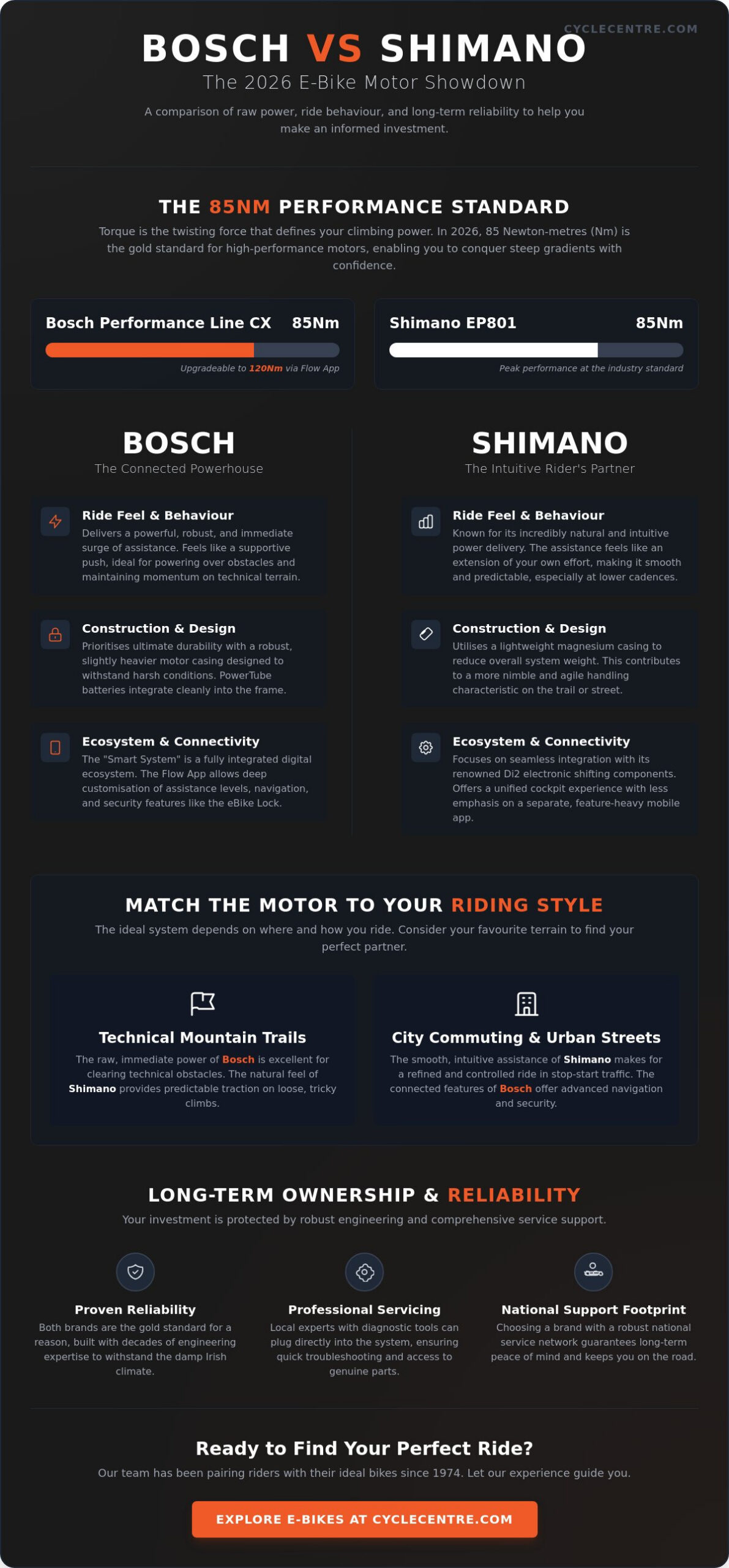
Technical specifications shouldn’t be viewed as just numbers on a page. They define how your bike responds when you’re halfway up a muddy incline or navigating a busy junction. When comparing Bosch vs Shimano e-bike motors in 2026, the industry has settled on 85Nm of torque as the gold standard for high-end performance. This figure represents the twisting force the motor provides; it’s the difference between struggling on a steep gradient and gliding upwards with poise. While 85Nm remains the standard benchmark, Bosch’s 2026 software updates now allow certain Performance Line CX motors to be upgraded to a staggering 120Nm via the Flow App for those seeking extreme power.
Construction materials also play a vital role in how the bike handles. Shimano’s EP801 utilises a lightweight magnesium casing to shed weight, whereas Bosch prioritises a robust, slightly heavier unit designed for ultimate durability. Battery integration has kept pace too. Bosch’s PowerTube series and Shimano’s BT-EN batteries offer sleek, internal designs that don’t compromise the frame’s aesthetic. According to a recent eMTB motor market comparison, these systems are now more efficient than ever. If you’re eager to see how these specs feel in practice, exploring our latest Electric Mountain Bikes can help narrow down your choice.
Bosch Smart System: The Connected Powerhouse
The Bosch Performance Line CX is more than just a motor; it’s a fully integrated digital ecosystem. Through the Flow App, currently on version 1.35, you can customise assistance levels to suit your specific fitness goals. New features like ‘Hill Hold’ prevent the bike from rolling backwards on steep starts, while ‘Auto Mode’ intelligently adjusts power based on the terrain. It’s a fantastic choice for riders who want the motor to do the heavy lifting, allowing them to focus entirely on the path ahead.
Shimano STEPS: The Natural Pedalling Feel
Shimano takes a different approach by prioritising a ‘bicycle-first’ experience. The EP801 motor is designed to feel like an extension of your own legs rather than a powerful external force. This is achieved through a low-drag internal design that makes pedalling over the 25km/h limit feel completely frictionless. When paired with Shimano’s Di2 electronic shifting, the motor and drivetrain communicate to provide seamless gear changes, even under heavy load. It’s an intuitive system that rewards riders who enjoy the mechanical rhythm of traditional cycling.
The Ride Experience: Comparing ‘Trail Feel’ and Behaviour
Beyond the raw data, the actual sensation of the motor’s assistance defines your journey. When comparing Bosch vs Shimano e-bike motors, you’re essentially choosing between two distinct personalities. Bosch is often described as the “athlete” of the pair. Its power delivery is punchy and immediate, particularly in Turbo mode. A standout feature for 2026 is the ‘over-run’ or Extended Boost. When you stop pedalling momentarily to avoid a rock or root, the motor continues to provide a fraction of a second of drive. This helps you clear obstacles without catching your pedals. In contrast, Shimano’s EP801 offers a more linear, progressive delivery. It feels less like a motor pushing you and more like you’ve suddenly developed world-class leg strength.
Noise and vibration also play a role in the ride quality. Bosch units tend to emit a high-pitched whine under heavy load, which some riders find reassuringly powerful. Shimano motors are generally quieter whilst climbing, but the EP801 is known for a mechanical “clack” or rattle when coasting over rough ground. This is a byproduct of the clutch system designed to reduce drag. According to Bike Magazin’s lab-tested motor comparison, both systems handle the 25km/h legal cut-off with impressive finesse. Bosch tapers the power off so gently you might not notice it, whereas Shimano’s low-drag internals make it easier to maintain speeds above the limit through your own effort.
Climbing and Technical Terrain
On slippery Irish trails, traction is everything. Bosch’s eMTB mode is an intelligent setting that varies the support between Tour and Turbo based on your pedal pressure. It’s incredibly effective at preventing wheelspin on muddy inclines. Shimano’s strength lies in its responsiveness at low cadences. If you find yourself in the wrong gear at the bottom of a technical rock section, the EP801 reacts instantly to your input, providing the necessary torque to keep you moving without a jerky surge. To see how these motor characteristics translate into specific bike builds, our detailed guide on Giant vs Cube electric mountain bikes explores how each brand integrates these systems into their 2026 frame designs.
Cadence and Efficiency
Your pedalling style, or cadence, significantly impacts how these motors perform. Bosch systems generally reward riders who prefer a higher pedalling frequency; they feel most efficient and responsive when you’re spinning the cranks quickly. Shimano is more versatile, offering consistent support across a broader range of rider inputs. Understanding this relationship is the best way to avoid electric bike range anxiety. By matching your natural cadence to the motor’s “sweet spot,” you ensure that every watt of battery power is used effectively, allowing you to stay out amongst the hills for longer.
How to Choose: Matching Your Motor to Your Riding Style
Selecting between Bosch vs Shimano e-bike motors shouldn’t feel like a gamble. It’s a structured process of aligning technology with your lifestyle. Start by identifying your primary terrain. Are you navigating the stop-start rhythm of city traffic, or are you seeking the silence of forest gravel paths? Once you’ve mapped your route, determine how much work you want the motor to do. Some riders want to arrive at the office without a bead of sweat, whilst others want a system that simply takes the sting out of the steepest climbs. Your physical effort should dictate the motor’s assistance level, not the other way around.
Next, evaluate your appetite for digital integration. Bosch’s Smart System is perfect if you enjoy fine-tuning performance via your phone. Finally, consider your investment. Modern e-bikes are significant purchases, but you can achieve substantial savings by utilising the bike to work scheme Ireland. This tax-incentive programme makes high-end motor technology far more accessible for the daily traveller. It’s a practical way to move from uncertainty to informed confidence in your purchase. For a comprehensive overview of the entire process, our guide on how to buy electric bike Ireland covers everything from maximising your tax savings to navigating the 2026 regulations with confidence.
The Commuter’s Choice: Reliability and Ease
For the urban cyclist, Bosch’s ‘Auto’ mode is a revelation. It senses changes in wind or gradient and adjusts support instantly. You don’t have to fiddle with buttons at every junction. Conversely, Shimano motors excel when paired with internal gear hubs. This combination offers a low-maintenance, clean solution that’s ideal for rainy Irish winters. It ensures that your daily transport remains a tool for freedom rather than a source of mechanical frustration. It makes the Monday morning ride feel effortless.
The Performance Enthusiast: E-MTB and E-Road
Competitive spirits often gravitate towards the Bosch CX Race Limited Edition for its aggressive power curve. It’s built for clearing technical sections at speed. However, Shimano remains a dominant force in the E-Road and E-Gravel categories. Their lighter units allow for a bike that handles more like a traditional road machine. This is crucial for weight-conscious riders who want to enhance their fitness goals without the bike feeling cumbersome. If you’re considering which brand best harnesses these motors on the trail, our in-depth look at Giant vs Cube electric mountain bikes for 2026 breaks down exactly how each manufacturer’s geometry and system integration affects real-world performance. If you’re ready to find your perfect match, you can browse our full range of electric bikes to see these systems in person.
Long-Term Ownership: Maintenance, Reliability, and Support
The true value of your investment isn’t measured on the day you leave the shop. It’s proven over thousands of kilometres of reliable service. In 2026, the reliability of Bosch vs Shimano e-bike motors has reached an all-time high. Modern drive units are engineered for longevity, yet they remain high-performance machines that operate in the challenging Irish climate. Whilst online forums often debate which brand is more robust, the reality is that both systems are incredibly dependable when supported by a regular maintenance schedule. Most technical issues reported by users are actually solvable through firmware updates or routine mechanical adjustments rather than hardware failure.
To ensure your motor remains in peak condition, seeking a professional high end road bike service Ireland is essential. This specialised care goes beyond a standard bicycle tune-up. It involves connecting your bike to proprietary diagnostic software to check for system errors, optimise power delivery, and monitor battery health. Whether you choose the connected ecosystem of Bosch or the natural feel of Shimano, your motor’s longevity depends on a proactive approach to care. Keeping your software up to date ensures you benefit from the latest efficiency tweaks and safety features released by the manufacturers.
Servicing Your E-Bike Motor
During a specialist Silver or Gold service package, our technicians perform a deep dive into your bike’s electronic health. We use official diagnostic tools to “read” your motor’s history, including the total number of battery charge cycles and any historical error codes. This data allows us to spot potential issues before they become costly repairs. At home, you can protect your motor by following a few simple steps. Never use a high-pressure power washer near the drive unit or bearings. Instead, use a damp cloth and a soft brush to remove road salt and grime. Always store your battery at room temperature whilst not in use to preserve its capacity over time.
The Cycle Centre Advantage
Our status as an independent retailer allows us to provide unbiased technology advice. We aren’t tied to a single brand; we simply recommend what works best for your specific needs. As a Shimano accredited workshop with extensive Bosch training, we have a “can-do” attitude towards complex repairs and warranty claims. We understand that your e-bike is often a vital part of your daily routine. We work efficiently to get you back on the road with total peace of mind. If you are ready to take the next step, you can get a no-obligation quote for your dream bike via our online portal or visit us in-store to chat with a knowledgeable mentor. Let us help you turn the frustration of modern commuting into a sense of freedom and exploration.
Ready to Embark on Your Next Adventure?
Deciding between the punchy assistance of a Bosch system and the natural, bicycle-first feel of Shimano is the first step toward a more rewarding ride. We’ve seen how the 2026 smart ecosystems have transformed these motors into intelligent partners that adapt to your every move. Whether you prioritise high-torque performance or seamless electronic shifting, the “best” motor is simply the one that makes you want to ride more often. Your choice between Bosch vs Shimano e-bike motors is an investment in your daily happiness and health.
At The Cycle Centre, we back our 50 years of independent expertise with a Shimano Accredited Workshop and specialist e-bike repair services to keep you moving. We’re here to ensure your technology choice remains a source of freedom for years to come. Apply for a Cycle to Work quote and find your perfect e-bike today. Your journey into the future of cycling starts with a single, effortless pedal stroke. We look forward to helping you find your perfect match and seeing you out on the trails.
Frequently Asked Questions
Which e-bike motor is more reliable, Bosch or Shimano?
Both brands are considered the gold standard for reliability in the global cycling industry. Bosch often has a more integrated service network for complex electronics, whilst Shimano benefits from being a cycling component giant with widely available mechanical spares. Most long-term issues are avoided by sticking to a professional service schedule rather than inherent flaws in the hardware.
Can I swap a Bosch motor for a Shimano motor on my e-bike?
You cannot swap between these motor brands because e-bike frames are engineered with proprietary mounting brackets. Each frame is designed specifically to house either a Bosch or a Shimano unit. If you’re deciding between Bosch vs Shimano e-bike motors, it’s vital to choose the right system before purchasing your bike, as you’ll be committed to that ecosystem for the life of the frame.
How often does a Bosch or Shimano e-bike motor need servicing?
We recommend a professional diagnostic check every 1,000 to 1,500 kilometres or at least once a year. Whilst the internal motor units are sealed, the sensors, software, and drivetrain components require regular attention to ensure peak performance. Regular servicing in an accredited workshop helps identify battery health trends and ensures your firmware is up to date.
Does a higher torque (Nm) always mean a better e-bike motor?
A higher torque figure doesn’t necessarily mean a better experience for every rider. Whilst 85Nm or 120Nm provides incredible climbing power, it can also lead to faster battery drain and a less natural pedalling sensation. The best motor is the one that delivers its power in a way that matches your specific riding style and the terrain you frequent most.
Which motor brand offers the best range for long-distance cycling?
Range is determined more by battery capacity and rider behaviour than the motor brand itself. Bosch offers high-capacity PowerTube batteries that are excellent for touring, whilst Shimano’s efficient EP801 system is often favoured for lightweight e-road bikes where battery size is smaller. Your choice should depend on whether you prioritise raw capacity or overall system efficiency.
Are Bosch or Shimano e-bike motors waterproof for Irish weather?
Both systems are highly weather-resistant and designed to handle the typical damp conditions of an Irish winter. They carry high IPX ratings that protect against splashes and heavy rain. However, you should never submerge the motor in deep water or use a high-pressure power washer directly on the seals, as this can force moisture into the sensitive electronics.
How do I update the software on my Shimano or Bosch e-bike?
You can perform most basic updates at home using the Bosch Flow App or the Shimano E-TUBE PROJECT App via a Bluetooth connection. For more complex system optimisations or critical firmware patches, it’s best to visit a specialist workshop. We use professional diagnostic hardware to ensure the update process is completed safely without risking a system error.
Which motor is quieter for a more peaceful riding experience?
Shimano motors, particularly the EP801, are generally quieter whilst under load during a steep climb. Bosch units tend to have a more noticeable high-pitched whine when you’re using higher assistance modes like Turbo. It’s worth noting that Shimano motors can produce a slight mechanical rattle when coasting over rough ground, which is a normal characteristic of their internal clutch design.