


Did you know that in 2025 alone, the UK recorded 432 fires related to lithium-ion batteries, many of which were linked to improper maintenance or uncertified chargers? It is a sobering statistic that explains why many riders feel a genuine sense of anxiety about their equipment, especially when searching for how to extend e-bike battery life to avoid a replacement bill of up to £800. You aren’t alone if you’ve noticed your range dropping after just one season or if you feel confused by the sea of conflicting advice found amongst various online forums.
We are here to provide a definitive path forward by sharing the professional techniques that protect your investment. By following these daily habits, you can effectively double the usable lifespan of your battery through a blend of smart chemical management and mechanical efficiency. This guide covers everything from a reliable daily charging routine to essential winter storage habits, ensuring you have the knowledge to maximise your return on investment whilst enjoying a safer, more reliable ride.
Key Takeaways
- Understand the technical distinction between daily range and total cycle life to manage your battery’s natural ageing process with professional precision.
- Master the ‘Goldilocks Zone’ by maintaining a 20-80% charge level; this is a fundamental technique for anyone looking at how to extend e-bike battery life and maximise their long-term ROI.
- Discover why a stable environment of 15°C to 20°C is the favourite climate for lithium-ion cells and how to protect your battery from damp winter storage conditions.
- Learn how to reduce peak current draw by optimising your cadence and gear selection, which effectively reduces the internal heat that leads to chemical degradation.
- Identify how regular professional diagnostic reports and firmware updates can pinpoint failing cells and refine the sophisticated power management algorithms used by top manufacturers.
Understanding E-Bike Battery Lifespan vs. Range
Many riders confuse the distance they can cover on a single charge with the total service life of their battery. Whilst range is what gets you home from a long day on the trails, longevity determines whether you’ll be buying a new power pack in two years or seven. Even in 2026, with the latest smart Battery Management Systems (BMS), the underlying chemistry remains a delicate balance. If you want to know how to extend e-bike battery life, you must first understand that your daily habits directly dictate the chemical health of the cells inside that casing.
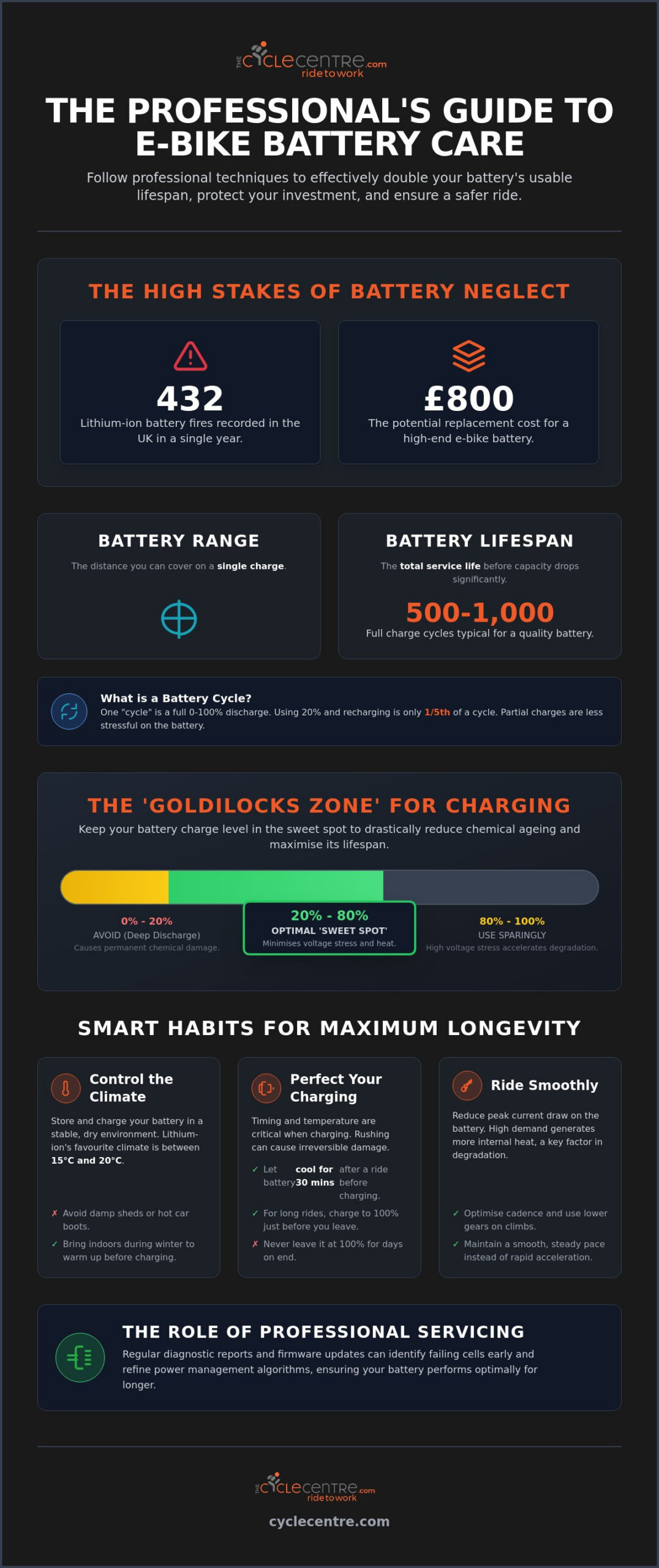
Four primary factors accelerate degradation: excessive heat, voltage stress from staying at 100% charge, deep discharge, and moisture ingress. Managing these “Big Four” is the secret to protecting your investment. Most high-quality lithium-ion batteries are rated for 500 to 1,000 full charge cycles before they reach their end of life threshold, which is typically defined as retaining 60% to 80% of their original capacity. By being proactive, you can ensure your battery stays at the higher end of that spectrum for much longer.
What is a Battery Cycle?
A common misconception amongst new riders is that every time you plug in the charger, you’ve used up one “life” of the battery. This isn’t true. A cycle is a full 0-100% discharge, regardless of how many sessions it takes to get there. If you use 20% of your capacity on a commute and top it up, you’ve only used a fifth of a cycle. Research into Understanding Lithium-Ion Batteries shows that partial charges are actually far less stressful for the internal components than full, deep cycles. In modern Bosch and Shimano systems, ‘Cycle Life’ refers to the number of full discharge-recharge sequences the battery can undergo before its capacity significantly drops below its original factory rating.
The Cost of Neglect
Ignoring basic battery hygiene is an expensive mistake. With replacement packs for high-end Electric Mountain Bikes often costing between £500 and £800, preventative care is the most cost-effective “component” you can buy. A healthy battery doesn’t just keep you on the road; it preserves the resale value of your entire bike. Prospective buyers always check the battery health report first. Amongst high-performance e-MTBs, early signs of neglect include sudden power drops during steep climbs or a battery percentage that “jumps” down unexpectedly. Learning how to extend e-bike battery life through simple daily routines ensures you aren’t caught out by these premature failures.
This principle of maintaining condition to protect resale value is a strategy used by owners of all high-value transport; for those also managing motor vehicles, you can learn more about Carz World and their expertise in car trade-in valuations in Singapore.
The ‘Goldilocks Zone’ for Charging Longevity
Keeping your battery topped up to 100% might feel like the best way to prepare for a ride, but it’s actually one of the quickest ways to degrade the internal chemistry. Lithium-ion cells are happiest when they aren’t pushed to their physical extremes. Adopting the “20-80% Rule” is perhaps the most effective strategy for anyone wondering how to extend e-bike battery life. By keeping the charge level within this “sweet spot,” you reduce the internal resistance and heat generation that leads to capacity loss, potentially tripling the total years of service you get from the pack.
Conversely, you should avoid the “Deep Discharge” at all costs. Letting your battery hit 0% can cause permanent chemical damage, as the voltage drops below a critical threshold that the Battery Management System (BMS) may not be able to recover from. Beyond the charge level, timing is everything. Never plug in your battery immediately after a long, strenuous climb on one of our Electric Mountain Bikes. The cells need a “cool down” period of at least 30 minutes to reach ambient temperature before they can safely accept a charge. Similarly, if you’ve been riding in the frost, allow the battery to reach room temperature indoors before connecting the power; charging a frozen battery can lead to “lithium plating,” which permanently reduces its ability to hold energy.
Why 100% Charge is Stressful
Think of a battery at 100% like a balloon stretched to its absolute limit. This high voltage stress accelerates the breakdown of the electrolyte fluid inside the cells. Whilst you should generally stop at 80% for daily use, you should occasionally charge to 100% to allow for “cell balancing.” This process ensures that all individual cells within the pack are at the same voltage, which prevents weaker cells from being overworked. Organise your schedule so that if you do need a full 100% charge for a long weekend adventure, the battery reaches that peak just before you set off, rather than sitting at full capacity for several days in a hot garage.
Charger Safety and Quality
It is tempting to save a few pounds on a “bargain” third-party charger, but these units often lack the sophisticated thermal cut-offs found in original equipment. Using the manufacturer’s charger from brands like Bosch, Shimano, or Yamaha is non-negotiable for both longevity and safety. Low-quality chargers can provide unstable voltage, which is a primary driver of how to extend e-bike battery life in the wrong direction. Using uncertified charging units significantly increases the risk of thermal runaway, a dangerous state where the battery enters an uncontrollable, self-heating fire cycle. If you are concerned about your current charging setup, our Workshop Silver Service includes a thorough inspection of your electrical components to ensure everything is functioning within safe parameters.
Environmental Protection and Winter Storage Strategies
Whilst the charging habits discussed previously are vital, the environment where you keep your bike plays an equally significant role. Lithium-ion cells are quite particular about their surroundings. A temperature range of 15°C to 20°C is the favourite climate for maintaining chemical stability. In the damp, temperate conditions often found across the UK and Ireland, humidity is just as dangerous as the cold. Storing a battery in a leaky garden shed or a damp garage can lead to contact corrosion, which disrupts the flow of electricity and can eventually lead to a total system failure. To protect your equipment, ensuring your storage structure is watertight is essential; for those in need of professional repairs, Acute Roofing provides expert services to keep garages and outbuildings dry.
If you plan to leave your bike for more than two weeks, don’t leave it at 100% or near empty. The 60% Storage Rule is the gold standard for long-term preservation. This specific level balances the internal pressure of the cells. Even when dormant, a battery will slowly lose its charge. Set a reminder on your phone to give it a quick monthly top-up to ensure it stays within that safe middle ground. This simple habit is a core part of how to extend e-bike battery life during the off-season.
Winter Riding and Battery Sags
Cold weather causes the internal resistance of the battery to increase, leading to a temporary “sag” in performance. You might notice your assist feels weaker or your range meter drops faster than usual. Using a neoprene battery cover can help maintain the internal thermal mass whilst you’re out on the trails. The most effective strategy, however, is simply bringing the battery indoors when you aren’t riding. Keeping the cells at room temperature until the moment you set off can extend the battery’s service life by several years.
Cleaning and Moisture Management
Keeping your bike clean is essential, but you must be careful with the electrical components. Never use a pressure washer. High-pressure water easily bypasses rubber seals and destroys internal circuitry in seconds. Instead, use a damp cloth for the casing and specialised contact cleaners for the battery terminals. Always follow the “Dry First” rule: ensure the battery mount and the unit itself are bone-dry before re-inserting them. This prevents moisture from being trapped in the connection points, which is a common cause of short circuits amongst year-round commuters. If you are ever unsure about the state of your seals, a Workshop Gold Service includes a detailed inspection of all electrical contact points to keep you riding safely.
Riding Habits That Reduce Battery Strain
Your behaviour on the saddle is just as influential as your charging routine. To understand how to extend e-bike battery life, you must view the motor as a bridge between your physical effort and the battery cells. If the motor has to work harder to overcome mechanical resistance or poor riding technique, it draws a higher current. This increased current generates internal heat, which is the primary driver of chemical ageing in lithium-ion packs. By riding more efficiently, you keep the battery’s internal temperature stable and preserve its capacity for the years ahead.
Maintaining an optimal cadence is your first line of defence. Aim for a rhythm between 70 and 90 revolutions per minute (RPM). Most modern mid-drive motors are designed to operate most efficiently at these higher speeds. If you “grind” in a high gear at a low cadence, you’re forcing the system to work at its absolute limit. Treat your e-bike like a manual car; you wouldn’t try to pull away from a junction in fifth gear, so don’t do it on your bike. Similarly, keep an eye on your tyre pressure. Low pressure creates significant rolling resistance that the battery must constantly “fight” to overcome. Even carrying unnecessary weight in your panniers adds up, as every extra kilogram requires more Amps to move, particularly on inclines.
Mechanical Efficiency = Electrical Longevity
A neglected drivetrain is a silent thief of battery health. If your chain is dry or your gears are misaligned, the motor must work harder to push through the friction. Even a slightly dragging brake caliper can shave miles off your range and months off your battery’s life. We recommend specialist e-bike servicing to ensure your mechanical components aren’t putting undue stress on your electrical system. If you want to ensure your bike is running at peak efficiency, book a Workshop Gold Service with our expert technicians today.
Starting and Stopping
The “High-Draw” trap is a common mistake amongst urban riders. Launching from a standstill in ‘Turbo’ or ‘Boost’ mode creates massive heat spikes within the battery cells. This is the moment when the motor demands the most power. To protect your pack, shift into a lower gear as you approach a stop. Use your own leg power and a lower assist setting to get the bike moving before gradually ramping up the power. This smooth acceleration technique is one of the most effective ways to manage heat and is a key secret in how to extend e-bike battery life during your daily commute.
The Role of Professional Servicing and Software
Whilst your daily habits and riding techniques are the foundation of longevity, the technical “brain” of your e-bike requires its own level of professional attention. To truly understand how to extend e-bike battery life, you must look beyond the physical casing and into the sophisticated software that manages every electron. In 2026, e-bike systems are more communicative than ever, providing a wealth of data that can help you avoid the £800 cost of a premature replacement. By leaning on the expertise of a trusted local workshop, you ensure your battery remains as efficient as the day you bought it.
Professional support is particularly vital for modern mid-drive systems. Manufacturers like Bosch and Shimano don’t just release updates for new features; they frequently refine the Battery Management System (BMS) algorithms to improve thermal efficiency and charging curves. These updates are essentially a digital tune-up that can extend the usable life of your cells by ensuring the power draw is as gentle as possible. If your range meter has started to feel inaccurate or “jumpy,” software can often re-calibrate a confused BMS, restoring your confidence in the bike’s remaining capacity.
Why Firmware Matters in 2026
Firmware is the invisible hand that guides your battery’s health. In 2026, these updates often include improved “gentle” charging curves that reduce chemical stress during the final 20% of a charge cycle. They also refine how the motor handles heat spikes during steep climbs, protecting the cells from the degradation we discussed in previous sections. Schedule your Shimano accredited service to ensure your software is current and your system is running the latest safety protocols.
Professional Battery Diagnostics
Professional diagnostics go far deeper than the simple percentage shown on your handlebars. During a Workshop Gold Service, our technicians use specialised software to analyse the internal resistance of individual cell groups. This level of detail allows us to spot failing cells before they ruin the entire pack. We also check for error codes hidden in the motor’s history, which can reveal if the battery has been subjected to extreme temperatures or moisture ingress whilst you were out on the trails. Professional diagnostics can identify minor cell imbalances before they escalate into catastrophic, out-of-warranty failures.
Eventually, every battery will reach the end of its natural life. Knowing when to say goodbye is a matter of safety. If you notice the casing bulging, a persistent smell of chemicals, or the battery becoming hot to the touch during a standard charge, stop using it immediately. These are signs of internal damage that no amount of software can fix. By combining your new daily habits with regular professional check-ups, you’ll ensure that when that day finally comes, you’ve squeezed every possible mile of value out of your investment whilst keeping your home and your bike safe. Learning how to extend e-bike battery life is a journey, and we are here to support you at every stage.
Protecting Your Ride for the Road Ahead
Mastering the daily habits of the “Goldilocks Zone” and maintaining your bike’s mechanical efficiency are the most effective ways to ensure your battery remains reliable for years to come. By keeping your charge between 20% and 80% whilst staying mindful of your pedalling cadence, you’ve already taken the most important steps in learning how to extend e-bike battery life. These simple adjustments don’t just save you the significant cost of a premature replacement; they ensure every journey remains as powerful as your very first ride.
Expert oversight is the final piece of the longevity puzzle. At The Cycle Centre, we’ve been supporting the cycling community since 1974, and our technicians bring decades of technical expertise to every diagnostic check. As a Shimano Accredited Workshop, we provide specialist servicing for Bosch, Shimano, Yamaha, and Bafang motors to keep your system’s firmware and hardware in peak condition. Book your specialist E-bike service at The Cycle Centre today to secure your bike’s performance. We look forward to seeing you in the workshop and helping you enjoy the freedom of the open road with total confidence.
Frequently Asked Questions
Is it okay to leave my e-bike battery on the charger overnight?
It is best to avoid leaving your battery on the charger overnight as keeping the cells at 100% capacity for extended periods creates unnecessary voltage stress. Whilst modern systems have safety cut-offs to prevent overcharging, the “trickle” effect can still lead to minor heat build-up. Use a simple plug-in timer to ensure the power shuts off once the battery reaches its target charge level, which helps maintain the internal chemistry’s stability.
Should I charge my e-bike battery after every ride?
You don’t need to charge after every ride unless your battery level has dropped below 20%. Frequent “top-ups” to 100% after very short trips can actually shorten the overall cycle life of the unit. If you’ve only used a small amount of power, it is better for the battery’s health to wait until you have used more of the capacity before plugging it in again, keeping it within that 20-80% “sweet spot” whenever possible.
How many years should a Bosch or Shimano e-bike battery last?
A high-quality Bosch or Shimano battery typically provides between three and seven years of reliable service depending on your maintenance habits. These units are generally rated for 500 to 1,000 full charge cycles before their capacity drops significantly below the original factory rating. Following professional advice on how to extend e-bike battery life can often push your unit toward the higher end of that lifespan, maximising your return on investment.
Can I leave my battery on the bike when transporting it on a car rack?
You should always remove your battery before placing your bike on a car rack for transport. Removing the battery reduces the weight load on the rack and protects the sensitive electrical contacts from high-speed vibrations and road spray. Use a dedicated terminal cover to keep the mount clean and dry whilst you are driving. This simple habit prevents moisture from being forced into the seals at motorway speeds.
What is the best percentage to store my e-bike battery at for the winter?
The ideal level for long-term winter storage is approximately 60% of its total capacity. Storing a battery at either 100% or 0% during the off-season leads to rapid chemical degradation and potential cell failure. Check the level every 30 days and give it a brief top-up if it has dropped below the 30% mark. This ensures the Battery Management System has enough power to function whilst keeping the cells in a relaxed state.
Does fast-charging damage my e-bike battery’s lifespan?
Frequent use of fast-chargers can reduce your battery’s total lifespan due to the extra heat generated during the rapid energy transfer. Whilst they are convenient for quick turnarounds, using a standard “slow” charger for your primary routine is much gentler on the internal components. Reserve the fast-charger for long days out on your Electric Mountain Bikes when you genuinely need a midday boost between trail sessions.
Is it safe to use a third-party battery for my e-bike?
We strongly advise against using third-party or uncertified batteries as they often lack the sophisticated safety protocols found in original equipment. These “bargain” alternatives are a primary cause of thermal runaway incidents and can void your motor’s warranty. Sticking to genuine manufacturer parts is the only way to ensure your safety and the long-term health of your electrical system, particularly with the stricter safety standards introduced in 2026.
How do I know if my e-bike battery is wearing out?
You will notice a significant drop in your maximum range and “power sags” during steep climbs when your battery begins to reach its end of life. Other warning signs include a percentage meter that jumps erratically or a battery that takes much longer to reach a full charge than it used to. If you notice these symptoms, it is time for a professional diagnostic check to assess the remaining health of your cells and ensure your system is still safe to operate.