

What if you could glide up that notorious local hill against a stiff Atlantic headwind without breaking a single bead of sweat? For many professionals, the daily trek into the office often feels like a wearying battle against unpredictable rain and the soaring costs of city parking. It is a frustrating routine that leaves you feeling drained before your first meeting even begins. Choosing the right e-bike for commuting Ireland is the logical solution to these modern hurdles, offering a sense of freedom and exploration that a car simply cannot match.
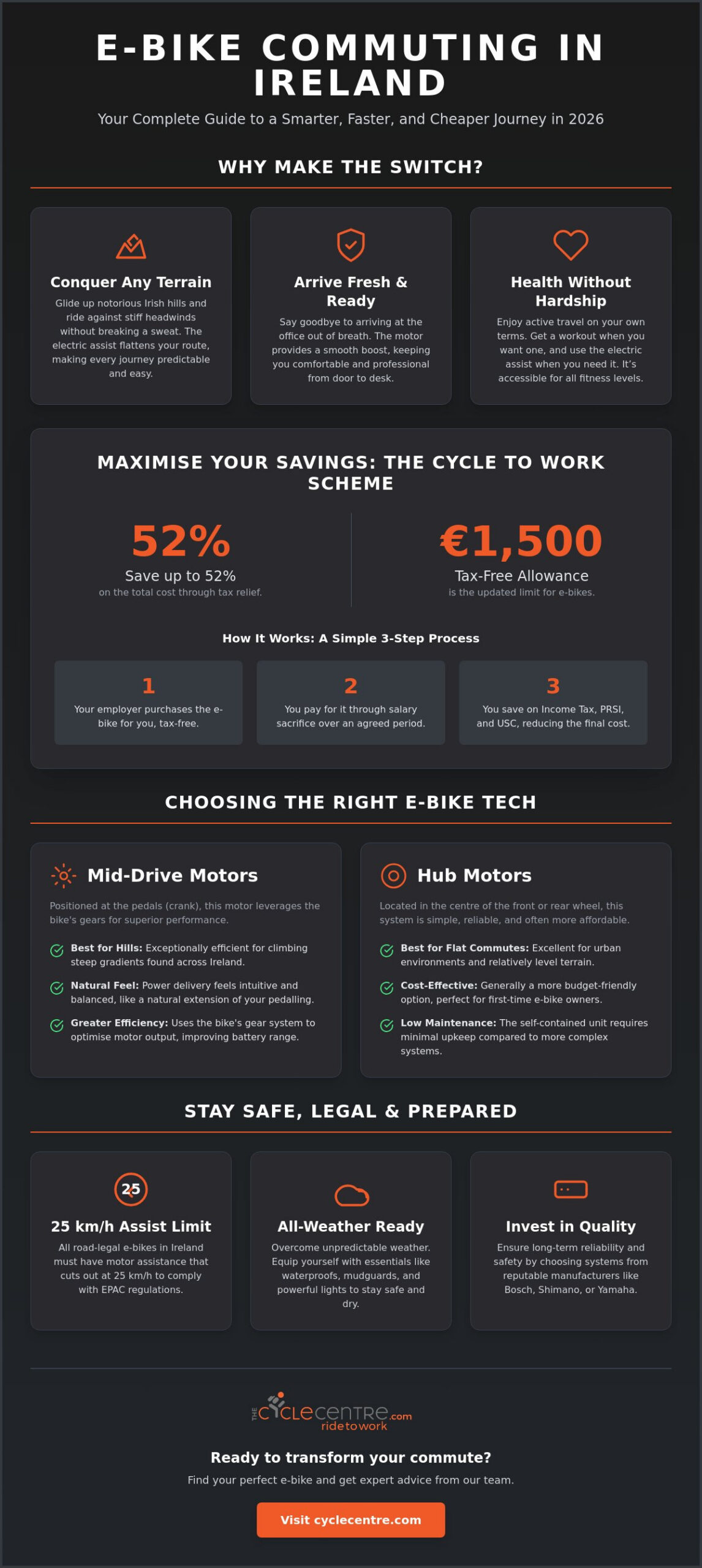
We understand that making the switch requires more than just enthusiasm; it requires clear, expert guidance on everything from battery safety to financial incentives. This guide promises to simplify your transition by explaining how to maximise your savings through the 2026 Cycle to Work scheme, where you can save up to 52% on the cost of a new ride. We will walk you through the updated €1,500 tax-free thresholds and the essential EPAC regulations to ensure your equipment is fully road-legal. From handling steep gradients to arriving at your desk feeling refreshed, you will discover how the latest technology turns a difficult journey into a reliable, enjoyable experience.
Key Takeaways
- Maximise your budget by understanding the updated 2026 Cycle to Work scheme limits, offering tax-free allowances of up to €1,500 for standard e-bikes.
- Identify the best motor and battery configurations for your specific route, ensuring you have enough torque to handle challenging Irish terrain with ease.
- Learn how to select the ideal e-bike for commuting Ireland by matching frame geometry and technical specs to your daily distance and storage needs.
- Overcome the hurdle of unpredictable weather by equipping yourself with essential all-weather gear that keeps you fresh and professional upon arrival.
- Stay compliant with the latest 2026 regulations regarding road legality and battery safety to ensure your investment remains secure and versatile.
The Rise of the E-Bike for Commuting in Ireland: Why 2026 is the Year to Switch
The modern commuter e-bike is far more than a standard bicycle with a motor bolted on. It’s a sophisticated hybrid that marries the mechanical efficiency of traditional cycling with cutting-edge electric bicycle technology. In 2026, we’ve reached a tipping point where these machines have become the primary choice for Irish professionals. This shift isn’t just about fashion; it’s a calculated response to the increasing difficulty of urban travel. By integrating an electric motor into the drivetrain, these bikes allow you to maintain a steady pace regardless of the incline or wind direction.
Choosing an e-bike for commuting Ireland solves the most common deterrent to cycling: the dreaded office arrival. Traditionally, a five-kilometre dash through city traffic meant arriving at your desk out of breath and needing a shower. E-bikes change this dynamic entirely. The motor provides a smooth, consistent boost that keeps your heart rate in a comfortable zone. You arrive feeling alert and energised, rather than exhausted. Beyond the physical ease, there is a profound mental health benefit to reclaiming your morning journey. Instead of being trapped in a metal box, you’re out in the fresh air, reducing your carbon footprint and starting your day with a sense of accomplishment.
Breaking the Car Dependency in Ireland
Owning a car in Ireland has become increasingly expensive. Between soaring insurance premiums, the rising cost of fuel, and the constant headache of maintenance, the financial burden is significant. In congested urban corridors like Dublin, Cork, or Galway, an e-bike often beats a car for door-to-door travel time. You bypass the static queues and ride directly to your destination without the twenty-minute hunt for a parking space. The e-bike revolution in Ireland represents a fundamental shift away from fossil-fuelled congestion and toward sustainable, independent mobility that puts the commuter back in control.
Health Without the Hardship
Pedal-assist technology provides a brilliant middle ground for those who want to stay active without the physical strain of a traditional commute. It’s active travel on your own terms. You can dial up the assistance on Monday morning when you’re feeling sluggish, or turn it down on a sunny Friday evening to get a proper workout. This customisable support makes it accessible to everyone, regardless of current fitness levels. If you’re still considering whether electricity is right for you, our guide to the standard commuter bike Ireland offers a look at traditional alternatives. However, for most, the ability to flatten hills with a simple click of a button is what makes the daily commute truly sustainable.
Understanding E-Bike Technology: Motors, Batteries, and Irish Terrain
Selecting the right e-bike for commuting Ireland requires a basic understanding of what happens beneath the frame. The motor and battery are the heart of your experience, and their configuration determines how well you’ll handle a coastal headwind or a steep inland climb. Unlike a car’s engine where horsepower is the headline figure, e-bike performance is defined by torque and efficiency. Choosing a system from a reputable manufacturer like Bosch, Shimano, or Yamaha ensures long-term reliability and access to spare parts, which is vital for a daily transport tool. You aren’t just buying a gadget; you’re investing in a vehicle that needs to perform every morning without fail.
Mid-Drive vs Hub Motors: Which Suits Your Route?
The position of the motor significantly impacts how the bike handles the Irish landscape. Mid-drive motors are located at the crank, directly between the pedals. This design allows the motor to leverage the bike’s gears, making it exceptionally efficient for climbing steep hills. If your commute involves significant elevation changes, a mid-drive system is usually the superior choice because it offers better balance and a more natural cycling feel. Hub motors, typically housed in the rear wheel, are often more cost-effective and work brilliantly for flatter urban commutes. Regardless of the motor type, all road-legal e-bikes in Ireland must adhere to a 25km/h assistance limit. This ensures you stay within the legal definition of a bicycle, meaning you don’t need a licence or insurance to ride.
When comparing models, look closely at the torque rating, measured in Newton metres (Nm). High torque is what allows you to start quickly at traffic lights and maintain momentum on inclines. Whilst top speed is restricted, a motor with 65Nm to 85Nm of torque will make the toughest hills feel practically flat. This is the “secret sauce” for an effortless e-bike for commuting Ireland, as it removes the physical strain from the most difficult parts of your journey.
Battery Life and Charging Logistics
Battery capacity is measured in Watt-hours (Wh). To estimate your real-world range, you must consider your total weight, the level of assistance you use, and the local terrain. A 500Wh battery typically provides ample range for most Irish commutes, often allowing for several days of travel between charges. Many modern designs feature removable batteries, which are incredibly convenient. You can simply click the battery out of the frame and charge it whilst at your desk using a standard wall socket. To keep these sophisticated systems running smoothly, we recommend regular professional maintenance such as our Workshop Gold Service.
When planning your purchase, keep in mind that the Cycle to Work Scheme rules allow for a €1,500 tax-free allowance for these machines. This financial support makes high-quality electrical systems much more accessible for the average professional.
Conquering the Irish Climate: Practical Tips for All-Weather Commuting
The most common objection we hear from potential riders is the belief that it simply rains too much. Whilst it is true that we have our fair share of “soft days,” the reality of using an e-bike for commuting Ireland is that you are rarely caught in a torrential downpour for the entire journey. Most rainfall in Ireland is intermittent. With the correct preparation, the weather becomes a minor logistical detail rather than a barrier. The key is shifting your mindset from avoiding the rain to equipping for the conditions. Modern e-bike components are designed with high IP (Ingress Protection) ratings, meaning they are built to handle the damp Irish climate without skipping a beat.
Your “Irish Commuter Kit” should be built around three pillars: protection, storage, and visibility. High-quality waterproof panniers are essential to keep your laptop and office clothes dry, as backpacks can lead to a sweaty back even with motor assistance. Integrated lights that run off the main e-bike battery are another significant advantage. They ensure you are never caught out by a dead battery on a dark November evening. Finally, don’t overlook the impact of road salt and grit during the winter months. A quick rinse with fresh water after a coastal or wintry ride prevents corrosion on your motor housing and drivetrain, preserving your investment for years to come.
Irish-Proofing Your E-Bike
Full-length mudguards are the single most important accessory for keeping your work attire pristine. They prevent the “skunk stripe” of road spray from reaching your back and keep water away from your shoes. For those seeking the ultimate low-maintenance experience, we often recommend e-bikes with belt drives rather than traditional chains. These systems don’t require oil, which means no greasy marks on your trousers and no rust after a rainy week. To ensure you stay comfortable from head to toe, consult our comprehensive guide on cycling apparel Ireland for expert advice on breathable, waterproof layers.
Security and Storage Solutions
Security is a valid concern in urban centres. We suggest a “hierarchy of locks” approach. A high-quality D-lock should be your primary defence, ideally paired with a heavy-duty chain for the wheels. Many modern e-bikes now feature integrated GPS trackers and alarm systems that sync directly to your smartphone. These provide a layer of digital security that was previously unavailable, allowing you to monitor your bike’s location in real-time. Whenever possible, utilise secure indoor bike parking at your workplace. If you must park on the street, choosing a well-lit, high-traffic area is always the best strategy for peace of mind.
Maximising Savings with the Cycle to Work Scheme Ireland
Standard E-Bike vs Cargo E-Bike Limits
It’s vital to understand the specific thresholds set by Revenue to ensure you maximise your allowance. For a standard e-bike for commuting Ireland, the tax-free limit is €1,500, which covers the bike and essential safety equipment. However, if you require a more versatile car replacement, the limit for cargo and e-cargo bikes is significantly higher at €3,000. These larger models are ideal for families needing to transport children or professionals carrying heavy equipment. For a deeper dive into the specific policy nuances and eligibility, you can consult the ultimate guide to the Bike to Work scheme Ireland 2026.
The Application Journey
Starting your journey is a straightforward, step-by-step process designed to reduce administrative friction. Once you’ve selected your ideal model from leading brands like Cube or Giant, we provide a formal quote that you submit to your employer. After your employer approves the quote and settles the invoice, you can collect your new e-bike and begin your commute. Our online quote system is built for busy professionals, ensuring you can organise the paperwork quickly and efficiently. If you’re ready to transform your daily travel and start saving, you can apply for the Cycle to Work scheme today and join the thousands of Irish commuters who have already reclaimed their morning journey.
Choosing the Right E-Bike: Performance, Comfort, and Reliability
Finding the perfect e-bike for commuting Ireland isn’t just about the biggest battery or the most powerful motor. It’s about how the bike feels beneath you during those crucial morning miles. A bike that fits your body and your route will become a reliable partner, whereas a poorly matched frame will likely end up gathering dust in the shed. This is where the value of a test ride becomes apparent. Every motor system has a slightly different “feel”; some provide a punchy, immediate boost whilst others offer a more subtle, natural assistance. Experiencing these nuances firsthand is the only way to find your favourite setup.
Our Smart-bike Search tool is designed to narrow down these choices from world-class brands, filtering by your specific needs and budget. However, the technology is only half the story. The role of an independent bike shop is to provide the expert fit and long-term support that online retailers simply cannot match. We ensure the handlebars, saddle height, and reach are perfectly adjusted to prevent discomfort and injury over long-term use. A professional fitting ensures that your e-bike for commuting Ireland is a joy to ride, day after day.
E-City vs E-Road: Finding Your Fit
E-city bikes are the quintessential choice for urban professionals. They feature an upright geometry that provides excellent visibility in traffic and makes mounting and dismounting easy, even in office attire. These are perfect for shorter hops across the city centre where comfort is the priority. In contrast, E-road or Gravel bikes are engineered for efficiency over longer distances. Their more aerodynamic position and lightweight frames make them the ideal choice for multi-terrain commutes that might include towpaths or rural backroads. If you’re planning to extend your cycling adventures to the whole family, our kids bike size guide Ireland is an excellent resource for ensuring the younger riders are just as comfortable on weekend excursions.
The Cycle Centre Advantage
Since our family-owned shop was founded in 1974, we’ve seen decades of industry evolution. We aren’t just selling a product; we’re facilitating a lifestyle change. Our commitment to your journey continues long after you leave the shop. As a Shimano accredited centre, we offer specialised Workshop Silver and Gold service packages specifically designed to keep high-mileage commuter bikes in peak condition. Regular professional maintenance is the secret to a reliable commute, ensuring your brakes, gears, and electrical systems are always ready for the road ahead. If you’re ready to make the switch, apply for your no-obligation Cycle to Work quote today and let our decades of expertise guide you toward the perfect ride.
Reclaim Your Daily Journey
Reclaiming your morning commute is no longer a distant aspiration; it’s a practical reality made possible by the latest technical innovations and supportive government schemes. Choosing an e-bike for commuting Ireland allows you to prioritise your mental well-being and financial health over the stress of gridlock and rising fuel costs. Whether you require the hill-climbing torque of a mid-drive motor or the family-friendly capacity of a cargo bike, the solution is within reach.
At The Cycle Centre, we’ve been serving Irish cyclists since 1974. As a Shimano Accredited Workshop and proud stockists of world-class brands like Giant, Cube, and Romet, we possess the expertise to ensure your transition is seamless and supported. From the initial test ride to long-term maintenance, our team is here to help you navigate every step of the process with confidence. Take the first step toward a sweat-free, cost-effective journey today.
Get your free, no-obligation Cycle to Work quote from The Cycle Centre and discover just how much you can save on your new ride. We look forward to helping you start your next adventure.
Frequently Asked Questions
Can I really save 52% on an e-bike through the Cycle to Work scheme?
Yes, you can save up to 52% on the retail price of an e-bike by utilising the Cycle to Work scheme. This saving is achieved through a salary sacrifice arrangement where deductions are taken from your gross pay before Income Tax, PRSI, and USC are applied. For an e-bike for commuting Ireland with a €1,500 limit, a higher-rate taxpayer could save approximately €780 compared to buying the bike privately.
What happens if my e-bike battery runs out whilst I’m commuting?
If your battery runs out, your e-bike will continue to function exactly like a traditional bicycle. You won’t be stranded, but you will have to rely entirely on your own leg power to move the bike’s additional weight without motor assistance. Most modern systems provide clear displays to help you manage your range and avoid this situation during your journey into the office.
Are e-bikes legal to use on all Irish roads and cycle lanes?
E-bikes that meet EPAC standards are legal on all Irish roads where traditional bicycles are permitted, including dedicated cycle lanes and bus lanes. Under the Road Traffic and Roads Act 2023, these vehicles are treated as bicycles rather than motor vehicles. You must not ride them on footpaths or motorways, and you must always adhere to the standard rules of the road.
How often does an e-bike need a professional motor service in Ireland?
We recommend a professional service at least once every twelve months, or every six months if you are a high-mileage commuter. Regular maintenance ensures that your motor remains efficient and your battery health is monitored. Our Shimano accredited workshop provides specialised care to keep your electrical components and drivetrain running smoothly through the damp and grit of Irish winters.
Is it safe to leave my e-bike outside in the Irish rain?
E-bikes are designed to be weather-resistant and can certainly handle being ridden or parked briefly in the rain. Most components carry high IP ratings to protect against moisture ingress. However, for long-term reliability and to prevent corrosion from salt air or prolonged dampness, it’s best to store your bike indoors or under a high-quality waterproof cover whenever possible.
Do I need a special licence or insurance to ride an e-bike in Ireland?
You do not need a driving licence, road tax, or mandatory insurance to ride a standard EPAC e-bike in Ireland. As long as the motor has a maximum continuous rated power of 250 watts and the assistance cuts out at 25 km/h, the law treats it like a pedal bicycle. If a bike exceeds these specific limits, it is classified as an e-moped and requires a licence and registration.
Which is better for commuting: a mid-drive or a hub motor e-bike?
The best choice depends entirely on your specific route and topography. Mid-drive motors are superior for hilly commutes as they leverage the bike’s gears for better climbing efficiency and a more natural feel. Hub motors are often more affordable and work perfectly for flatter, urban journeys. Choosing the right e-bike for commuting Ireland involves matching these motor characteristics to your local terrain.
Can I use the Cycle to Work scheme if I already have a traditional bike?
You can absolutely use the scheme even if you already own a traditional bicycle. The primary restriction is the four-year eligibility period rather than previous bike ownership. If you last utilised the scheme in 2022 or earlier, you are eligible to use it again from January 1, 2026. This allows you to upgrade to electric technology whilst keeping your old bike for weekend leisure.