


Why pay the full retail price for your daily commute when the Irish government is willing to cover more than half the cost? It’s a question many professionals are asking as they look to upgrade their morning travel whilst managing the rising costs of living. We understand that the ride to work scheme Ireland can often feel like a maze of technical jargon and bureaucratic hurdles. You might be feeling some anxiety over the salary sacrifice process or find yourself confused by the varying price caps for e-bikes versus traditional road cycles. It’s perfectly natural to want absolute clarity before committing to a four-year investment in your personal mobility.
This guide provides a clear, methodical breakdown of the 2026 regulations so you can save up to 52% on a brand-new bicycle and essential safety gear. We’ll explain the three specific spending limits, ranging from €1,250 for standard bikes to €3,000 for e-cargo models, and demystify the four-year eligibility rule. By the end of this article, you’ll have the knowledge to choose a durable bike and understand exactly how to apply for a no-obligation quote. Let’s explore how you can transform your commute into a source of freedom and fitness through informed, practical choices.
Key Takeaways
- Understand the core mechanics of the ride to work scheme Ireland, a government-backed incentive that allows you to purchase a high-quality bicycle and safety equipment through tax-free salary deductions.
- Learn how the salary sacrifice model can reduce the total cost of your commute by up to 52%, depending on your specific tax bracket and PRSI rates.
- Navigate the 2026 price thresholds, including the €1,500 limit for e-bikes and the €3,000 allowance for cargo bikes, to ensure you select the right machine for your journey.
- Master the four-year eligibility rule to avoid the trap of buying low-quality bikes that won’t last the duration of your tax-free period.
- Follow a simple, step-by-step application process to obtain a formal, no-obligation quote and get your commute upgrade moving.
What is the Ride to Work Scheme in Ireland?
The ride to work scheme Ireland is a government-backed tax incentive designed to make active travel more accessible for the modern professional. At its core, the initiative allows employers to purchase new bicycles and safety equipment on behalf of their staff. Employees then repay the cost through a salary sacrifice arrangement. This isn’t just a simple purchase agreement; it’s a strategic move to reduce urban congestion and improve national health. By 2026, Ireland’s cycling infrastructure has matured significantly, with more dedicated lanes and secure parking facilities, making this the ideal time to transition away from car-dependent commuting.
There is often some confusion surrounding the terminology used by different providers and government bodies. Whether you hear it described as “Bike to Work,” “Cycle to Work,” or the “Ride to Work” scheme, these names all refer to the same statutory tax break. This initiative is closely modelled on the broader Cycle to Work Scheme found in other jurisdictions, though the Irish version has its own unique thresholds and eligibility rules. We’ve seen this scheme evolve over decades, and the current 2026 regulations offer some of the most generous incentives since its inception.
The Three Spending Tiers Explained
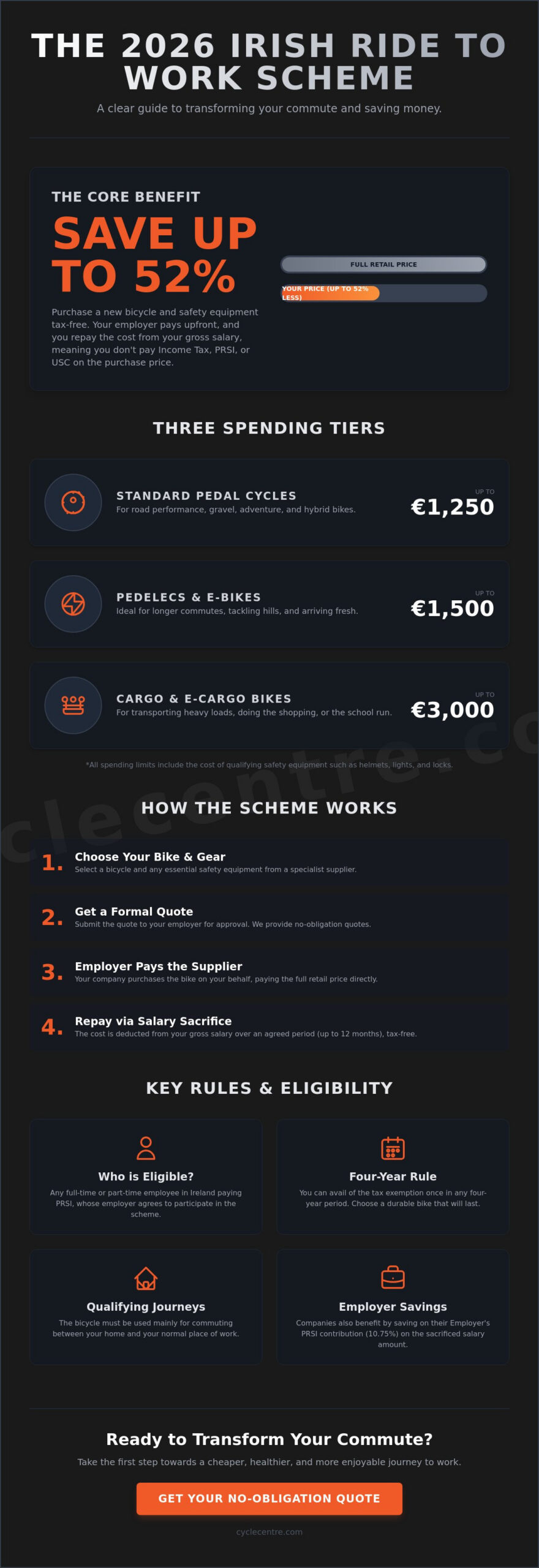
The scheme utilizes a tiered financial structure to reflect the diverse needs of commuters. For those seeking standard pedal cycles, such as road performance bicycles or gravel and adventure bikes, the tax-free limit is set at €1,250. If your commute involves significant hills or longer distances, you can avail of a €1,500 limit specifically for pedelecs and electric bikes. For those needing to transport heavy loads or children, the limit extends to €3,000 for cargo and e-cargo bicycles. These figures include both the bike and qualifying safety equipment like helmets and lights.
Who is Eligible for the Scheme?
Eligibility is straightforward but carries specific requirements. Any full-time or part-time employee paying PRSI in Ireland can participate, provided their employer is willing to facilitate the scheme. The primary condition is that the bicycle must be used mainly for “qualifying journeys,” which includes travel between your home and your normal place of work. It’s important to understand that self-employed individuals generally cannot participate unless they are also registered as PAYE employees of their own limited company. This ensures the tax benefit remains tied to the salary sacrifice mechanism.
Understanding the Financial Savings: Tax, PRSI, and USC
The financial appeal of the ride to work scheme Ireland is rooted in how the Revenue treats the purchase. Instead of buying a bike with your take-home pay, your employer pays the full retail price upfront and you “sacrifice” a portion of your gross salary to pay them back. This subtle shift in accounting means you don’t pay Income Tax, PRSI, or USC on the money used for the bike. For those in the higher tax bracket, these combined savings often reach a substantial 52% off the retail price. It’s an efficient way to acquire premium equipment whilst keeping more of your hard-earned money in your pocket.
It is a mutually beneficial arrangement that extends beyond the employee’s payslip. Employers also save money by not paying the 10.75% employer PRSI on the portion of the salary you sacrifice. This financial incentive is why so many Irish companies are eager to facilitate the scheme. It reduces their overheads whilst promoting a healthier, more punctual workforce. You can find the finer details and statutory limits in Revenue’s official Cycle to Work Scheme guide.
How Salary Sacrifice Works in Practice
Revenue guidelines are quite specific about the timeline for these deductions. The salary sacrifice arrangement must be completed within a maximum period of 12 months. Because the deductions happen before any tax is applied to your payslip, the cost is spread out across your chosen term whilst your tax bill is simultaneously lowered. It’s a steady, methodical way to manage the investment. Under the terms of the agreement, the bicycle is technically owned by your employer until the final deduction is made and the agreement is satisfied.
Calculating Your Potential Savings
Your total savings depend largely on whether you pay the standard 20% rate of Income Tax or the higher 40% rate. When you factor in the relief on PRSI and USC, the reduction in cost becomes truly significant. To get the maximum value from the scheme, we always recommend bundling your essential safety equipment, such as cycling helmets and apparel, into your initial application. This ensures your entire setup is tax-efficient from day one. For a deeper dive into the specific math and to see how the numbers work for different bike types, check out our Cycle to Work Scheme: How It Works guide.
If you’re ready to see how these figures apply to your dream bike, you can browse our range of Road Performance Bicycles and start planning your upgrade today.
Qualifying Bicycles and Equipment: Choosing Your Ride
Selecting the right equipment is perhaps the most critical stage of your journey. Since you can only use the ride to work scheme Ireland once every four years, it’s vital to choose a machine that withstands the rigours of daily commuting. Many seasoned commuters now favour road performance bicycles for their speed on tarmac, whilst others opt for gravel and adventure bikes to handle the varied surfaces of Irish backroads. These categories offer the durability and technical precision needed to ensure your investment remains a reliable companion well beyond the repayment period. To help you narrow down your options, our guide to the best bike for cycle to work scheme savings in 2026 provides a detailed roundup of the top commuter models available across every spending tier.
The Revenue is quite specific about what qualifies for the tax break. According to the Citizens Information guide to the Cycle to Work Scheme, the equipment must be new and purchased through an approved retailer. Whilst most safety gear is covered, there are notable exclusions. For instance, you cannot use the scheme for second-hand bicycles, child seats, or trailers. It’s best to focus your budget on the core essentials that fit within the ride to work scheme Ireland framework: a reliable frame and the safety components that keep you visible and secure.
Electric Bikes and the Ride to Work Scheme
The recent increase in the threshold to €1,500 has transformed the market for E-city bikes and E-road models. These electric-assist models allow you to tackle steep gradients and longer distances without arriving at the office exhausted. When evaluating your options, we recommend focusing on models equipped with Bosch, Shimano, or Yamaha motor systems. These brands are the industry standard for reliability and long-term serviceability. For a deeper technical breakdown, our Electric Bike Cycle to Work Guide offers motor-specific advice to help you decide.
Essential Safety Accessories to Bundle
Don’t overlook the accessories that make daily cycling practical. In the Irish climate, mudguards and panniers aren’t just luxuries; they’re essential for arriving dry and organised. Security is another major consideration for urban commuters. We strongly advise investing in high-quality locks, such as those from Kryptonite, to protect your new asset. Remember to include pumps, puncture repair kits, and a helmet that meets the EN 1078 safety standard in your initial application. Bundling these items now ensures you get the full tax benefit on everything you need to stay on the road safely.
Navigating the Four-Year Eligibility Rule
One of the most misunderstood aspects of the ride to work scheme Ireland is the timing of your next application. The regulation operates on a strict tax-year cycle rather than a rolling 48-month period. If you avail of the scheme at any point during 2026, you will only become eligible again on the 1st of January 2030. This lockout period is non-negotiable and applies to you as an individual, regardless of whether you change employers in the meantime. Because you are effectively “locked in” to your choice for four years, your selection must be based on long-term durability rather than immediate cost savings.
We often see commuters fall into the trap of purchasing “bargain” bikes that aren’t designed for the rigours of a daily Irish commute. If a low-quality bicycle suffers a terminal frame failure or significant mechanical breakdown after only two years, you cannot simply re-apply for a tax-free replacement. You would be forced to purchase a new bike with your net, after-tax income. This makes maintenance absolutely critical whilst you wait for your next eligibility window to open. Taking a “quality-first” approach is the only way to ensure your investment actually lasts the full duration of the scheme’s cycle.
Future-Proofing Your Purchase
To ensure your bike survives four years of Irish weather and road conditions, we recommend selecting durable, well-established brands like Giant or Cube. These manufacturers offer superior frame warranties and use standardised components that are easier to service as the years progress. Gravel and adventure bikes have become particularly popular for this reason; their robust frames and wider tyre clearances make them incredibly versatile for both city streets and rougher backroads. To keep your machine in peak condition during the four-year lockout, investing in a High-End Road Bike Service is a wise move that prevents minor wear from turning into a costly replacement.
What Happens if You Change Jobs?
If you move to a new company before your 12-month salary sacrifice term is complete, the remaining balance becomes due immediately. Typically, your current employer will deduct this final amount from your last payslip. It’s important to remember that moving jobs doesn’t reset your four-year clock. Revenue tracks the benefit against your PPS number, so your eligibility date remains January 2030 even at a new firm. Always keep your original invoice in a safe place; it’s essential for any warranty claims you might need to make during your four-year journey.
Ready to choose a bike that stands the test of time? Explore our range of Gravel and Adventure Bikes to find your perfect long-term commuting partner.
Starting Your Application: The Specialist Advantage
Initiating your journey with the ride to work scheme Ireland is a straightforward process when approached with a methodical mindset. Whilst the administrative side is handled by your employer, your first task is to ensure you’re choosing a partner that offers more than just a transaction. We’ve helped thousands of commuters navigate this path, and the most successful applications always follow these four clear steps:
- Consult your HR department: Confirm which scheme provider your organisation uses and check for any internal deadlines or specific caps they might have in place.
- Obtain a formal quote: Visit an accredited retailer to select your bike and gear. You’ll need a precise, no-obligation quote that clearly breaks down the costs for your employer.
- Submit for approval: Pass your quote to your employer for final sign-off. They will then arrange payment directly with the bike shop.
- Collect and commute: Once the payment is processed and the salary sacrifice agreement is signed, you can collect your new machine and start your tax-free journey.
Why an Independent Shop Outperforms the Chains
While large retail chains might offer a vast array of stock, they often lack the deep-rooted expertise of a specialist independent shop. Choosing a retailer with a Shimano-accredited workshop ensures your bike receives a professional assembly and a rigorous safety check before you ever turn a pedal. We utilise a Smart-bike Search approach to help you find a frame that perfectly matches your height, reach, and the specific terrain of your daily route. This level of technical precision is vital for a bike you’ll be riding for the next four years. Beyond the initial purchase, having access to Workshop Gold and Silver Service packages means your investment is protected by experts who know your bike’s history from day one.
Getting Your No-Obligation Quote
Precision is paramount when preparing your paperwork. Revenue is strict about the details, and any discrepancies in pricing or equipment descriptions can lead to frustrating delays. To streamline this process, you can use our Cycle to Work Application Guide, which provides a clear template for everything you need to include. By ensuring your quote is accurate and comprehensive from the start, you reduce the friction for your HR department and get on the road much faster. It’s about moving from uncertainty to informed confidence with the help of a mentor who has seen every iteration of the ride to work scheme Ireland.
Ready to take the first step towards a healthier, more cost-effective commute? Request your no-obligation Ride to Work quote from The Cycle Centre today.
Upgrade Your Commute with Confidence
Transitioning to a cycle-based commute is more than a cost-saving measure; it’s a commitment to a healthier lifestyle and a more efficient daily routine. By leveraging the ride to work scheme Ireland, you can secure world-class brands like Giant and Cube whilst enjoying tax relief of up to 52%. Remember that your choice today must sustain you through the four-year eligibility window. This makes quality assembly and ongoing maintenance essential components of your long-term investment.
Since 1974, we’ve provided over 50 years of expertise to the Irish cycling community. Our Shimano Accredited Workshop is ready to support you with professional Silver and Gold servicing to keep your bike in peak condition for years to come. Don’t leave your commute to chance. Apply for your tax-free Ride to Work quote at The Cycle Centre and let our team guide you towards the perfect ride. We look forward to helping you rediscover the freedom and exploration of the open road.
Frequently Asked Questions
Can I buy two bikes under the Ride to Work scheme Ireland?
Yes, you can purchase two bicycles as part of a single application, provided the combined cost of both bikes and your safety gear stays within the relevant threshold. This is a practical solution for commuters who might require a folding bike for public transport links and a standard road bike for the final leg of their journey. It’s important to remember that you can’t make two separate applications at different times within the four-year window.
Does the Ride to Work scheme cover electric scooters in 2026?
No, the ride to work scheme Ireland does not currently include electric scooters or any other micro-mobility vehicles. The tax incentive is strictly reserved for bicycles, pedelecs (electric-assist bikes), and cargo bikes as defined by the Revenue. Whilst e-scooters are a common sight in urban centres, they remain outside the statutory framework of this specific commuting scheme for the 2026 tax year.
What happens to the bike if I leave my job before the 12 months are up?
If your employment ends before you’ve completed the salary sacrifice term, you must settle the remaining balance immediately. Typically, your employer will deduct this final amount from your last payslip before you leave the company. Once this payment is finalised, the ownership of the bicycle transfers to you, and you’re free to take the bike to your new workplace without any further obligations.
Is there a minimum number of days I must cycle to work?
There is no specific number of days or miles mandated by law, but the bicycle must be used mainly for qualifying journeys. This means the primary purpose of the bike should be for travel between your home and your normal place of employment. You’ll be required to sign a declaration confirming that the bike is for your own use and will be used for these commuting purposes.
Can I use the scheme to buy a bike for my child or spouse?
No, the scheme is designed exclusively for the employee’s personal use for commuting to and from work. You cannot use the tax-free benefit to purchase a bicycle for a spouse, partner, or child. Since the salary sacrifice is tied to your own PRSI and Income Tax contributions, the equipment must be used by you to satisfy the requirements of the Revenue’s commuting regulations.
Does the scheme apply to second-hand or refurbished bicycles?
No, the incentive is only applicable to brand-new bicycles and qualifying safety equipment. Second-hand or refurbished bikes are excluded from the scheme, even if they’re sold through an accredited retailer. This ensures that all bikes purchased through the initiative meet current safety standards and are capable of lasting the full four-year period before you become eligible to use the scheme again.
What is the maximum I can spend on an E-bike in 2026?
The maximum threshold for an electric-assist bicycle (pedelec) and safety equipment is €1,500 in 2026. This limit allows you to choose from a wide range of high-quality E-city and E-road models. If you select a bike that costs more than this amount, you can still purchase it through the scheme, but you’ll only receive tax relief on the first €1,500 of the total price.
How do I know if my employer is registered for the scheme?
The most direct way to find out is to speak with your HR or payroll department. There’s no central public register because the ride to work scheme Ireland is a voluntary arrangement that employers choose to facilitate. Most companies are very supportive of the initiative because it reduces their employer PRSI costs whilst encouraging a healthier, more active workforce. If they haven’t used the scheme before, they can easily set it up with a provider of their choice.