


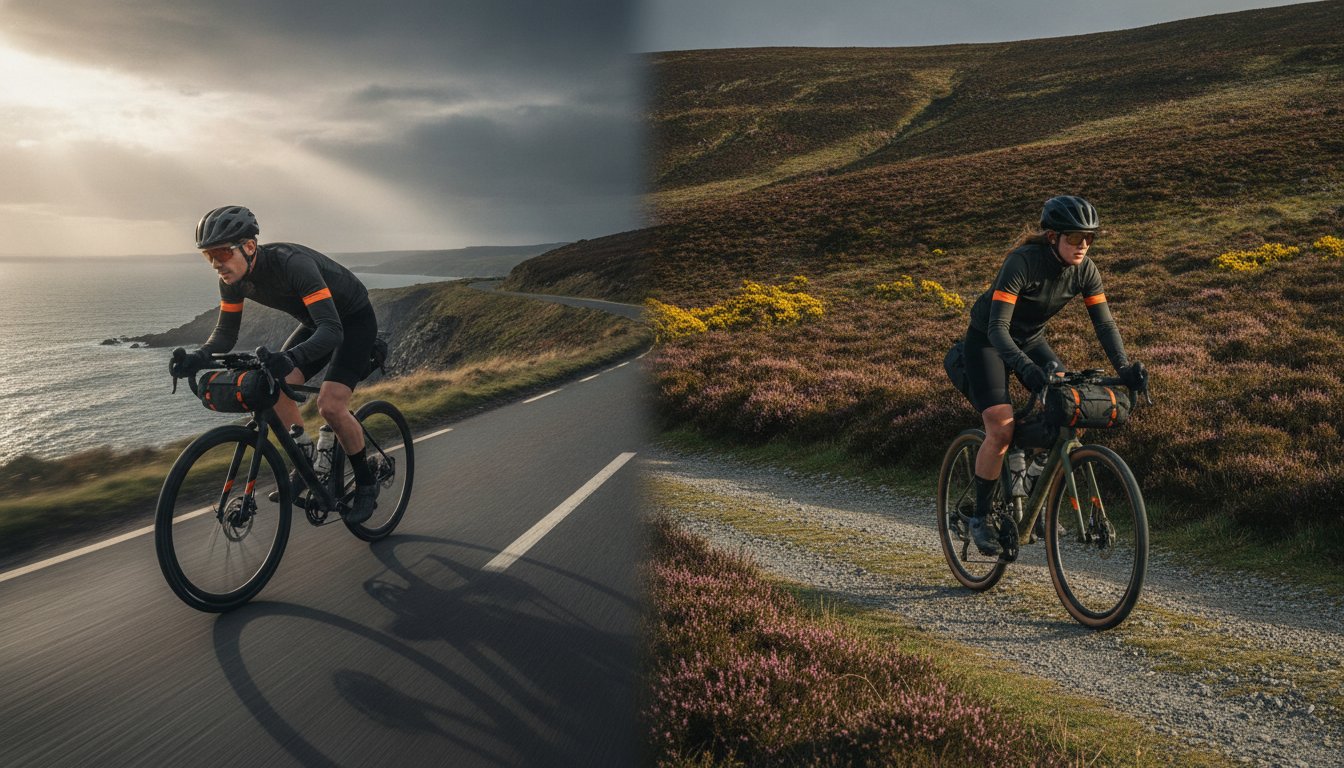
Could the bike you think is perfect for your weekend escapes actually be the one that leaves you feeling exhausted by the time you reach the Wicklow Gap? It’s a common dilemma in 2026, as the lines between different off-road categories continue to blur. You might worry about buying a machine that feels sluggish on the smooth sections of the coast road, or conversely, a bike that feels fragile at the first sight of a loose limestone trail. Understanding the adventure bike vs gravel bike Ireland distinction is no longer just for the gear-obsessed; it’s essential for anyone looking to make the most of our unique, often unpredictable landscape.
While cycling offers a unique connection to the terrain, some explorers prefer the range and power of motorised options; for instance, specialists in Pre-owned motorcycle and powersports vehicle sales provide the type of robust machinery needed for those who want to push their off-road adventures even further.
We know that choosing a new ride is a significant decision, especially whilst trying to maximise the benefits of the €1,250 Cycle to Work scheme threshold. You want a bike that handles the grit of a rainy Tuesday commute just as well as a sun-drenched tour of the Wild Atlantic Way. This article provides the clarity you need to choose between speed and stability. We will examine the core differences in geometry and tyre clearance, whilst explaining how to match specific bike features to the rugged Irish routes you plan to conquer.
Key Takeaways
- Identify how frame geometry impacts your endurance, helping you choose between aerodynamic speed for club rides or upright comfort for multi-day touring.
- Understand the critical role of tyre clearance in mastering Irish terrain, whether you are navigating prepared greenways or rugged, unpaved boreens.
- Evaluate the adventure bike vs gravel bike Ireland performance trade-offs to ensure your new ride is neither too slow for the road nor too fragile for the trails.
- Learn how to maximise your 2026 Cycle to Work scheme benefits whilst selecting a bike that features the necessary mounting points for your specific luggage needs.
- Discover how to use our Smart-bike Search to filter technical specifications and find a machine that matches your primary riding surface perfectly.
Defining the Adventure Bike vs Gravel Bike Debate for Irish Riders
For many years, Irish cyclists felt they needed a garage full of bikes to cover every eventuality. You might have had a lightweight frame for the Sunday club run, a sturdy hybrid for the commute, and perhaps a mountain bike for the occasional forest trail. In 2026, the trend has shifted decisively toward a single, versatile machine. This “one-bike” solution is at the heart of the adventure bike vs gravel bike Ireland discussion, as riders look to simplify their setups without losing the ability to explore.
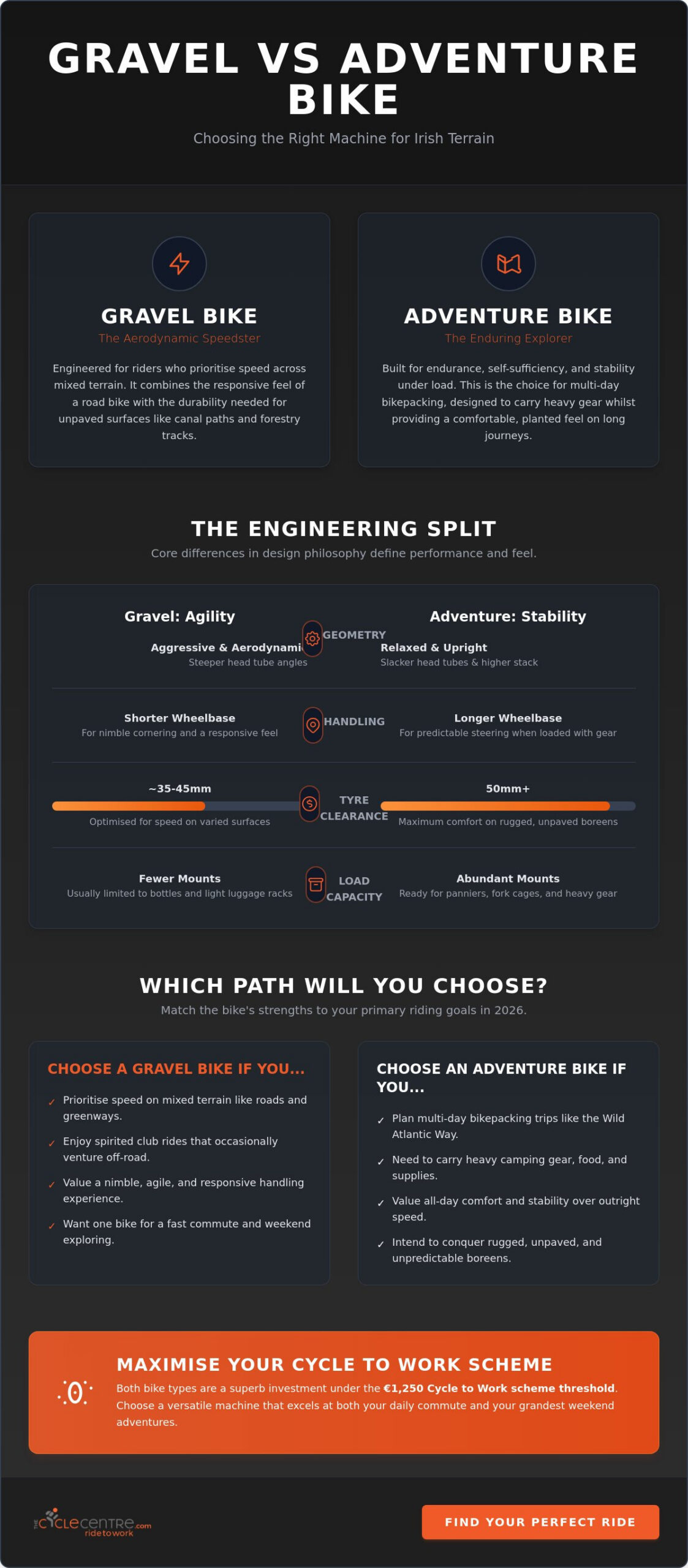
A gravel bike is effectively the aerodynamic speedster of the unpaved world. It inherits the spirited DNA of a road performance bicycle but adds the ruggedness needed for loose surfaces. To get a sense of the technical evolution, exploring What is a Gravel Bike? shows how these machines bridge the gap between tarmac racing and off-road durability. They are designed for those who prioritise speed across mixed terrain, offering a responsive feel that can keep pace with road groups whilst still confidently tackling canal paths and forestry tracks.
Adventure bikes focus on a different set of priorities. These are the load-carrying explorers of the cycling world, engineered for self-sufficiency and endurance. Whilst they share the drop-handlebar silhouette of their gravel cousins, they are built to be more stable under the weight of camping gear or heavy panniers. Choosing between these categories matters for your 2026 goals because the wrong choice could mean a bike that feels too twitchy on a descent or one that feels unnecessarily heavy on a fast group ride.
The Rise of Off-Road Cycling in Ireland
The popularity of off-road cycling has soared recently, driven by a combination of factors unique to the Irish landscape. Our rural roads, or “boreens,” are often characterised by crumbling tarmac and loose chippings that make traditional 25mm road tyres feel punishing. Simultaneously, the massive expansion of the national Greenway network has opened up hundreds of kilometres of traffic-free, prepared trails. Irish riders are moving away from aggressive, race-focused geometry in favour of bikes that can handle these varied surfaces with ease and comfort.
Quick Definitions: Gravel vs Adventure
Gravel bikes are performance-oriented mixed-surface machines designed to maintain high speeds over varied terrain. Adventure bikes are utility-focused endurance machines built for stability and carrying capacity over long distances. In modern bike design, these lines often blur; many gravel frames now include the mounting points once reserved for adventure bikes, whilst adventure bikes are becoming lighter and more capable on the road.
The Engineering Split: Geometry, Tyre Clearance, and Mounting Points
Whilst the silhouettes of these two categories appear identical to the untrained eye, the engineering DNA beneath the paintwork tells a different story. The adventure bike vs gravel bike Ireland debate often centres on how a frame handles the weight of a rider and their gear over several hours. In 2026, we see a clear divergence in how manufacturers approach these designs. A gravel bike is built for agility; it feels snappy and responsive when you stand on the pedals to clear a short, steep climb. Conversely, an adventure bike prioritises a “planted” feel, ensuring that your steering remains predictable even when you’ve strapped twenty kilograms of gear to the frame.
Geometry: Stability vs. Agility
Gravel geometry typically features shorter wheelbases and steeper head tube angles. This setup encourages aggressive cornering and makes the bike feel alive on winding forest tracks. Adventure bikes lean toward a more relaxed approach, utilising slack head tubes and longer wheelbases to provide maximum stability. This difference in stack and reach is vital for managing fatigue. A higher stack height on an adventure frame keeps your posture more upright, reducing the strain on your lower back and neck during a long day in the saddle. Understanding the nuance between Adventure vs. Gravel vs. Touring is essential for deciding whether you need a nimble racer or a steady workhorse for your next expedition.
Load Capacity and Utility
If you plan on multi-day bikepacking across the Wild Atlantic Way, the adventure bike is your dedicated pack-mule. These frames are peppered with mounting points, including “anything cages” on the fork blades and multiple bottle bosses. Gravel bikes take a more minimalist approach, often favouring “fast-packing” setups that use strap-on bags rather than permanent racks. For the Irish rider, mudguard clearance is perhaps the most critical engineering factor. A bike that lacks sufficient space for full-length guards will quickly become a liability during our frequent downpours. You can explore our latest range of Gravel and Adventure Bikes to see how different brands balance these mounting options.
The final piece of the engineering puzzle is tyre clearance. The 2026 trend has seen standard gravel bikes comfortably adopting 40mm tyres, whilst adventure models often push beyond 50mm to handle truly rugged terrain. When paired with hydraulic disc brakes, which are non-negotiable for safe descending on wet Irish roads, these wider tyres provide the grip and confidence needed to explore beyond the tarmac. Choosing the right clearance today ensures your bike remains versatile as you discover new routes next season.
Speed on the Boreens vs. Comfort on the Coast: Performance Comparison
Speed is often the first metric riders consider when weighing up the adventure bike vs gravel bike Ireland debate. If your typical Sunday involves chasing personal bests on the smooth tarmac of the Copper Coast, a gravel bike is your natural ally. These machines are designed to feel light and eager under power. In contrast, an adventure bike prioritises the way a frame absorbs the relentless “buzz” of poorly maintained secondary roads. Whilst a gravel bike might skip over the surface, an adventure bike uses its increased mass and specific tubing profiles to dampen vibrations, keeping you fresher for longer on multi-day excursions.
The “Quiver Killer” Argument
Many riders ask if a gravel bike can truly replace a dedicated road performance bicycle. In 2026, the answer is increasingly yes. By simply swapping out 40mm knobbly tyres for 32mm slicks, a modern gravel bike can comfortably hold its own in a standard road club group. However, an adventure bike often becomes too heavy for these casual weekend spins. The extra frame reinforcement and heavier wheelsets required for carrying luggage can make an adventure bike feel sluggish when you’re trying to keep pace on a fast climb. For the average Irish commuter, the gravel bike offers a more energetic middle ground that handles the daily grind without feeling like a chore.
Drivetrains and Braking
The rolling nature of the Irish landscape places unique demands on your gearing. In 2026, the industry standards for off-road shifting have settled around Shimano GRX and SRAM XPLR. You must choose between the simplicity of a 1x (single chainring) system or the versatility of a 2x setup. For riders frequently tackling the steep, relentless gradients of the Gap of Dunloe or the Healy Pass, a 2x drivetrain remains the superior choice. It provides smaller jumps between gears, allowing you to maintain a consistent cadence regardless of the incline. 1x systems are popular for their reliability in the mud, but they can sometimes leave you searching for a “missing” gear on long, flat coastal stretches. Riders who find those coastal headwinds particularly punishing may also want to explore how an electric road bike Ireland cyclists are adopting can augment your effort on exposed stretches without sacrificing the feel of a traditional ride.
Maintenance is the final, practical consideration. Irish grit and rain are notoriously hard on components. Whilst carbon frames offer incredible agility, the durability of aluminium or steel adventure frames shouldn’t be overlooked if you plan to ride year-round. These materials often withstand the “sandblasting” effect of wet Irish roads better over several seasons. Regular cleaning is essential, but choosing a bike with well-sealed bearings and internal cable routing will significantly reduce your time in the workshop and ensure your ride remains crisp and responsive.
Selecting the Right Frame for the Irish Landscape
Ireland isn’t a land of uniform terrain. Choosing your frame starts with a map, not a spec sheet. If your goal is to master the 130 kilometres of the Royal Canal Greenway, a gravel bike is your specialist tool. Its efficiency on prepared, flat surfaces allows you to cover vast distances with minimal effort. However, if you’re drawn to the “no-man-s-land” where the tarmac ends and the peat bogs begin, an adventure bike offers the necessary resilience. You need a frame that won’t flinch when a country lane suddenly turns into a mountain track.
Selecting the right adventure bike vs gravel bike Ireland depends on whether you value pure pace or the ability to wander. A gravel bike thrives on the predictable grit of our growing Greenway network. In contrast, the Wild Atlantic Explorer needs an adventure bike to handle the unpredictable coastal tracks of Donegal or Kerry. These frames are designed for the long haul, ensuring that a sudden shift from smooth road to broken rock doesn’t end your journey prematurely. It’s about matching the bike’s soul to the routes you actually intend to ride.
Matching Bike to Route
- Royal Canal Greenway: The nimble gravel bike is the winner here. You don’t need heavy reinforcement or massive mounting points for these flat, well-maintained paths.
- Beara Peninsula: The stable adventure bike excels on these rugged, winding climbs where the surface quality changes at every corner.
It’s clear that gravel and adventure bikes Ireland are the ultimate choice for our national topography. They provide a level of confidence that a traditional road bike simply cannot match when the weather turns or the road surface disappears. They are the versatile companions that Irish riders have been waiting for.
The Tyre Pressure Secret
By 2026, tubeless technology has become the standard for Irish off-road riding. It’s the most effective way to prevent the “pinch flats” caused by hitting hidden rocks on our limestone trails. Finding the “sweet spot” in your tyre pressure is more important than your tread pattern. On a damp morning in the Midlands, dropping your pressure by just 5 PSI can transform your grip on slippery surfaces. Focus on tyre volume rather than aggressive knobs; a wider 45mm tyre at lower pressure will almost always offer more control than a narrow, heavily treaded alternative.
Ready to find your perfect match? You can view our full collection of off-road bicycles and speak with our experts to ensure your 2026 ride is ready for any Irish adventure.
Securing Your Next Ride through The Cycle Centre
Deciding between an adventure bike vs gravel bike Ireland is only the first step; ensuring that frame fits your body and your lifestyle is where our expertise becomes invaluable. We have developed a Smart-bike Search tool that allows you to filter our extensive inventory by specific geometry and intent. Instead of scrolling through endless lists, you can narrow your choice based on the stack height, wheelbase, and mounting points we discussed in previous sections. This methodical approach removes the guesswork and ensures you invest in a machine that feels like a natural extension of your riding style.
The Cycle to Work Advantage
In 2026, the financial case for upgrading your off-road setup is stronger than ever. By utilising the bike to work scheme Ireland, you can save up to 52% on the retail price of a premium bicycle and essential safety equipment. For standard pedal-powered gravel and adventure bikes, the government-backed threshold is currently set at €1,250. If you are eyeing an electric variant to help with those relentless coastal headwinds, that limit increases to €1,500. We encourage you to include essential accessories like mudguards, high-quality helmets, and pannier racks in your initial quote to maximise your tax savings. Our online application process is designed to be frictionless, providing you with a no-obligation quote that you can present to your employer immediately.
Expert Servicing for Rugged Rides
Riding through Irish grit, salt air, and mud places significant strain on your drivetrain and braking systems. Because these machines face harsher conditions than a standard commuter, they often require more frequent high end road bike service to maintain their crisp shifting and reliable stopping power. Our Shimano accredited workshop is specifically equipped to handle the complexities of modern off-road components. Whether you need a Workshop Silver Service for a mid-season tune-up or a comprehensive Gold Service to strip and regrease your bearings after a winter of bikepacking, our technicians provide the seasoned authority your investment deserves.
For those choosing e-bike versions of these versatile frames, our workshop team holds professional certifications for both Bosch and Shimano motor systems. We don’t just sell you a bike; we act as a facilitator for your future experiences. A professional fit is included with every purchase to prevent the common aches that can ruin a four-hour ride. By combining technical precision with a welcoming community spirit, we ensure that your 2026 cycling goals are met with confidence and long-term support. If you are considering whether a pedal-assist system could transform your experience on Ireland’s toughest climbs, our guide to the best electric road bike Ireland options for 2026 covers the latest lightweight motor systems and range-extending batteries in detail.
Ready Your Ride for the 2026 Season
Choosing the right companion for the Irish landscape comes down to a simple choice between focused speed and rugged versatility. Whilst a gravel bike offers the agility needed for fast-paced Greenway spins, an adventure bike provides the stability required for multi-day coastal expeditions. By matching your frame geometry and tyre clearance to your intended routes, you ensure that every journey across our unique topography is as comfortable as it is rewarding. Understanding the adventure bike vs gravel bike Ireland split is the final step in securing a machine that truly fits your lifestyle.
As an independent, family-owned institution since 1974, we take pride in being more than just a retailer. Our Smart-bike Search tool helps you filter through the technical noise, whilst our Shimano Accredited Workshop ensures your investment remains in peak condition through every season. We are here to guide you from your first enquiry to your first hundred kilometres off-road. The freedom of the open trail is closer than you think.
Apply for your no-obligation Cycle to Work quote at The Cycle Centre today and take the first step toward a new era of exploration.
Frequently Asked Questions
What is the main difference between an adventure bike and a gravel bike?
The primary distinction lies in the frame’s geometry and its intended load-carrying capacity. Gravel bikes are designed for speed and agility on mixed surfaces, featuring steeper angles that feel responsive and snappy. Adventure bikes prioritise stability and endurance, offering a longer wheelbase and more mounting points for heavy luggage. This makes them better suited for multi-day touring whilst gravel bikes excel on shorter, faster rides across varied terrain.
Can I use a gravel bike for daily commuting in Ireland?
A gravel bike is one of the most practical choices for the Irish commute. The wider tyres and robust frame handle broken tarmac and potholes far better than a traditional road bike. Most models also include dedicated mounts for mudguards and racks, ensuring you stay dry and can carry your work gear easily. It’s a versatile solution for those who want one bike for both the office run and weekend exploration.
Are adventure bikes slower than road bikes on paved surfaces?
Adventure bikes are generally slower on paved surfaces due to their increased weight and the rolling resistance of wider, knobbly tyres. They are engineered for durability and stability rather than pure aerodynamic efficiency. However, the performance gap is often negligible for most leisure riders. If you value comfort over the high-frequency vibration of the road, the slight trade-off in speed is a worthwhile compromise for a more stable ride.
Do I need a carbon frame for gravel riding in Ireland?
No, a carbon frame is not a requirement for enjoying the Irish landscape. Whilst carbon offers weight savings and excellent vibration damping, high-quality aluminium or steel frames are incredibly durable and often more affordable. Aluminium is a popular choice for those using the Cycle to Work scheme, as it allows for a higher specification of components within the budget. Steel remains a favourite amongst long-distance adventure riders who value its classic feel.
How much can I save on an adventure bike using the Bike to Work scheme?
You can save up to 52% on the retail price of a new bike and safety equipment through the government-backed scheme. The exact amount depends on your personal tax bracket. For 2026, the price ceiling for standard bicycles like those in the adventure bike vs gravel bike Ireland category is €1,250. This includes the cost of the bike and essential accessories like helmets, lights, and locks, making it a highly cost-effective way to upgrade your gear.
What tyre width is best for Irish gravel trails?
A width of 40mm to 45mm is considered the “sweet spot” for most Irish gravel trails and greenways. This volume provides enough air to cushion the ride on loose limestone whilst remaining efficient enough for sections of tarmac. If you plan on tackling more rugged, unpaved boreens in the west of Ireland, pushing toward 50mm can offer significantly more grip and confidence, especially when the surface is damp or muddy.
Is a mountain bike better than an adventure bike for bikepacking?
A mountain bike is superior only if your route involves technical singletrack or very steep, rocky descents. For the majority of Irish bikepacking routes, such as the Wild Atlantic Way or the various Greenways, an adventure bike is more efficient. It allows you to cover distance faster on the linked road sections whilst still providing the stability and mounting points needed for all your camping gear and panniers. Riders who want to tackle more technical terrain alongside their bikepacking adventures may find that our guide to choosing an electric mountain bike Ireland has to offer covers the pedal-assist options that can make those steep, rocky descents far more accessible.
Should I choose a 1x or 2x drivetrain for Irish hills?
A 2x drivetrain is usually the better choice for the rolling and often steep Irish hills. It provides a wider range of gears with smaller jumps between them, allowing you to find the perfect cadence on long climbs. Whilst 1x systems are simpler and easier to maintain in the mud, the versatility of a double chainring is invaluable when you’re tackling the varied gradients found in the Wicklow Mountains or the Kerry passes. For those who find the steepest Irish climbs a genuine challenge, exploring the best electric mountain bike Ireland options can reveal how mid-drive motor systems complement traditional gearing to conquer even the most demanding ascents.